Moody Bedroom Decor Ideas That Feel Cozy, Not Gloomy
The best moody bedroom decor ideas aren’t about painting everything black. They’re about building a room that feels like evening all day: deep, saturated color, warm light sitting low in the room, and textures that look as good as they feel.
Get those three right and the room wraps around you; get the balance wrong and it just reads dark.
If you lean toward the bohemian end of this look, our guide to dark boho bedrooms pairs the same deep palette with layered textiles and vintage finds. Below are twelve ideas that cover every starting point, from full color-drenched paint jobs to renter-friendly swaps that never touch a paint roller.
Moody Bedroom Decor Ideas That Start With Color
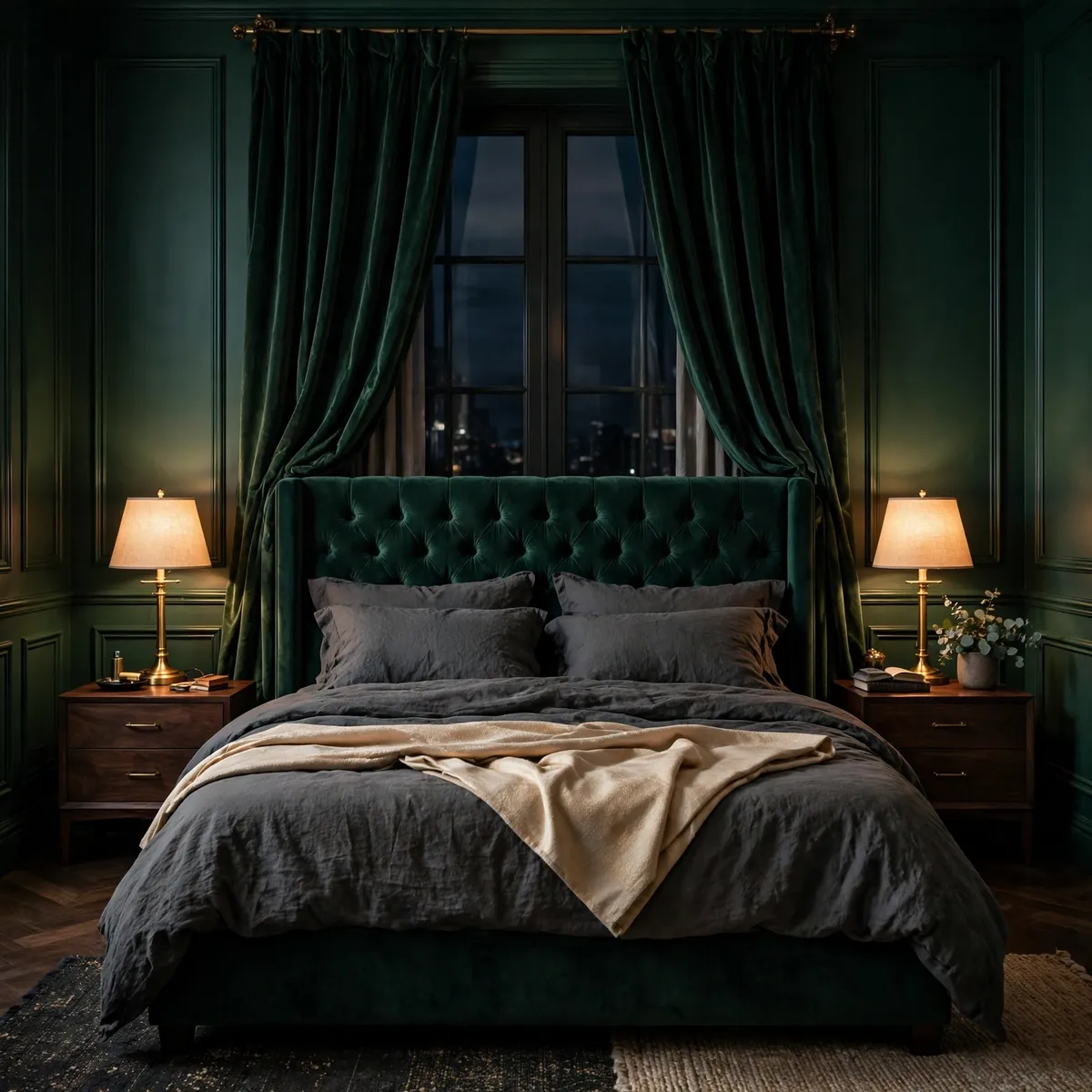
A moody bedroom begins with a decision about color, and the most common mistake is treating dark walls as the entire plan. Color is only the backdrop; the mood comes from what it does to everything else in the room.
A deep green wall makes lamplight look warmer, turns an ordinary linen throw into something cinematic, and pulls the corners of the room into soft shadow so the bed becomes the glowing center. Before choosing anything else, settle on one dominant dark tone and let it filter every later choice: bedding that sits against it, metal finishes that glow in front of it, wood tones that warm it up.
The most reliable moody colors are charcoal, midnight navy, forest green, deep plum, and chocolate brown — each carries enough color to feel intentional rather than flat. And test your pick on a large foam board, moved around the room across a full day, because dark paints shift dramatically between morning light and evening lamps.
Quick tips
- Eggshell or satin finishes bounce lamplight; flat matte can look dusty on dark walls.
- If you commit to a single accent wall, make it the one behind the bed — that’s where the eye lands.
Color-Drench the Whole Room
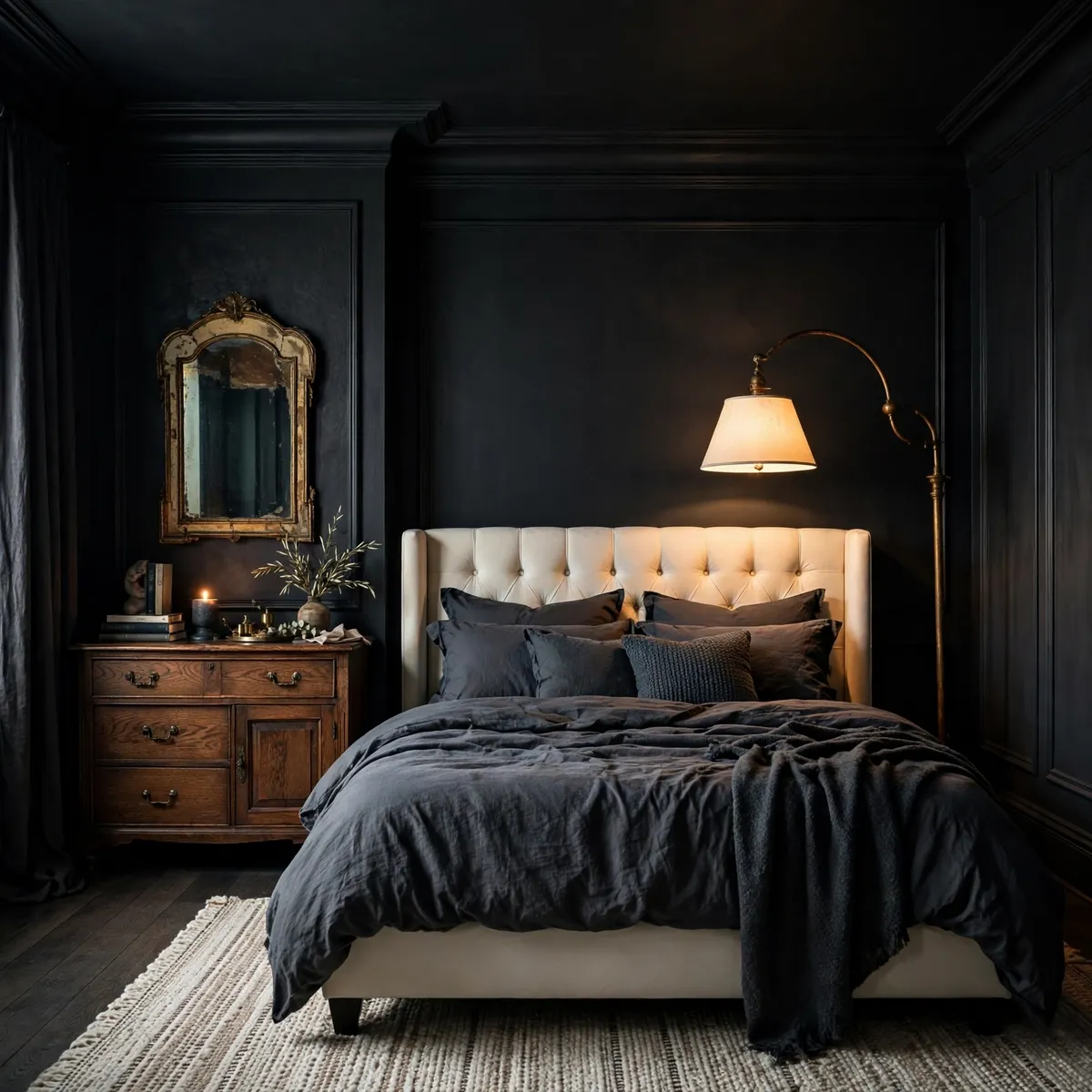
Color drenching means painting the walls, ceiling, and trim all in the same deep tone, and in a bedroom it is the fastest route to a cocoon. With no white ceiling or trim to break the envelope, the room’s edges soften and corners blur, which makes the space feel intimate rather than small.
This works best in bedrooms with at least some natural light — one good window is enough — and it rewards commitment: a half-drenched room with dark walls and a bright white ceiling can look unfinished by comparison.
Keep it working in this order:
- Choose a paint with depth. Near-black greens, inky navies, and soft blacks with warm undertones read moody; flat gray-black can read industrial.
- Paint ceiling and trim the same color, or one shade lighter at most, so nothing breaks the envelope.
- Lighten the bed. Ivory, oatmeal, or warm white bedding becomes the room’s glowing center against drenched walls.
- Add one reflective element — a mirror, a brass lamp, a glass vase — to keep light moving around the room.
Go Moody Without Painting a Single Wall

Dark paint is optional. Renters and the paint-shy can build the same atmosphere entirely from furnishings: a navy velvet quilt against white walls reads just as moody as a navy wall once the lamps are low.
The rule is weight — every large surface should carry a deep tone, so the eye never lands on something bright and the mood never breaks.
- Dark bedding set in charcoal, oxblood, or forest green — the single biggest lever you have without paint.
- Heavy floor-length curtains in a deep tone, hung high and wide to frame the window like a stage.
- One oversized dark artwork to anchor the largest blank wall.
- A large dark area rug to ground the floor, since bare floors read bright and undo the mood.
Layer Warm Light at Three Levels

In a moody bedroom, the ceiling light is the enemy. The glow should come from at least three low sources — bedside lamps, an accent away from the bed, and something with a flame or a flicker.
Each layer should be warm (2700K or lower) and individually controllable, because the difference between “moody” and “murky” is being able to dim each layer on its own. Cooler bulbs flatten dark walls and make the whole room feel unwelcoming, so check the color temperature on every bulb you bring in.
- Start with bedside lamps at 2700K warm white — table lamps or wall sconces set around head height.
- Add an accent light away from the bed: a small lamp on the dresser or an arc floor lamp in a corner.
- Finish with candlelight — real candles where safe, or flameless ones with a flicker effect for the same movement of light.
- Put each layer on its own dimmer or smart plug so you can mix scenes: reading bright, winding down low.
Dress the Bed in Velvet

Velvet is the fabric that does the most work in a moody bedroom. Its pile catches lamplight differently from every angle, so a plum or emerald duvet looks alive in a way flat cotton never will — the same surface reads dark in shadow and rich where the light hits.
You don’t need a full velvet bedding set; a velvet duvet cover plus linen or silk pillowcases in a lighter tone gives you the drama without the weight. If velvet feels too formal, brushed cotton or washed linen in deep tones delivers the same softness with a more relaxed hand.
Quick tips
- Pair velvet with one matte fabric — linen or wool — so the bed doesn’t look shiny all over.
- Rotate or flip the duvet occasionally; velvet pile wears in one direction over time.
Make the Headboard the Centerpiece
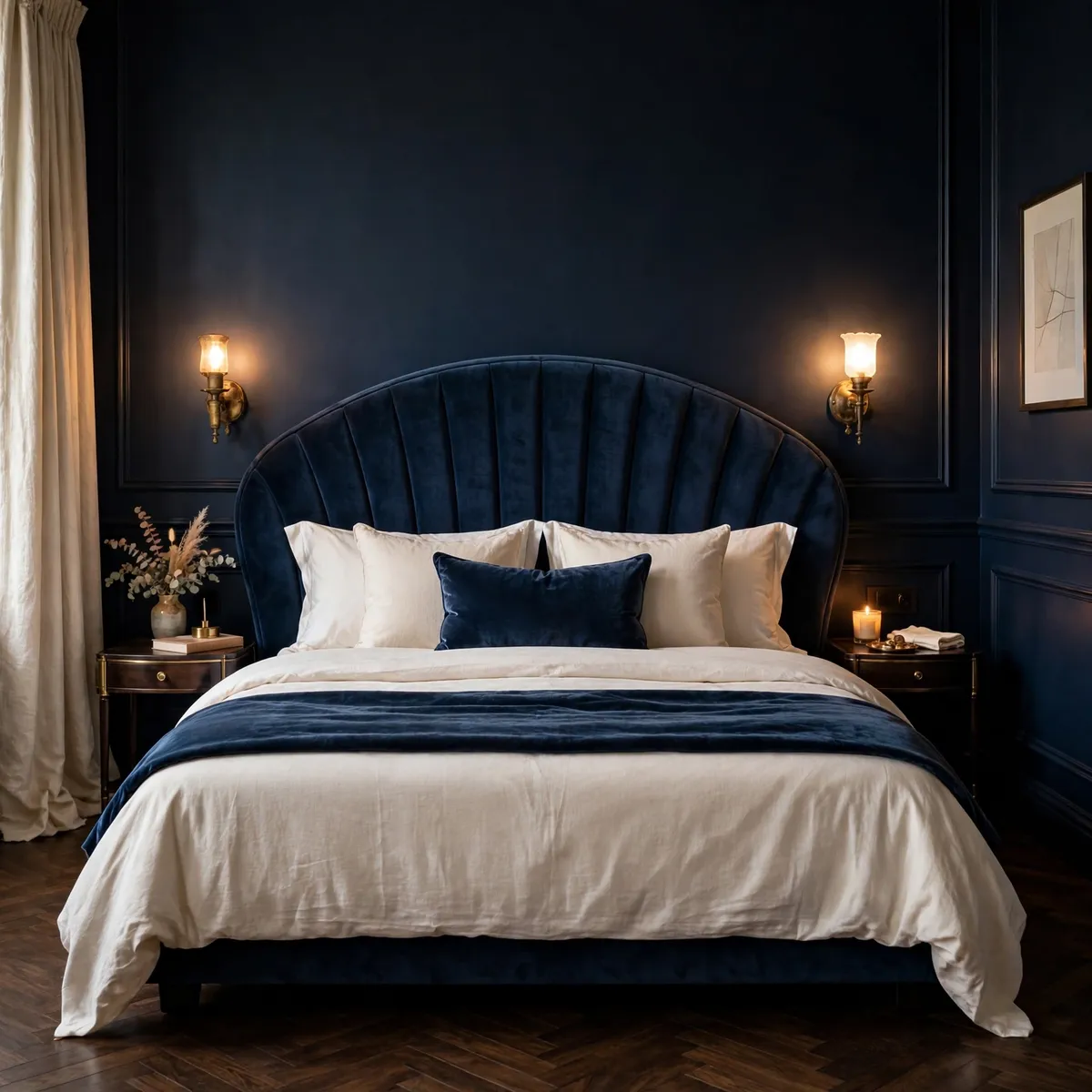
In a dark room, an upholstered headboard in velvet or leather becomes the piece everything else orbits. A tall, curved channel-tufted headboard in the same family as your wall color makes the bed look built into the room, and curves matter more here than in bright rooms — soft silhouettes keep dark spaces romantic instead of severe.
Keep the bedding calmer than the headboard so the two aren’t competing for attention.
- Match the headboard tone to the wall for a wrapped, seamless look — or go one shade darker for quiet contrast.
- Wingback and curved shapes soften the geometry of a dark room.
- Flank it with wall sconces instead of table lamps to free up nightstand space and wash light across the fabric.
Hang One Big, Dark Piece of Art
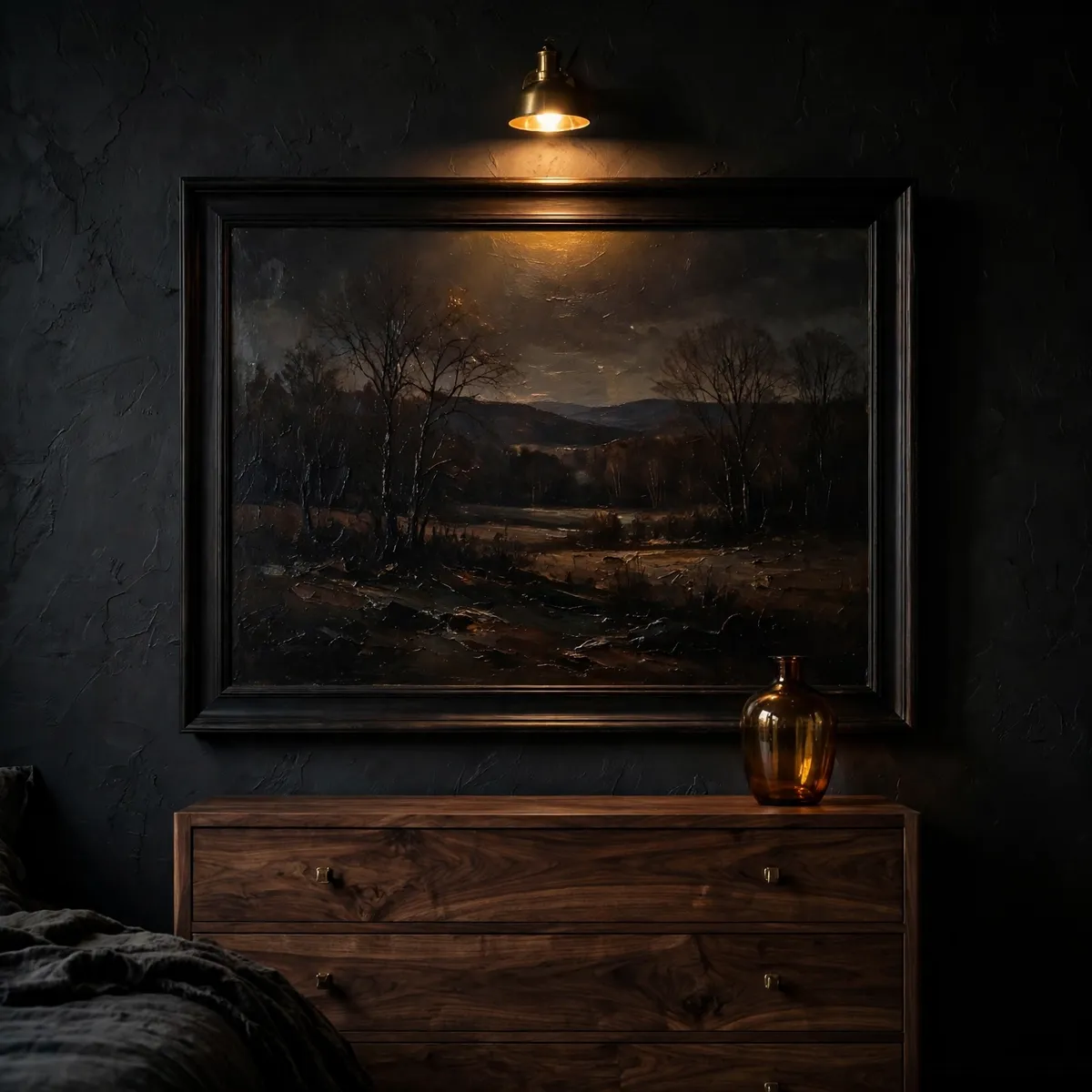
Small frames scattered across dark walls look like clutter; one oversized piece looks like a decision.
A large dark landscape, an abstract in umbers and blacks, or a black-and-white photograph with deep tones gives the eye a single place to rest — and on a dark wall it reads as texture rather than decoration. Hang it lower than instinct suggests, roughly at eye level when you’re sitting up in bed, and keep the frame dark — black, walnut, or aged brass — so it belongs to the palette instead of interrupting it.
If the budget allows, add a slim brass picture light above the piece. A warm spotlight washing across a dark canvas is one of the most effective gallery tricks you can borrow for a bedroom, and at night it becomes a fourth layer of light all on its own.
Try Moody Wallpaper on One Wall
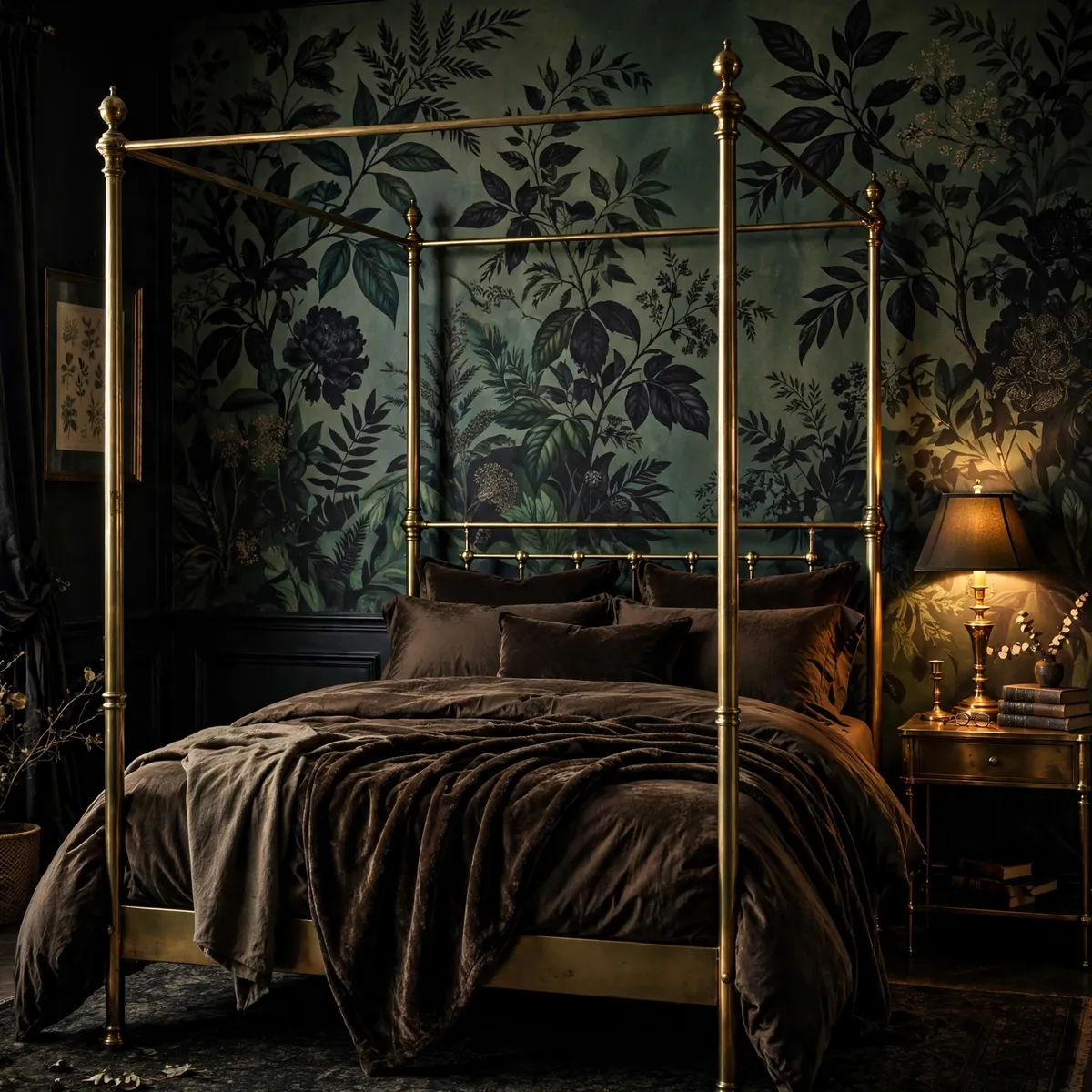
Wallpaper is the shortcut to a moody bedroom with depth that paint can’t quite reach — painterly florals, dark botanicals, and marbleized patterns carry pattern and shadow in a single surface. Keep it to one feature wall, usually behind the bed, and let the bedding stay calm so the pattern leads without shouting.
- Botanical and damask prints suit dark academia and romantic styles; black-on-black geometrics suit modern rooms.
- Peel-and-stick and paste-the-wall options make this fully renter-reversible.
- Echo one color from the paper in your throw pillows to tie the room together.
Warm It Up With Brass and Aged Gold
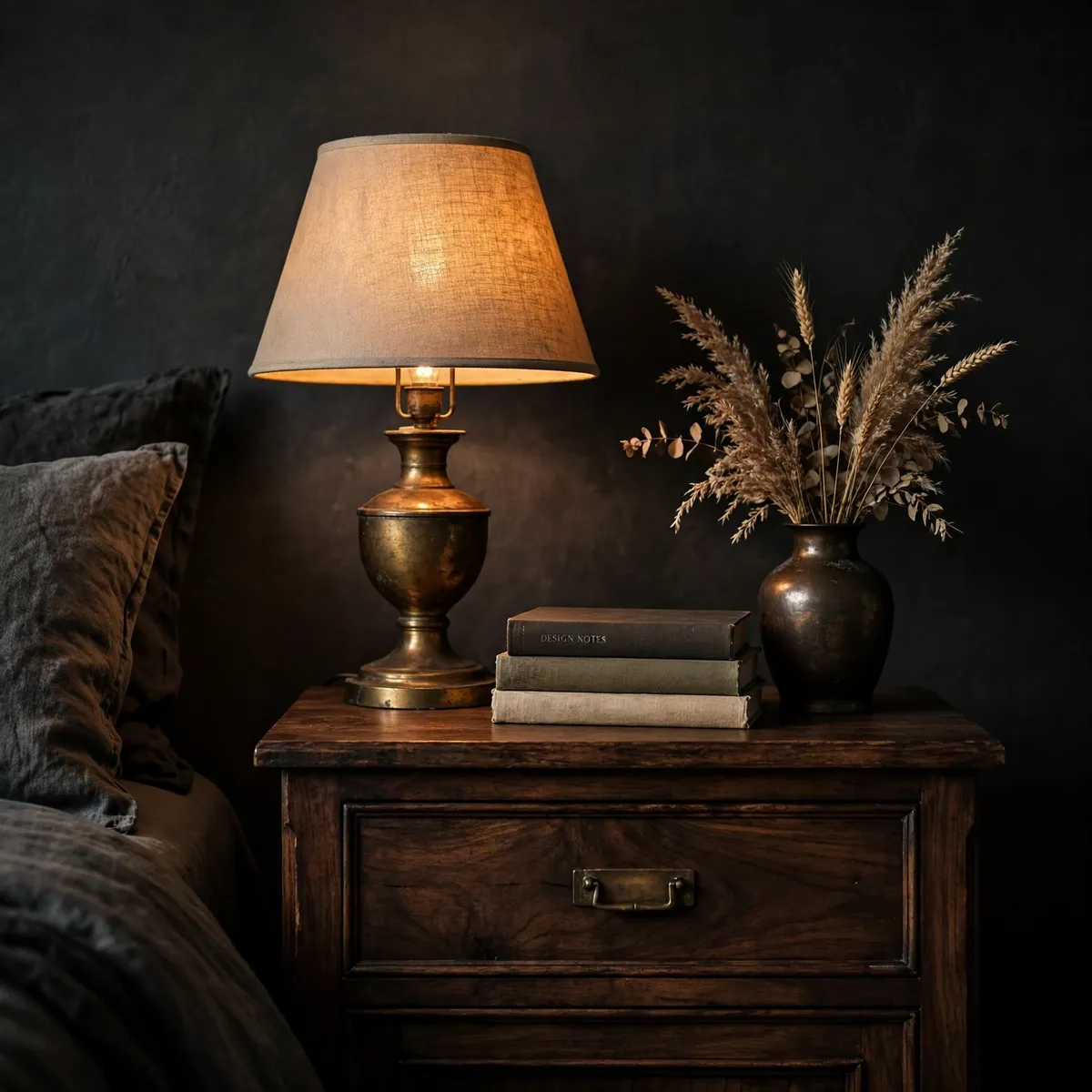
Dark rooms can drift cold, and nothing corrects that faster than warm metal. Brass, aged gold, and copper reflect lamplight back into the room, which is exactly what a dark palette needs — small points of glow that keep the shadows friendly.
The key is repetition: one brass lamp reads as an accident, while brass on the lamp, the mirror frame, and the picture light reads as a plan.
- Choose one warm metal — aged brass is the safest bet — and use it at least three times in the room.
- Put metal where light hits it: lampshades, sconces, mirror frames, drawer hardware.
- Mix finishes within the same warm family (satin brass with antique bronze) rather than mixing warm and cool metals.
Ground the Room With Wood and Plants

Wood is what stops a moody bedroom from feeling like a set. A walnut dresser, an oak bench at the foot of the bed, or even a simple wooden stool introduces grain and warmth that painted surfaces can’t.
Plants do the same job in green: a snake plant or an olive tree in a clay or bronze pot breaks up the darkness with something alive, and against deep green walls the effect is quietly luxurious. Neither needs much — two or three pieces of each is enough, since the mood depends on restraint.
Quick tips
- Medium walnut and warm oak flatter dark walls best; pale ash can look washed out next to deep color.
- Stick to low-maintenance plants — snake plant, ZZ, pothos — because bedrooms aren’t greenhouses.
Layer Rugs and Light Under the Bed
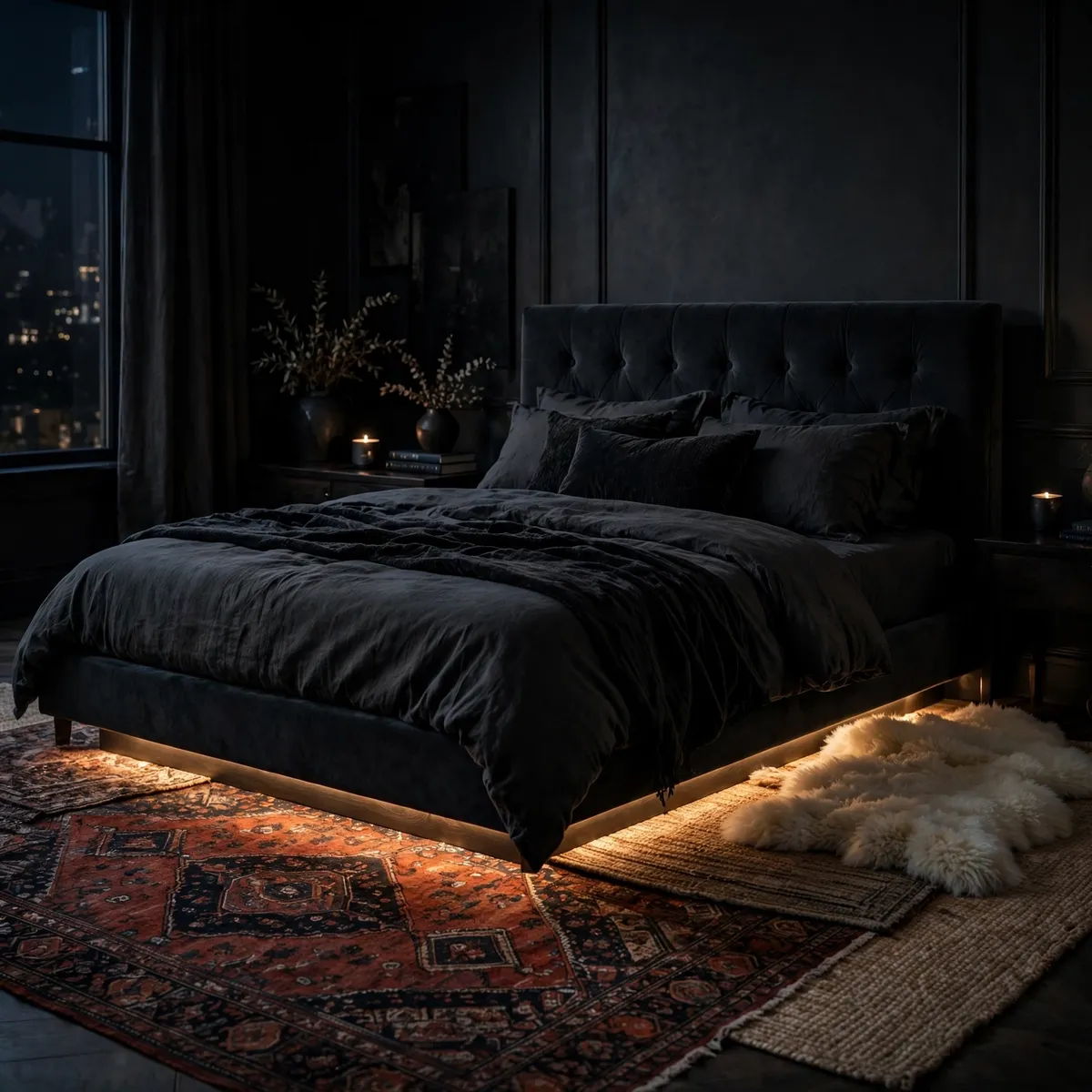
A moody bedroom should feel soft underfoot as well as around you. A large rug — big enough to extend past both sides of the bed — quiets the room acoustically and visually, and layering a smaller rug or a sheepskin on top adds the texture that makes dark rooms feel plush rather than flat.
Then add the one lighting trick that changes everything at night: a warm LED strip under the bed frame. It casts a soft halo that makes the bed appear to float, gives you just enough light for a midnight trip without killing the mood, and costs almost nothing to run.
- Scale the rug generously; undersized rugs make dark rooms feel smaller.
- Choose low-contrast patterns — vintage Persian, tonal Moroccan — so the rug doesn’t shout over the mood.
- Use 2700K or warmer LED strips with a dimmer or a motion sensor for hands-free glow.
Carve Out a Moody Reading Corner
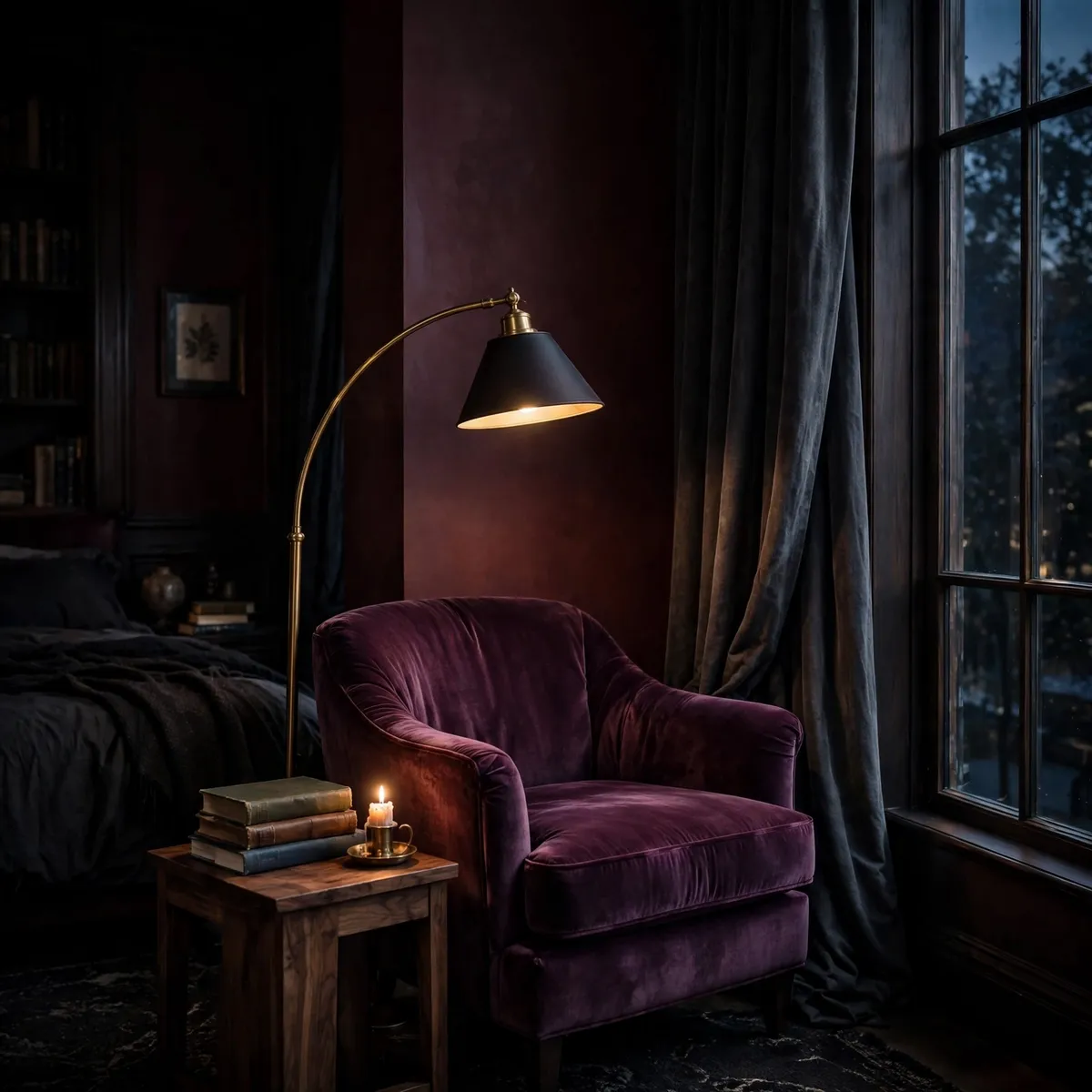
If your bedroom has a corner, a window seat, or a few spare square feet, give the mood somewhere to concentrate.
A deep armchair in plum or oxblood velvet, a brass floor lamp arcing over it, and a small side table for a book and a candle is a complete vignette — it costs one corner and returns a whole second room-within-the-room. Face the chair toward the window or into the room, never into a wall, and keep this corner’s palette one shade deeper than the rest of the room so it reads as a nook.
This is also the best place in the bedroom to spend on texture: a wool throw over the arm, a leather-bound stack of books on the table, a small dark rug underfoot.
When the rest of the bedroom is calm, one richly layered corner makes the whole room feel more intentional.
Quick tips
- A floor lamp with an adjustable head doubles as your reading light and your corner’s mood light.
- Keep a basket or lidded box beside the chair so the corner stays tidy — clutter kills the cocoon fast.
Frequently Asked Questions
What makes a bedroom feel moody?
Deep, saturated colors and rich textures. Charcoal or black walls, jewel tones like emerald and plum, layered textiles in velvet and wool, and warm low lighting together create an intimate, cocooning atmosphere — it’s the combination, not any single element, that does it.
Can I create a moody bedroom without painting the walls dark?
Yes. Lean on dark textiles — a deep-toned duvet set, heavy curtains, a large dark rug — plus one oversized dark artwork and warm low lighting. A peel-and-stick mural on a single wall adds drama with no permanence, and dark furniture does the same work as dark paint in a small room.
What colors work best for a moody bedroom?
Deep jewel tones like emerald, navy, and oxblood, plus charcoal neutrals, are the most reliable. Keep the supporting elements simple so the color stays the star of the room.
Does a dark bedroom make the room feel smaller?
Not necessarily. Dark walls recede, which can make a room feel enveloping rather than cramped — especially when paired with layered lighting, natural textures like wood, and one or two reflective accents to keep light moving.
Conclusion
A moody bedroom isn’t about darkness for its own sake. It’s a room tuned for rest: deep color that softens the edges, light that stays low and warm, and textures that make you want to stay in bed a little longer.
You don’t need all twelve of these ideas — pick the one that solves your room’s biggest gap, whether that’s color, light, or texture, and start there. The rest layers on naturally, one evening lamp at a time.