12 Stunning Bedroom Curtain Ideas That Instantly Make Your Bedroom Look Cozy, Luxurious and Put Together
The best bedroom curtain ideas start with light, not fabric. Decide how dark your room needs to be at 6 a.m., how much privacy you want after dark, and whether you need warmth or airflow — then choose a fabric, length, and hanging height that delivers all three. The right pair makes a plain bedroom feel calm and finished; the wrong one leaves it bright at dawn. Below are 12 bedroom curtain ideas for every sleep style and room size, from airy sheers to full blackout velvet. They also pair well with a statement wall — see these bedroom accent wall ideas for a backdrop that makes them stand out.
Key Takeaways
Q: What is the single most important bedroom curtain decision?
A: How dark the room must be. Choose blackout lining for deep sleep, room-darkening fabric for most adults, or sheers when daylight matters more.
Q: How long should bedroom curtains be?
A: Floor length in almost every bedroom. Let the hem skim the floor or hover half an inch above it.
Q: How high should I hang the curtain rod?
A: Four to six inches above the frame, or near the ceiling, and three to six inches wider on each side.
Q: Can one pair of curtains do everything?
A: No. Layer a sheer behind a heavier curtain for soft daylight by day and full privacy at night.
1. How Do Sheer White Linen Curtains Change a Bright Bedroom?
Sheer white linen curtains soften harsh morning sun into gentle, diffused light while keeping the room bright and private during the day. They suit bedrooms that get plenty of sun but do not need total darkness.
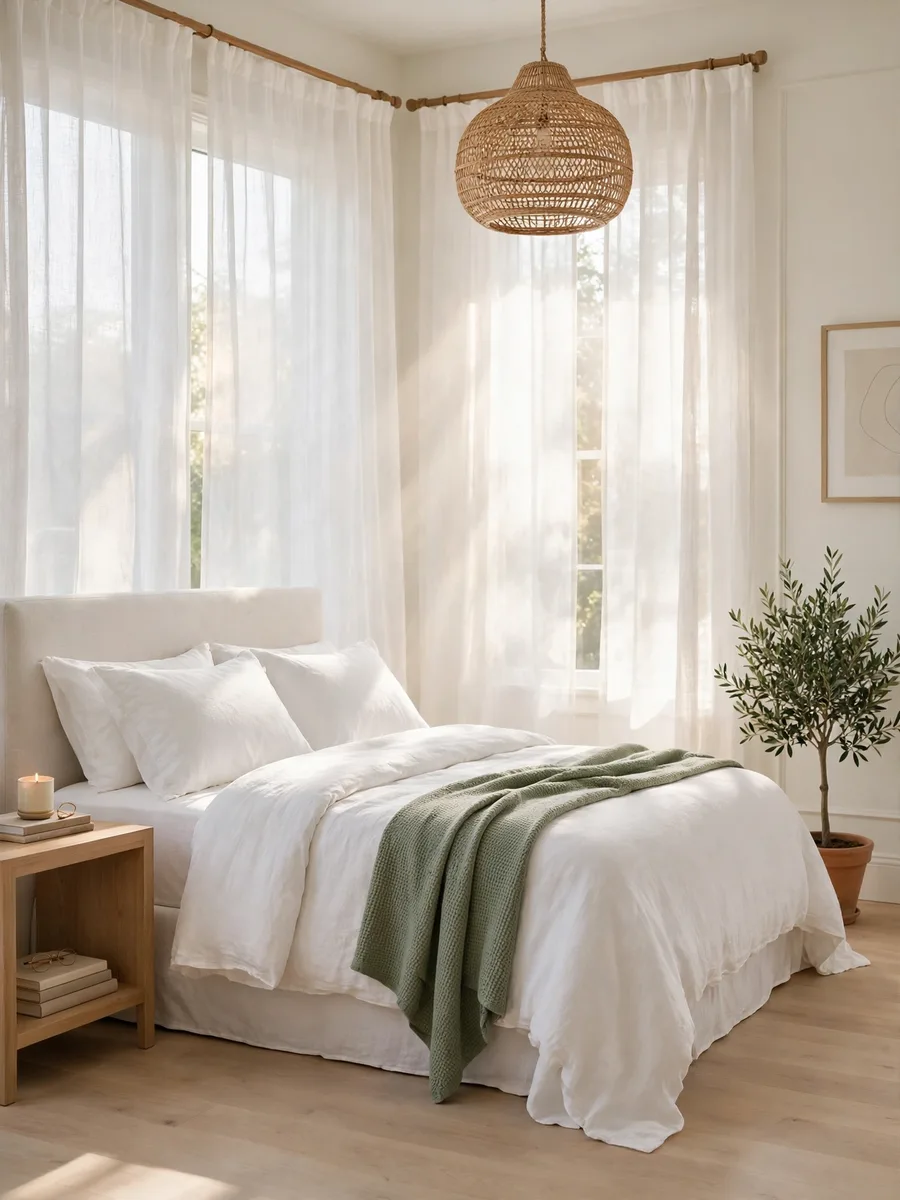
Sheer linen filters sunlight instead of blocking it, so the room keeps its glow without the glare, and the loose weave breathes well in a warm bedroom. A good example is a west-facing bedroom with white walls and a pale oak floor: two sheer linen panels on a slim black rod, hung from just below the ceiling to the floor, with a sage green throw across crisp white bedding.
Quick tips:
- Hang sheers alone only when street privacy at night is not an issue.
- Wash linen panels gently and hang them damp to avoid ironing.
2. Why Are Blackout Velvet Curtains the Best Choice for Deep Sleep?
Blackout velvet curtains block most incoming light, muffle street noise, and add insulation, making them the best bedroom curtain choice for light sleepers, shift workers, and street-facing rooms.
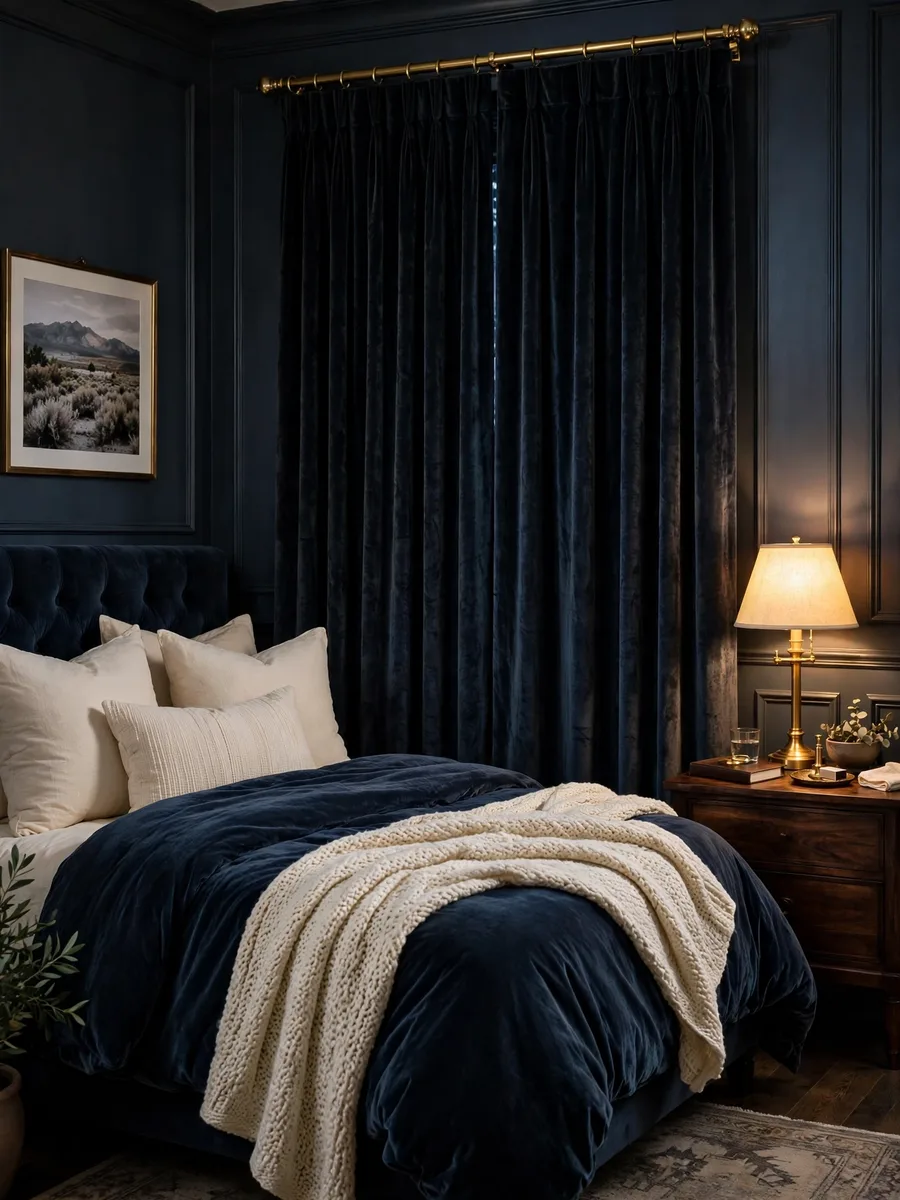
Velvet earns its place twice over: the dense pile absorbs sound as well as light. A sewn-in blackout lining does the real light-blocking work, so look for lined panels rather than relying on velvet alone. Picture a city bedroom facing a busy road: floor-length navy velvet panels with blackout lining, closed each night, with a brass lamp glowing on a dark walnut nightstand.
Quick tips:
- Overlap panels in the middle and extend them past the frame to stop light leaking at the edges.
- Brush velvet downward with a soft clothes brush to keep the pile even.
3. How Do Layered Curtains Give You Daylight and Darkness in One Window?
Layered curtains pair a sheer panel closest to the glass with a heavier curtain in front, giving you filtered daylight during the day and full privacy and darkness at night from a single window.
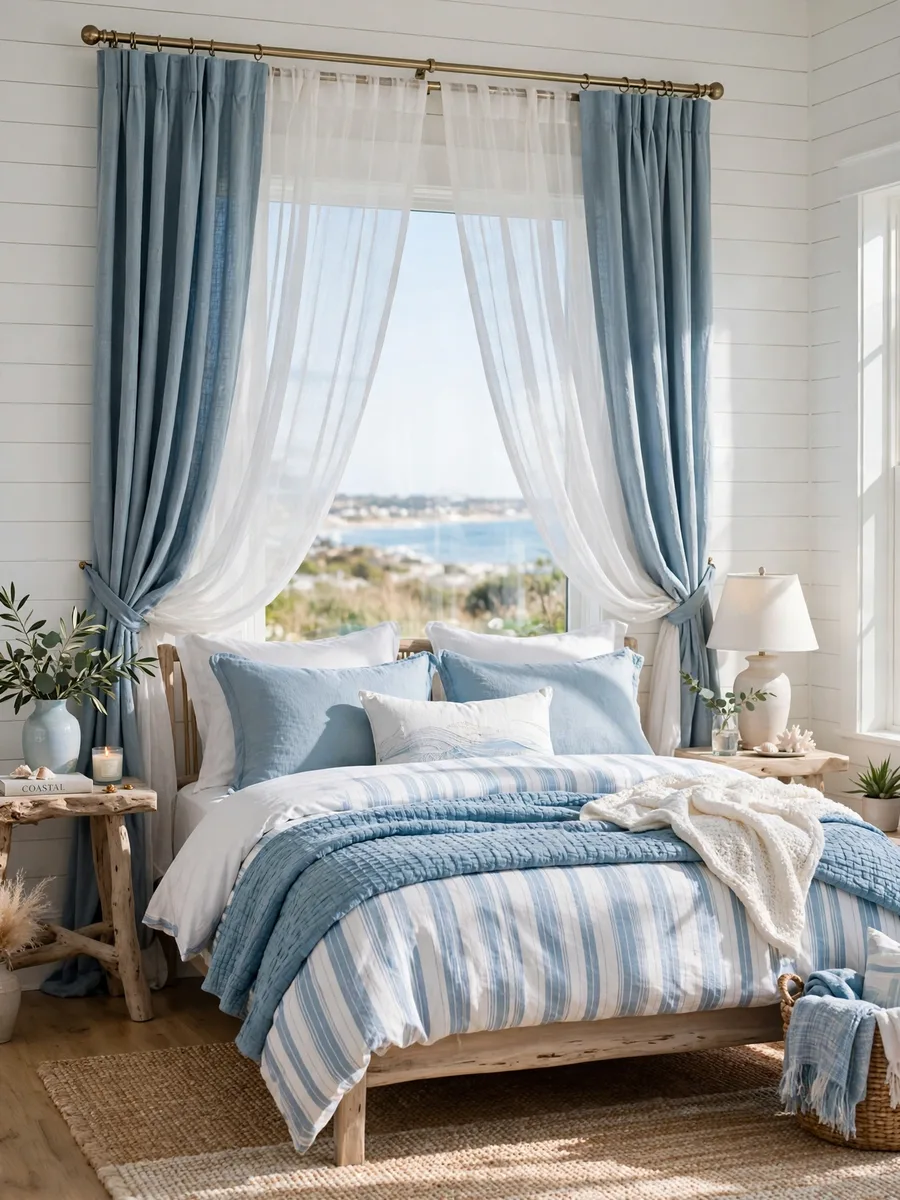
Layering is the most practical of all bedroom curtain ideas because one layer never has to do two opposite jobs. The sheer stays closed most of the day, softening the light, while the heavier outer layer pulls across at night. Try it in a coastal bedroom: sheer white voile inside, dusty-blue linen outside, over white shiplap.
Quick tips:
- Keep the sheer slightly shorter than the outer curtain so the hem lines do not clash.
- Use a double rod with two finials, or a ceiling track with two channels.
4. What Makes Floor-to-Ceiling Puddled Curtains Look So Luxurious?
Floor-to-ceiling curtains hung from a rod near the ceiling and left to puddle an inch or two on the floor make ceilings look taller, windows look grander, and the whole bedroom feel like a boutique hotel.
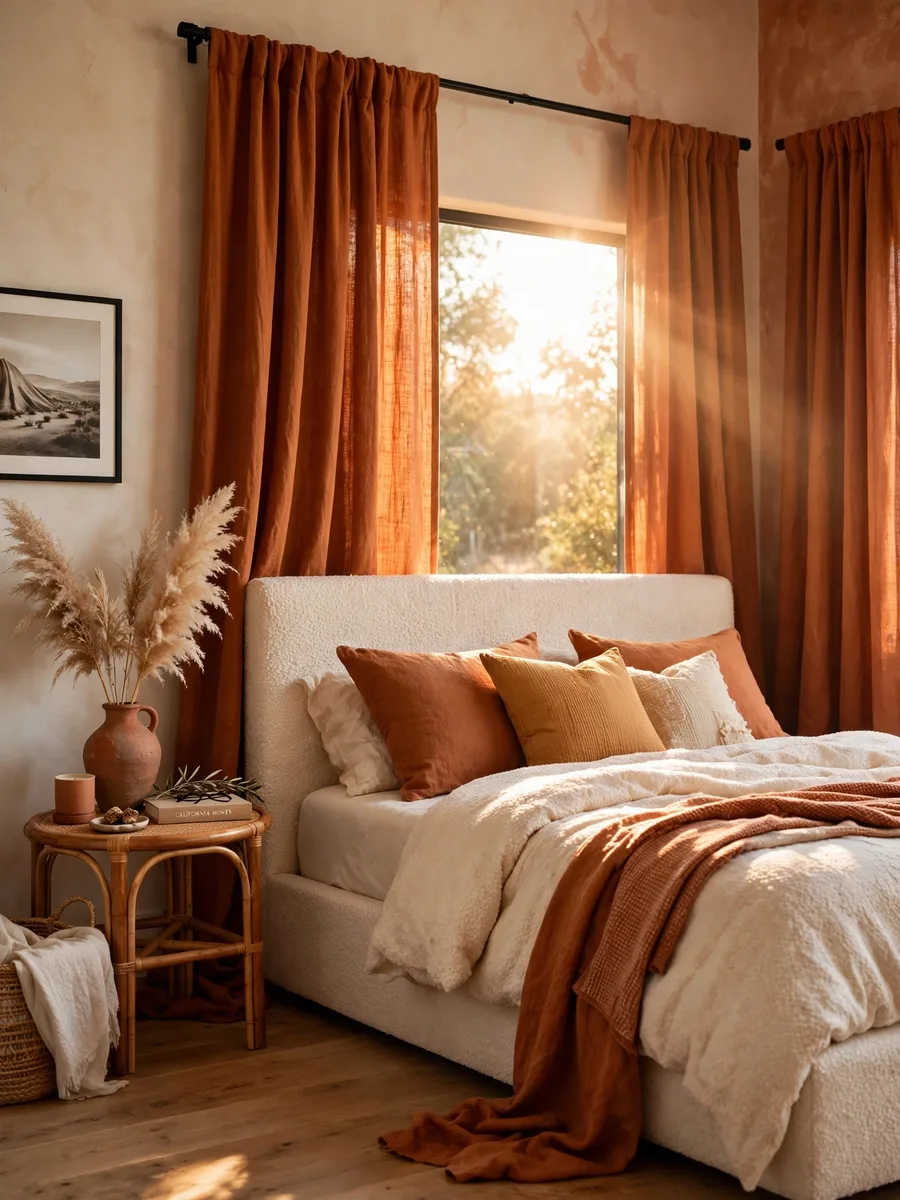
Height is the trick here, not the fabric. Mounting the rod close to the ceiling draws the eye upward and makes a standard eight-foot ceiling feel taller, while the extra length adds softness that short curtains never manage. A slight puddle reads as intentional, though it collects dust. Try rust-orange linen panels on a matte black rod in a terracotta-toned bedroom, pooling gently beside a cream boucle bed.
Quick tips:
- Add two to three inches to your measured length for a deliberate puddle.
- Steam the hem after hanging so the puddle falls in soft folds, not creases.
5. How Do Blush Pinch-Pleat Curtains Add Softness to a Bedroom?
Blush pinch-pleat curtains add tailored, even folds and a gentle rosy glow that softens a bedroom without the fuss of ruffles, making them ideal for romantic, calm, and feminine spaces.
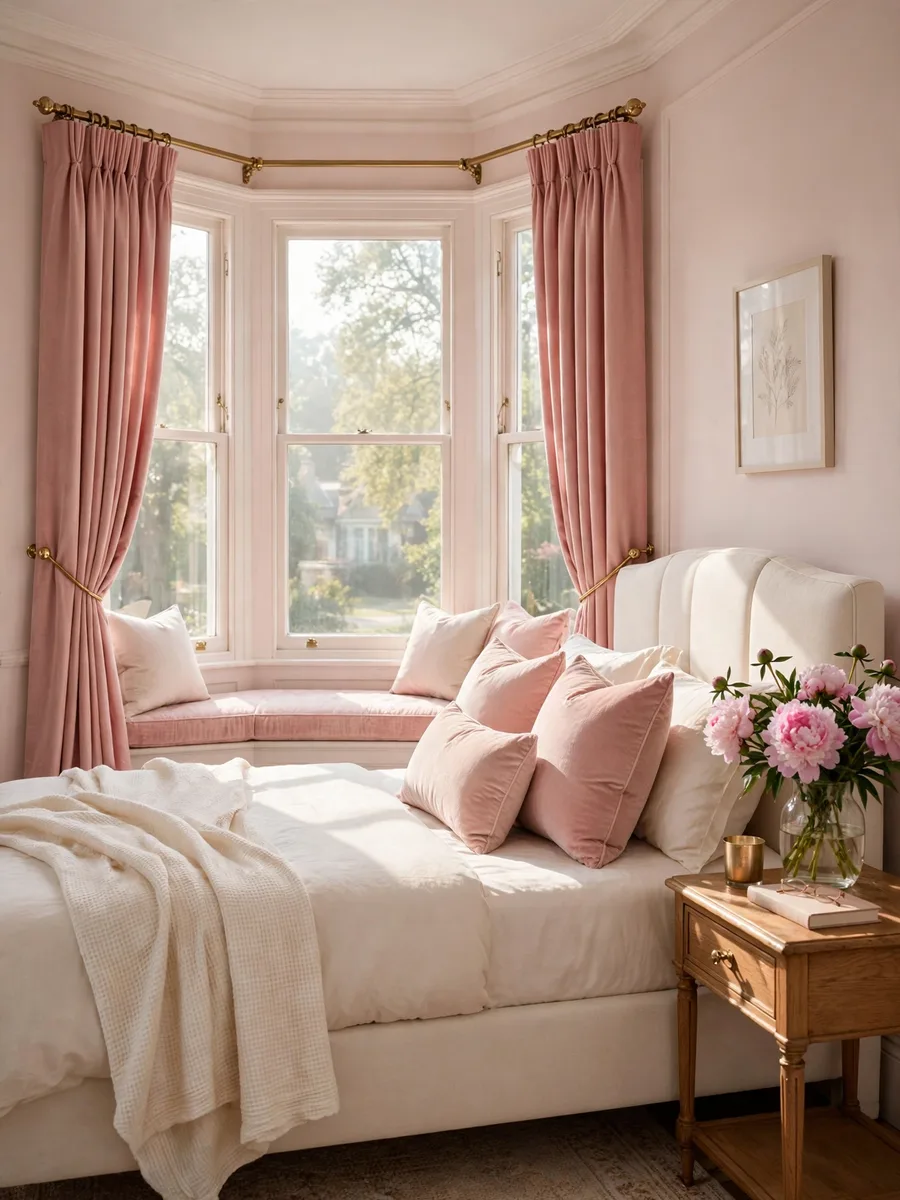
Pinch pleats are sewn-in folds that hold their shape, so the curtain looks neat whether it is open or closed — a real advantage in a bedroom where curtains move twice a day. Imagine a bay window in a soft pink bedroom: blush pinch-pleat panels drawn back with slim brass tiebacks, a cream upholstered bed with blush velvet cushions, and pink peonies in a glass vase on the nightstand.
Quick tips:
- Train new pinch pleats with loose ties for the first week so the folds set evenly.
- Pair blush with warm metals like brass or gold, not chrome.
6. Why Are Wave-Fold Curtains Perfect for a Modern Bedroom?
Wave-fold curtains glide on a ceiling track in smooth, even S-shaped folds, giving a modern bedroom a clean architectural line with no visible rod, rings, or bunching.
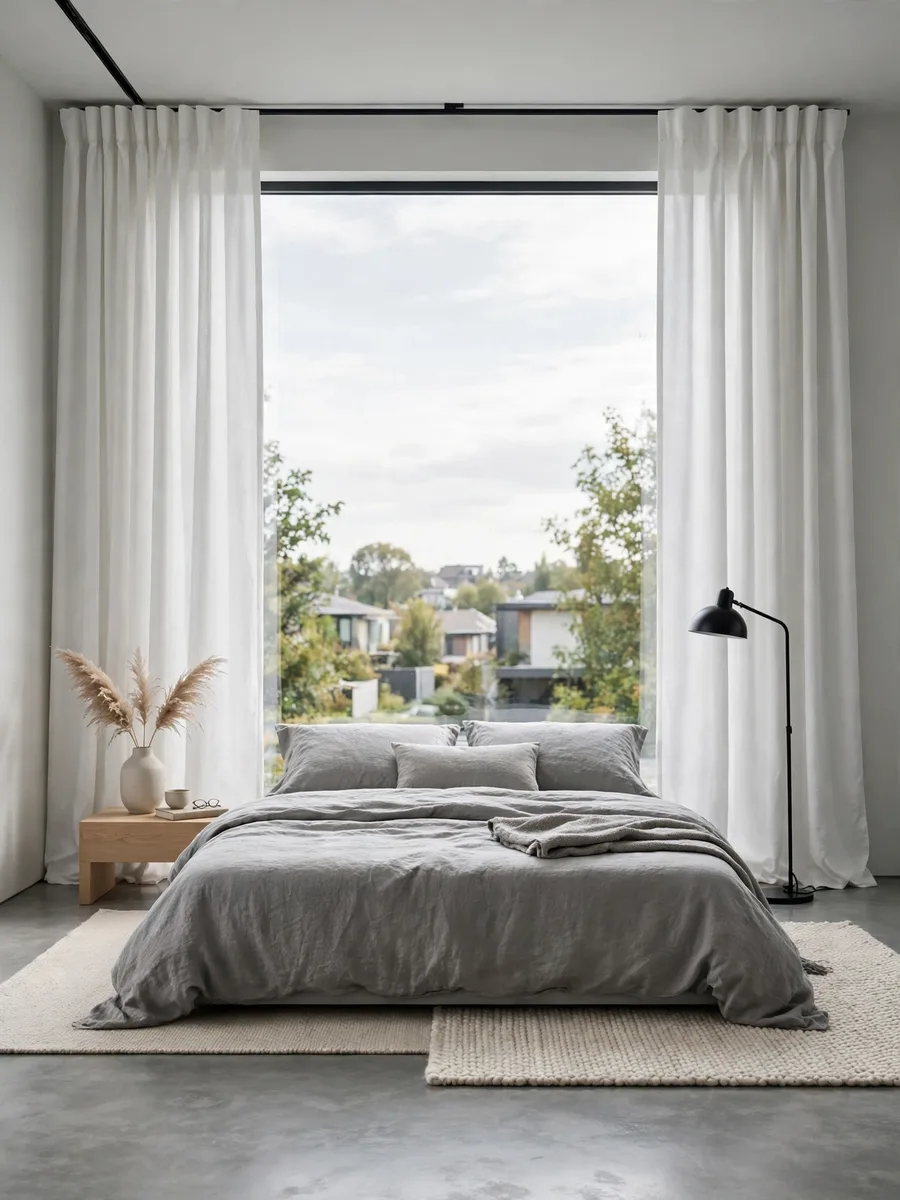
Wave folds suit modern bedrooms because the hardware disappears. A slim ceiling track sits flush above the window, and the fabric hangs in uniform waves that look the same open or closed — no sagging, no uneven gathers, no fussing with rings. Take a minimalist bedroom with a floor-to-ceiling window: crisp white wave-fold curtains on a recessed ceiling track, a low platform bed in grey linen, and a single black floor lamp.
Quick tips:
- Order wave-fold curtains made to measure, since fold spacing depends on the track.
- Leave a small gap between the track and the ceiling for smooth gliding.
7. How Do Patterned Curtains Add Personality Without Overwhelming the Room?
Patterned curtains add personality when the pattern is medium in scale, limited to one color family, and balanced by plain bedding and walls, so the window becomes a feature instead of a distraction.
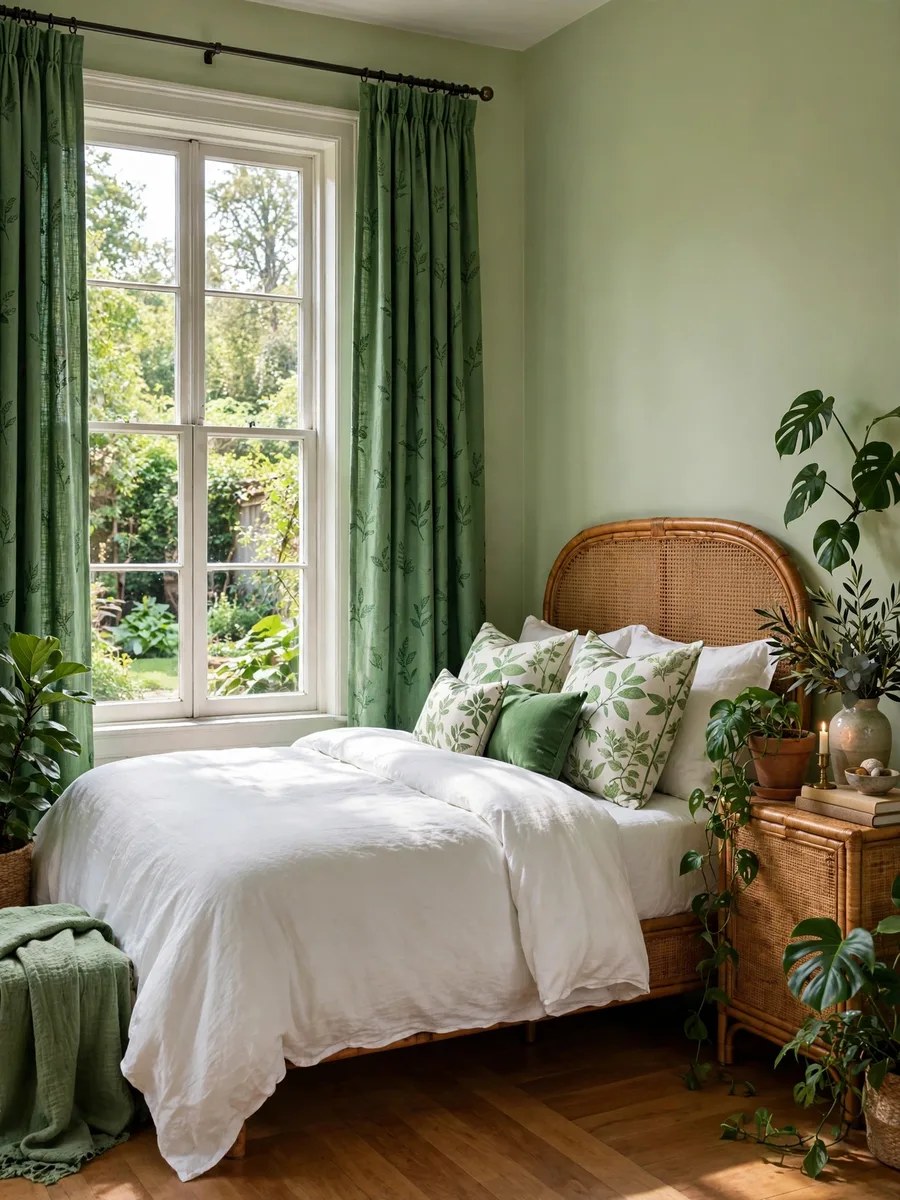
Pattern is the fastest way to give a plain bedroom a point of view, but it needs restraint. A botanical leaf print, a subtle stripe, or a small geometric repeat brings life to neutral walls, while a huge, high-contrast print can dominate a small room and fight with patterned bedding. A good example is a garden-facing bedroom with emerald botanical linen curtains, a rattan headboard, white bedding with two green cushions.
Quick tips:
- Test a large fabric swatch on the window for a few days before ordering.
- Match the pattern across joined panels so the design flows without a visible seam.
8. How Can Curtains Make a Small Bedroom Look Bigger?
Curtains make a small bedroom look bigger when the rod is mounted close to the ceiling and extended well past the window frame, so the window reads as taller and wider than it really is.
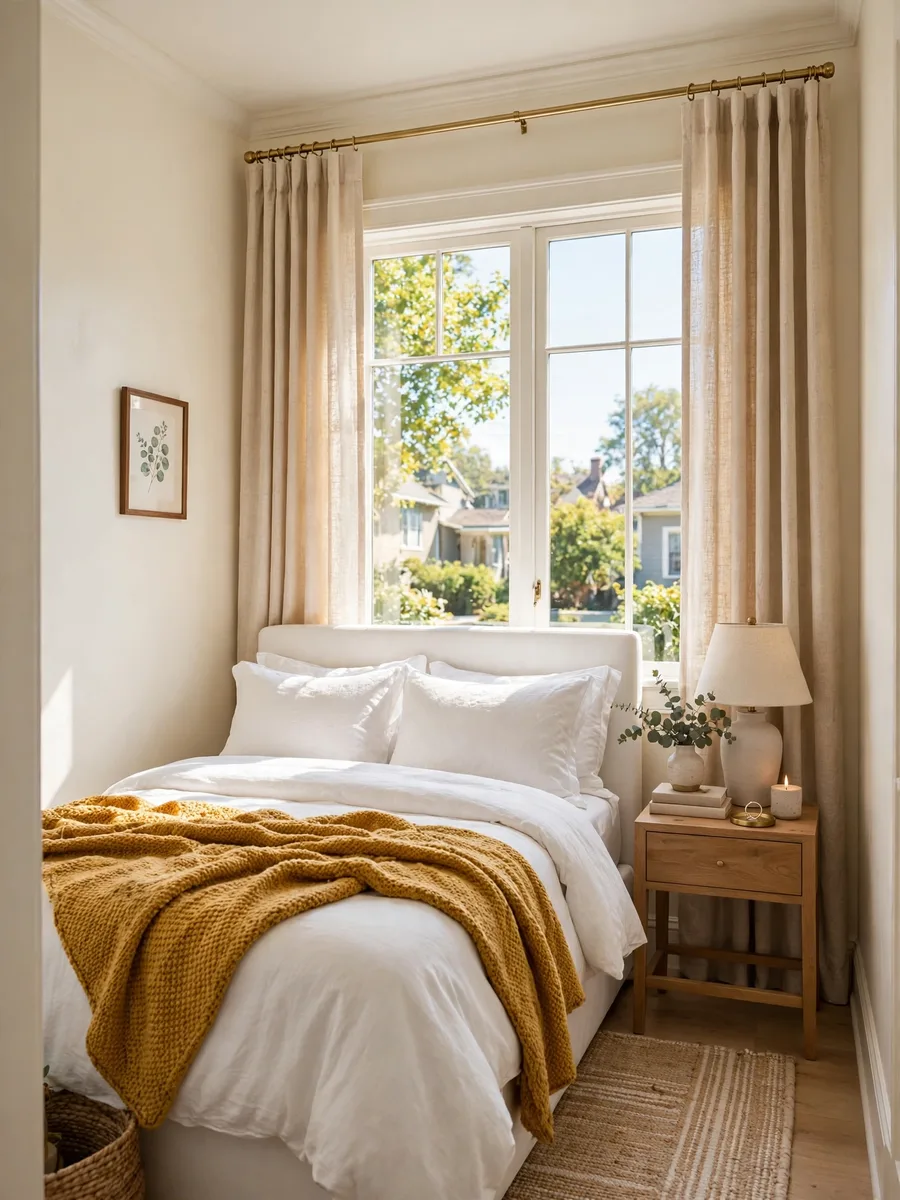
This is the single most useful trick for a small bedroom, and it costs nothing extra. A rod mounted four to six inches above the frame — or right at the ceiling — pulls the eye upward, while extending the rod three to six inches beyond each side means the open curtains stack on the wall, not over the glass, Combine this hanging method with other small bedroom ideas that use light colors and low furniture. Picture a compact bedroom: warm beige linen panels on a slim brass rod mounted near the ceiling, a white bed with a mustard-yellow throw.
Quick tips:
- Never mount the rod directly on the frame in a small room; it shrinks the window visually.
- Use one continuous rod rather than two short ones for a wider look.
9. Why Do Silk Curtains With Tiebacks Suit a Classic Bedroom?
Silk curtains with tassel tiebacks suit a classic bedroom because the fabric’s soft sheen, graceful drape, and formal pleats echo traditional furniture and give the window a dressed, finished elegance.

Silk is the most formal curtain fabric: it catches light with a gentle glow, falls in liquid folds, and holds a pleat beautifully. The catch is care — silk fades in strong sun and marks easily — so line silk panels, keep them out of direct midday sun, and dry-clean rather than wash. Imagine a traditional bedroom: ivory silk curtains with a faint damask pattern, swept back with gold tassel tiebacks, a four-poster bed in white and gold bedding, and a crystal chandelier glowing above.
Quick tips:
- Always line silk curtains to protect them from sun damage and add body.
- Use tiebacks at two-thirds of the curtain height for the most elegant sweep.
10. How Do Boho Tassel-Trim Curtains Create a Relaxed Bedroom?
Boho tassel-trim curtains create a relaxed bedroom with natural cotton, handcrafted texture, and soft movement, giving the window a casual, collected feel instead of a formal one.
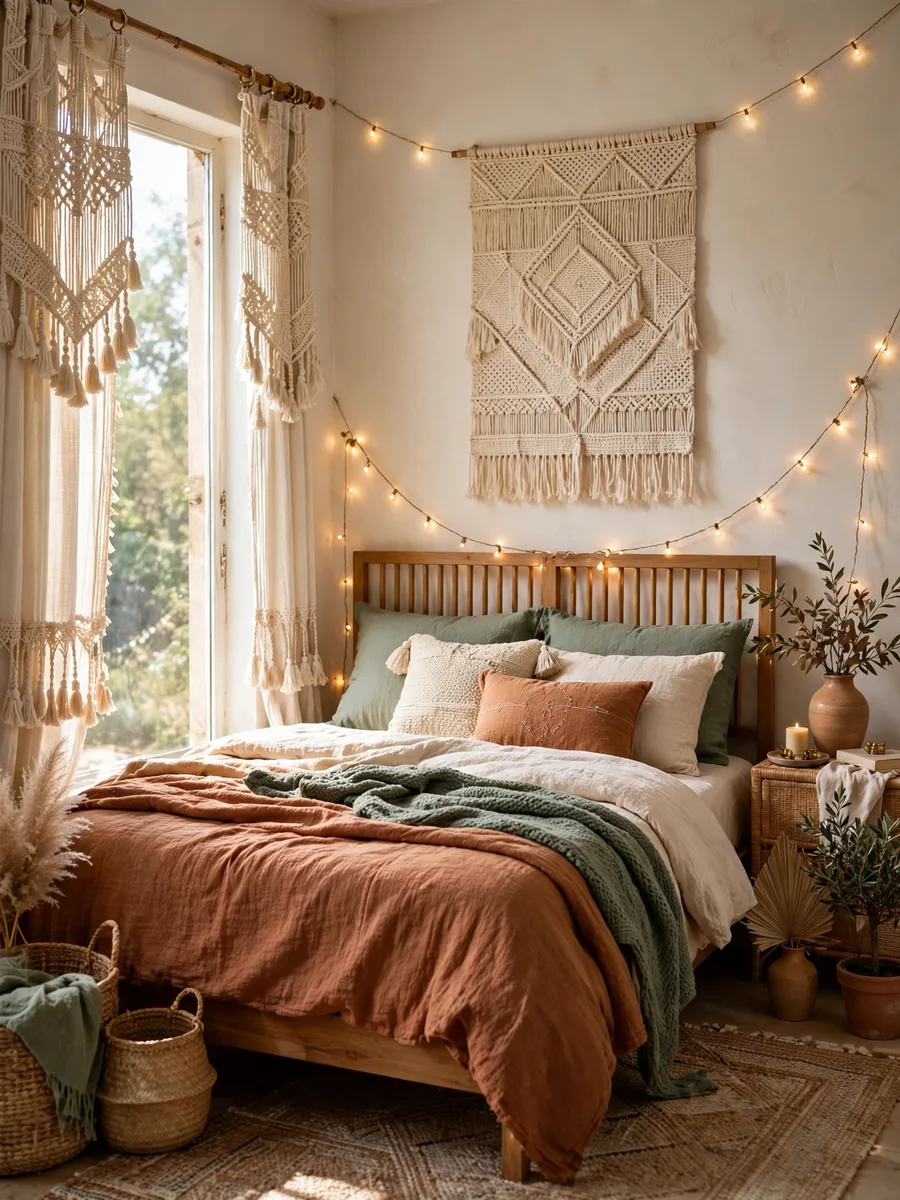
Boho style is about layers and texture, and tassel trim is its signature at the window. Cream or natural cotton panels with a tassel edge feel handmade and warm, and they pair naturally with rattan, woven wall hangings, layered throws, and plants. A good example is a sunlit boho bedroom: cream cotton curtains with tassel trim on a wooden rod, a low wooden bed layered with terracotta, cream, and sage bedding, and a string of warm fairy lights along the window.
Quick tips:
- Choose a wooden or bamboo rod to keep the natural, handmade feel.
- Layer a sheer panel behind the cotton for privacy without losing the boho look.
11. How Do Lilac-Grey Velvet Curtains Make a Bedroom Feel Calm?
Lilac-grey velvet curtains make a bedroom feel calm by combining a cool, muted color with a soft, heavy fabric that blocks light, absorbs sound, and adds quiet luxury without drama.
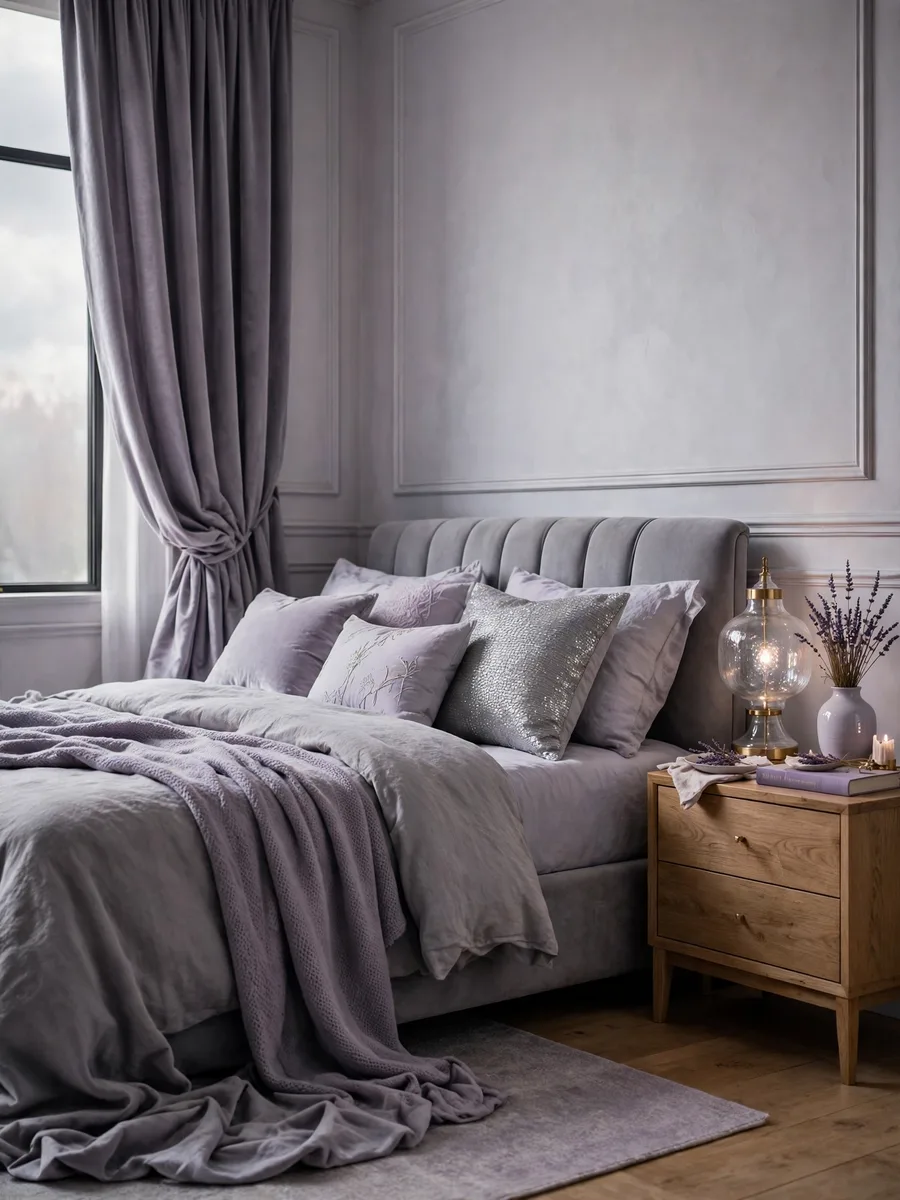
Not every bedroom wants a bold color statement, and lilac-grey is the answer when the goal is peace. The grey keeps it sophisticated, the lilac keeps it warm and gentle, and the velvet adds the weight and softness that make a room feel expensive. Picture a quiet bedroom at dusk: lilac-grey velvet curtains pooling softly on the floor, a grey upholstered bed with lavender and silver cushions, and a glass lamp glowing on the nightstand.
Quick tips:
- Pair lilac-grey with warm white walls rather than cool white, so the tone stays cozy.
- Add one lavender accent, such as a cushion or a throw, to tie the color story together.
12. How Do Sunny Striped Curtains Brighten a Dark Bedroom?
Sunny striped curtains brighten a dark bedroom by bouncing warm color and pattern around the room, making a north-facing or shaded window feel cheerful even on a cloudy day.
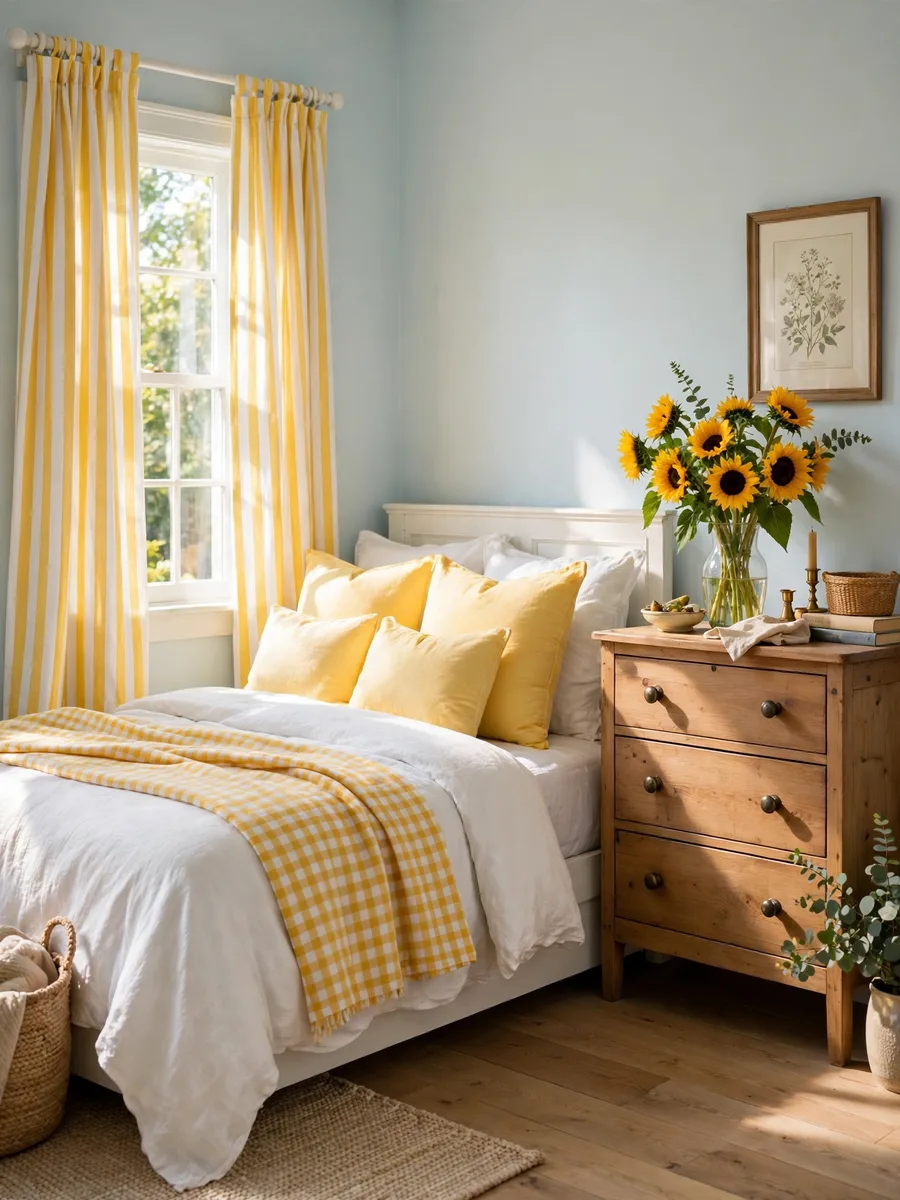
A dark bedroom needs help that paint alone cannot give, and stripes are one of the simplest fixes. Yellow and white stripes read as sunshine even when the sky is grey, and the vertical lines make the window look taller. Cotton is the right fabric here because it holds a crisp stripe, washes easily, and lets a little light through. A cheerful example is a cottage bedroom with a shaded window: yellow-and-white striped cotton curtains on a white rod, a white bed with sunny yellow cushions and a gingham throw, and a wooden dresser topped with a vase of sunflowers.
Quick tips:
- Match stripes across both panels so the pattern lines up at the center.
- Use a white or pale rod so the hardware does not compete with the stripe.
Frequently Asked Questions
What are the best curtains for a bedroom?
Lined curtains in a medium to heavy fabric are the best all-round choice for a bedroom. Choose blackout lining if you want the room dark for sleep, or a lighter privacy lining if you want soft daylight with no view in from outside.
How long should bedroom curtains be?
Floor length looks best in almost every bedroom and blocks the most light, so let the panels just skim the floor or hover about half an inch above it. Sill length only suits a window above a bed, desk, or radiator.
What color curtains are best for a bedroom?
Calming colors work best: soft neutrals, gentle pastels, or deep moody shades such as navy, forest green, or charcoal. Curtains cover a large area of wall, so keep bright reds and saturated yellows for small accents rather than the whole window.
Should bedroom curtains be blackout or sheer?
It depends on what matters more to you. Blackout curtains are the right choice when sleep quality comes first, especially for shift workers and light sleepers. Sheers are better when daytime softness and natural light matter more than darkness. Layering both gives you the best of each.
How wide should bedroom curtains be?
For a full, elegant look, the total fabric width should be one and a half to two times the width of the curtain rod. Fuller panels fall in soft, even folds and cover the window properly.
How high should I hang bedroom curtains?
Mount the rod four to six inches above the window frame, or as close to the ceiling as the room allows, and extend it three to six inches beyond each side of the frame.
Conclusion
The right bedroom curtains do far more than cover a window: they control the light you wake up to, the privacy you sleep behind. Start with how dark and how private the room needs to be, hang the rod high and wide, let the panels reach the floor, and layer a sheer behind a heavier curtain whenever you want both daylight and darkness. Then pick the fabric and color that fits your style and let the curtains make your bedroom feel finished. Choose one idea, measure your window carefully, and hang your new curtains this weekend.