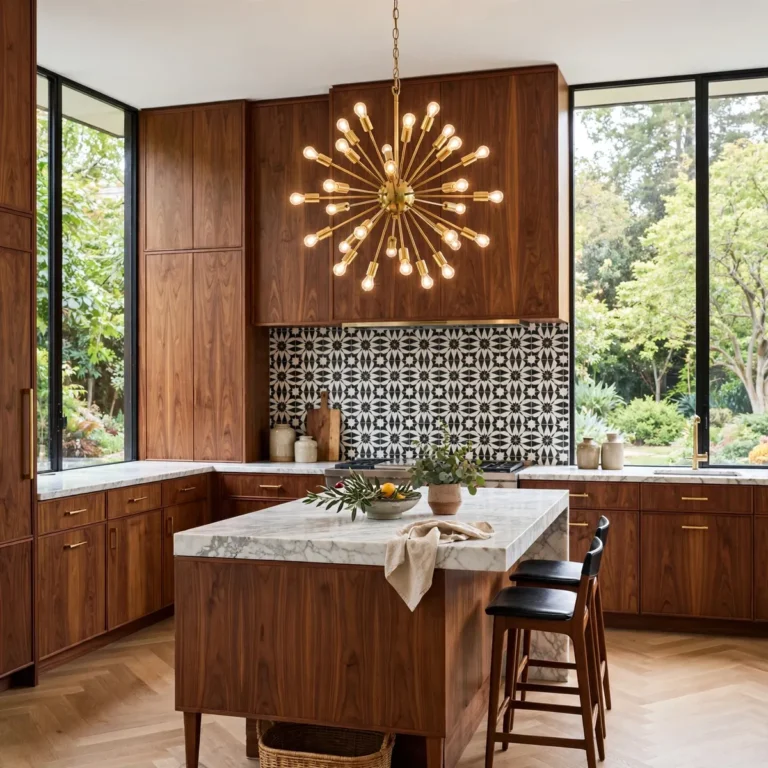
19 Timeless Mid-Century Modern Dining Room Ideas Full of Warm Character
Mid-century modern dining room ideas start with three signatures: warm wood, sculptural chairs, and one bold light overhead. A walnut or teak table on tapered legs, molded or wishbone chairs, and a sputnik or globe pendant give the room its 1950s and 1960s character, while mustard, olive, and burnt orange accents keep it warm rather than museum-like. The style works because every piece earns its place — clean lines, honest materials, and nothing fussy.
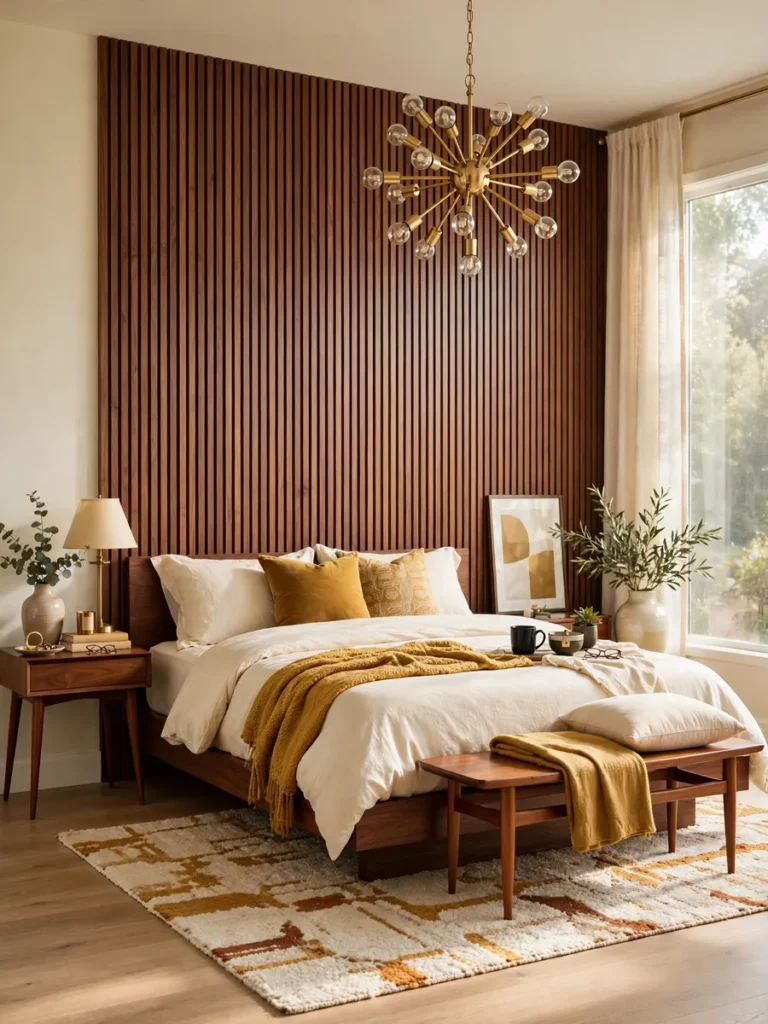
The look suits almost any dining space, from a compact apartment nook to a long open-plan room, because the furniture sits light on slim legs and leaves the floor visible. If the bedroom already carries the same warm wood and tapered legs, these mid-century modern bedroom ideas show how the style flows from room to room — in the dining room, the same rules apply: one strong table, chairs with character, and a single confident accent color.
Mid-Century Modern Dining Room Ideas: Key Takeaways
What defines a mid-century modern dining room? Tapered legs, warm wood like walnut or teak, molded or wishbone chairs, and sculptural lighting — function first, ornament last, and every piece chosen for its shape.
Which table works best? A walnut or teak table on tapered legs suits rectangular rooms, while a round or oval pedestal table fits small or square rooms because it removes the tangle of corner legs.
What colors should you use? Warm neutrals — cream, warm white, and natural wood — with one bold accent doing the work: mustard, olive, burnt orange, or teal.
How do you keep it from feeling dated? Mix one or two genuine vintage pieces with quality new ones, keep surfaces uncluttered, and let a single statement light do the talking.
1. How Does a Walnut Tapered-Leg Table Anchor a Mid-Century Modern Dining Room?
A walnut table on tapered legs anchors the room because its rich grain, splayed legs, and clean rectangular top set the whole tone in a single piece of furniture.
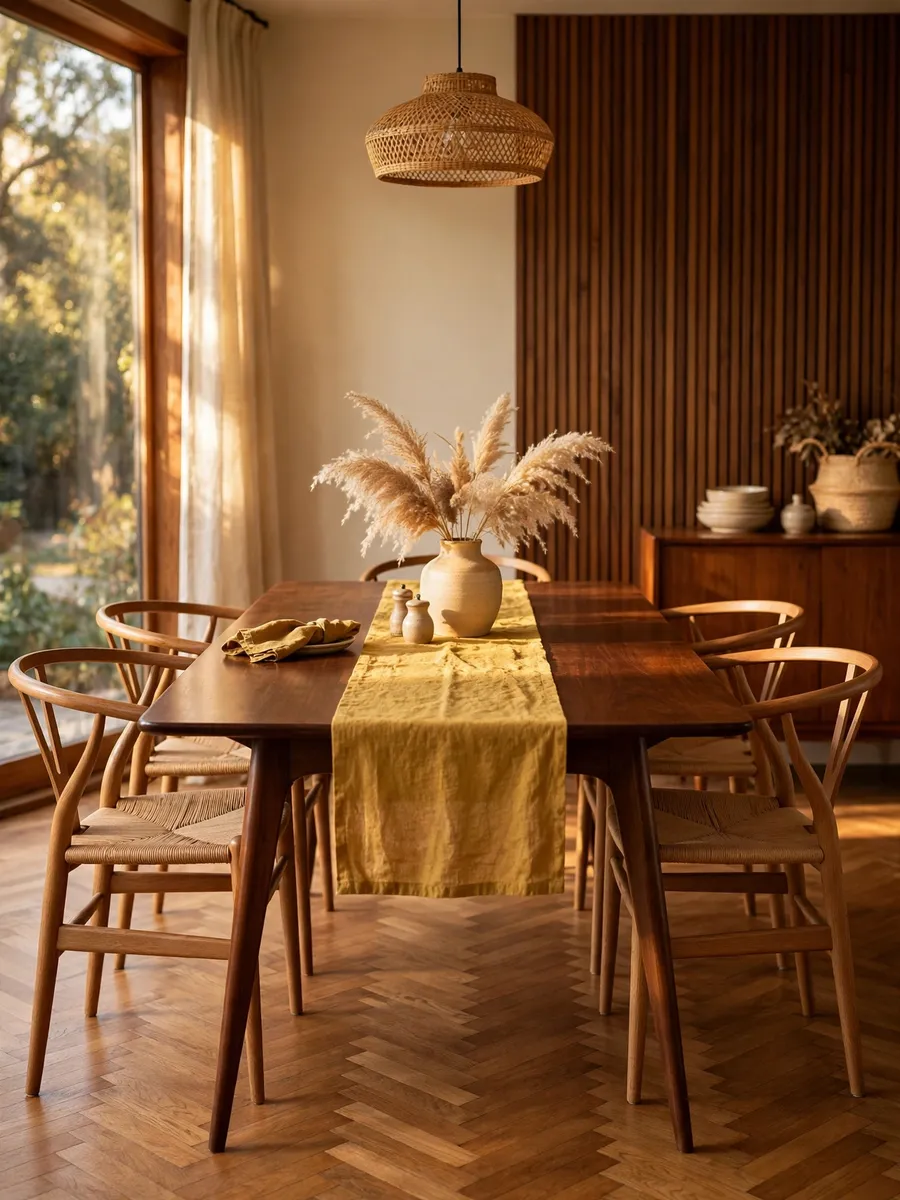
A concrete example: a 72-inch walnut table with gently splayed tapered legs, six oak wishbone chairs, and a mustard linen runner down the center. The walnut’s deep brown grain warms the cream walls, the tapered legs keep the table looking light instead of heavy, and a low ceramic vase with dried pampas grass finishes the center without blocking conversation across the table. A pair of linen placemats in warm ochre repeats the runner’s color and protects the wood from hot plates.
Quick tips
- Choose a satin or matte finish — high-gloss varnish fights the mid-century look.
- Leave 24 inches of table edge per person so nobody feels squeezed.
2. Why Is a Round Pedestal Table Perfect for a Small Mid-Century Modern Dining Room?
A round pedestal table fits small dining rooms because one central base removes the corner legs that trap knees, and the curved top makes it easy to squeeze in an extra chair.
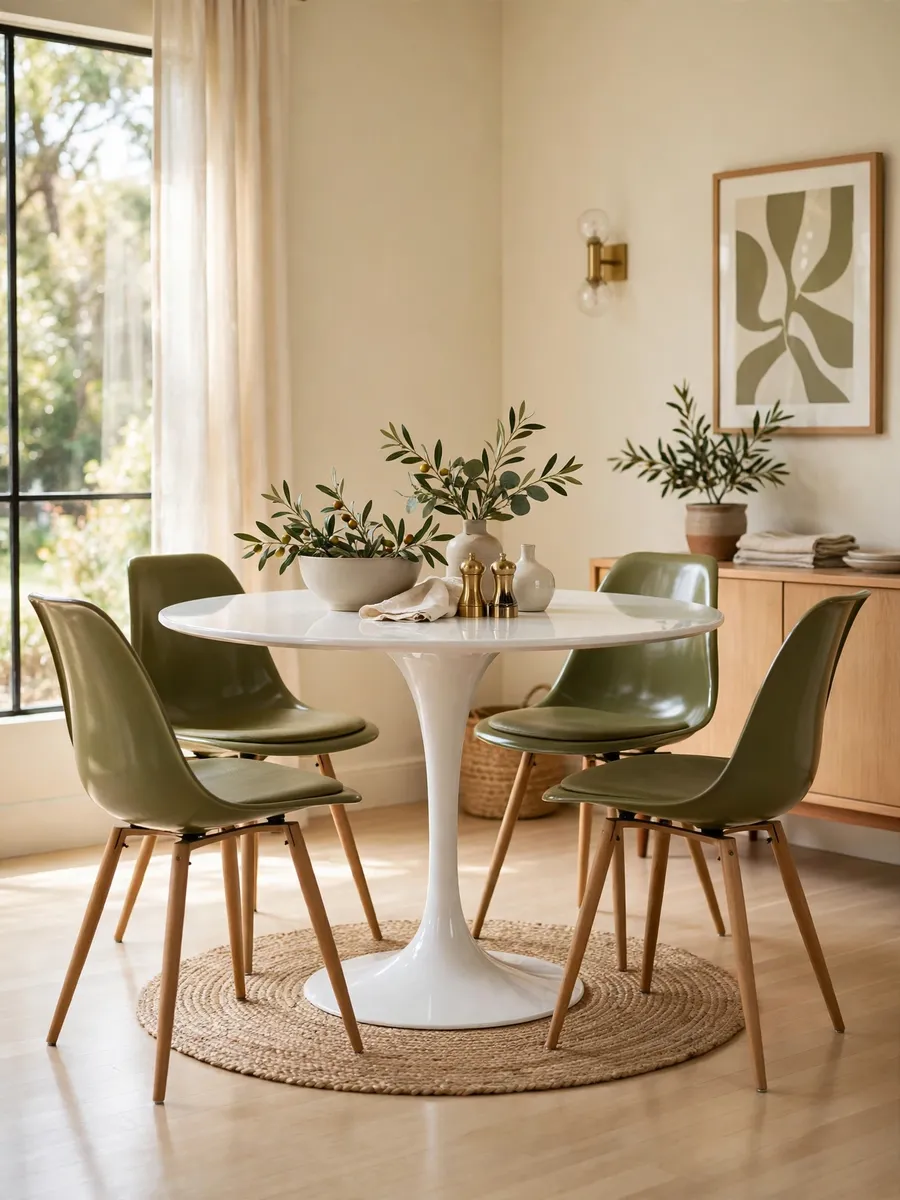
A concrete example: a 42-inch white laminate tulip-style pedestal table with four molded shell chairs in olive green, sitting on a pale oak floor with a small round jute rug underneath. The single base leaves the floor open, the round top softens a square room, and the olive chairs add the one bold color the room needs.
Quick tips
- A 42-inch round seats four comfortably; step up to 54 inches for six.
- Pair it with armless chairs so they tuck fully under the table.
3. What Makes Wishbone Chairs a Classic Mid-Century Modern Dining Choice?
Wishbone chairs are a classic because their bentwood Y-shaped back, woven paper cord seat, and slim tapered legs combine craftsmanship with a light, open silhouette.
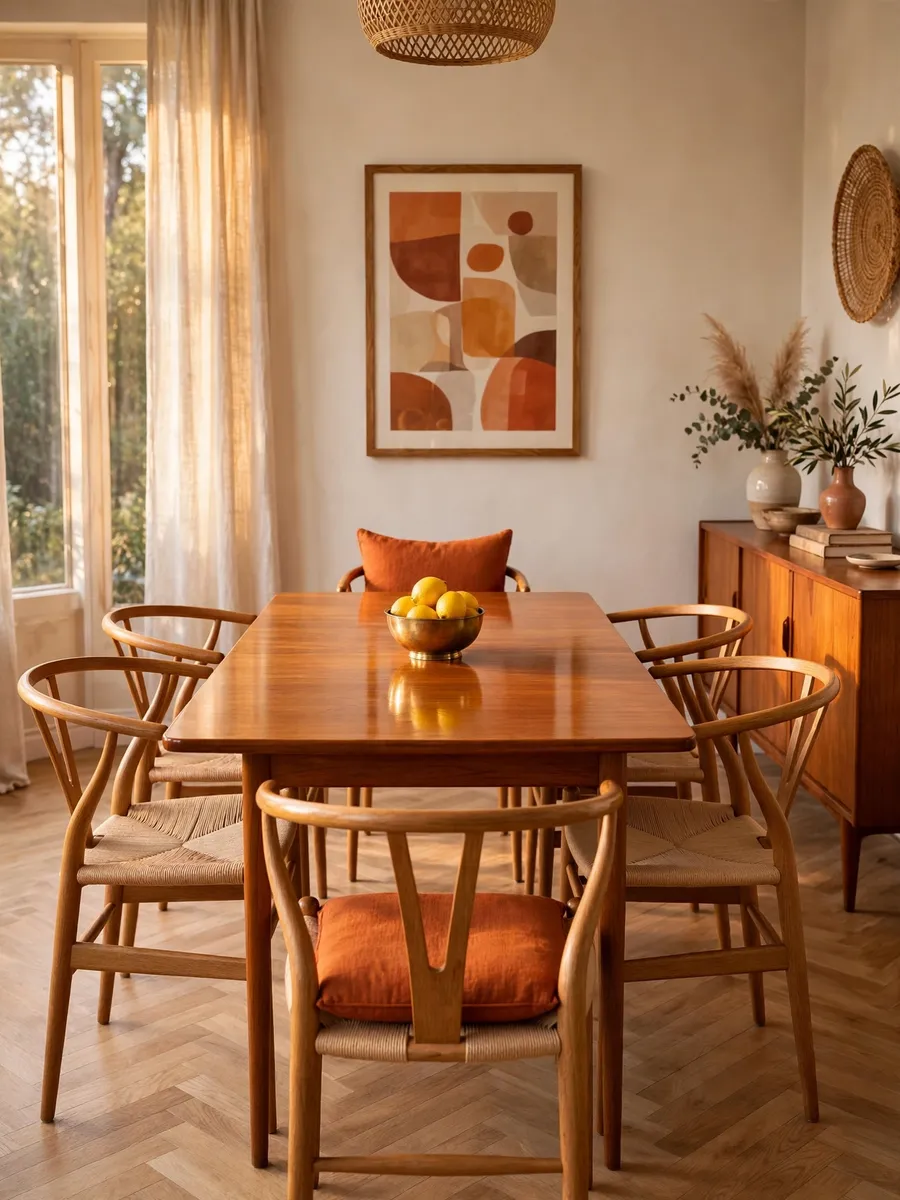
A concrete example: six natural oak wishbone chairs around a rectangular teak table, with burnt orange linen seat pads on the two end chairs only. The woven cord seats add texture, the curved top rails echo the table’s rounded corners, and the burnt orange pads repeat the color of the abstract print hanging on the wall behind the sideboard. A small brass bowl of lemons at the table’s center adds a fresh scent and a second hit of warm color.
Quick tips
- Keep the wood tone close to the table’s so the set reads as one family.
- Check the seat height — 17 to 19 inches works with standard 29 to 30 inch tables.
4. How Do Molded Shell Chairs Bring Mid-Century Modern Style to the Table?
Molded shell chairs bring the style to the table because their one-piece curved seat, first made famous by the Eames designs, is the most recognizable mid-century silhouette.
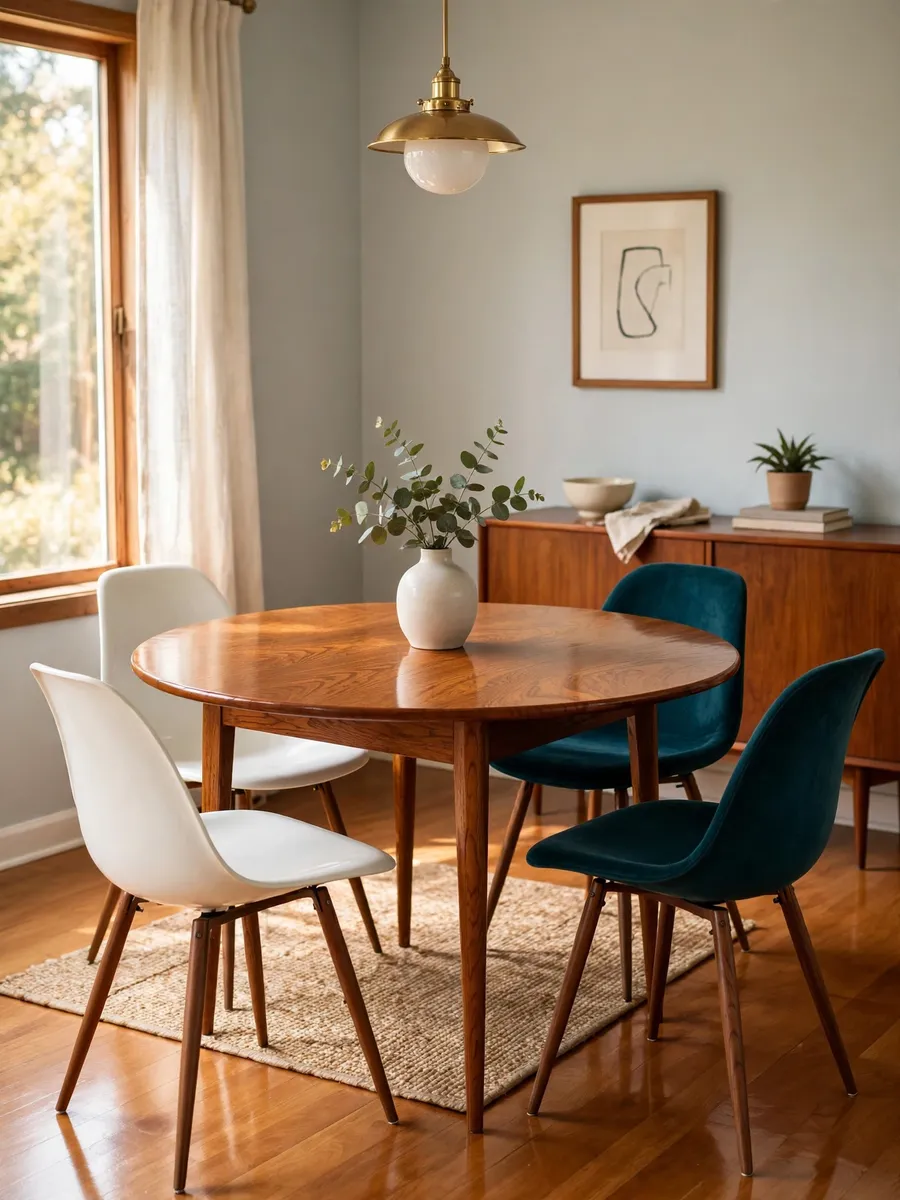
A concrete example: four white molded shell chairs on walnut dowel legs around a round oak table, with two of the chairs in deep teal for a quiet color contrast. The smooth shells wipe clean after family dinners, the dowel legs pick up the warm wood of the table, and the teal pair stops the room from feeling all-white.
Quick tips
- Mix two shell colors at most — more than that looks accidental.
- Choose dowel legs for warmth or wire legs for a lighter, airier look.
5. Why Is a Sputnik Chandelier the Boldest Mid-Century Modern Dining Light?
A sputnik chandelier is the boldest choice because its radiating brass arms and exposed bulbs turn the ceiling into sculpture, and it throws warm light in every direction at once.
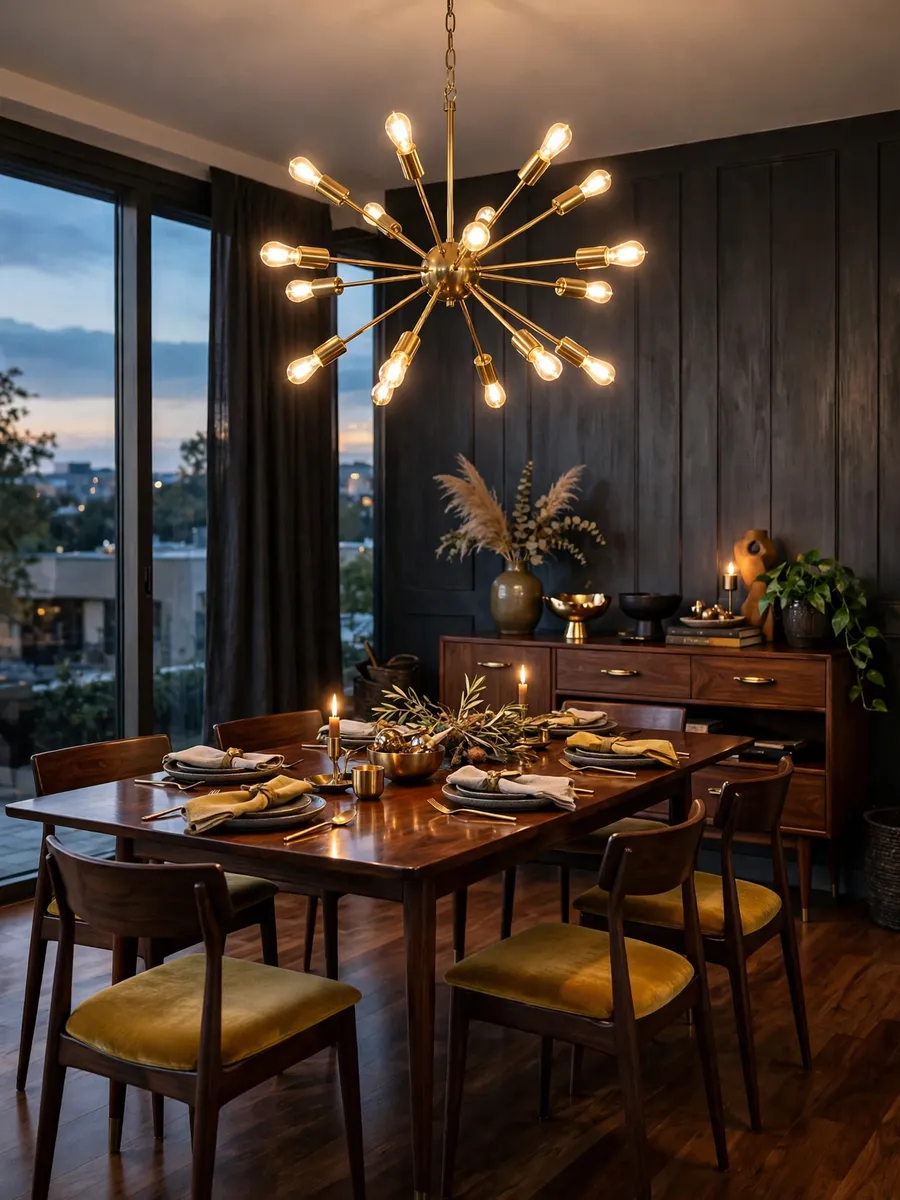
A concrete example: a brass sputnik chandelier with twelve arms hung low over a dark walnut table, its glow catching the mustard velvet seat pads and the charcoal wall behind the sideboard. The fixture fills the space above the table so the room needs little else, and dimmable bulbs let the same light shift from bright family dinners to soft evening meals. The brass arms pick up the warm tones of the walnut below, so the whole room glows instead of glaring.
Quick tips
- Hang it 30 to 34 inches above the tabletop so it lights plates, not foreheads.
- Size it about half to two-thirds the width of the table.
6. How Does a Globe Pendant Soften a Mid-Century Modern Dining Room?
A globe pendant softens the room because its round frosted glass diffuses light evenly, balancing the straight lines of the table and the sharp angles of tapered legs.
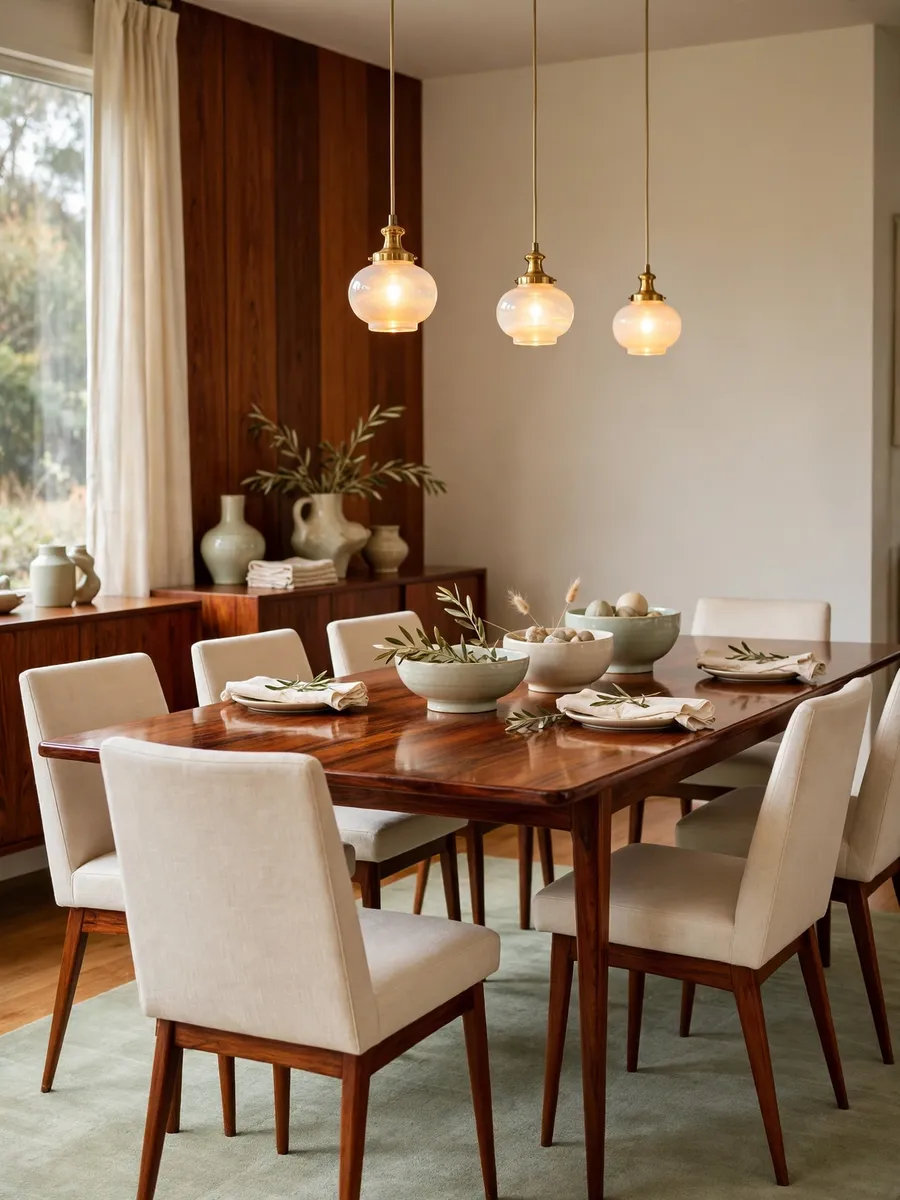
A concrete example: three small brass-and-opal globe pendants hung in a row over a long rosewood table, with cream linen chairs and a pale sage rug below. The row of glowing spheres echoes the round shapes of the ceramic centerpiece bowls, and the soft light flatters both the wood grain and the people sitting around it.
Quick tips
- Use warm bulbs around 2700K — cool white light kills the retro warmth.
- Hang a row of three over long tables; one large globe suits round tables.
7. What Does a Teak Credenza Add to a Mid-Century Modern Dining Room?
A teak credenza adds storage and a second focal point, because its long low shape, sliding doors, and tapered legs hold table linens and dishes while anchoring the wall.
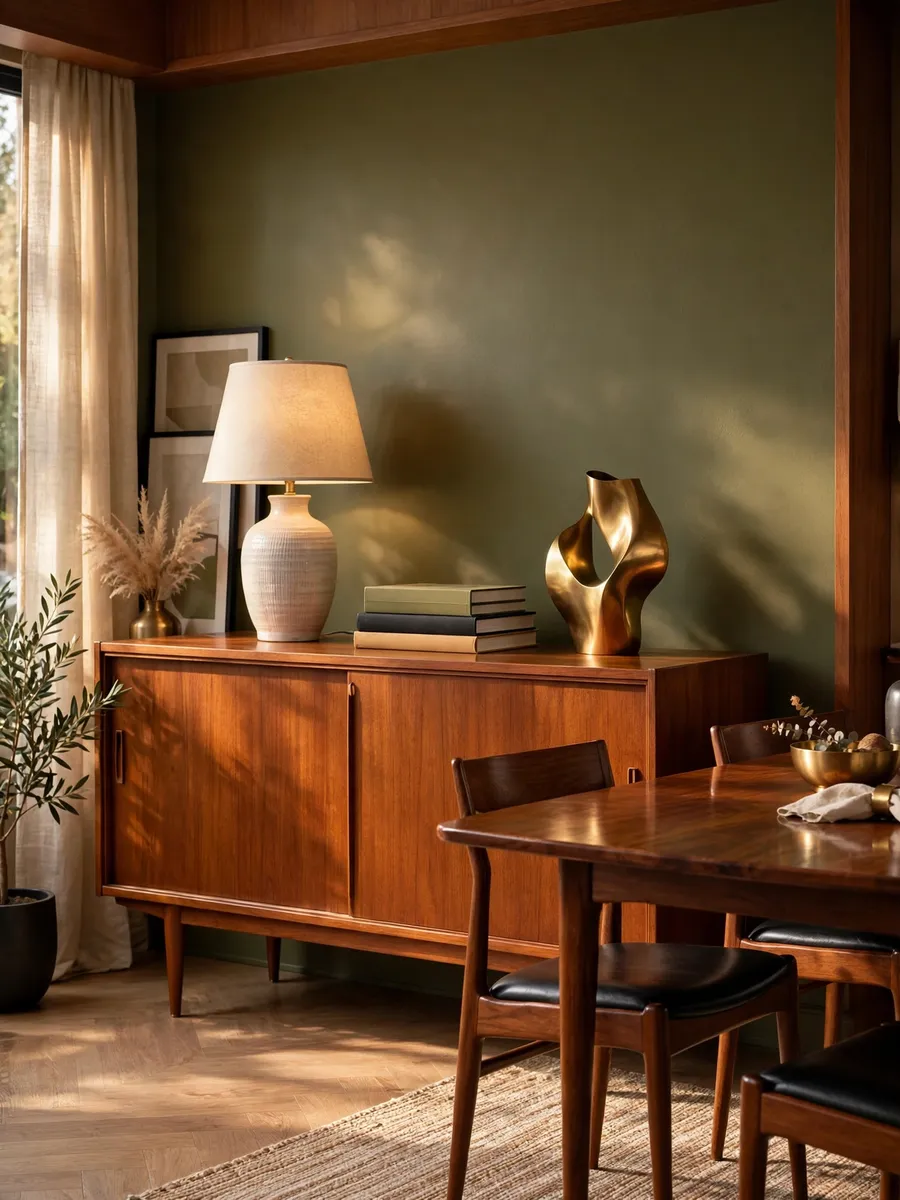
A concrete example: a 60-inch teak credenza with sliding doors and slim tapered legs against an olive green wall, topped with a ceramic table lamp, a stack of design books, and a sculptural brass vase. It stores placemats and serving dishes out of sight, and its warm wood balances the walnut table across the room. A small woven basket tucked beneath one end holds extra napkins and keeps the top clear for serving.
Quick tips
- Look for one 48 to 60 inches wide, about 30 inches tall, and 16 to 18 inches deep.
- Keep the top styled with three objects at most so it never looks crowded.
8. How Does a Starburst Clock Complete a Mid-Century Modern Dining Wall?
A starburst clock completes the wall because its radiating wood or brass rays are pure 1950s sculpture, and it fills a blank wall without adding clutter.
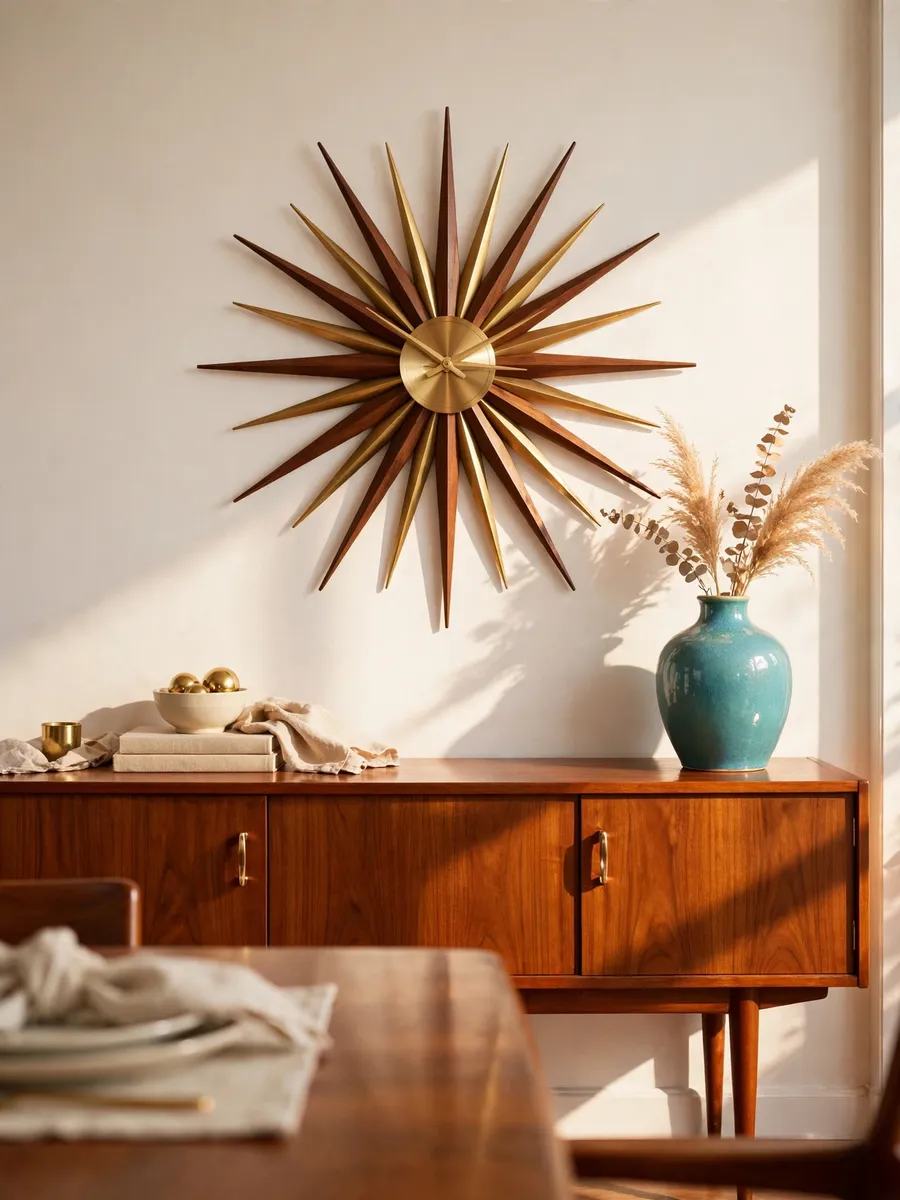
A concrete example: a walnut and brass starburst clock centered on a warm white wall above a low teak sideboard, its rays catching the afternoon sun next to a turquoise ceramic vase. The clock gives the eye a focal point between the pendant light and the table, and its mid-century shape ties the whole wall together.
Quick tips
- Hang it at eye level, centered over the sideboard or the table’s long side.
- Let it be the only wall decor on that wall so the rays stay the star.
9. Why Does a Geometric Rug Work Under a Mid-Century Modern Dining Table?
A geometric rug works under the table because its bold shapes and retro colors ground the furniture, define the dining zone, and add pattern where the wood stays plain.
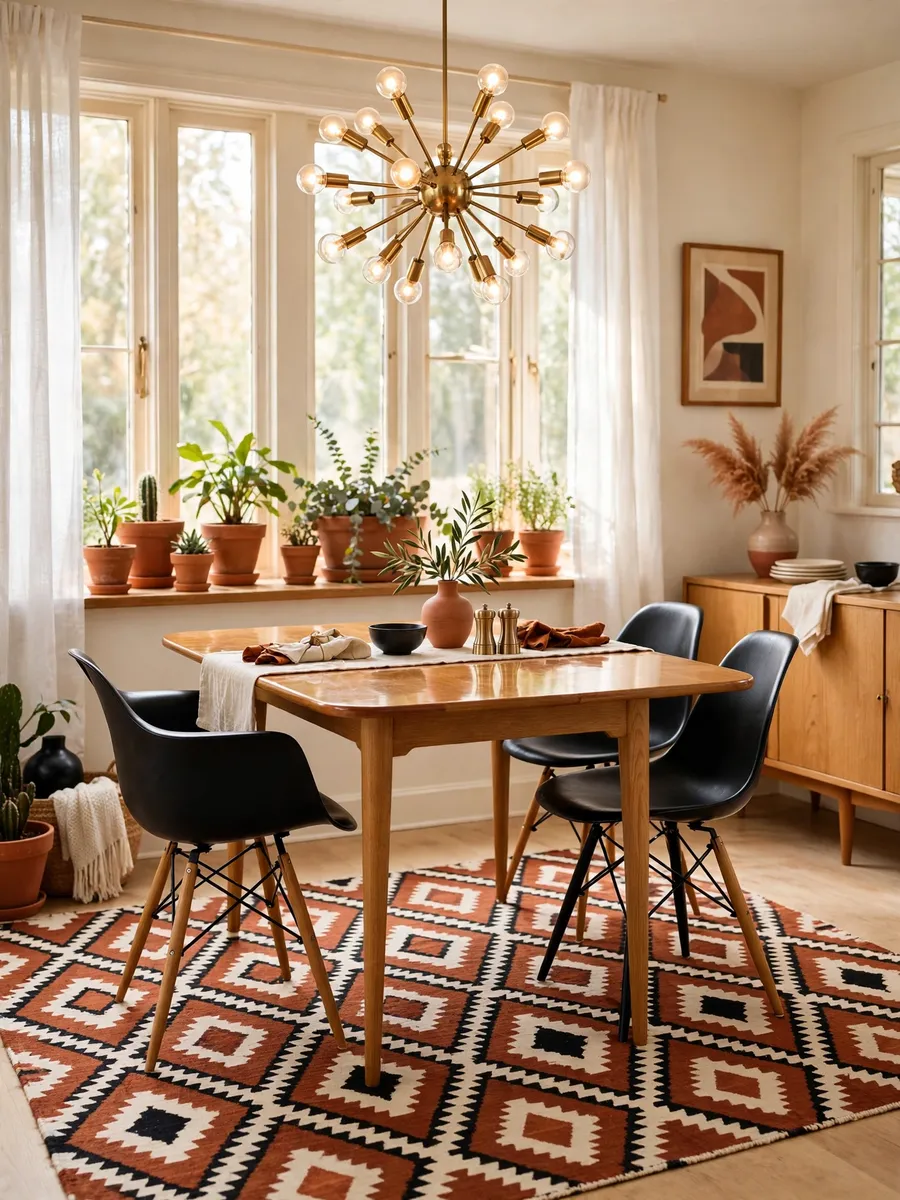
A concrete example: a flat-weave rug in rust, cream, and black diamonds under a light oak table with four black molded chairs, its pattern echoing the angles of the sputnik light above. The rug extends 24 inches past the table on every side so chairs stay on it when pulled out, and its low pile makes sliding chairs easy. The rust diamonds echo the terracotta planters on the windowsill, so the color feels repeated rather than random.
Quick tips
- Size the rug so chairs stay on it even when pulled out for sitting.
- Choose flat-weave or low-pile rugs — deep pile traps crumbs and chair legs.
10. How Does a Bar Cart Add Retro Charm to a Mid-Century Modern Dining Room?
A bar cart adds retro charm because its brass frame, glass shelves, and rolling wheels are a small piece of 1960s entertaining that doubles as a serving station.
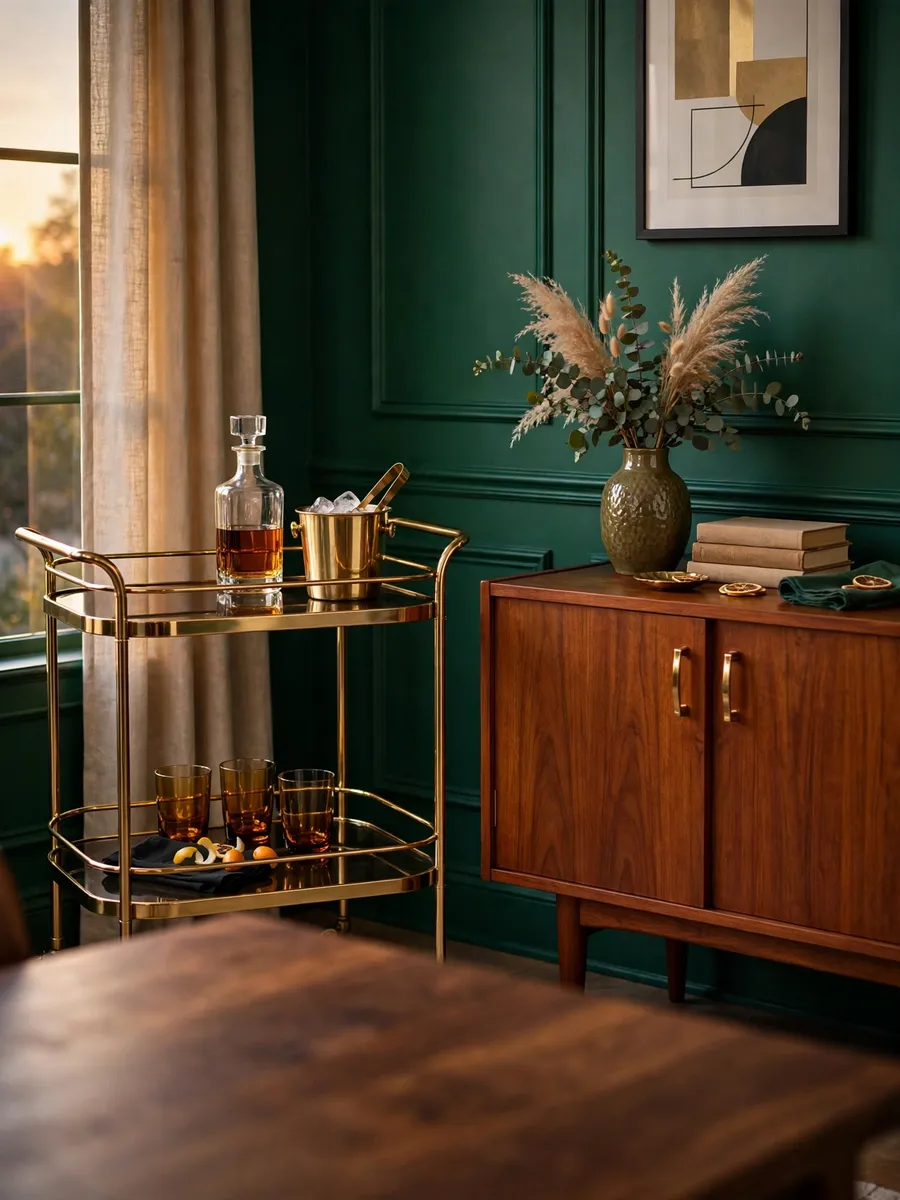
A concrete example: a two-tier brass and smoked-glass bar cart parked in the corner beside the credenza, holding a decanter, four amber tumblers, a small brass ice bucket, and a sprig of rosemary in a bud vase. It rolls to the table for dessert drinks and back to the corner afterward, and its emerald green wall behind it makes the brass glow.
Quick tips
- Stock it with five or six pieces only — a crowded cart looks like a shelf.
- Park it where it never blocks the path between the table and the kitchen.
11. What Kind of Abstract Art Fits a Mid-Century Modern Dining Room?
Large abstract art with bold shapes and warm colors fits because mid-century design loves graphic forms, and one big print gives the room a focal point beyond the table.
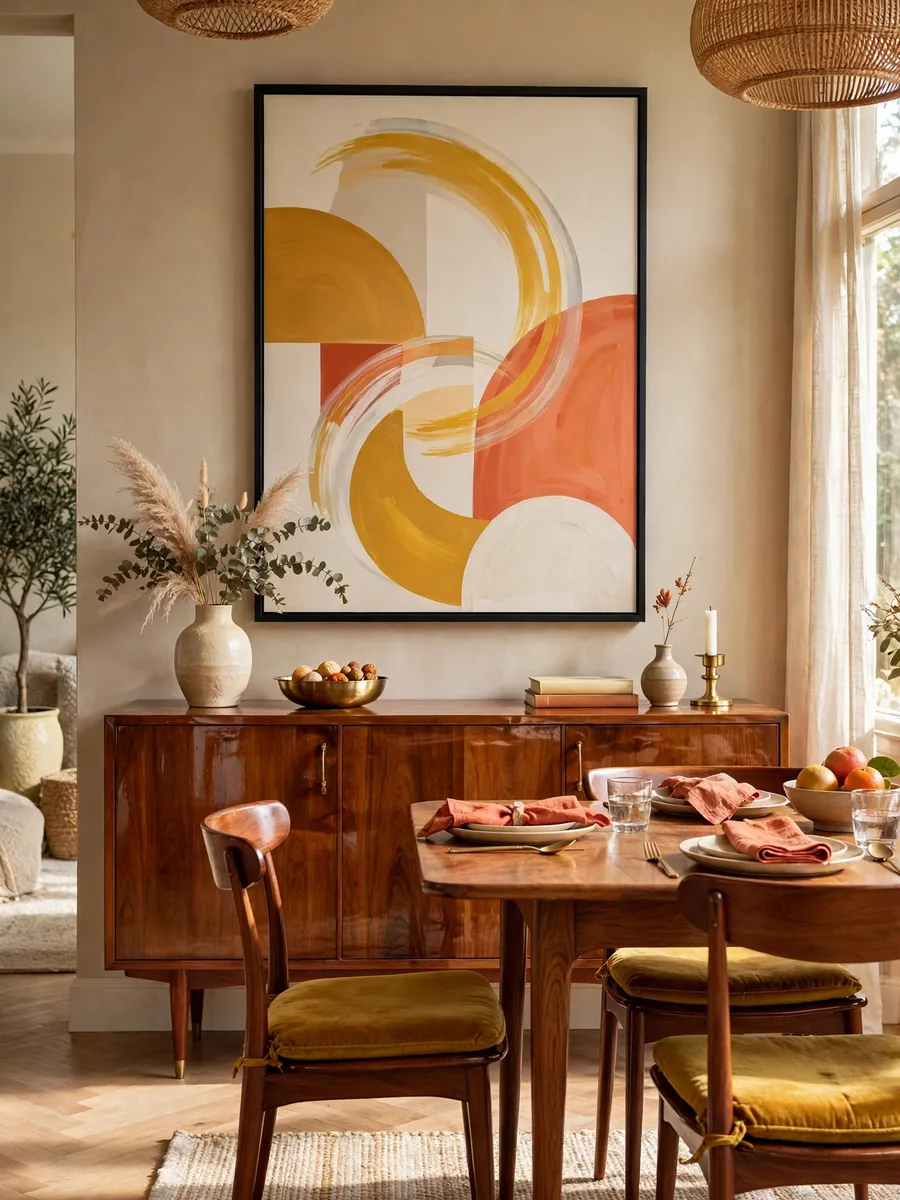
A concrete example: a large framed print of mustard, coral, and cream arcs and semicircles hanging above a walnut sideboard, its colors picked up by the coral linen napkins and the mustard seat pads at the table. The print’s simple shapes mirror the curved chair backs, and its warm palette pulls the whole room together. A slim black frame keeps the focus on the shapes themselves, and the print’s cream background matches the wall so it feels painted on rather than hung.
Quick tips
- Hang art so its center sits at eye level, about 57 inches from the floor.
- Pull one color from the art into the table setting to tie the room together.
12. Can You Mix and Match Dining Chairs in a Mid-Century Modern Room?
You can mix dining chairs as long as one element stays consistent — the same leg finish, seat color, or wood tone — so the mix looks intentional instead of random.
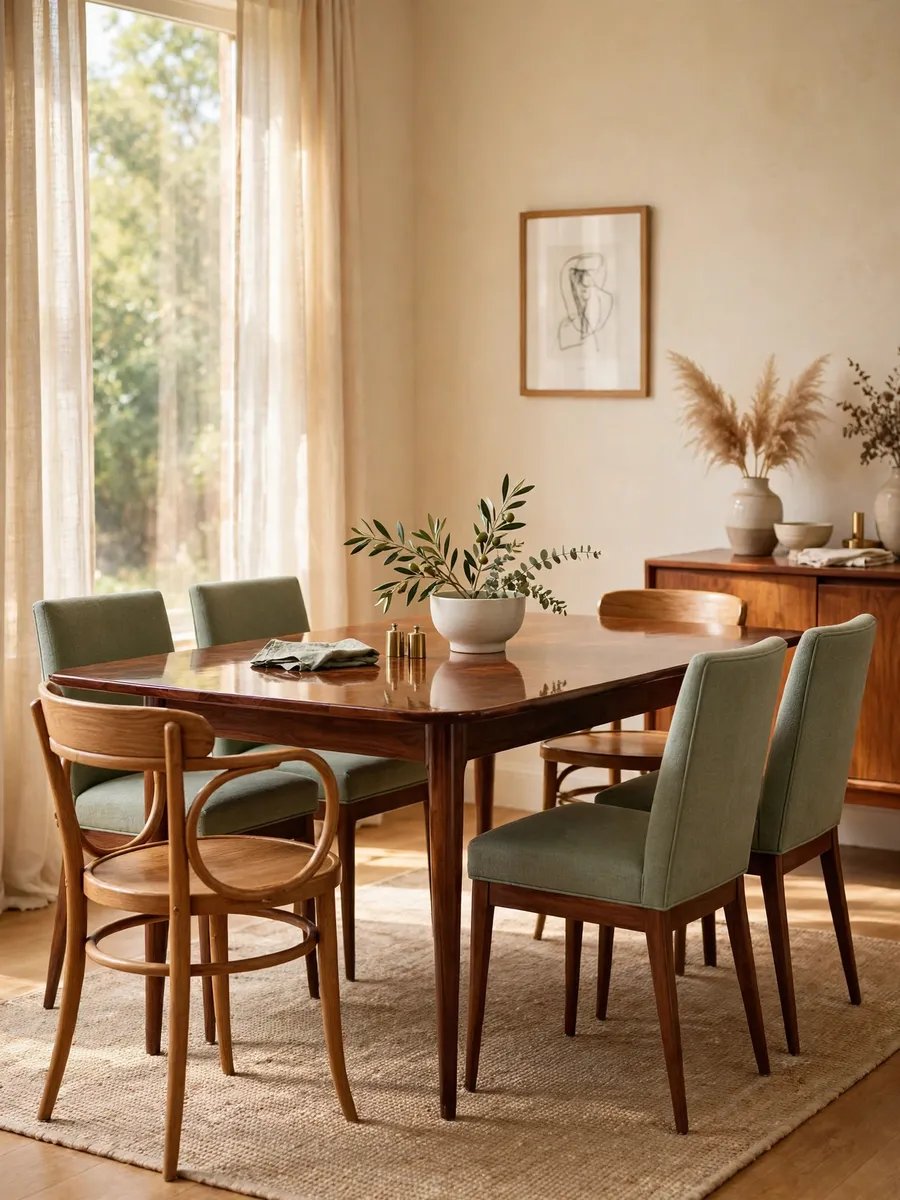
A concrete example: a walnut table with four sage green upholstered side chairs and two bentwood armchairs in natural oak at the ends, all sharing the same tapered leg shape. The armchairs give the hosts a little more comfort, the green seats add the room’s one soft color, and these dining room chair ideas show more ways to pair different chair shapes without losing the mid-century thread.
Quick tips
- Keep seat heights within an inch of each other so the table line stays even.
- Repeat one material — wood, leather, or fabric — across every chair.
13. How Does a Built-In Banquette Save Space in a Mid-Century Modern Dining Room?
A built-in banquette saves space because a bench along one wall replaces two chairs, slides tight to the table, and hides storage for linens underneath the seat.
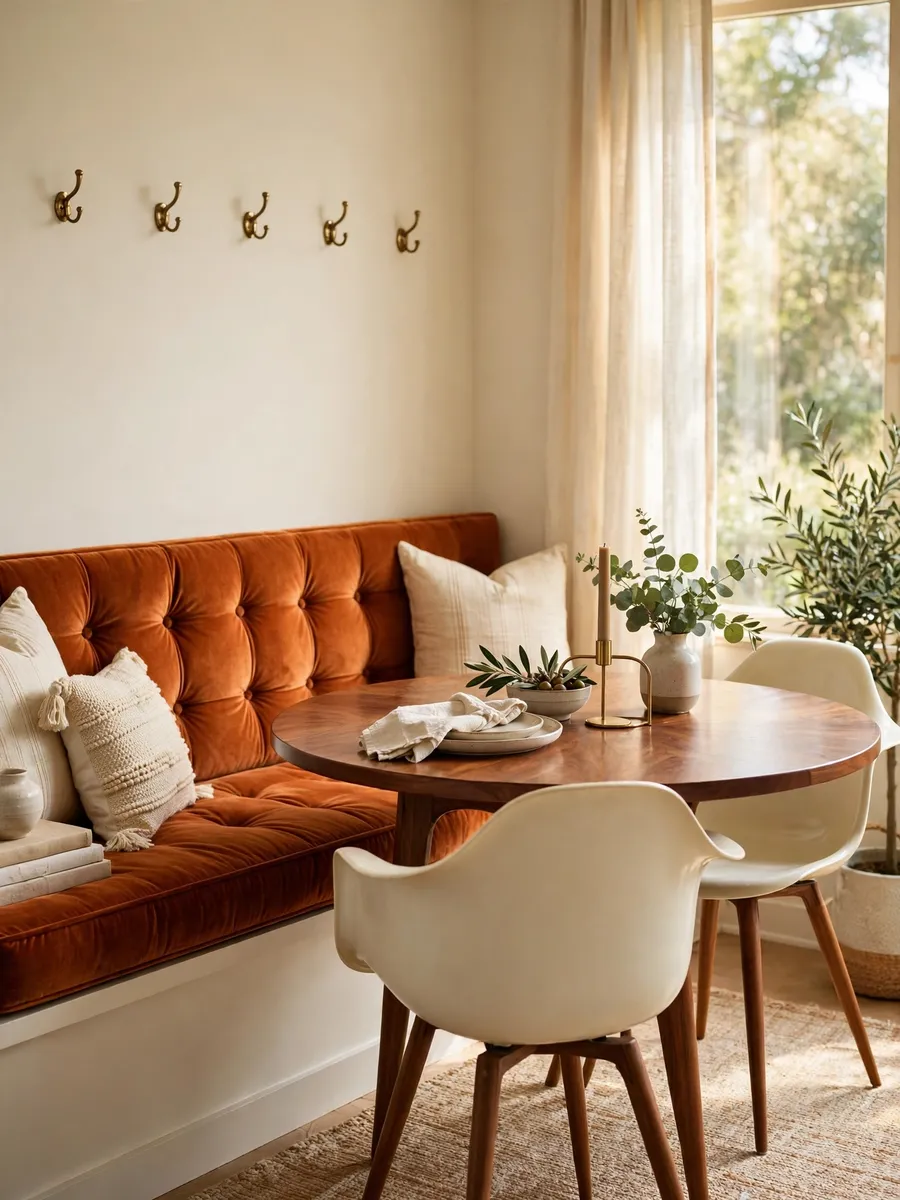
A concrete example: a burnt orange velvet banquette with button-tufted back cushions along the wall, paired with a round walnut table and two molded chairs on the open side. The bench seats three where two chairs would fit, the storage below holds tablecloths and board games, and the orange velvet warms the cream walls. A row of small brass hooks on the wall above the bench holds aprons and tote bags out of the way.
Quick tips
- Leave 36 inches behind any chair on the open side so it pulls out freely.
- Choose wipeable fabric or leather for the seat — spills happen at dinner.
14. Why Are Hairpin Legs a Smart Detail for a Mid-Century Modern Dining Table?
Hairpin legs are smart because their thin bent-steel rods lift the table visually, cost little, and give even a simple wood top an unmistakable mid-century silhouette.
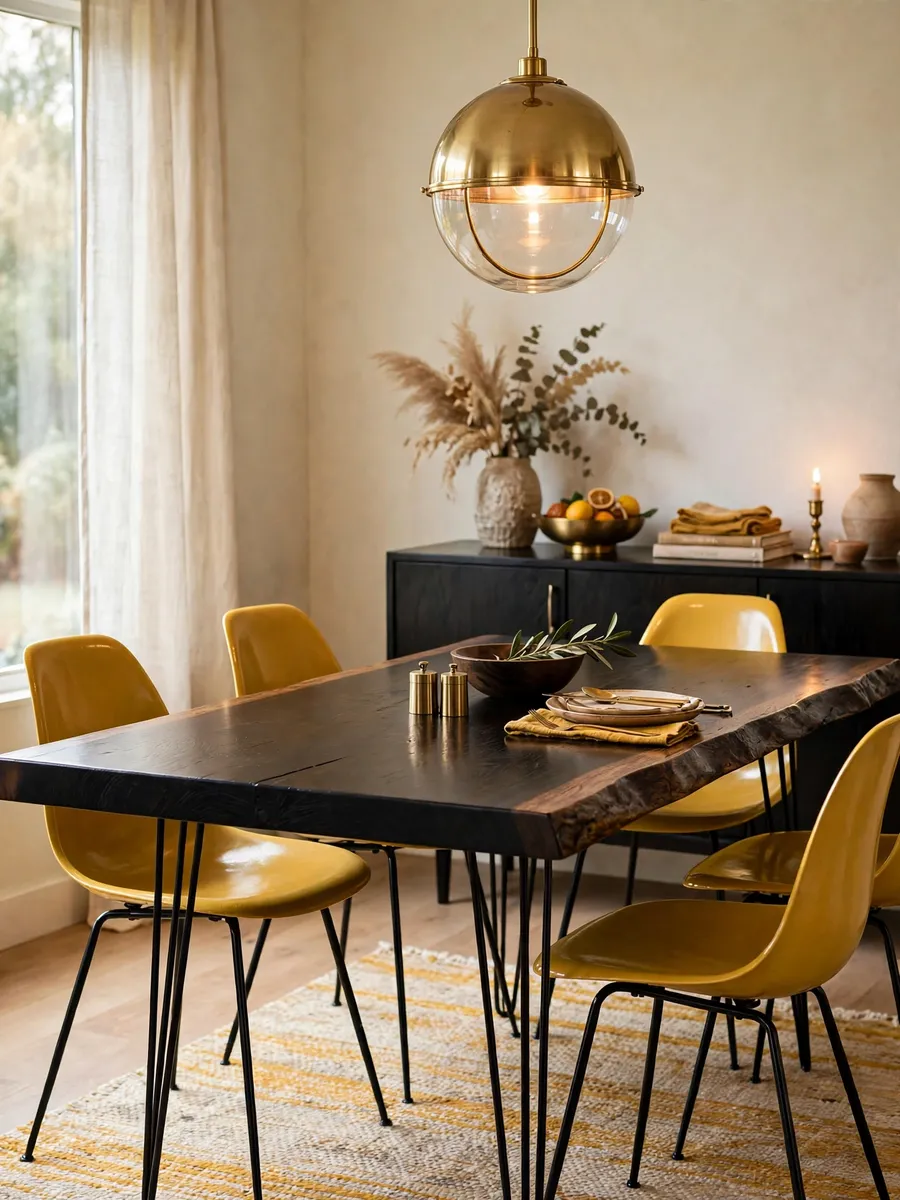
A concrete example: a live-edge ebony-stained oak top on four black hairpin legs, with mustard molded chairs and a brass globe pendant above. The slim legs make the heavy top look like it floats, the black steel echoes the pendant’s fittings, and the mustard chairs keep the dark table from feeling severe.
Quick tips
- Use hairpin legs on tops up to about 60 inches — longer tops need a center support.
- Match the leg finish to another metal in the room, like the light or the handles.
15. How Does Terrazzo Add Pattern to a Mid-Century Modern Dining Room?
Terrazzo adds pattern because its speckled chips of stone and glass bring color and texture to a room that otherwise relies on plain wood and smooth surfaces.
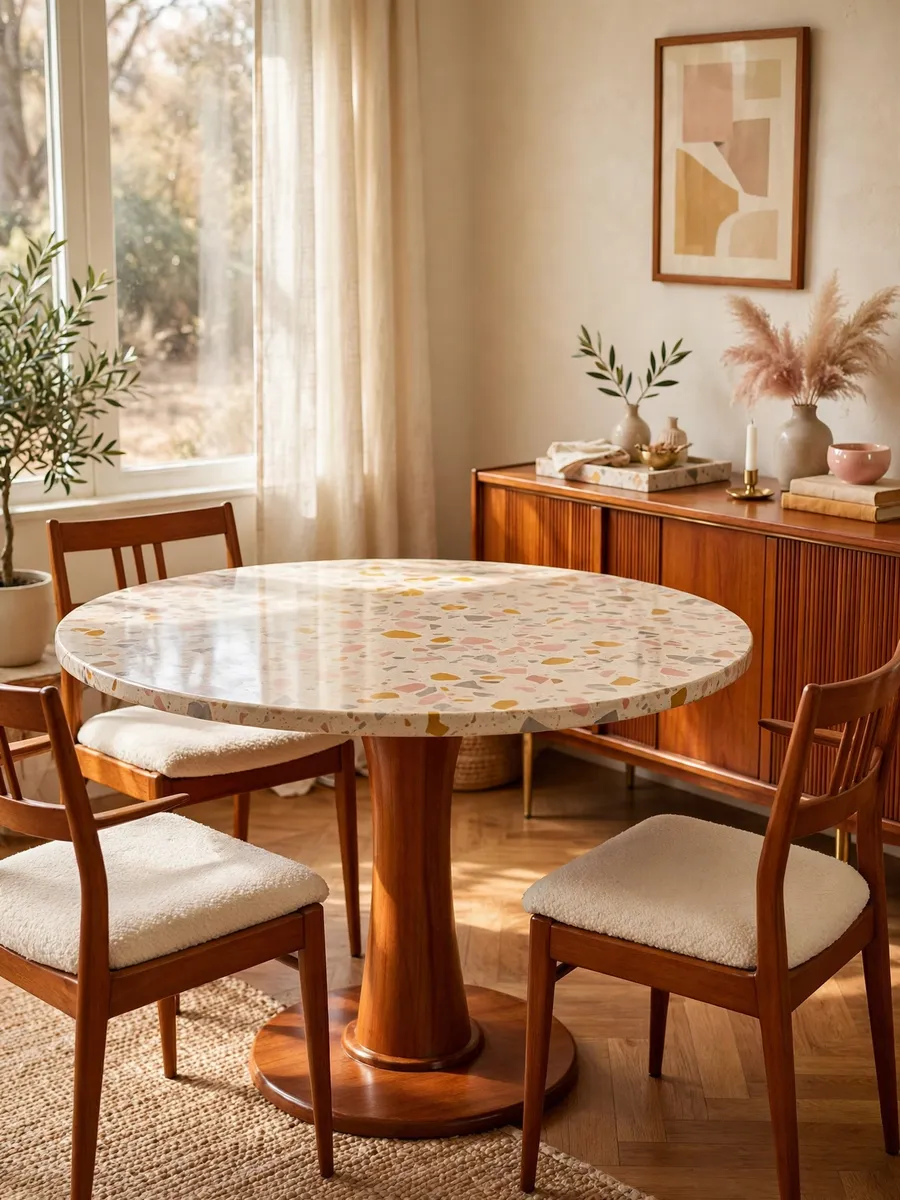
A concrete example: a terrazzo-topped pedestal table in cream with blush, mustard, and grey chips, surrounded by teak chairs with cream bouclé seat pads. The speckled top becomes the room’s artwork, the teak legs warm the cool stone, and a small terrazzo tray on the sideboard repeats the pattern at a smaller scale. A pair of blush linen napkins on the table picks up the blush chips and softens the stone’s hard edge.
Quick tips
- Let terrazzo be the only strong pattern in the room so it stays the star.
- Seal the surface so wine and coffee never stain the chips.
16. Why Does Warm Wood Paneling Suit a Mid-Century Modern Dining Room?
Warm wood paneling suits the room because mid-century homes often wrapped one wall in vertical wood slats, and that texture makes the dining area feel crafted rather than painted.
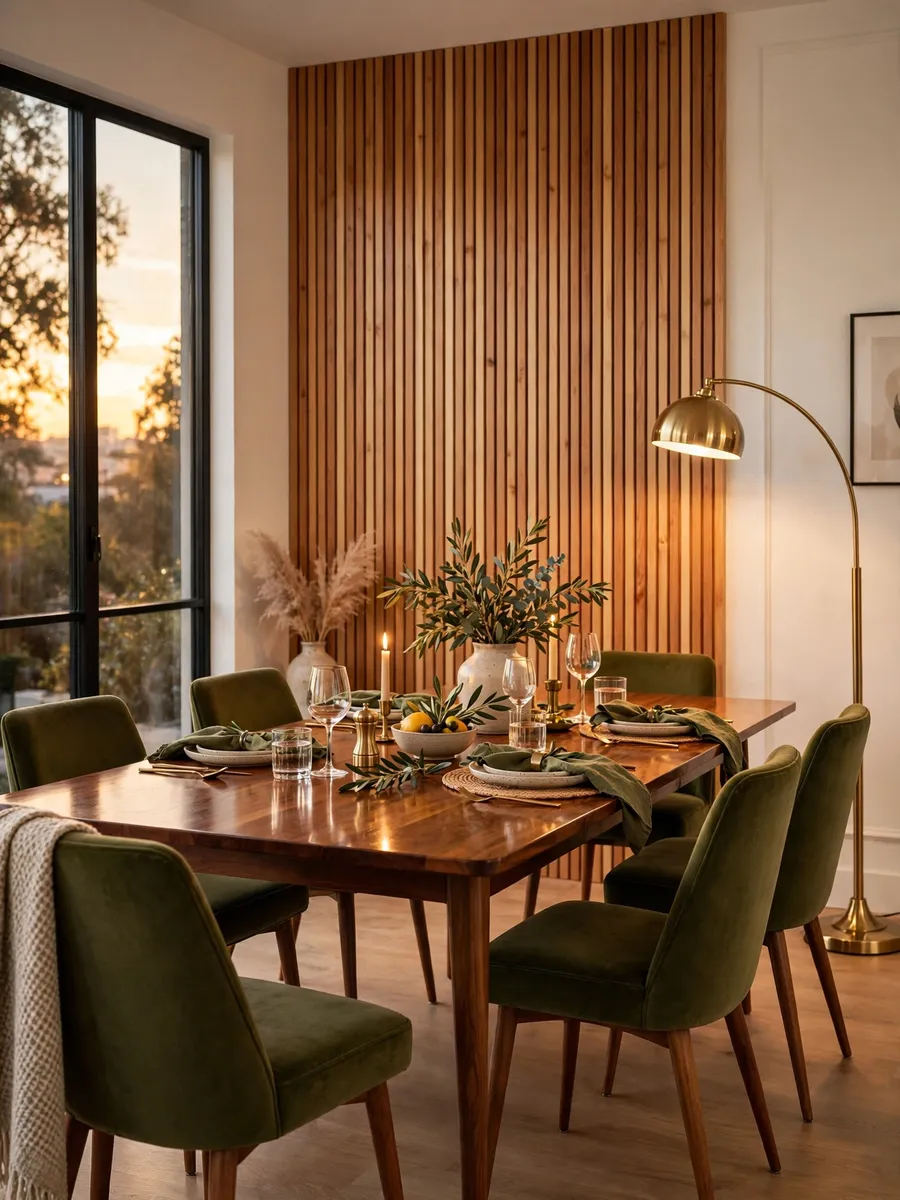
A concrete example: a cedar slat wall behind a long walnut table, with olive green upholstered chairs and a single brass arc lamp in the corner. The vertical slats draw the eye upward, the cedar’s honey tone glows in the pendant light, and the olive chairs stop the wood from overwhelming the room.
Quick tips
- Panel one wall only — four wood walls turn a dining room into a cabin.
- Keep the other walls warm white so the paneling reads as an accent.
17. What Centerpiece Works Best on a Mid-Century Modern Dining Table?
The best centerpiece is low, sculptural, and simple — a ceramic bowl, a brass tray, or a single vase — because it decorates the table without blocking the view across it.
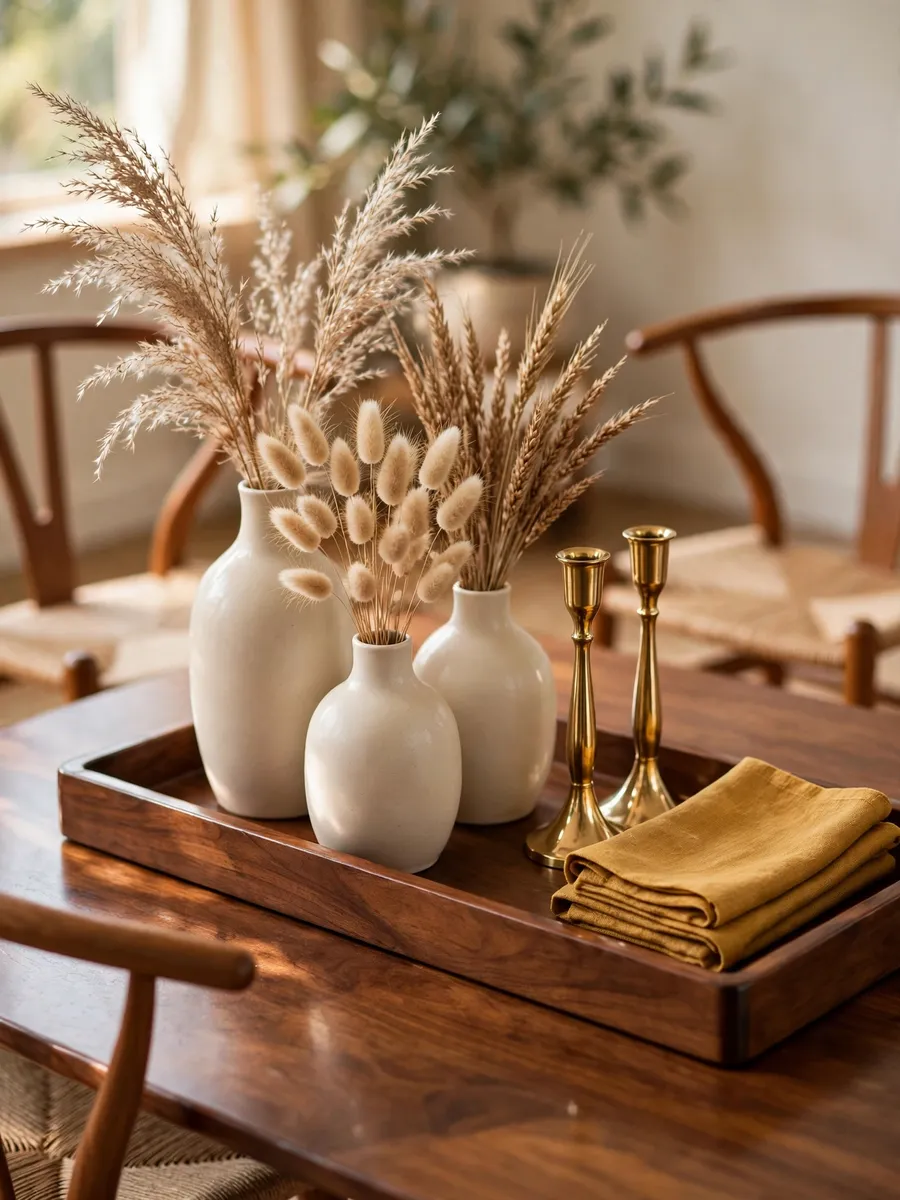
A concrete example: a long low walnut tray holding three cream ceramic vases with dried grasses, flanked by two brass candlesticks and a small stack of linen napkins. The tray keeps everything in one line down the table’s center, the dried grasses add soft height without blocking faces, and the whole arrangement lifts off in seconds for a full family dinner. A folded mustard linen napkin under each vase adds one more layer of color without any extra effort.
Quick tips
- Keep the centerpiece under 12 inches tall so guests can see each other.
- Use odd numbers — three vases or five candles — for a natural, collected look.
18. How Do Vintage Finds Make a Mid-Century Modern Dining Room Feel Collected?
Vintage finds make the room feel collected because one genuine 1950s or 1960s piece — a lamp, a sideboard, a set of glasses — adds patina that new furniture cannot fake.
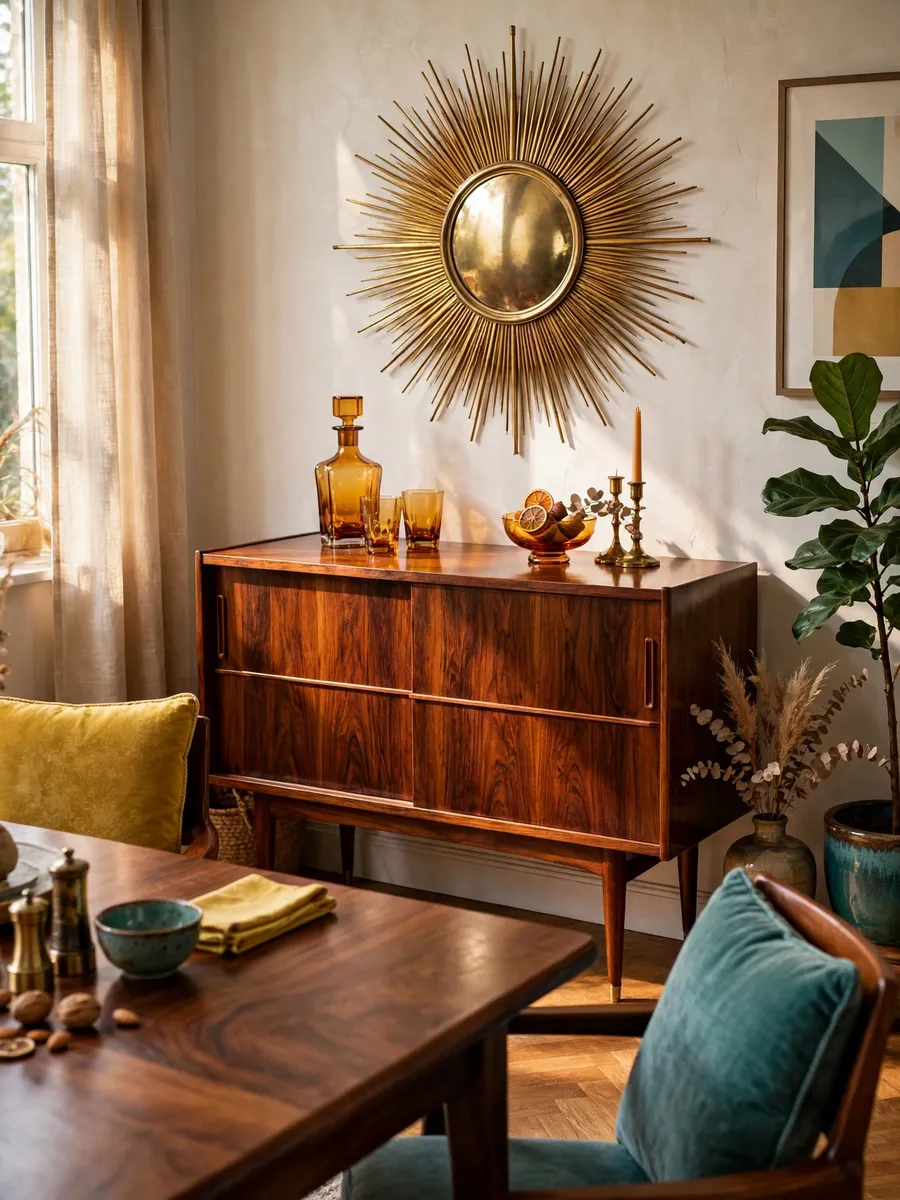
A concrete example: a rosewood sideboard found at an estate sale, its sliding doors and tapered legs original, topped with a vintage amber glass decanter set and a sunburst mirror above. The worn edges and deep rosewood grain tell the room’s story, and the mustard and teal cushions on the nearby chairs pick up the amber glass tones.
Quick tips
- Buy one strong vintage piece per room — a collection of ten reads like a shop.
- Check joints and drawers before buying; solid wood repairs well, veneer less so.
19. How Do You Lay Out a Small Mid-Century Modern Dining Room Without Crowding It?
Lay out a small dining room by choosing a round table, keeping one wall clear, and letting every piece sit on legs, because visible floor and open sightlines make the room read larger.
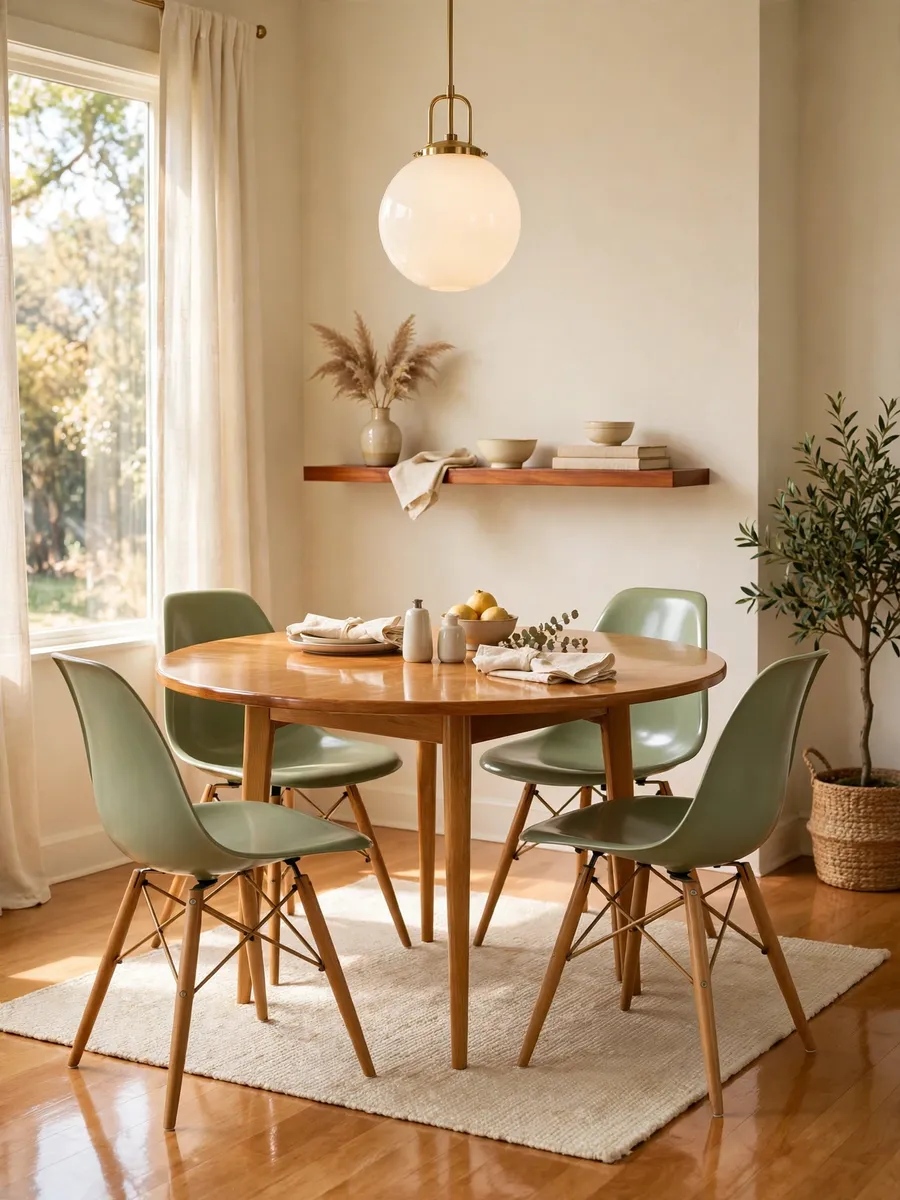
A concrete example: a 42-inch light oak round table with four sage green molded chairs in a small square room, a slim teak floating shelf on one wall, and a single globe pendant above. The round top leaves corners free, the floating shelf holds dishes without taking floor space, and the sage chairs add color without a single extra object. A small potted olive tree in the corner adds height and a living green note that the sage chairs echo.
Quick tips
- Measure 36 inches of clearance behind every chair before buying the table.
- Skip the sideboard in a small room — a floating shelf does the same job.
Mid-Century Modern Dining Room Ideas: Frequently Asked Questions
What is mid-century modern dining room style?
Mid-century modern dining room style is a design approach from the 1940s through the 1960s, built on clean geometric lines, minimal ornamentation, and function over decoration. The dining room version centers on warm wood like walnut and teak, furniture with tapered legs, molded or sculptural chairs, and one statement light over the table.
What kind of dining table looks mid-century modern?
Look for a table with four legs that angle outward from the top and taper toward the floor — that shape is the era’s signature. Walnut and teak suit it best, and a round or oval pedestal table is the other authentic route, especially in small rooms where corner legs get in the way.
Which chairs best complement a mid-century modern dining room?
Molded shell chairs with dowel or wire legs, wishbone chairs with woven paper cord seats, and upholstered chairs with tapered frames all work beautifully. Keep one element consistent — leg finish, seat color, or wood tone — and place two armchairs at the ends with matching side chairs along the length for a collected look.
What colors work best in a mid-century modern dining room?
Start with warm neutrals — cream, warm white, and natural wood tones — then add one bold accent like mustard yellow, burnt orange, olive green, or deep teal. Use the bold color sparingly but confidently, for example on the chairs, the rug, or one piece of art, so it becomes the room’s focal point.
How should I light a mid-century modern dining room?
Hang one statement fixture over the center of the table — a sputnik chandelier, a globe pendant, or a row of small pendants on a long table. Use warm bulbs around 2700K, hang the fixture 30 to 34 inches above the tabletop, and size it about half to two-thirds the width of the table.
Conclusion
A mid-century modern dining room does not need a full set of matching furniture or a big budget. Start with one strong table, add chairs with character, hang a single sculptural light, and let one warm accent color do the rest. These 19 mid-century modern dining room ideas work in any order, so begin with the piece that bothers you most and let the room collect itself from there.