12 Stunning Christmas Outdoor Lights Ideas That Make Your Home Glow Warm, Welcoming and Magical All Season
Christmas outdoor lights ideas work best when you layer warm-white 2700K LED lights across four zones: the roofline, trees, porch, and walkway. One color temperature, one timer, and even spacing turn an ordinary house into the warmest home on the street. These 12 ideas, from a classic C9 roofline to a glowing window trick, give you the spacing and bulb counts that make each one work.
Most displays fail for small reasons: mixed color temperatures, sagging strands, or lights that cover only one spot. Layering fixes all three. If you are planning the whole front of the house, these Christmas outdoor decor ideas pair beautifully with the lighting plans below, so the wreaths, garlands, and lanterns share the same warm glow.
Key Takeaways
What are the best Christmas outdoor lights ideas? Layer warm-white 2700K LED lights across four zones: a C9 roofline, wrapped trees, a lit garland at the door, and path lights.
When should I put outdoor Christmas lights up? Install them in early to mid-November, on a dry, mild day, before freezing weather arrives.
How many lights do I need outside? Plan on 100 mini lights per 10 feet of roofline, 100 to 200 per shrub, and 300 to 400 for a wrapped 8-foot tree.
What color temperature looks best outdoors? Warm white at 2700K is the classic choice; 3000K is the brightest still-warm option. Keep one temperature across the display.
Are LED Christmas lights better than incandescent? Yes. LEDs use far less energy, stay cool, and last much longer in cold, wet weather.
1. How Do I Outline My Roofline With Warm-White C9 Bulbs?
Use large C9 bulbs in warm-white 2700K LED, spaced about 12 inches apart along the roofline and peaks, so the outline reads clearly from across the street.
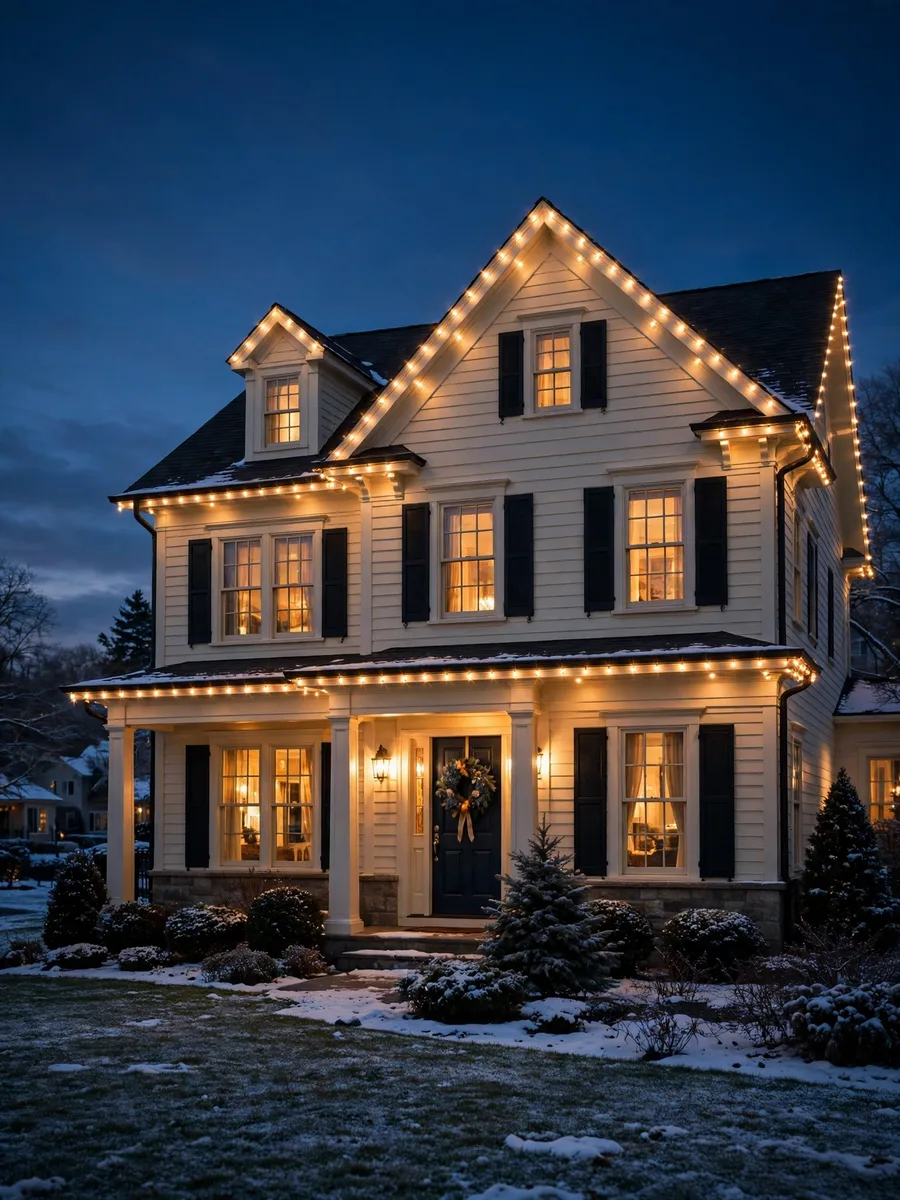
Big C9 bulbs, about two and a half inches tall, create bold points of light visible from a distance. Measure the roofline, buy 10 to 20 percent extra strand length, and clip it with plastic gutter clips every 12 inches, pulling it taut first. Example: a 40-foot ranch-house roofline takes four 100-count C9 strands, clipped along the gutter and up both gable peaks.
Quick tips:
- Use clips, never nails or staples.
- Keep every bulb the same 2700K temperature.
- Test strands on the ground first.
2. How Can I Make a Front Yard Tree Glow Like a Showpiece?
Wrap the trunk and main branches of one feature tree with warm-white mini lights, spiraling upward with about 4 to 6 inches between turns, for a full, even glow.
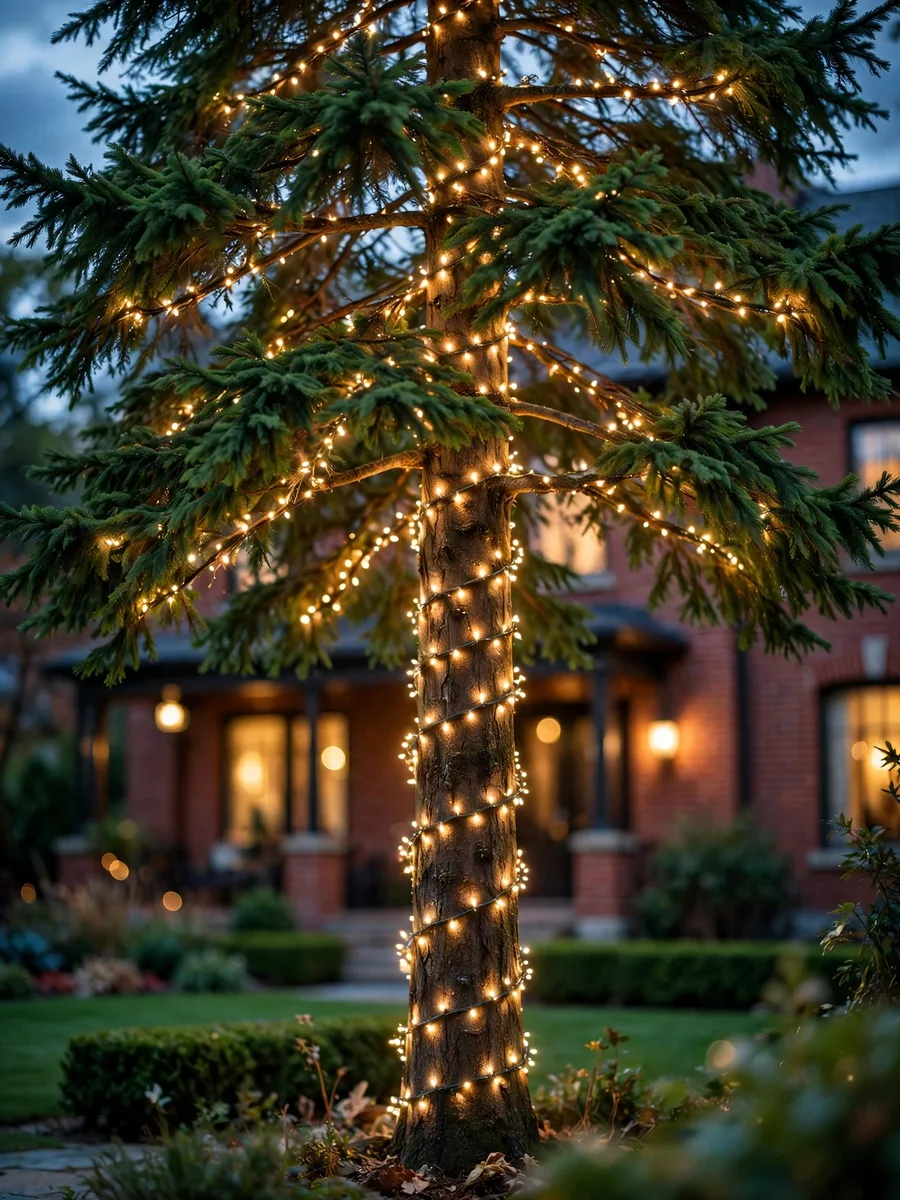
One well-wrapped tree beats three half-lit ones. Start at the base, spiral upward, and tuck the wire against the bark. Plan on 100 lights per foot of tree height, so an 8-foot tree needs roughly 300 to 400 lights. Example: a maple by the driveway takes two 100-count strands up the trunk, a third through the lowest branches, and a red bow at the base.
Quick tips:
- Wrap from the bottom up.
- Leave slack for branches that sway in wind.
- Light one tree well instead of spreading lights thin.
3. What Makes Icicle Lights Look Good Instead of Messy?
Hang icicle lights from gutters and eaves with the drops falling straight down, keeping one color temperature, so they read as a clean, frozen edge along the roof.
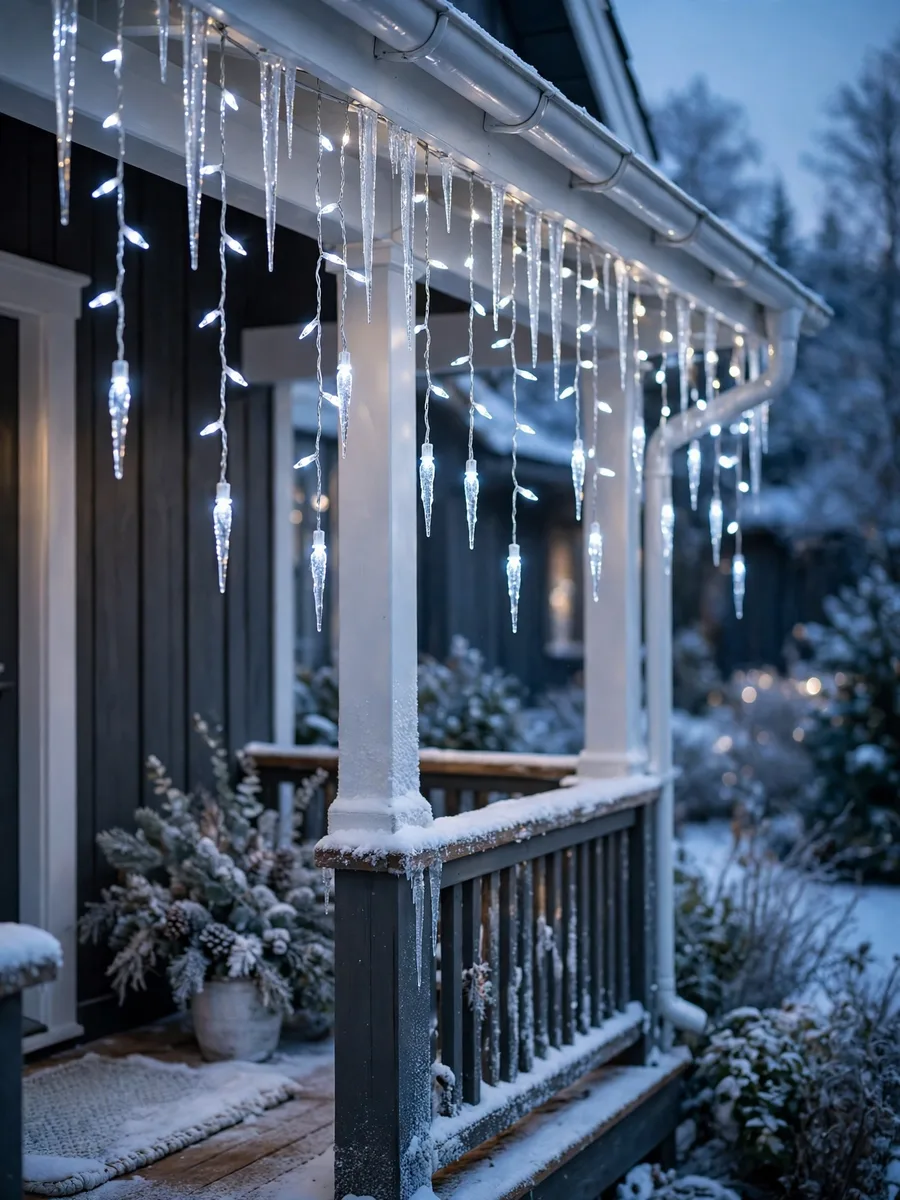
Icicle lights work when they look like a frozen drip edge, and fail when strands bunch, twist, or mix colors. Clip the main wire straight along the gutter every 12 inches so the drops fall freely. Example: a white cottage with one run of warm-white icicle lights along the front gutter, snow dusting the roof above.
Quick tips:
- Clip every 12 inches so the wire stays straight.
- Untangle each strand fully before hanging it.
- Match the icicle temperature to the display.
4. How Do I Light My Front Door and Porch Garland?
Drape a lit evergreen garland around the door frame, weave warm-white string lights through it, and hang a glowing wreath on the door for a finished entryway.
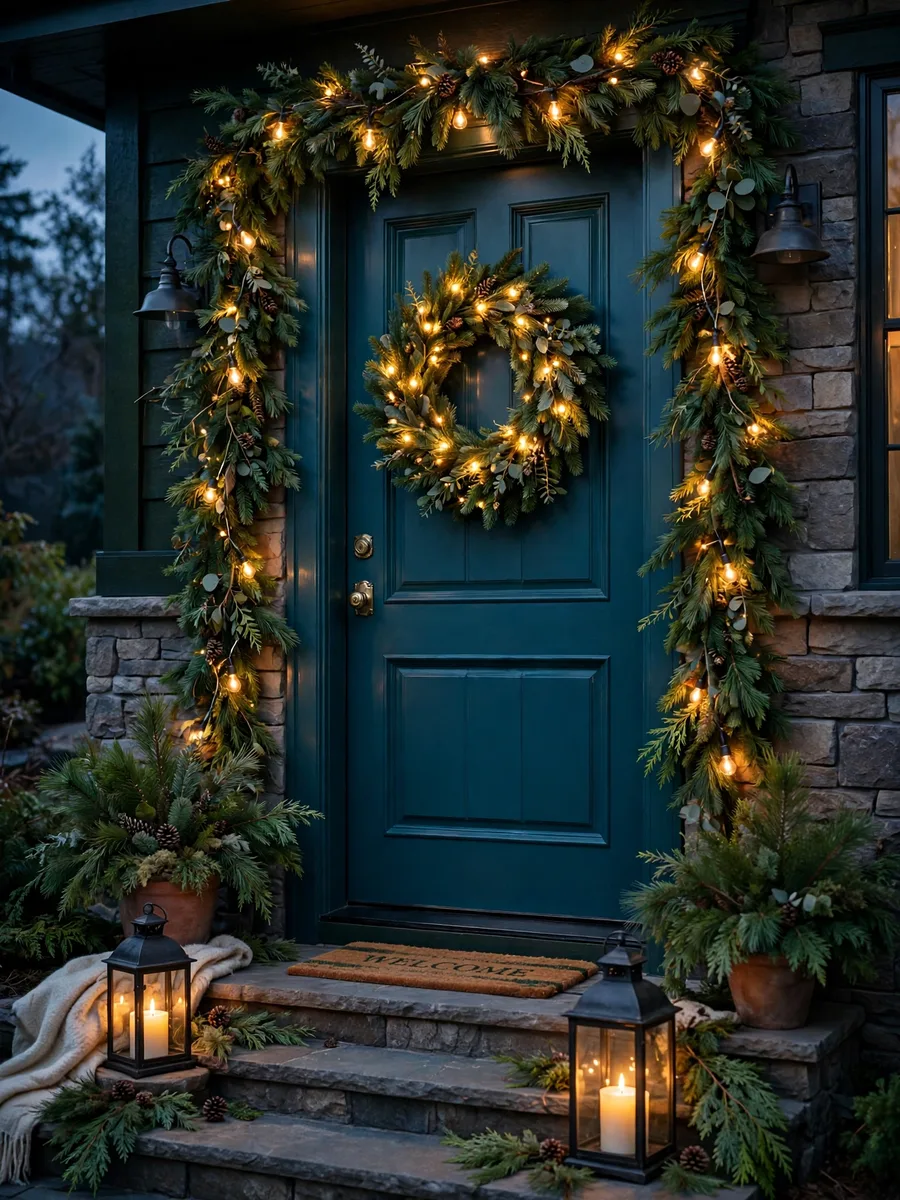
The front door is the closest thing guests see. Weave a warm-white string light through the garland before you hang it, so the bulbs sit inside the branches and the garland glows from within. Add a lit wreath and two lanterns with LED candles on the steps. If you want more ways to style the space around the door, these Christmas entryway decor ideas show how the warm glow carries from the porch into the hall. Example: a deep teal door with a cedar garland across the top, warm lights winking through the needles, and a pinecone wreath glowing at eye level.
Quick tips:
- Weave lights through the garland before you hang it.
- Use battery lights in the wreath.
- Keep door lights warm white to match.
5. How Should I Light a Walkway or Garden Path?
Line the walkway with warm-white path stake lights spaced about 24 inches apart, plus a few luminarias, so guests can see every step and the path glows like a guide to the door.
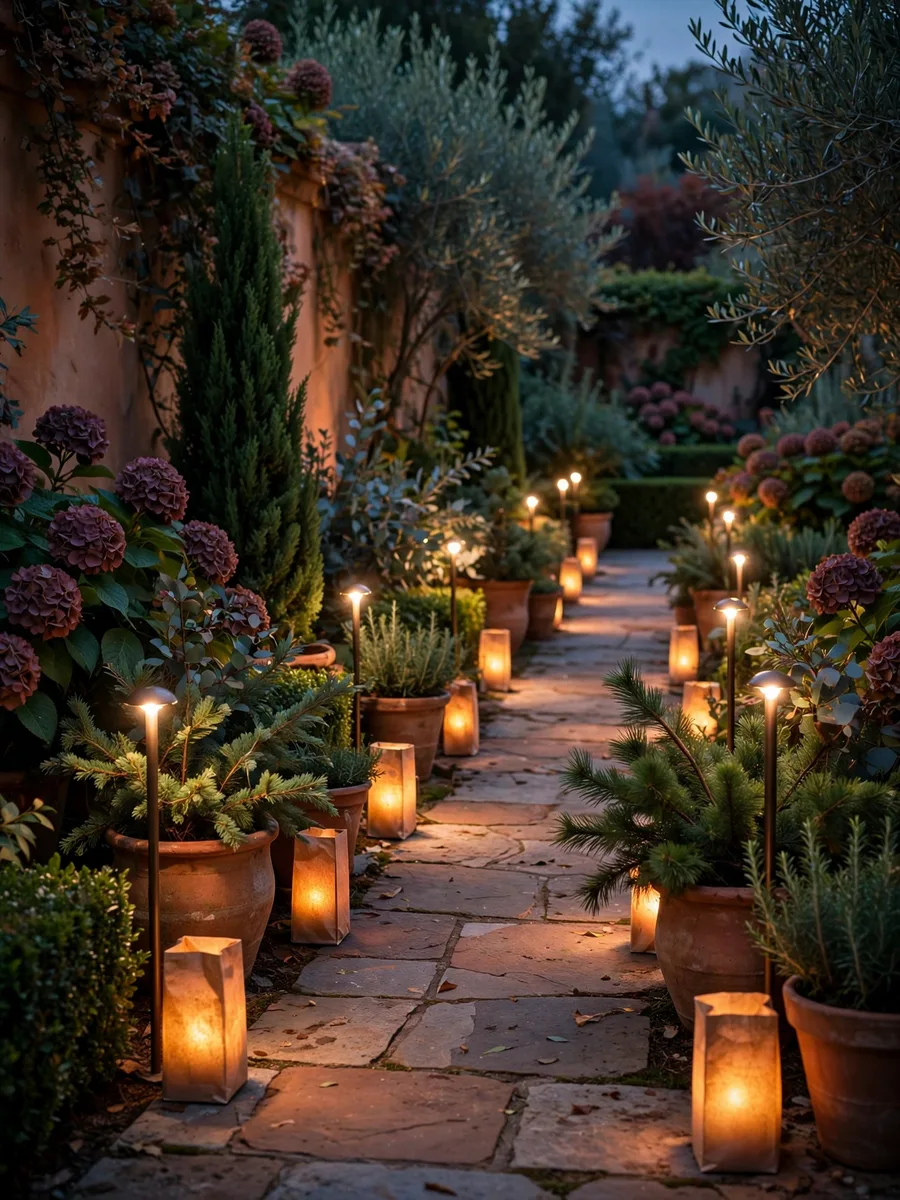
A lit path keeps guests safe on dark winter evenings and pulls the eye from the street to your front door. Stake lights push into the soil in seconds, so space them evenly on both sides, or alternate sides on a narrow path. Luminarias add a handmade touch: a paper bag weighted with sand and lit by a battery tea light glows softly on steps and walks. Example: a curved stone path with eight warm-white stake lights alternating sides, three paper luminarias by the bottom step, and a terracotta pot of evergreens with fairy lights at the bend.
Quick tips:
- Space stakes evenly for one continuous line.
- Use solar stakes only in real daylight.
- Bring paper luminarias inside on wet nights.
6. What Is the Easiest Way to Light Bushes and Hedges?
Drape warm-white net lights over shrubs and hedges, clipping the corners so the net sits flat, for an even glow that takes minutes instead of hours.
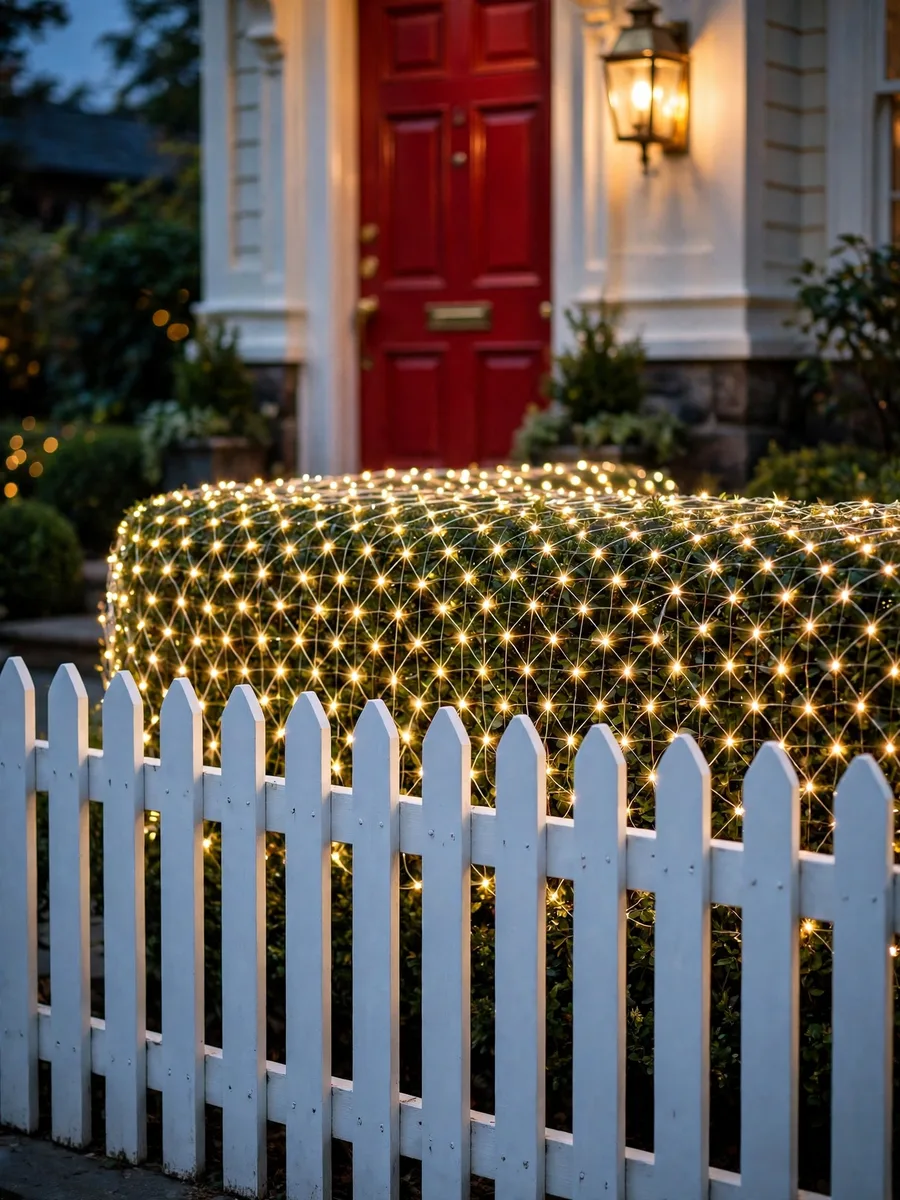
Net lights are the fastest win in outdoor decorating. A single net, usually about 4 by 6 feet, drops over a shrub and covers it with an even grid of light. For larger hedges, use two or three nets side by side, overlapping the edges slightly so there is no dark gap. Example: two boxwoods flanking a white picket fence, one warm-white net over each shrub, clipped at the corners, with the same lights along the fence top rail.
Quick tips:
- Measure the shrub so the net covers it fully.
- Overlap net edges to avoid dark gaps.
- Store nets flat so they do not tangle.
7. How Do I Make Windows Glow From the Inside?
Hang a warm-white fairy light strand just inside the window frame, behind sheer curtains, so the whole window glows like candlelight while the lights stay dry.
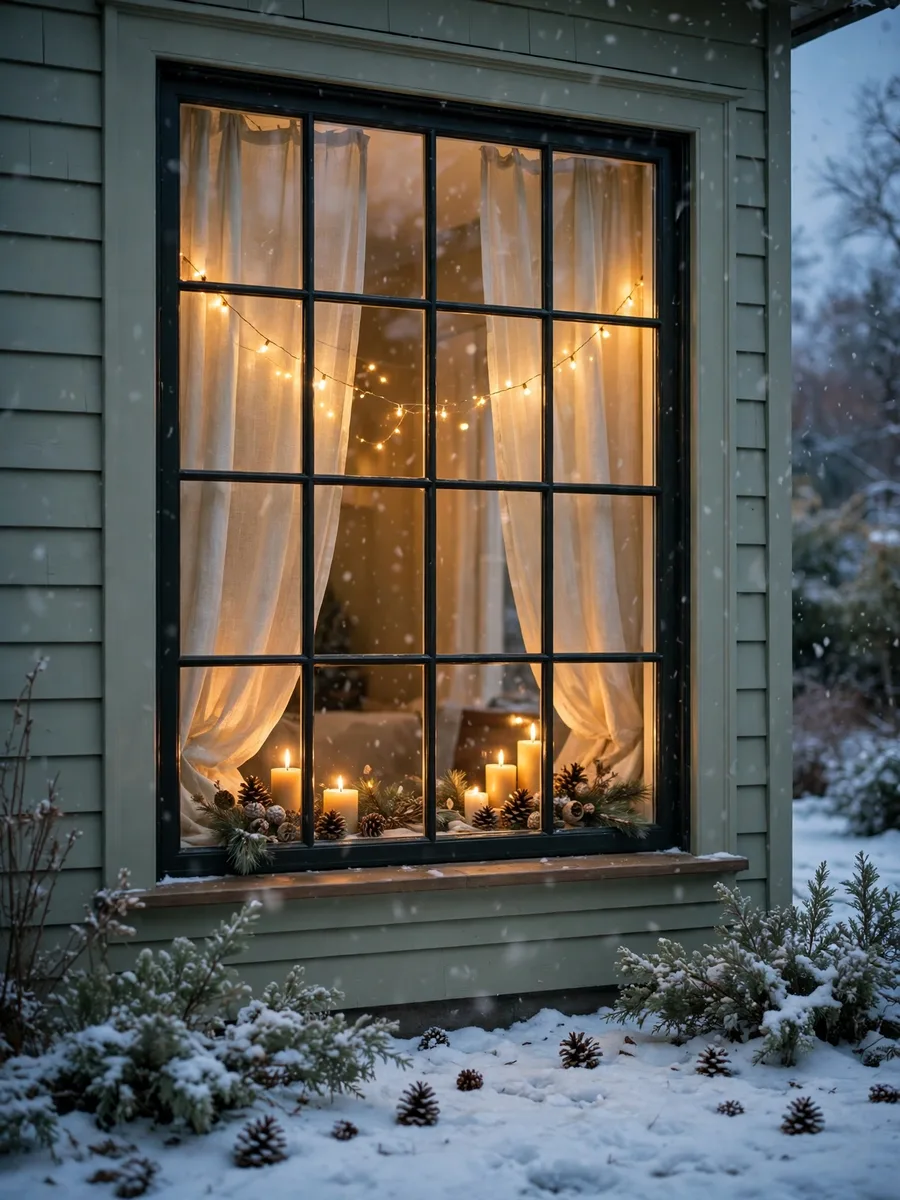
This is one of the simplest ideas, and one of the most charming. A strand hung just inside the glass turns the window into a lantern: the light diffuses through the curtain, the glass protects the strand from rain and wind, and the effect reads beautifully from the street. Use suction-cup hooks or a tension rod, and keep the strand close to the glass. Example: a living room window at dusk, a warm strand behind sheer linen curtains, two LED candles on the sill, and a sprig of pine beside them.
Quick tips:
- Hang the strand inside the glass.
- Use sheer curtains to soften the glow.
- Choose battery lights to hide the cords.
8. When Should I Choose Multicolor Lights Instead of Warm White?
Choose multicolor lights for a playful, family-focused display, keeping them in one zone such as the yard trees, while the roofline and porch stay warm white.
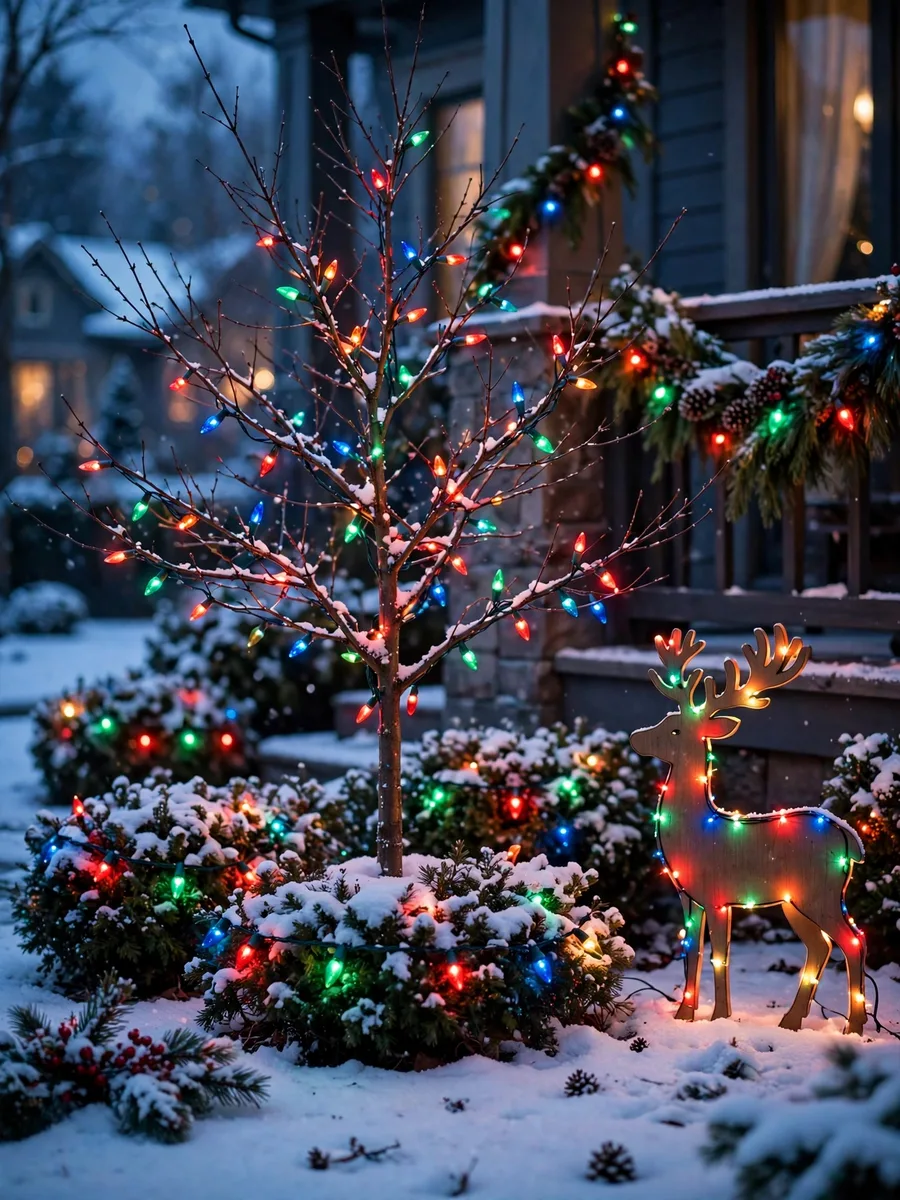
Multicolor lights bring energy and nostalgia, and suit homes where kids are the audience or the whole street goes bold. The mistake is mixing them everywhere: roofline, trees, and porch all in multicolor at once looks chaotic, so give color one clear job. Example: a snowy yard where the house glows warm white, the small maple wears red, green, and blue bulbs, and a wooden reindeer in the same colors stands beside it.
Quick tips:
- Give multicolor lights one zone only.
- Match the color set to one bulb style.
- Use a timer so the display switches off on time.
9. How Can I Turn a Pergola or Patio Into a Winter Gathering Spot?
Drape warm-white festoon string lights across a pergola or patio in gentle swags, add a fire pit or outdoor heater below, and the space becomes a usable winter room.
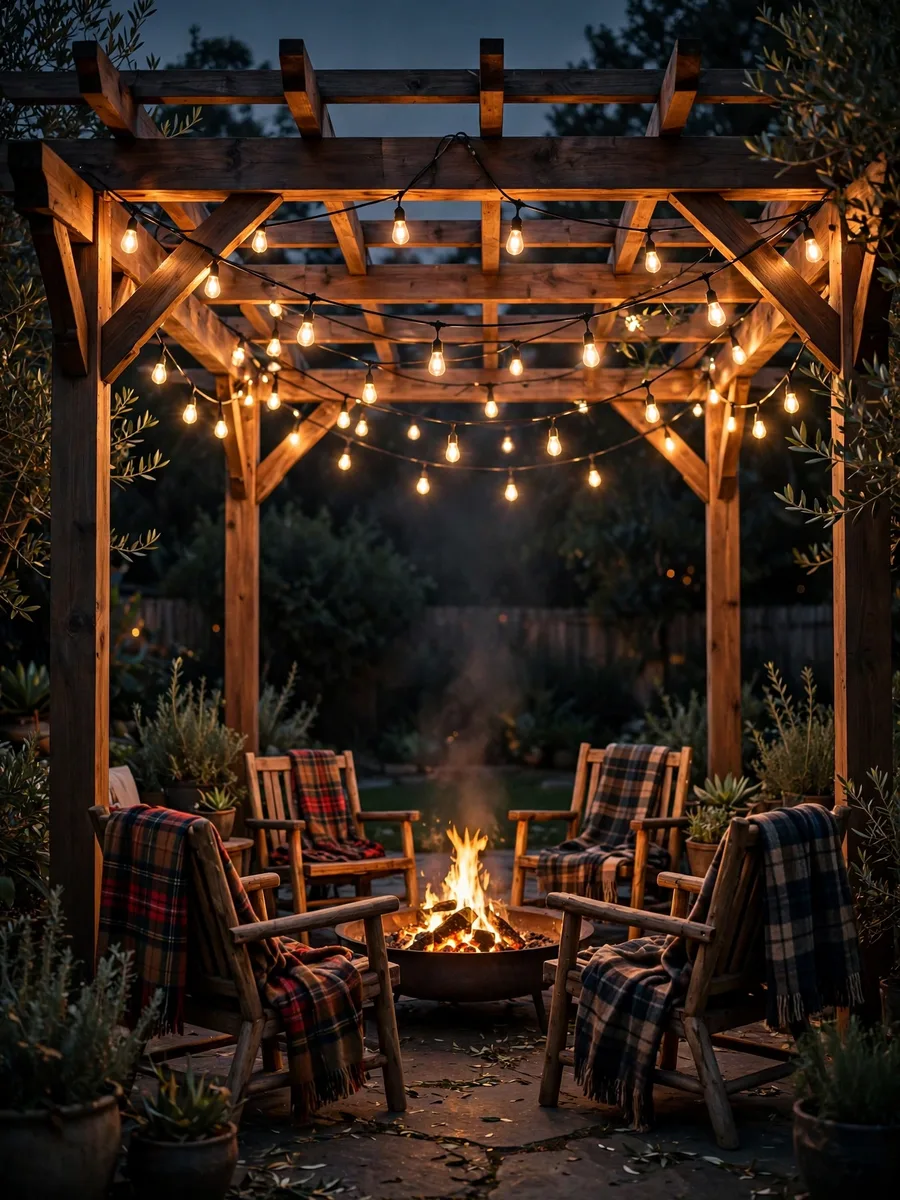
Festoon lights, the larger globe bulbs on a heavy outdoor cable, are made for this job. Hang them in swags across the pergola beams, letting each run dip about 12 inches in the middle, and the patio reads as a ceiling of light. Below, add a fire pit or patio heater, plaid blankets on the chairs, and a lantern or two on the table. Example: a wooden pergola over a stone patio, three swags of warm-white festoon bulbs overhead, a low fire pit glowing in the center, and two chairs with red plaid throws.
Quick tips:
- Let each run dip gently; a taut line looks stiff.
- Use outdoor-rated cable and a GFCI outlet.
- Add blankets and heat so guests stay outside.
10. What Are Curtain Lights, and Where Do They Work Best?
Hang LED curtain lights, a single top wire with many vertical drops, across a tall window, porch wall, or fence for a full sheet of light that fills a surface in one step.
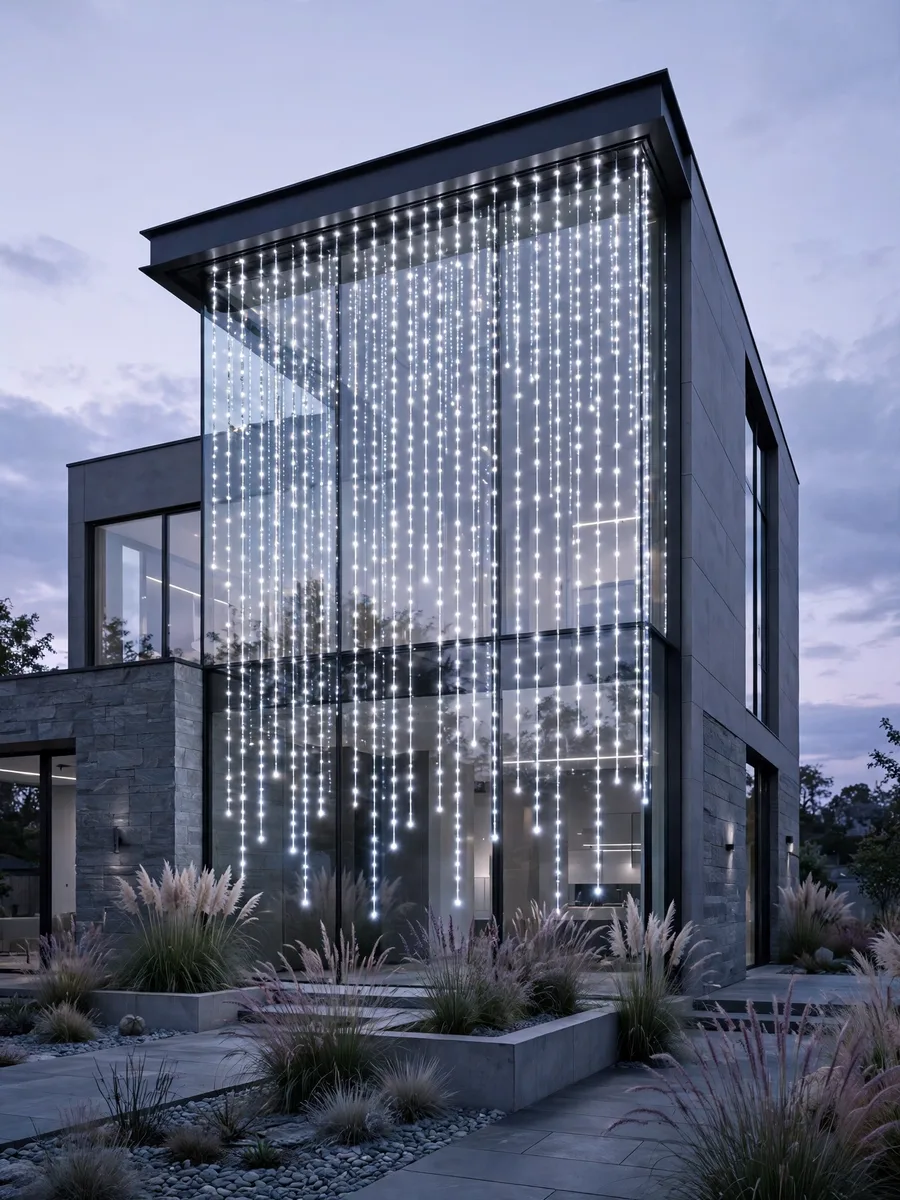
Curtain lights are the fastest way to fill a large, flat surface: the main wire runs across the top, and dozens of short drops hang down like a glowing veil. They suit tall windows, porch walls, fence panels, or garage fronts, anywhere a single strand would look lost. Measure the width and drop length before you buy, because sets come in fixed sizes and a short set leaves an awkward gap. Example: a modern house with a tall glass window wall, a 10-foot-wide warm-white curtain set clipped along the top, drops falling evenly to the sill.
Quick tips:
- Measure width and drop length first.
- Clip the top wire straight.
- Use curtain lights on one surface only.
11. How Do I Light Driveways, Steps, and Stairs Safely?
Outline driveways and steps with rope lights or light stakes, keeping every run visible and low to the ground, so drivers and guests can see edges clearly after dark.
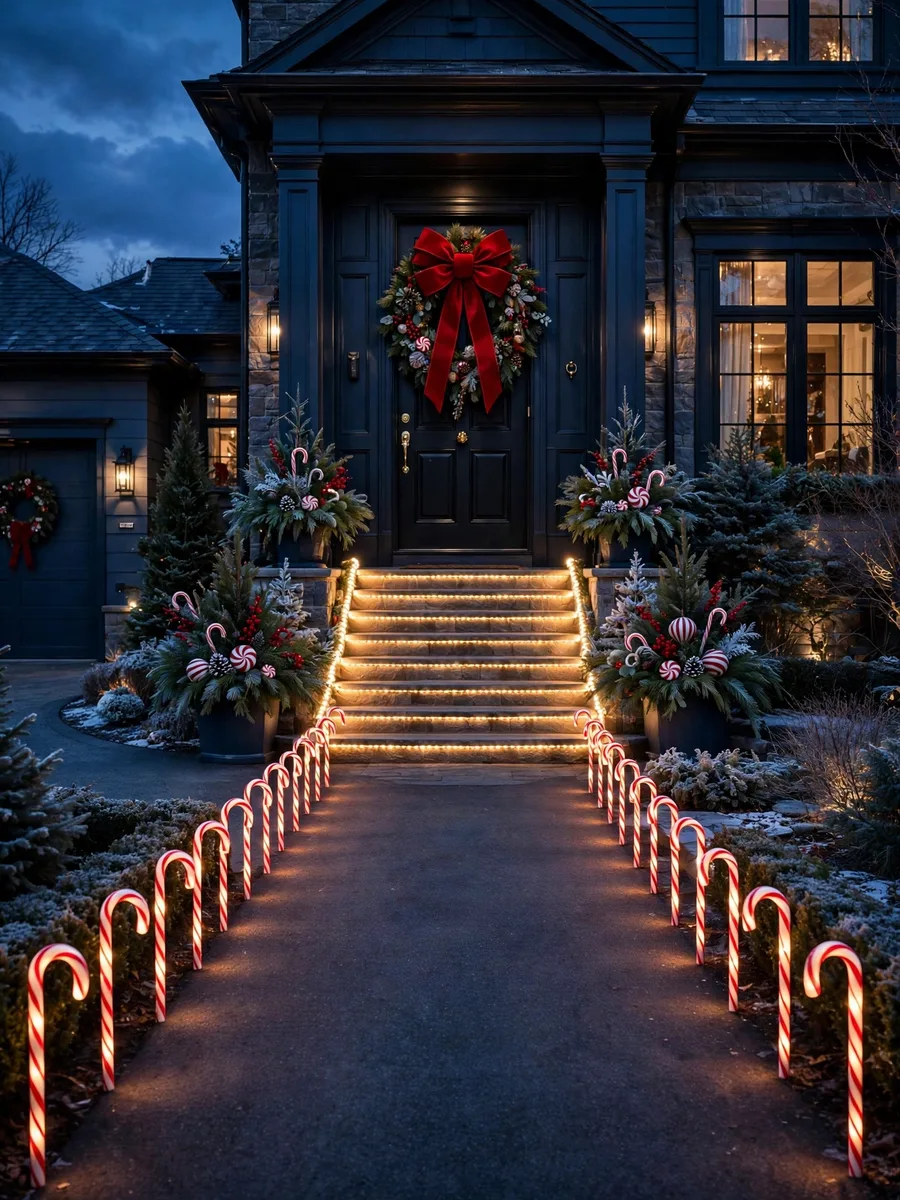
Steps and driveways are where lighting becomes safety. Rope lights work well along step edges because they sit flat, bend around corners, and mark exactly where each step begins. Light stakes suit driveway edges, marking the boundary without blocking cars. Example: a short driveway and three front steps, red-and-white stakes every three feet along the driveway edge, a warm-white rope light on each step edge, and a red-bow wreath on the door above.
Quick tips:
- Mark every step edge.
- Keep stakes clear of tires and snow shovels.
- Run step lights on the same timer.
12. Are Smart Outdoor Christmas Lights Worth It?
Smart outdoor Christmas lights are worth it if you want app control, timers, and color changes, because one set can switch from warm white to multicolor without rehanging anything.
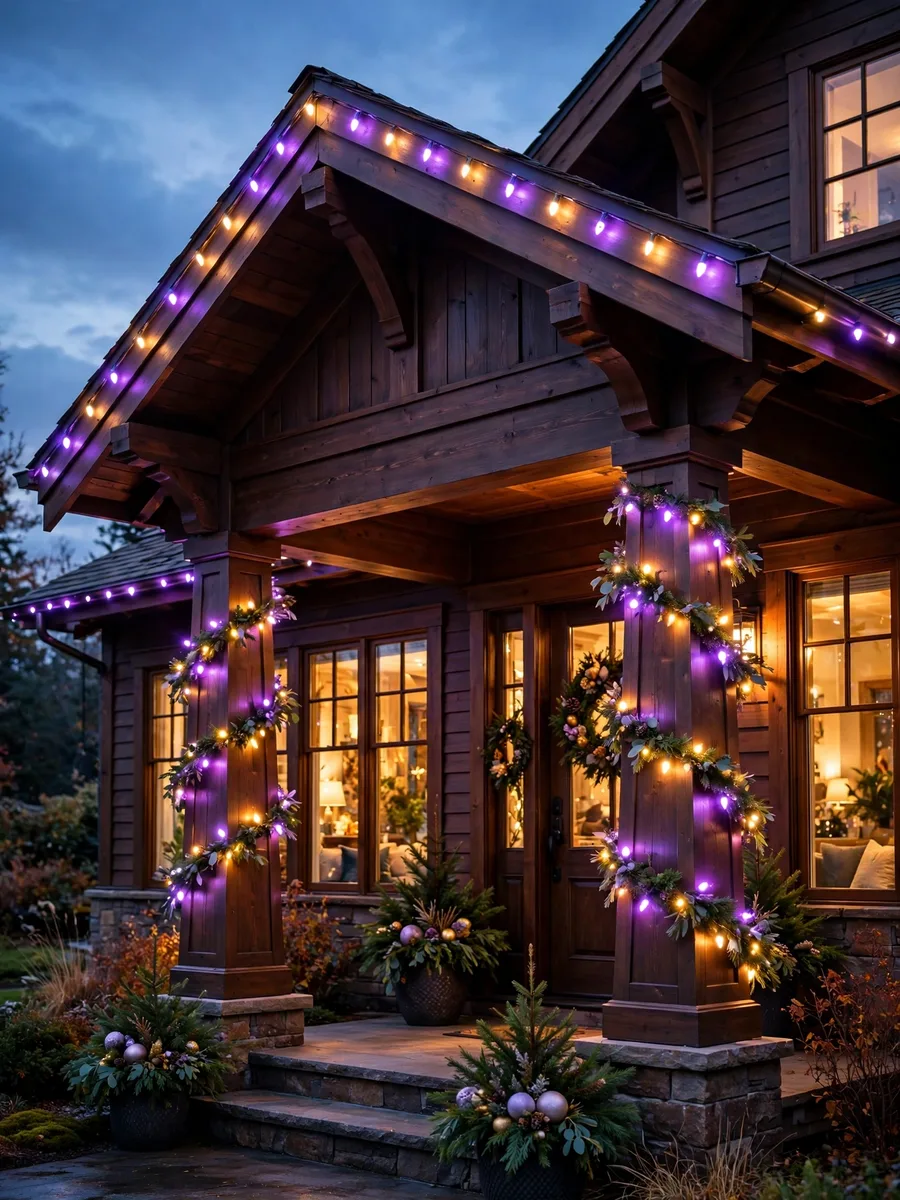
Smart lights cost more than basic strands, but they replace several sets at once. Each bulb can show its own color, so you can run warm white 2700K on quiet evenings, switch to red and green for a party, and dim everything from the sofa. Most sets also include schedules, so the lights come on at dusk and switch off at 11 p.m. without a separate timer. Before you buy, check Wi-Fi reach at the far end of the yard and whether the set is rated for outdoor use. Example: a craftsman house with smart lights on the roofline and porch columns, warm gold on weeknights, soft purple and gold for a gathering, all changed from a phone app.
Quick tips:
- Test Wi-Fi at the farthest light first.
- Start with one zone and expand later.
- Keep a simple timer as backup.
How to Plan, Power, and Time Your Whole Display
Plan before you buy a single strand. Sketch the front of the house, mark each zone, and measure every run, then buy 10 to 20 percent extra, because corners and peaks always add up. Use only outdoor-rated extension cords and lights, plug everything into GFCI-protected outlets, and never connect more strands end to end than the manufacturer allows. The U.S. Consumer Product Safety Commission links overloaded circuits to holiday-season electrical fires, so keep connections off the ground and out of puddles.
The real secret is the way the zones work together: the roofline gives the house its shape, the tree gives the yard its height, the garland gives the door its warmth, the path lights give guests their way in, and the timer gives you your evenings back. When all five run on the same warm-white 2700K temperature and dusk-to-11 schedule, the home looks planned, not thrown together on Christmas Eve. Install in early to mid-November on a dry, mild day, and take the lights down by mid to late January, coiling each strand loosely into labeled bins.
Frequently Asked Questions
How early should I put up outdoor Christmas lights?
Most people hang outdoor Christmas lights between late October and mid-November. Early to mid-November is the sweet spot: temperatures are milder, days are longer, and you are not rushing on a ladder in the cold.
How many lights do I need for my house?
Plan on 100 mini lights per 10 feet of roofline, 100 to 200 per shrub, and 300 to 400 for a wrapped 8-foot tree. Measure first, then buy 10 to 20 percent more.
What Kelvin is warm white for outdoor Christmas lights?
Warm white for outdoor Christmas lights is 2700K, a soft gold like lamplight. 3000K is a touch brighter and still warm. Anything 4000K or above is cool white.
Can I leave Christmas lights up all year?
It is not recommended. Sunlight, rain, and temperature swings shorten the life of the strands and fade the wire. Take lights down by mid to late January and store them in labeled bins.
How do I hang outdoor Christmas lights safely?
Use only outdoor-rated lights, secure them with plastic clips instead of nails or staples, and plug them into a GFCI-protected outlet. Never connect more strands than the manufacturer allows.
Are LED Christmas lights better than incandescent lights outdoors?
Yes. LEDs use up to 80 percent less energy than incandescent bulbs, last much longer, and stay cool to the touch.
Conclusion
The best Christmas outdoor lights ideas share one formula: warm-white 2700K LEDs, layered across the roofline, trees, porch, and path, all on one timer. Start with the roofline, add one wrapped tree and a lit garland, and light the path. Install in early to mid-November and let the whole house glow on the same soft gold all season.