19 Beautiful Winter Door Decor Ideas That Welcome Guests All Season Long
The best winter door decor ideas use plain evergreen, warm light, and natural texture so your entrance looks welcoming from the first cold snap right through January and February, long after the holiday decorations come down. A cedar wreath, a pair of lanterns, and a layered doormat can carry a front door for the whole season without a single ornament or red bow.
That long season is exactly why winter doors deserve their own plan. December gets all the attention, but the door keeps greeting guests for another eight to ten weeks. The ideas below are built for that stretch, using materials that survive frost, wind, and damp, and most of them take an afternoon or less to put together.
Think of your door in three layers, because that is how the most polished winter entries are built, and it is also the easiest way to avoid the bare-slab look that makes a house feel unfinished in the cold months. The first layer sits on the door itself, usually a wreath or a swag that gives the eye one clear focal point and sets the colour story for everything else. The second layer frames the door with garland, lights, or planters, and the third layer sits at your feet, where lanterns, a layered mat, or birch logs ground the arrangement. When those three layers share two or three colours and one kind of texture, even a small stoop looks considered, and evergreen, metal, stone, and wood keep the look right into February. If the door is the first thing guests see when they arrive for a seasonal gathering, the same three-layer thinking carries straight into the rest of the evening, which is why so many hosts plan the entrance alongside their Christmas party decor ideas and then simply strip the holiday pieces away in January while the evergreen base stays put.
Key Takeaways: Winter Door Decor in Short
Q: What makes winter door decor different from Christmas door decor? A: Winter decor uses plain evergreen, neutral ribbon, and warm light with no ornaments, glitter, or holiday signs, so it still looks intentional in January and February.
Q: How long will a winter wreath last outside? A: A good faux cedar or eucalyptus wreath lasts the whole season, while fresh cut evergreen holds its colour for about four to six weeks.
Q: What is the one rule that keeps a winter door from looking cheap? A: Keep the light warm, between 2700K and 3000K, and keep the palette to two or three colours.
1. How Do I Style a Cedar and Eucalyptus Wreath So It Lasts Past Christmas?
Choose a full faux cedar wreath mixed with seeded eucalyptus, hang it on a flat over-the-door hanger, and finish it with one loose knot of oatmeal linen ribbon.
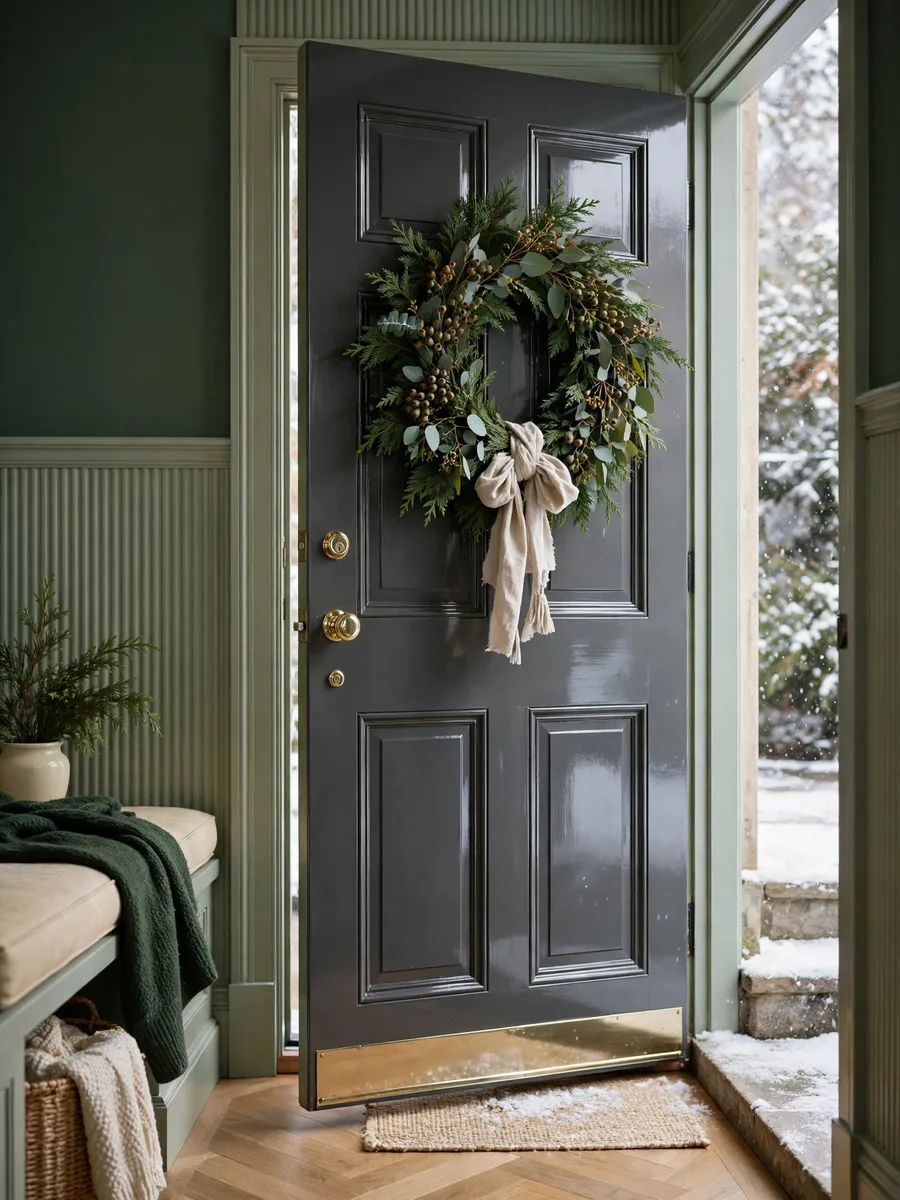
Cedar is the workhorse of the winter door because its flat, layered sprays read as winter rather than as December, while seeded eucalyptus adds silvery beads that catch the light. For a concrete example, picture a charcoal door with a cedar and eucalyptus wreath, the linen tails moving in the wind, and a bucket of birch logs at the foot of the door.
Quick tips:
- Hang the wreath about 14 inches from the top of the door.
- Fluff the branches so natural gaps show.
2. Can an Oversized Wreath Work on a Standard Front Door?
Yes, if the wreath is about two-thirds of the door width and hung a few inches off centre toward the handle side, where it balances the hardware.
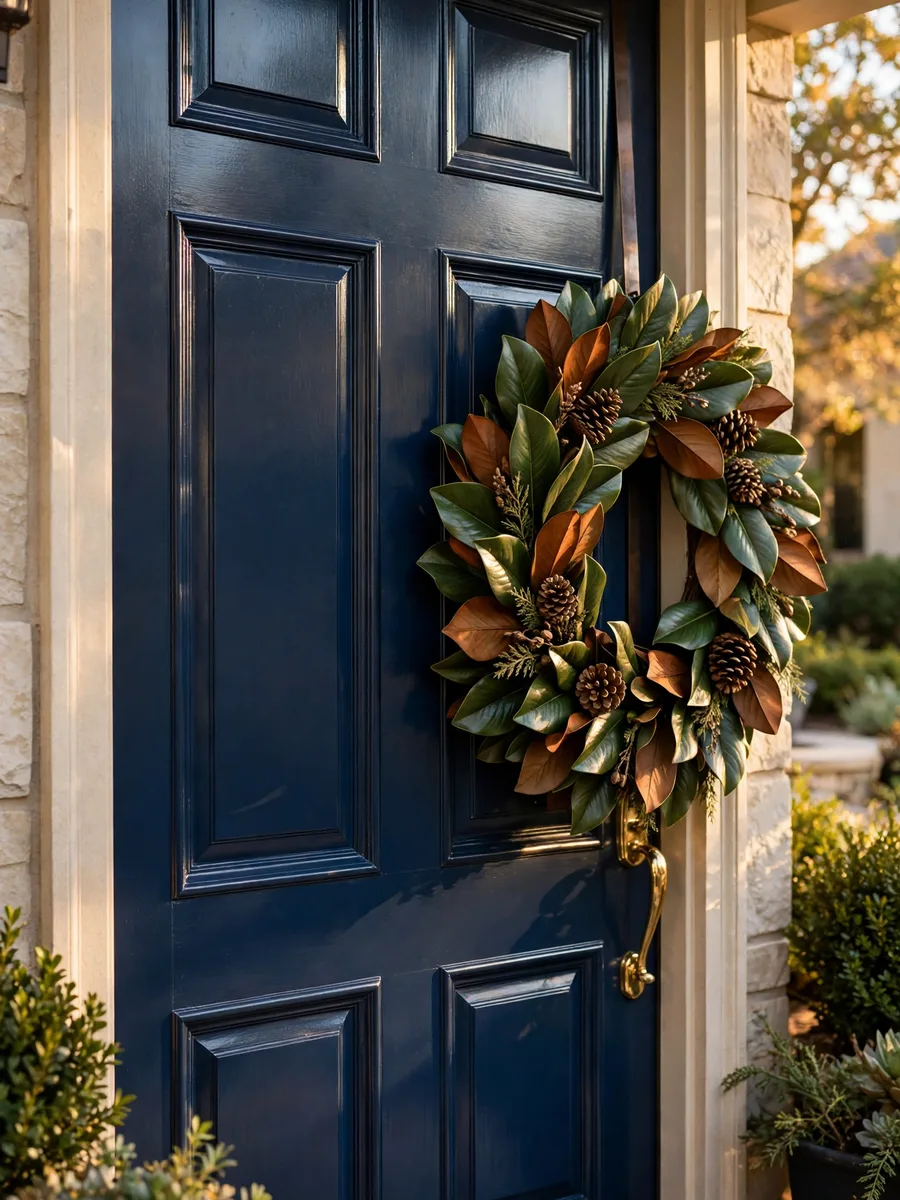
Most wreaths are too small for their doors: a thin 18-inch ring on a 36-inch door looks apologetic from the pavement, while a 28-inch wreath makes the whole entrance feel generous. For a concrete example, imagine a deep navy door with a magnolia wreath the size of a serving tray, its bronze undersides catching the afternoon sun.
Quick tips:
- Measure the door first and aim for two-thirds of its width.
- Use a ribbon loop or two wide-set hooks for a heavy wreath.
3. How Do Matte Black Lanterns Make a Dark Winter Entry Feel Warm?
Place one tall lantern on each side of the door, or a tall and a short one together, filled with flameless LED pillar candles on a six-hour dusk timer.
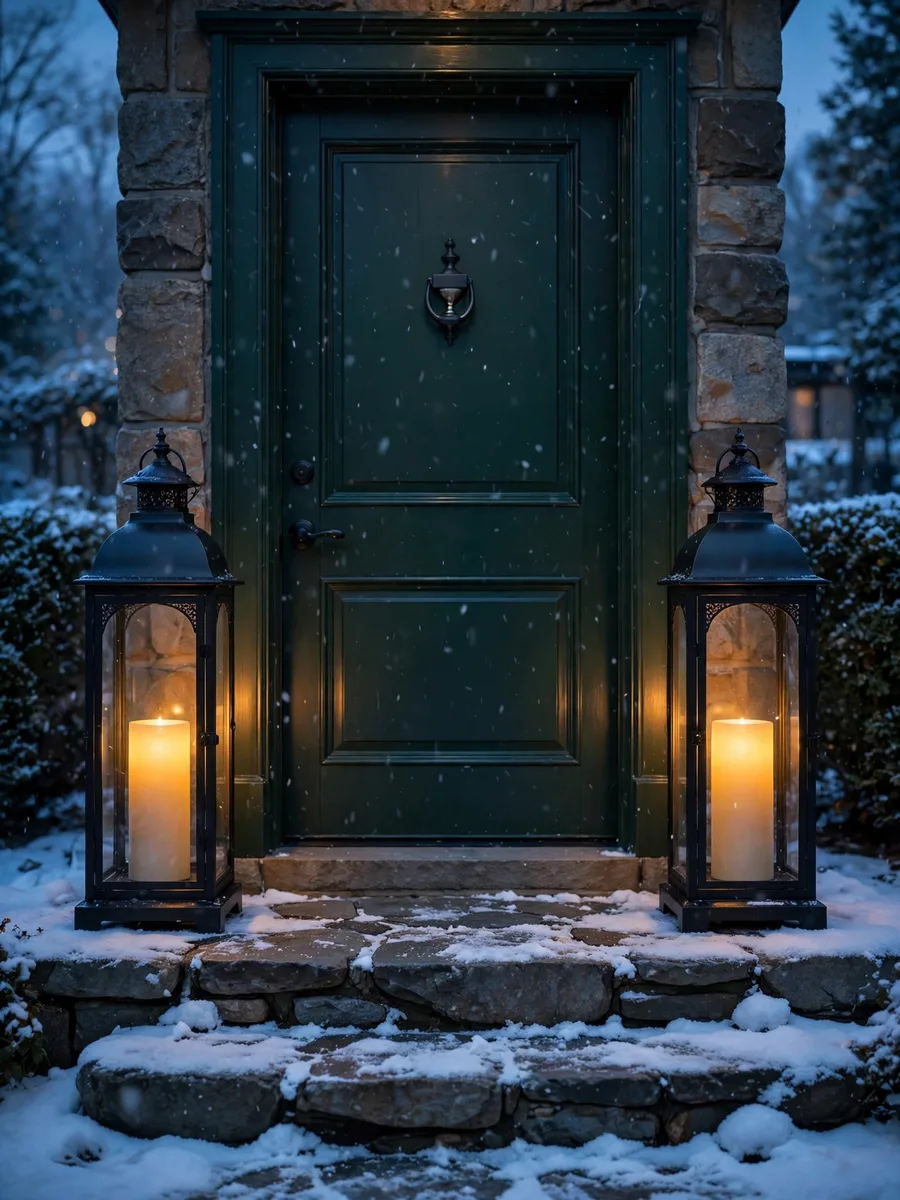
Winter afternoons go dark early, and a bare stoop can feel dreary by half past four. Matte black lanterns fix that without any wiring, because the dark metal frames the glow instead of competing with it. For a concrete example, picture two black lanterns on stone steps beside a dark green door, their warm light pooling on the frost.
Quick tips:
- Choose lanterns between 10 and 18 inches tall for a standard door.
- Match the candle colour temperature to the porch light.
4. What Is the Easiest Way to Layer Doormats for Winter?
Lay a larger washable rug flat first, then centre a smaller coir doormat on top of it, so the rug frames the mat and the mat does the scraping.
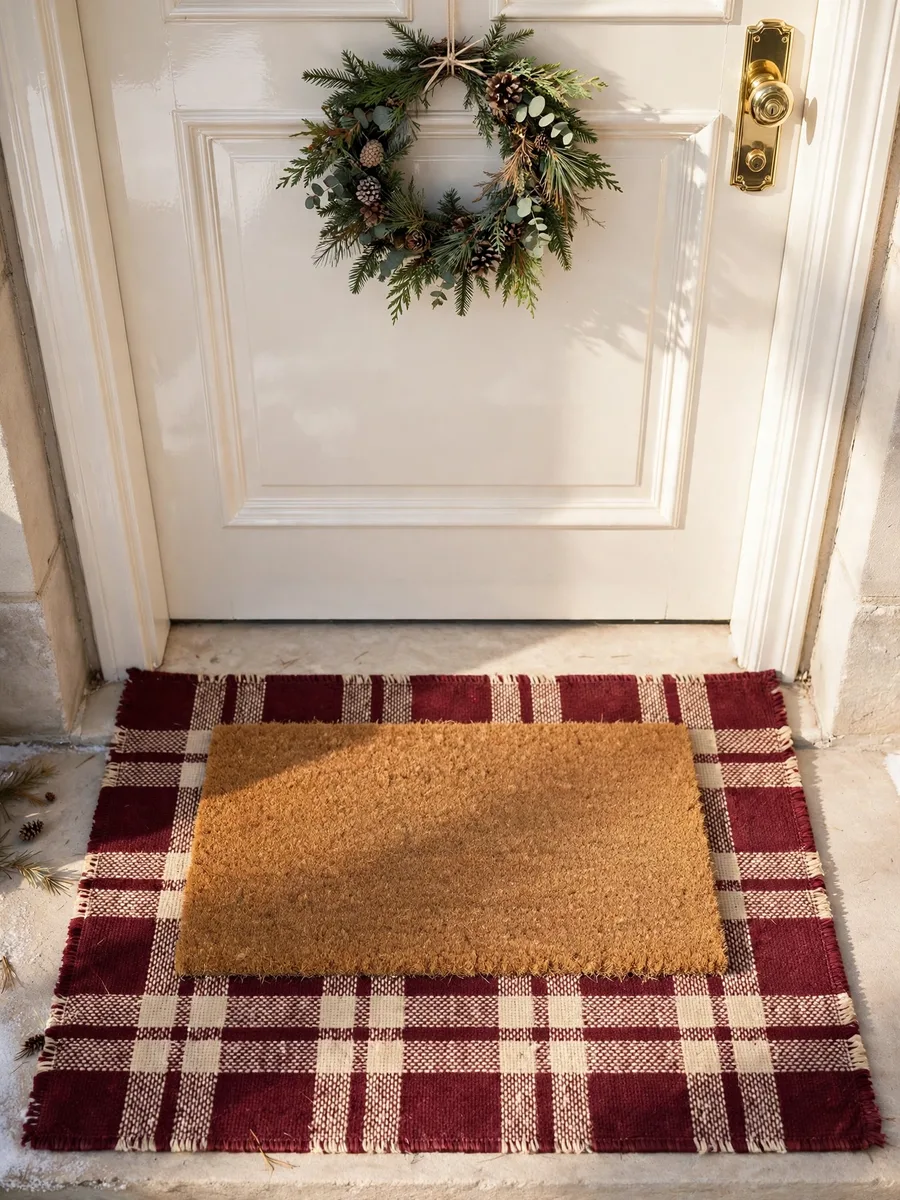
A standard 18-by-30-inch coir mat looks tiny on its own against a 36-inch door. Layering solves it: a 24-by-36-inch washable rug in a striped or plaid pattern goes down first, and the coir mat sits on top, overlapping the rug on all sides. For a concrete example, imagine a white door with a burgundy plaid rug and a natural coir mat, a cedar wreath above, and wet footprints stopping neatly at the mat.
Quick tips:
- Pick a rug at least six inches wider than the mat on each side.
- Choose a washable outdoor rug so winter slush rinses off.
5. How Do I Frame a Door With Garland Without Nails?
Drape a cedar garland in a shallow U down one side, over the top, and down the other side to handle height, held with clear adhesive outdoor clips.
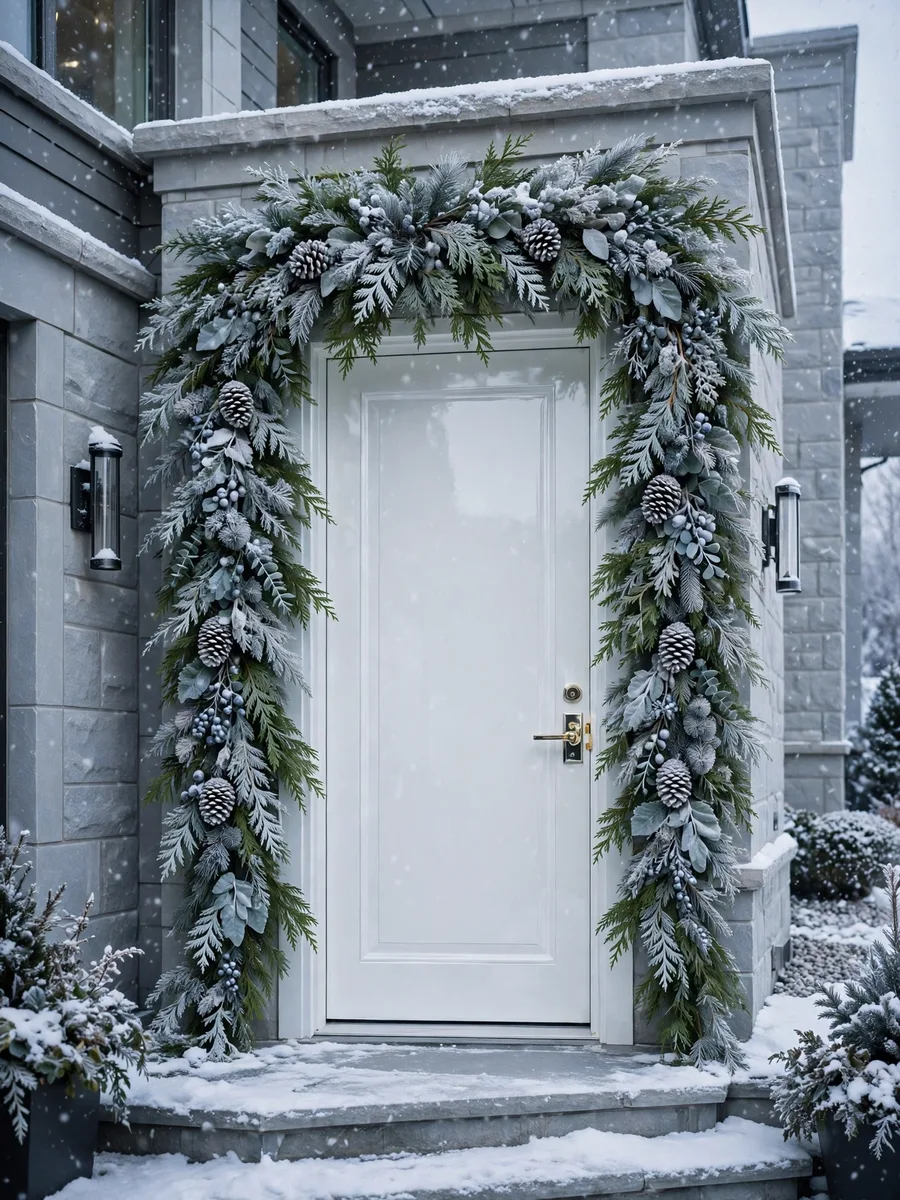
Garland that follows the frame rather than crossing the door makes the entrance feel taller, and it leaves the wreath free to be the focal point. For a concrete example, picture a white front door with a frosted cedar garland tracing the frame and a plain linen wreath in the middle, with not a single hole drilled.
Quick tips:
- Test one adhesive clip on the trim before hanging the full garland.
- Twist two garland strands together for a fuller look on a wide frame.
6. What Makes a Dried Orange and Pinecone Swag Look Expensive?
Keep it slim and asymmetric, with a cedar base, a few sugar pinecones, and baked orange slices tied with twine, hung off centre on a clear removable hook.
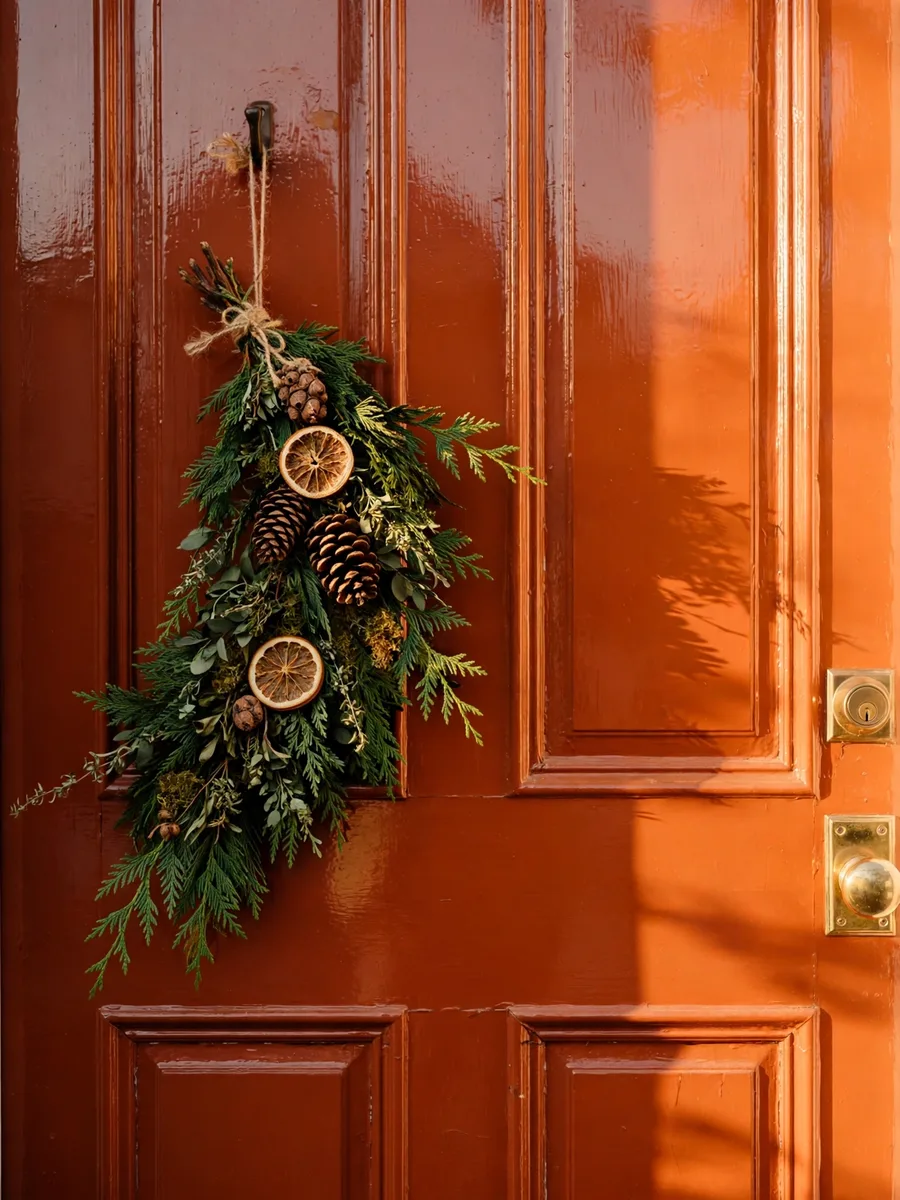
A swag is a hanging bundle of greenery tied at the top and left loose at the bottom, and it suits doors where a round wreath feels too formal. For a concrete example, imagine a terracotta door with a cedar swag of pinecones and dried orange slices hanging beside the peephole, the twine bow small and neat.
Quick tips:
- Bake orange slices low and slow until fully dry.
- Wire the pinecones in rather than gluing them, so they survive wind.
7. How Can Birch Logs Decorate a Door Without Looking Like Firewood?
Stand white birch logs upright in a galvanised bucket, keep the cut ends facing up, and tuck a few evergreen sprigs among them so the arrangement reads as decor, not fuel.
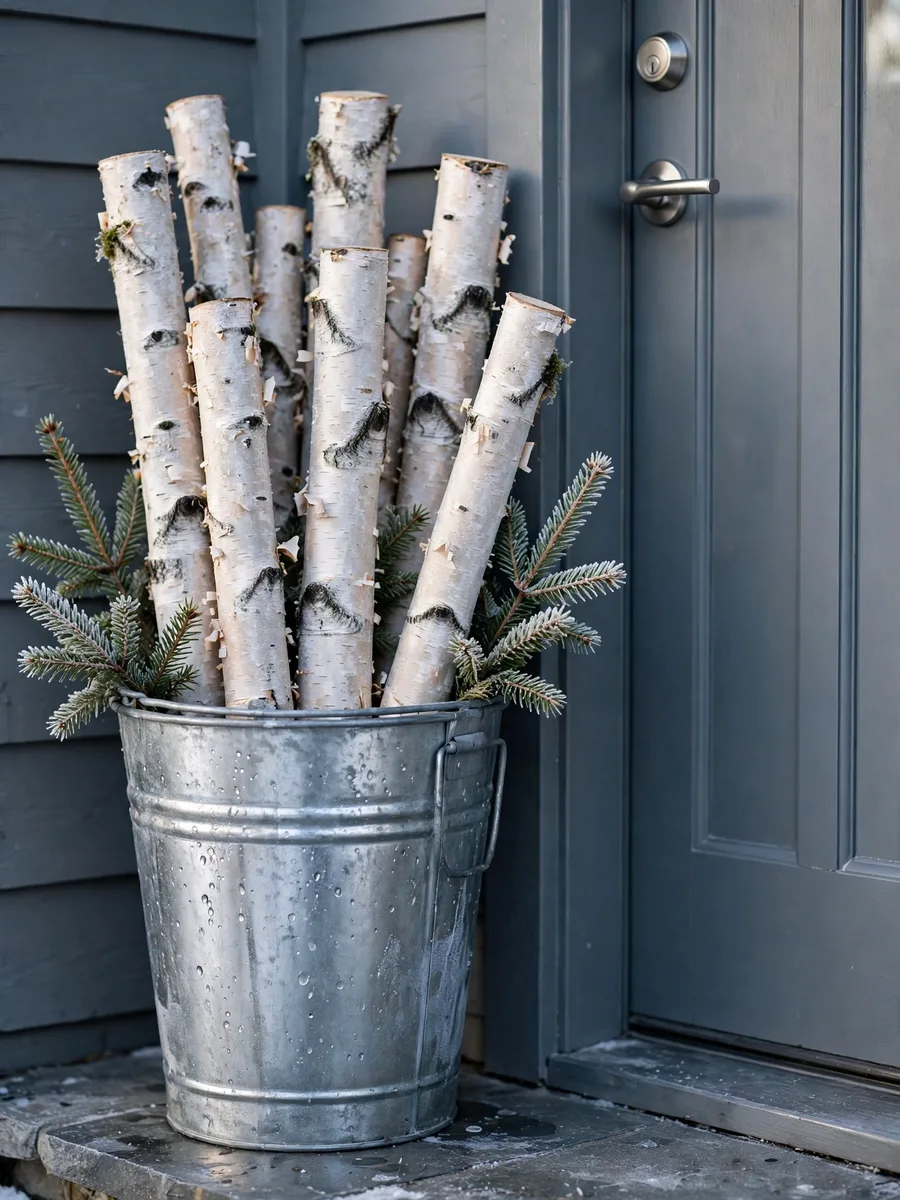
Birch is the easiest winter material to style because the white bark with its dark markings already looks finished. For a concrete example, picture a slate-grey door with a galvanised bucket of white birch logs, three cedar sprigs fanned out from the top, and a dusting of snow on the bark.
Quick tips:
- Choose logs of similar length so the top edge sits level.
- Keep the bucket just out of the main walking path.
8. Which Lights Make a Winter Door Glow Instead of Glare?
Warm white micro lights between 2700K and 3000K, wrapped loosely around the door trim or woven through garland, give a soft lamplight glow that cool blue-white bulbs cannot match.
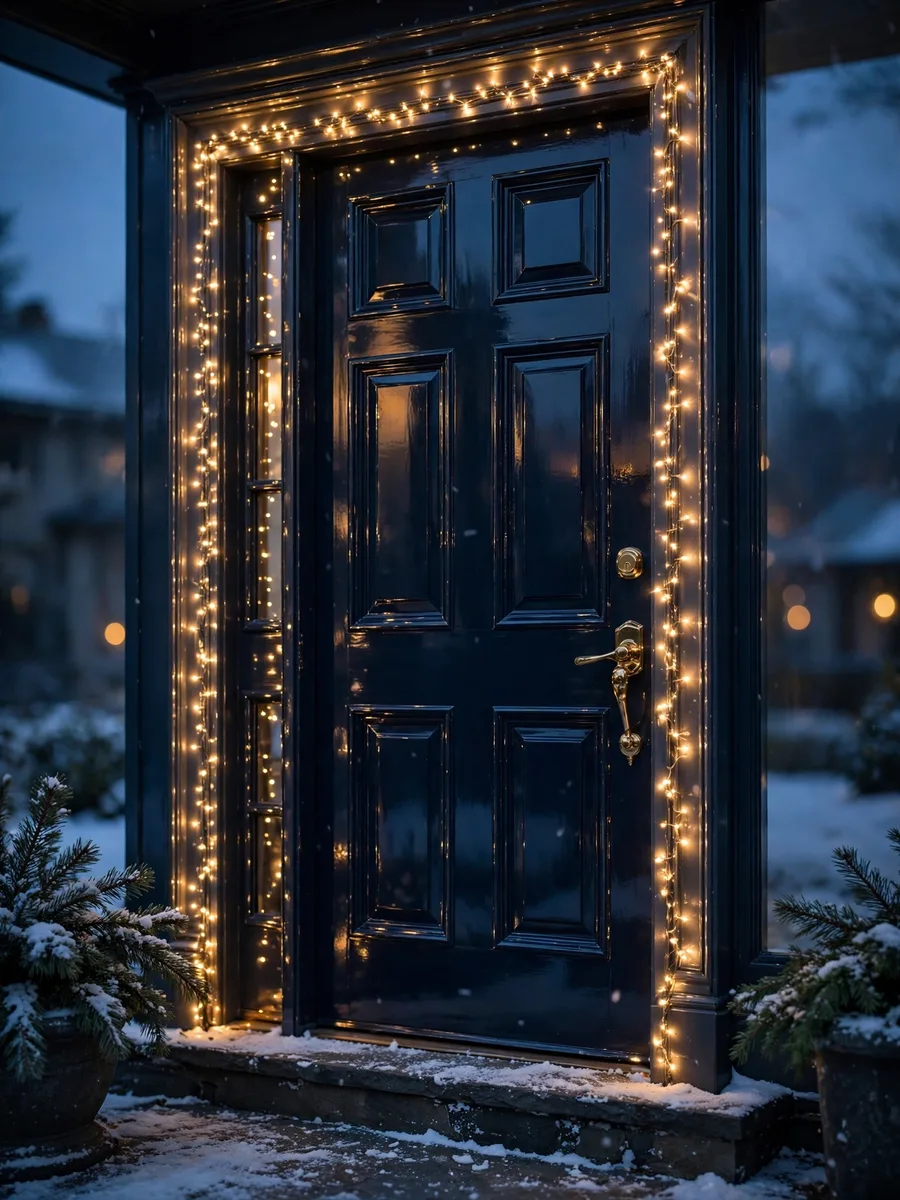
Light colour is the single most common reason a winter porch looks cheap. Cool bulbs above 4000K turn concrete harsh and make greenery look grey, while warm white light mimics indoor lamplight and softens everything it touches. For a concrete example, imagine a midnight-blue door at dusk, its trim traced with warm micro lights, the glow catching the frost on a cedar garland.
The materials around the door matter too, because freezing weather punishes the wrong choices. The table below shows which ones hold up and which ones quietly fail.
| Material | Why it survives winter | Watch out for |
|---|---|---|
| Faux cedar and eucalyptus | Keeps its shape and colour through frost and sleet | Thin single-tone versions look flat up close |
| Fresh cut evergreen | Looks and smells real for four to six weeks | Dries out and browns, so plan a January refresh |
| Metal lanterns | Powder-coated metal shrugs off rain and snow | Uncoated steel can rust at the joints |
| Coir doormats | Stiff fibres scrape off mud and grit | Soak up water, so let them dry between storms |
| Terracotta pots | None, they crack when wet soil freezes | Swap for fibreglass, resin, or wood planters |
| LED micro lights | Run cool and sip power on a timer | Check the outdoor rating before hanging them |
Quick tips:
- Keep every bulb the same colour temperature so the porch does not clash.
- Use a timer so the lights come on at dusk and off before midnight.
9. How Do I Build a Winter Planter That Stays Fresh Until Spring?
Pack a frost-proof stoneware or fibreglass pot with damp soil, then push in cut pine boughs, cedar sprigs, and red winterberry stems.
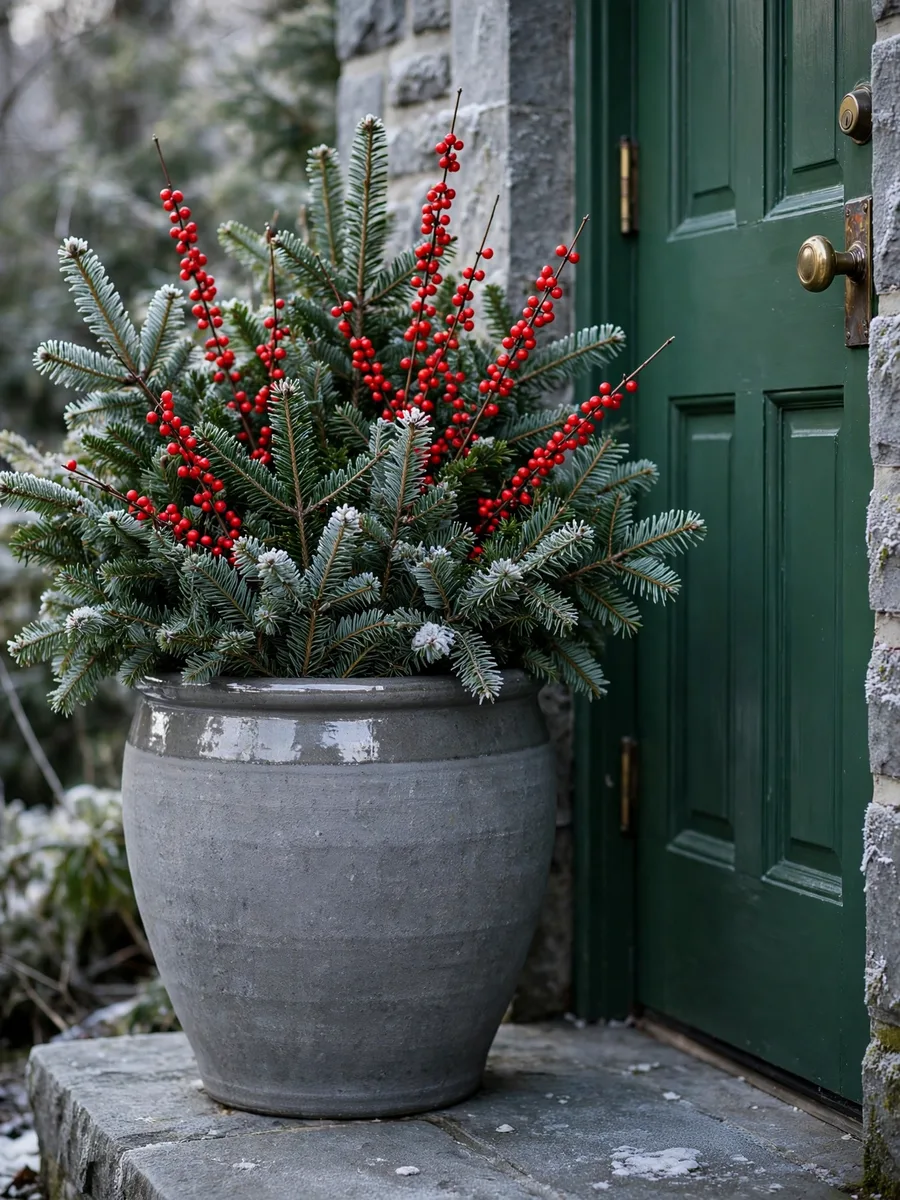
A winter planter works because the soil holds the stems upright and keeps them from drying out as fast as a bare bundle would. Start with the tallest stems at the back, layer cedar in front, and finish with winterberry stems poking through at different heights. For a concrete example, picture a grey stoneware planter beside a forest-green door, its pine boughs dusted with snow and winterberry stems glowing red against the green.
Quick tips:
- Water the soil once before the first hard freeze.
- Cut stems at an angle so they drink better in damp soil.
10. Should Double Doors Get Matching Wreaths?
Yes, hang one wreath on each door leaf, keep them the same size and greenery, and allow one small difference, such as a different ribbon, so the pair looks styled.
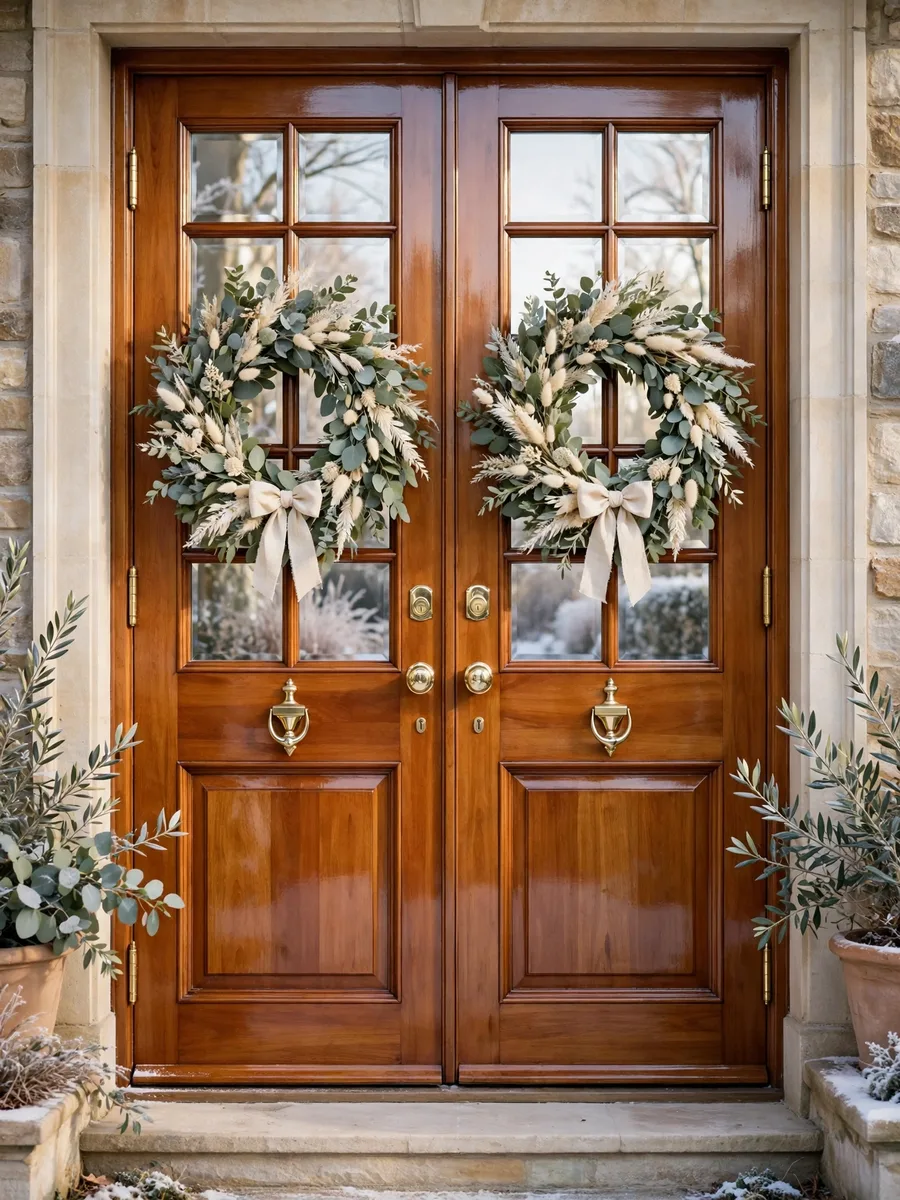
Double doors are wide enough that a single wreath disappears on them, and two wreaths restore the balance. Symmetry is the point here, because the doors themselves are symmetrical, and a matched pair makes the entrance feel formal and calm. For a concrete example, imagine cream double doors with sage and cream eucalyptus wreaths and brass handles between them.
Quick tips:
- Hang both wreaths at exactly the same height.
- Keep the ribbon on each wreath the same colour family.
11. How Do I Get the All-White Winter Door Look Right?
Build the look from texture rather than colour, layering flocked greenery, white lights, and silver accents so the door reads snowy and bright instead of blank.
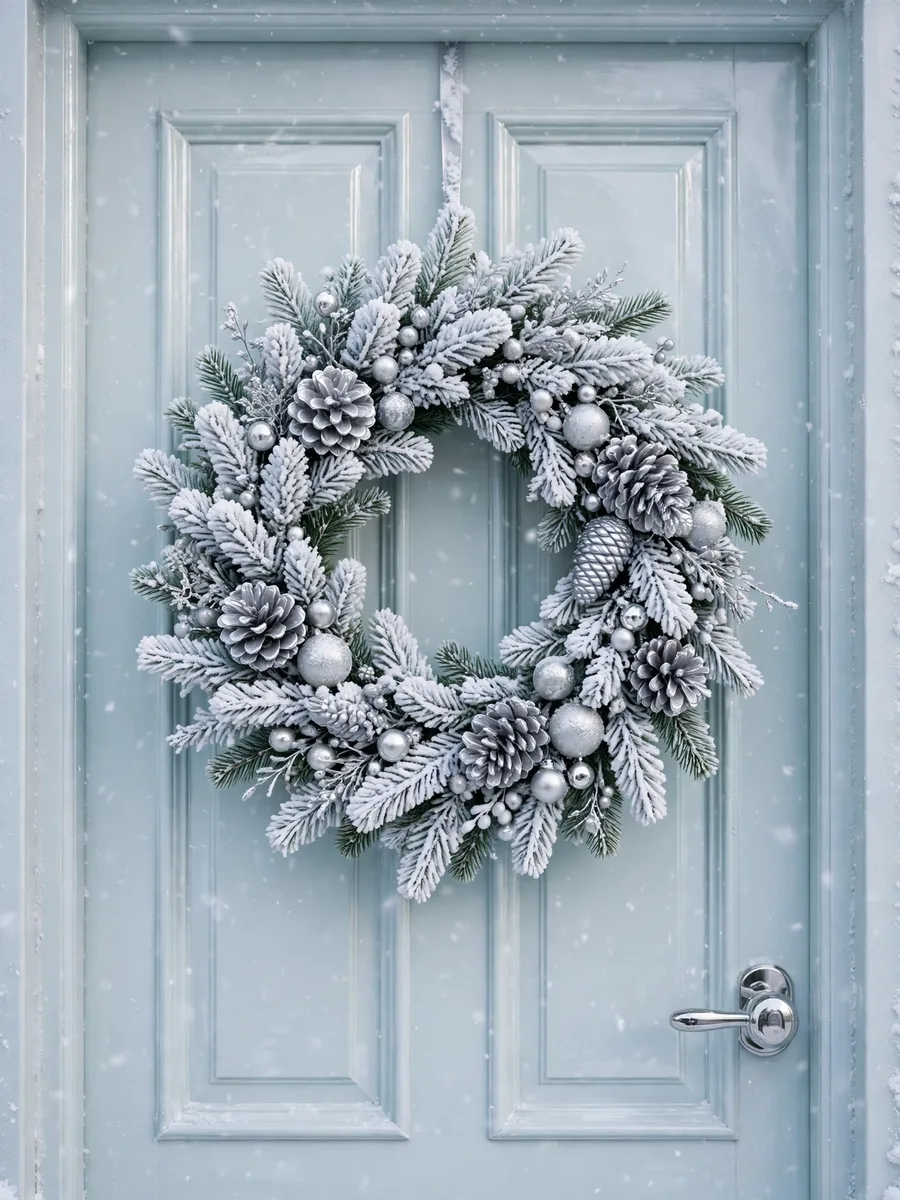
An all-white door works when every piece brings a different texture, because texture is doing the job colour usually does. Flocked evergreen gives a soft matte surface, silver pinecones add a hard shine, and white micro lights add a glow that ties the two together. For a concrete example, picture a pale blue door with a flocked wreath, silver pinecones catching the light, and a white lantern glowing at the foot of the steps.
Quick tips:
- Mix at least three textures, such as flocked, metallic, and glossy.
- Keep the doormat a soft grey instead of white so it does not show every mark.
12. What Size Evergreens Should Flank a Front Door?
Choose potted evergreens about one-third the height of the door, in matching pots, so they frame the entrance without crowding the path or hiding the door.
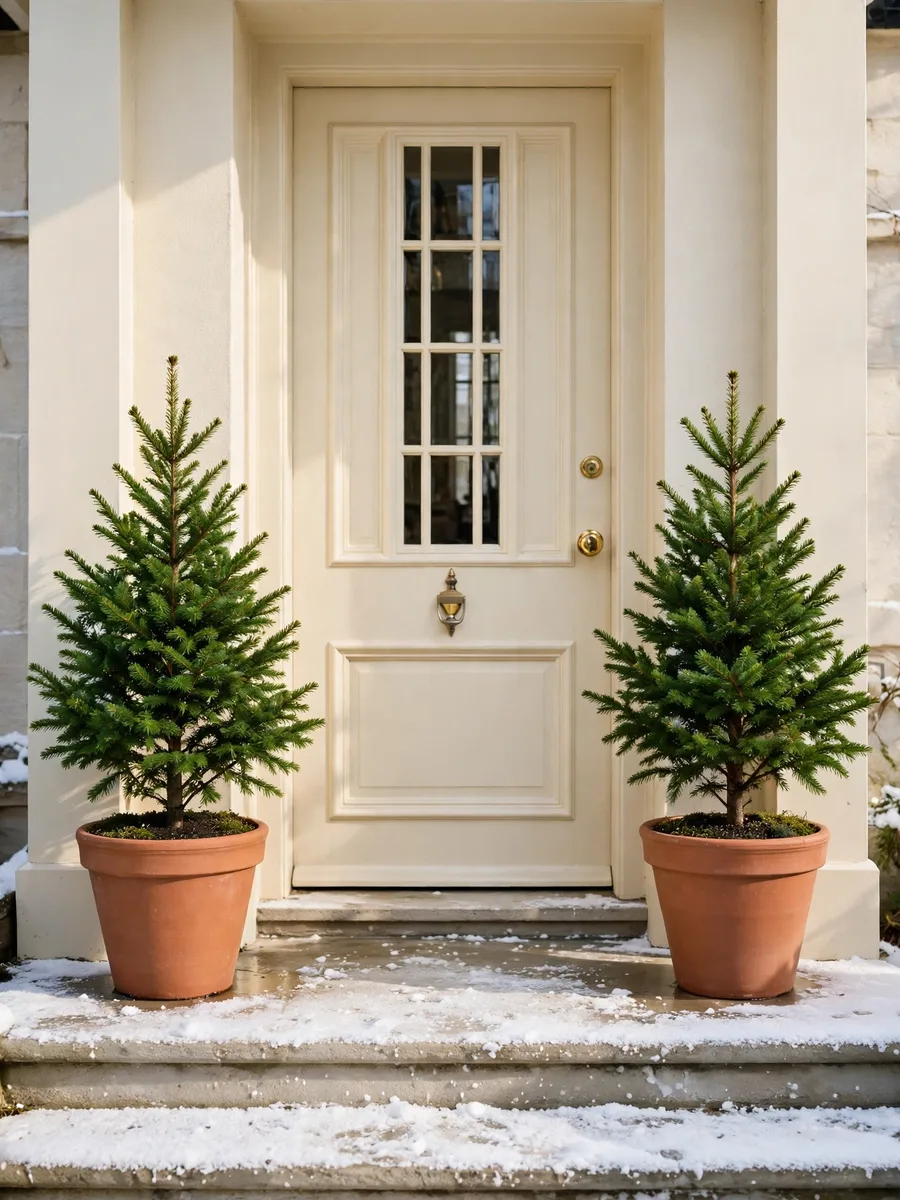
Symmetry is the oldest trick in entryway styling, and a matched pair of small evergreens is the easiest way to use it. For a concrete example, imagine a cream front door with two knee-high evergreens in terracotta pots, their branches dusted with snow, and a cedar wreath above. The same deep green works beautifully indoors too, which is why many homeowners carry it through the house with green living room ideas that keep the winter mood going past the front hall.
Quick tips:
- Pick pots with drainage holes and raise them on small feet.
- Wrap the pots in burlap if a hard freeze is forecast.
13. How Do I Dress Up a Plain Door Knocker for Winter?
Frame the knocker with a small boxwood ring or a short loop of cedar, and let the brass or black metal of the knocker be the shine.
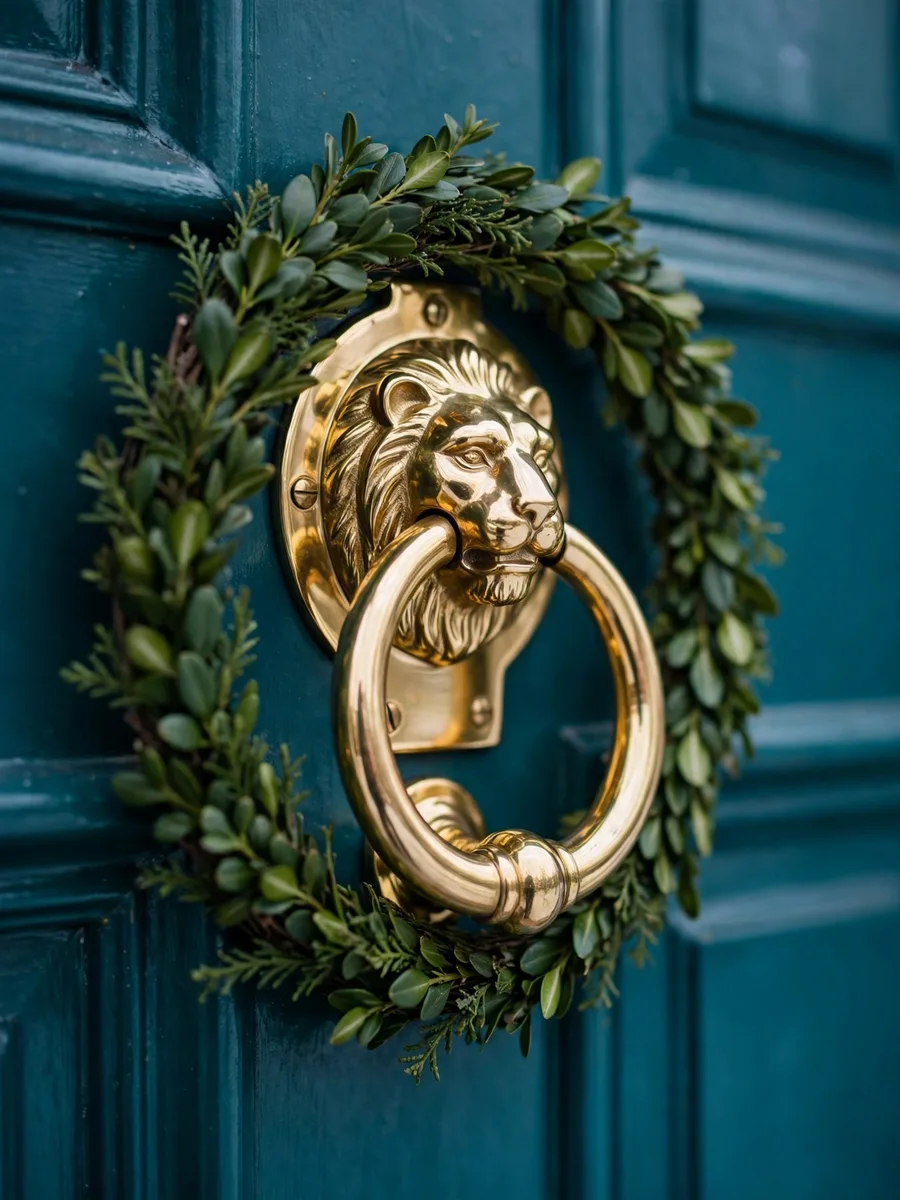
A door knocker is easy to forget because it is small, but it sits at exactly the height every visitor looks at. A small boxwood ring around it turns a piece of hardware into a piece of decor, and the tight, dark green leaves contrast beautifully with polished brass. For a concrete example, picture a deep teal door with a brass knocker framed by a boxwood ring, the brass catching the winter sun.
Quick tips:
- Keep the ring small, about twice the width of the knocker.
- Polish the brass before hanging the greenery so it shines against it.
14. Can a Porch Bench Be Part of Winter Door Decor?
Yes, dress a narrow bench beside the door with a folded plaid throw, one outdoor cushion, and a small basket of pinecones, keeping everything weatherproof.
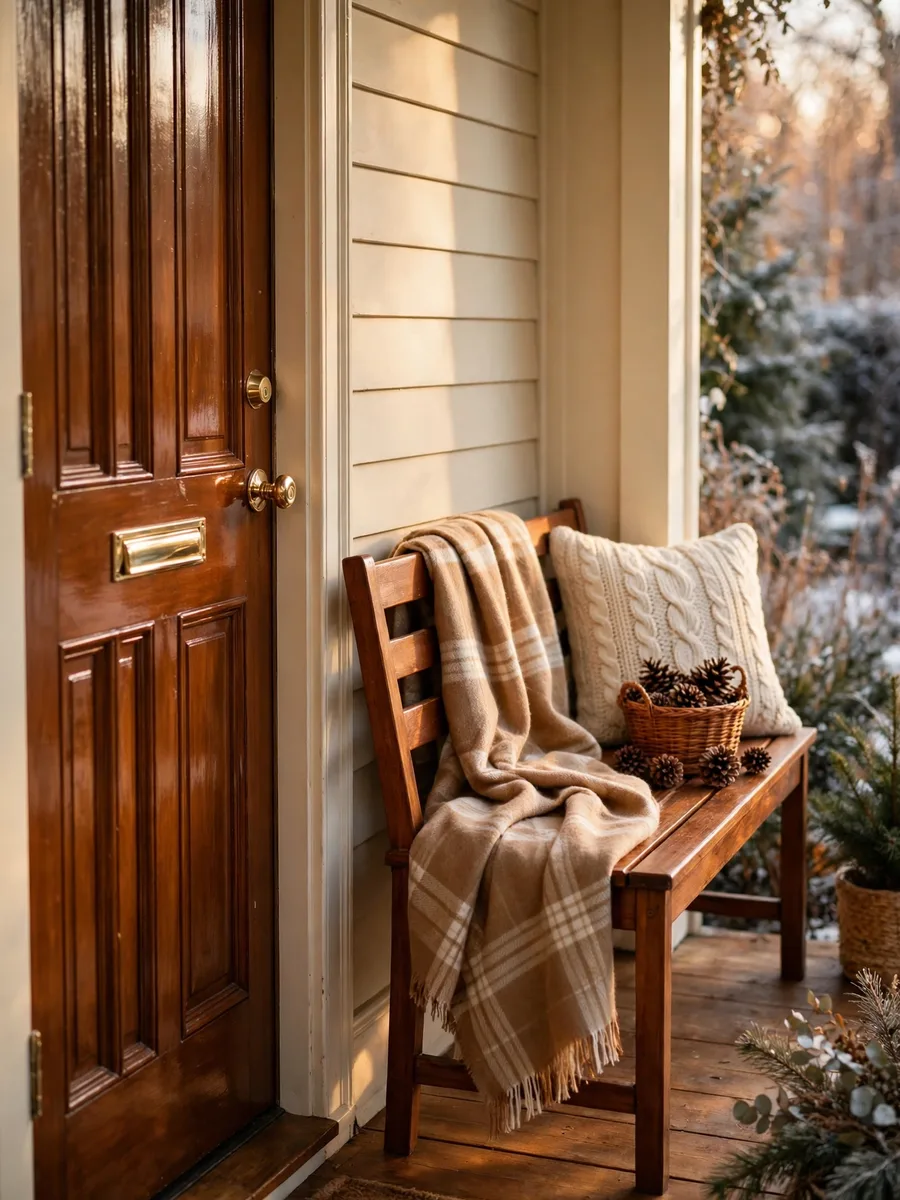
A bench turns a doorway into a place rather than a threshold. Weatherproofing is not optional: an outdoor cushion with a washable cover and a wool or acrylic throw that dries quickly will last the season, while indoor textiles will sag and stain within a week. For a concrete example, imagine a warm brown door with a narrow bench dressed in a camel plaid throw, a cream knit cushion, and a basket of pinecones at one end.
Quick tips:
- Fold the throw neatly instead of draping it, so wind does not pull it down.
- Keep the bench clear of the door swing and the main path.
15. How Do I Decorate an Interior Door for Winter?
Hang a light snowflake garland or a slim greenery swag inside the door on removable hooks, so the winter mood continues through the house.
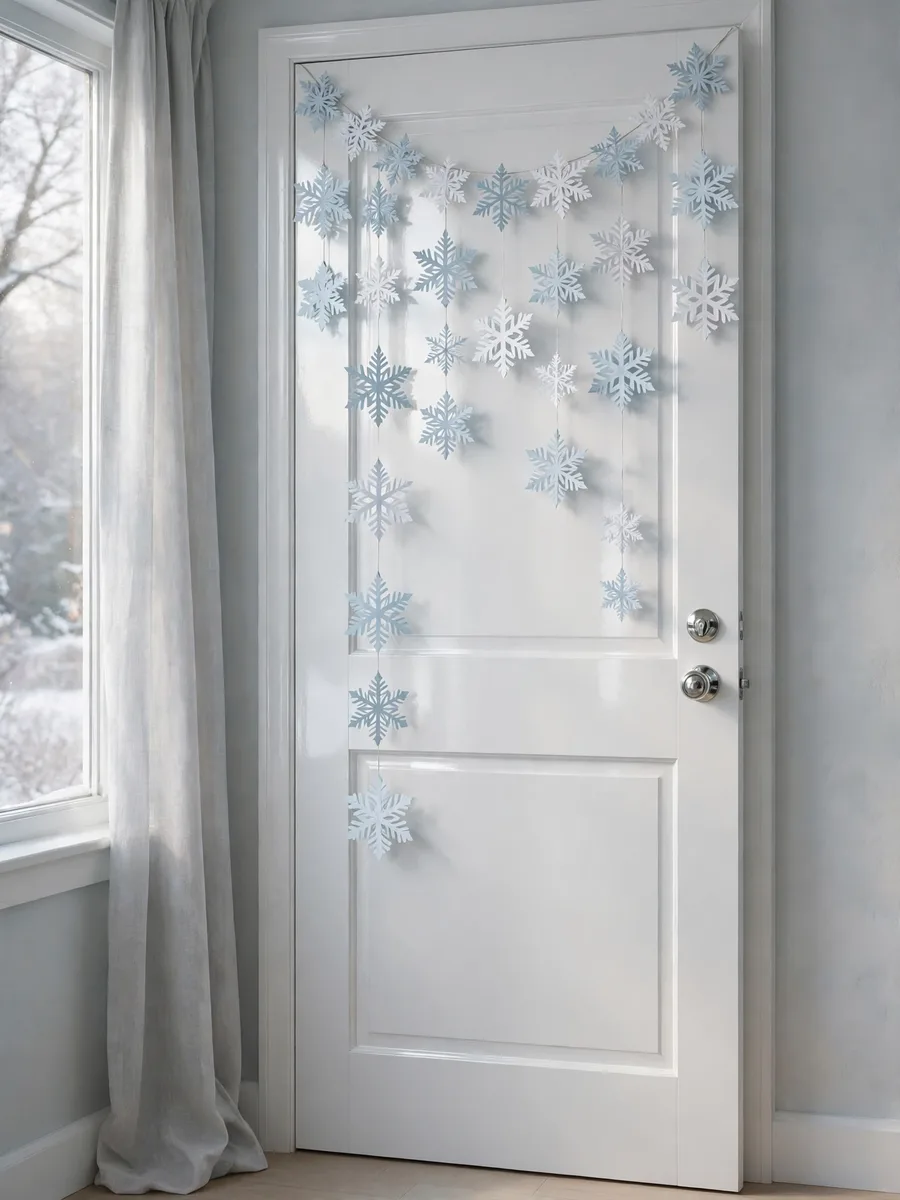
Interior doors are the forgotten half of winter door decor ideas, and they are the easiest place to add a seasonal touch because they are sheltered from the weather. Weight is the only real rule indoors: anything heavy will swing when the door moves, so keep the decoration light and flat against the door. For a concrete example, picture a white bedroom door with pale blue and white snowflakes hanging on fine thread at three different heights.
Quick tips:
- Use clear removable hooks so the decoration lifts off without marks.
- Hang snowflakes at staggered heights for a layered look.
16. What Should a Winter Welcome Sign Say?
Keep the message short and season-neutral, such as Welcome or Winter Welcome, in muted tones like sage, grey, or deep green, so the sign still works in February.
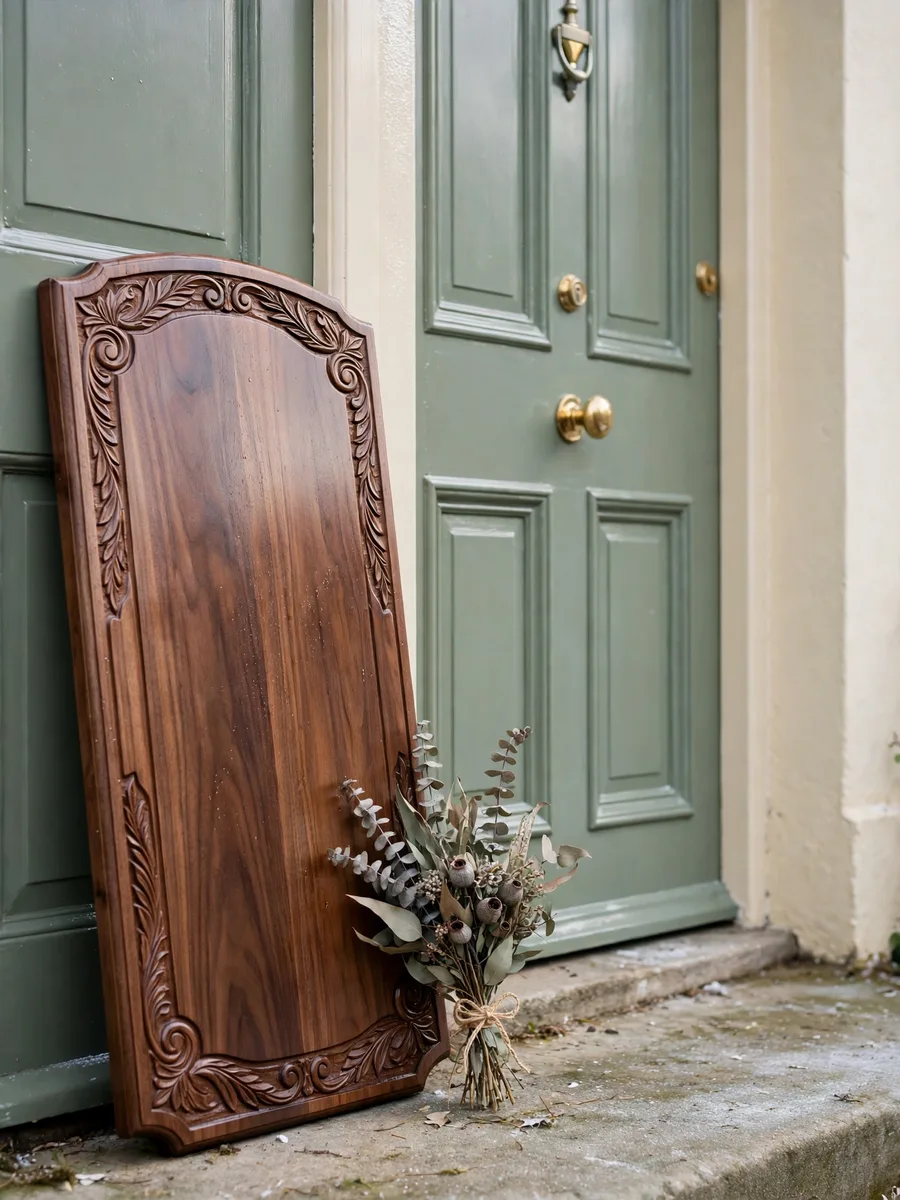
A welcome sign is the finishing touch, not the main event, and the best ones say very little. Long messages and holiday words date the sign within weeks, while a single word in a good typeface stays right all season. Muted tones matter too: sage, grey, walnut, and deep green sit comfortably against evergreen and stone. For a concrete example, picture a sage-green door with a walnut welcome sign leaning against the wall and a small bundle of dried eucalyptus tucked beside it.
Quick tips:
- Choose a sign no taller than knee height so it does not compete with the wreath.
- Seal a painted sign before the first wet weather.
17. How Do I Use Dried Eucalyptus and Pampas by the Door?
Stand a tall bundle of dried eucalyptus and pampas grass in a woven basket beside the door, and let the soft, feathery texture contrast with the hard lines of the door and steps.
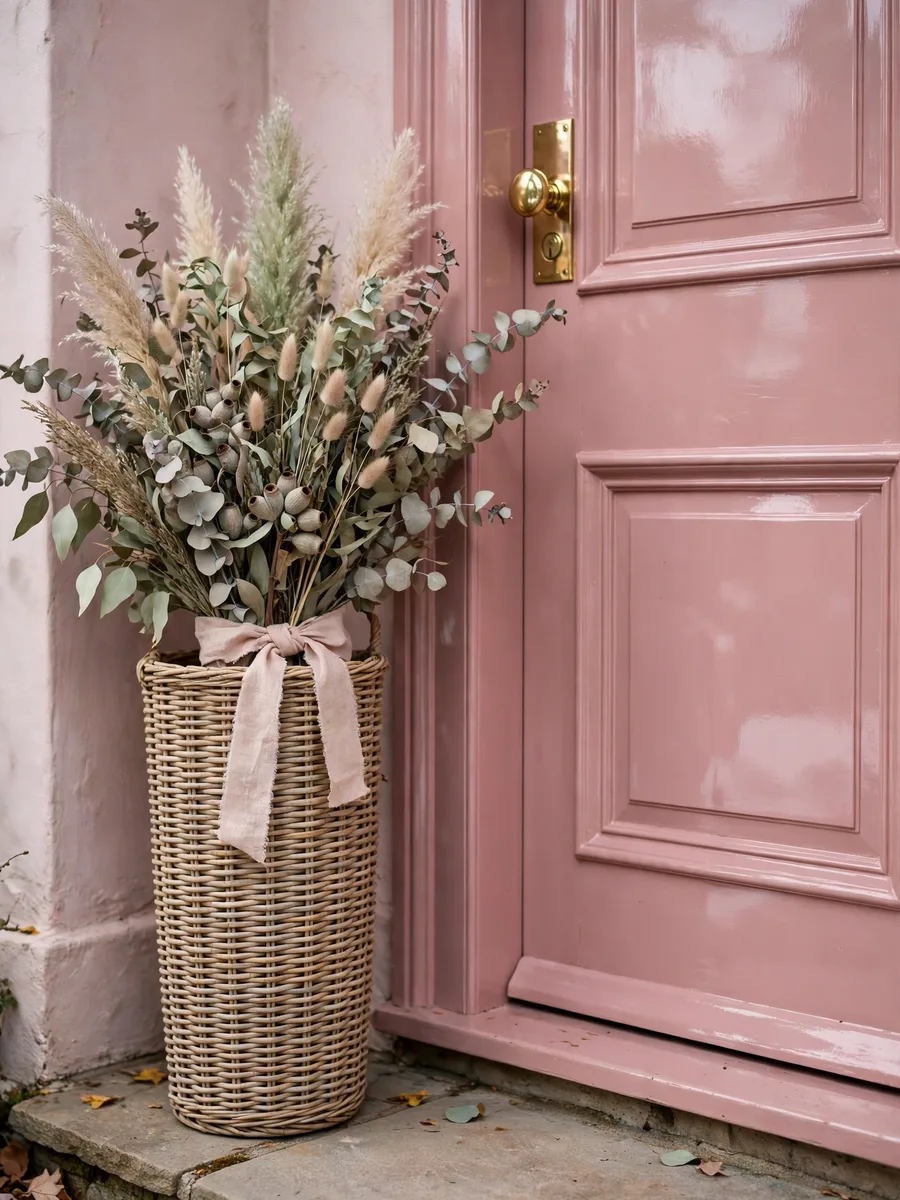
Dried stems are the lowest-maintenance winter material there is, because they cannot wilt, freeze, or dry out any further. Eucalyptus brings a soft sage colour and a faint scent, while pampas grass adds height and movement that catches the light. Together they suit houses where a traditional evergreen wreath would feel too formal. For a concrete example, picture a dusty pink door with a tall woven basket of eucalyptus and pampas, the feathery plumes moving gently in the wind.
Quick tips:
- Keep dried stems under a porch roof so heavy rain does not flatten them.
- Trim the stems to different heights for a natural, gathered look.
18. How Many Lanterns Are Too Many by a Front Door?
Three is the comfortable maximum for a standard stoop, grouped as a tall lantern with two shorter ones, because a cluster reads as styled.
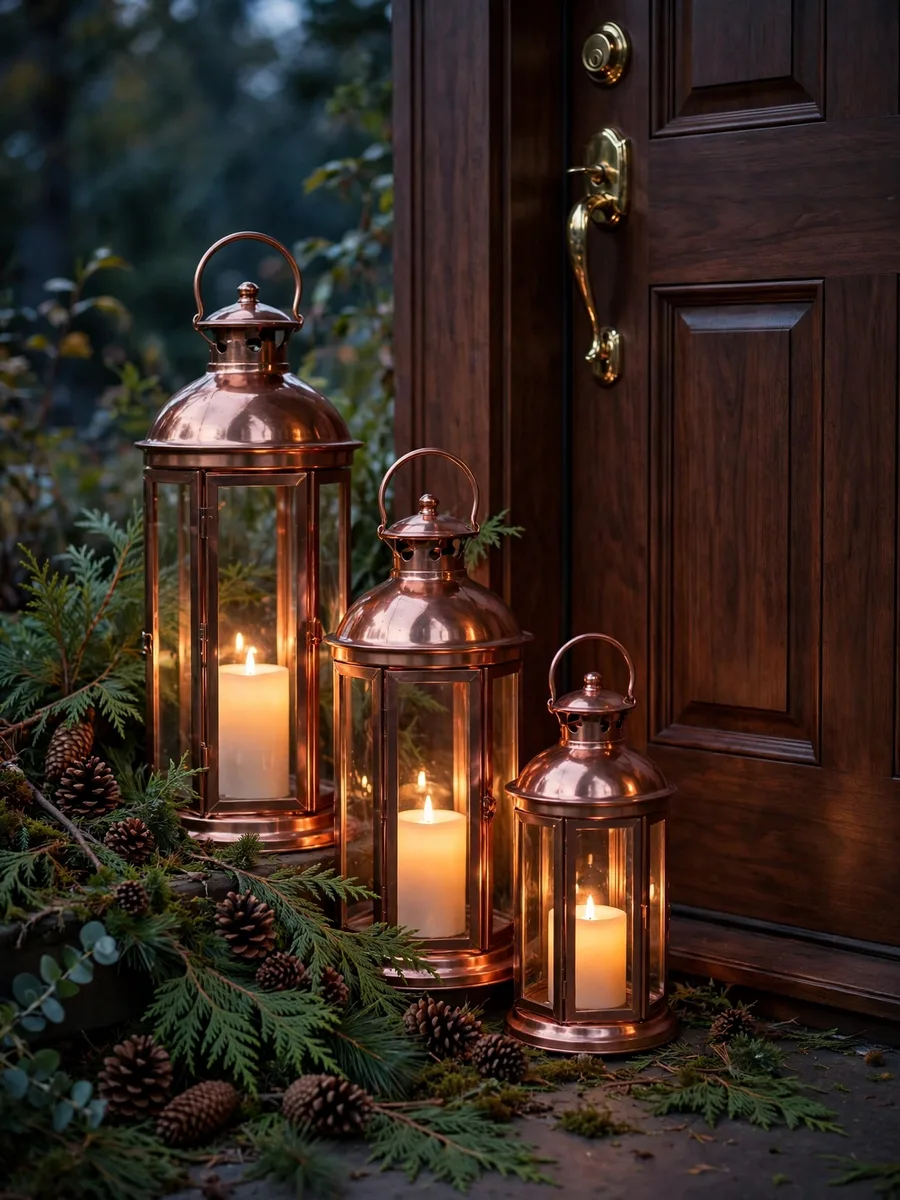
Lanterns work best in odd numbers and mixed heights, because the eye reads a cluster as one arrangement and a matching row as a set of objects. Copper lanterns are a warm alternative to matte black, and their glow flatters wood and stone in a way black metal does not. For a concrete example, picture a dark walnut door with three copper lanterns glowing at dusk and cedar sprigs fanned out around their bases.
Quick tips:
- Group lanterns in odd numbers and staggered heights.
- Keep at least one lantern on a timer so the cluster glows every evening.
19. Can a Hallway Door Carry Winter Decor Without Blocking the Way?
Yes, drape a slim garland over the top of the door and add a small velvet ribbon on a brass hook, keeping everything flat against the door.
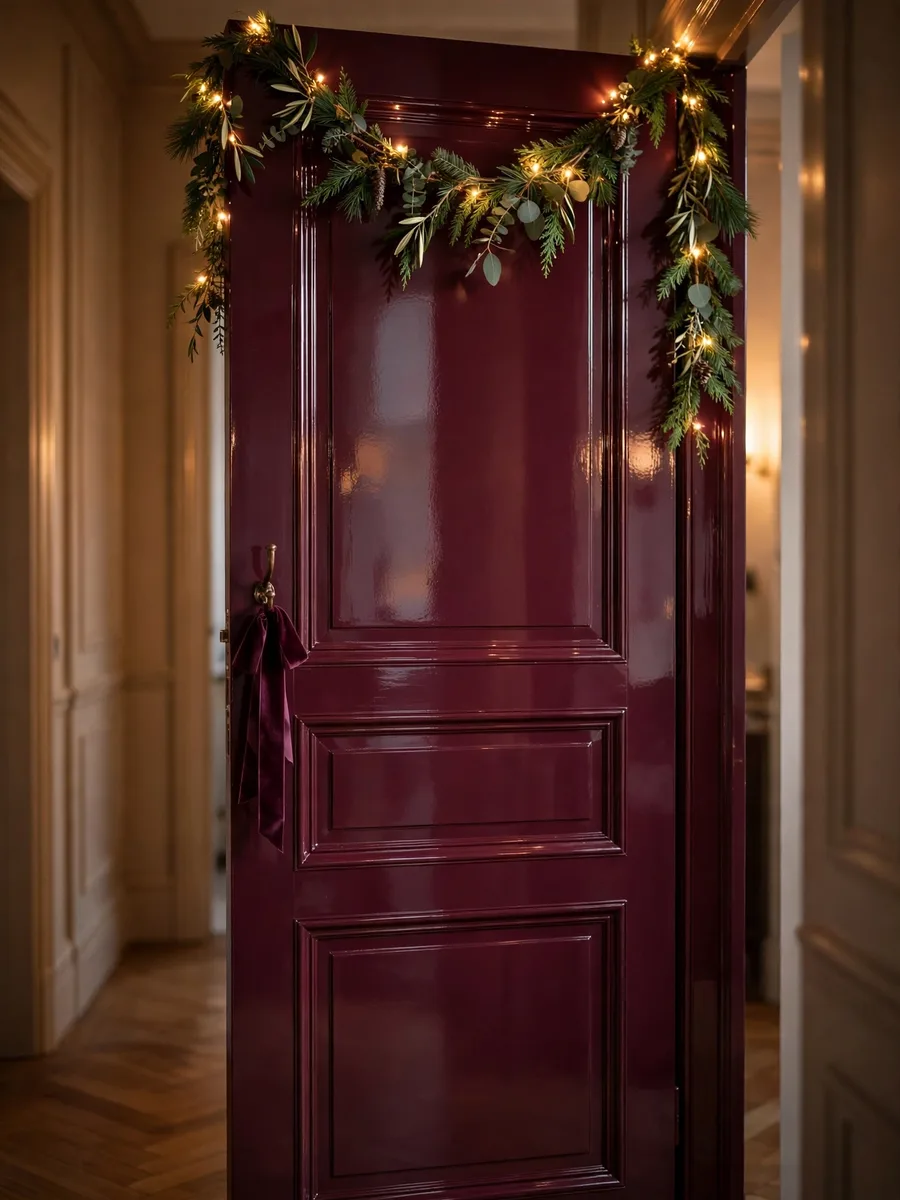
Hallway doors are narrow, busy, and opened dozens of times a day, so the decoration has to be flat, light, and out of the way. A slim garland over the top of the door does exactly that: it adds colour and light to the hallway without narrowing the opening or snagging on a coat. For a concrete example, picture a plum hallway door with a slim evergreen garland across the top, fairy lights glowing softly, and a small velvet ribbon hanging from a brass hook.
Quick tips:
- Keep the garland slim so it clears the frame when the door opens.
- Use battery fairy lights with a timer to avoid trailing cables.
Frequently Asked Questions
How do you transition front door decor for winter after Christmas?
Remove anything tied to December, such as red velvet bows and ornaments. Keep the plain pine, cedar, or eucalyptus base, then swap in a neutral linen ribbon, matte black lanterns, and white birch logs so the entry feels intentional through February.
What winter front door ideas last through January and February?
Faux cedar and eucalyptus wreaths, cut evergreen boughs packed into damp soil, winterberry stems, white birch logs, and matte black lanterns with timer LED candles all hold up well in freezing weather.
How do you hang a wreath without damaging the door?
Use a flat metal over-the-door hanger, which slides over the top rail and lets the door close against the weatherstripping. For a heavy wreath, a ribbon loop or two hooks set wide is more reliable.
How do you decorate a front door for winter without Christmas decorations?
Build the look from evergreen, pinecones, silver and white accents, and natural wood tones, which all read as winter without naming a holiday. Skip red and gold, choose a neutral ribbon, and let warm light and texture do the work instead of ornaments.
What colour wreath looks best in winter?
Deep green cedar or eucalyptus suits almost every door colour and house style, while magnolia reads warmer and more formal. A flocked white wreath works best on a coloured door, such as pale blue or sage, where the white has something to sit against.
Can you leave a wreath up all winter?
Yes, if the wreath is made from evergreen rather than holiday-specific pieces. A faux cedar or eucalyptus wreath can stay up from November into February, while a fresh one needs checking after four to six weeks.
Conclusion
A winter door does not need much, but it does need a plan that outlasts December. One evergreen wreath, one frame of garland or light, and one or two pieces at the foot of the door are enough, as long as every piece is chosen for the whole season rather than for one holiday. These winter door decor ideas are built on that simple rule: plain evergreen, warm light, and natural materials that still look right in January and February. Pick the three or four that fit your door, hang them in an afternoon, and let the entrance do its quiet work all winter long.