20 Stunning Coastal Kitchen Ideas That Feel Like a Breeze ♥ [Shoreline Chic]
Why Coastal Kitchen Ideas Never Go Out of Style
The best coastal kitchen ideas have nothing to do with anchors on the wall. They work because sunwashed color and natural texture genuinely lower stress — a kitchen that feels like a deep breath, balancing beauty with comfort without being too formal or exhausting to maintain.
Here is the definition worth holding onto: a great coastal kitchen is layered, airy, and intentionally relaxed. Woven lighting, pale woods, soft blues, marble, and sea-glass tones do the talking — never a theme shouted through seashells. These 20 coastal kitchen ideas show how to get that collected, vacation-coded calm with texture and light instead of decoration.
1. Start With a Driftwood-Inspired Palette

Before you buy a single thing, set the palette: soft whites, warm sand, weathered gray-beige, and one muted sea tone. Coastal kitchen ideas live or die on color discipline — when every surface sits in the same sunwashed family, even a basic kitchen feels considered. Paint swatches look different in coastal light, so test them on the sunniest wall.
Quick tips
- Limit the palette to four tones maximum.
- Test paint in morning and evening light before committing.
2. Let Woven Textures Soften the Room
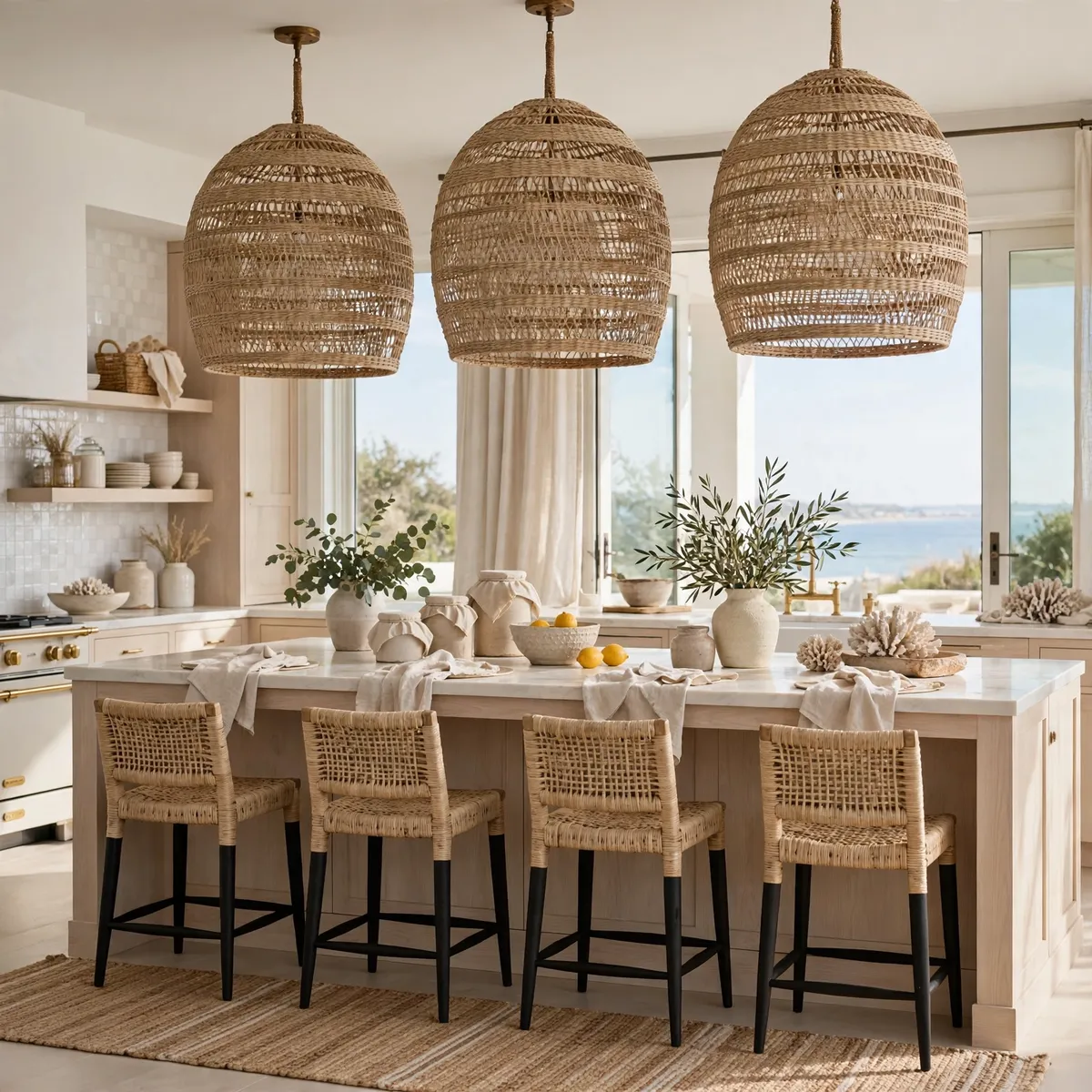
Nothing says coastal faster than weave. Hang oversized rattan pendants as the visual anchor, then repeat the organic texture — a pale wood island, woven counter stools, a jute runner. Layering wicker, pale oak, linen, ceramic, and brushed brass keeps the room relaxed instead of polished, and big pendants fill vertical space beautifully.
Quick tips
- Repeat each texture at least twice so it looks intentional.
- Scale pendants generously — small ones disappear over an island.
3. Try Soft Seafoam Cabinets With Cottage Ease

Muted seafoam cabinetry against warm wood floors and creamy subway tile gives instant relaxed-cottage energy. These coastal kitchen ideas lean on tonal variation rather than contrast — weathered woods, soft greens, off-whites, natural fibers — for a kitchen that feels collected over time. A built-in banquette with striped upholstery completes the story.
Quick tips
- Keep the seafoam muted; chalky beats saturated.
- Style open shelves with ceramics and trailing greenery.
4. Raise the Eye With a Warm Planked Ceiling
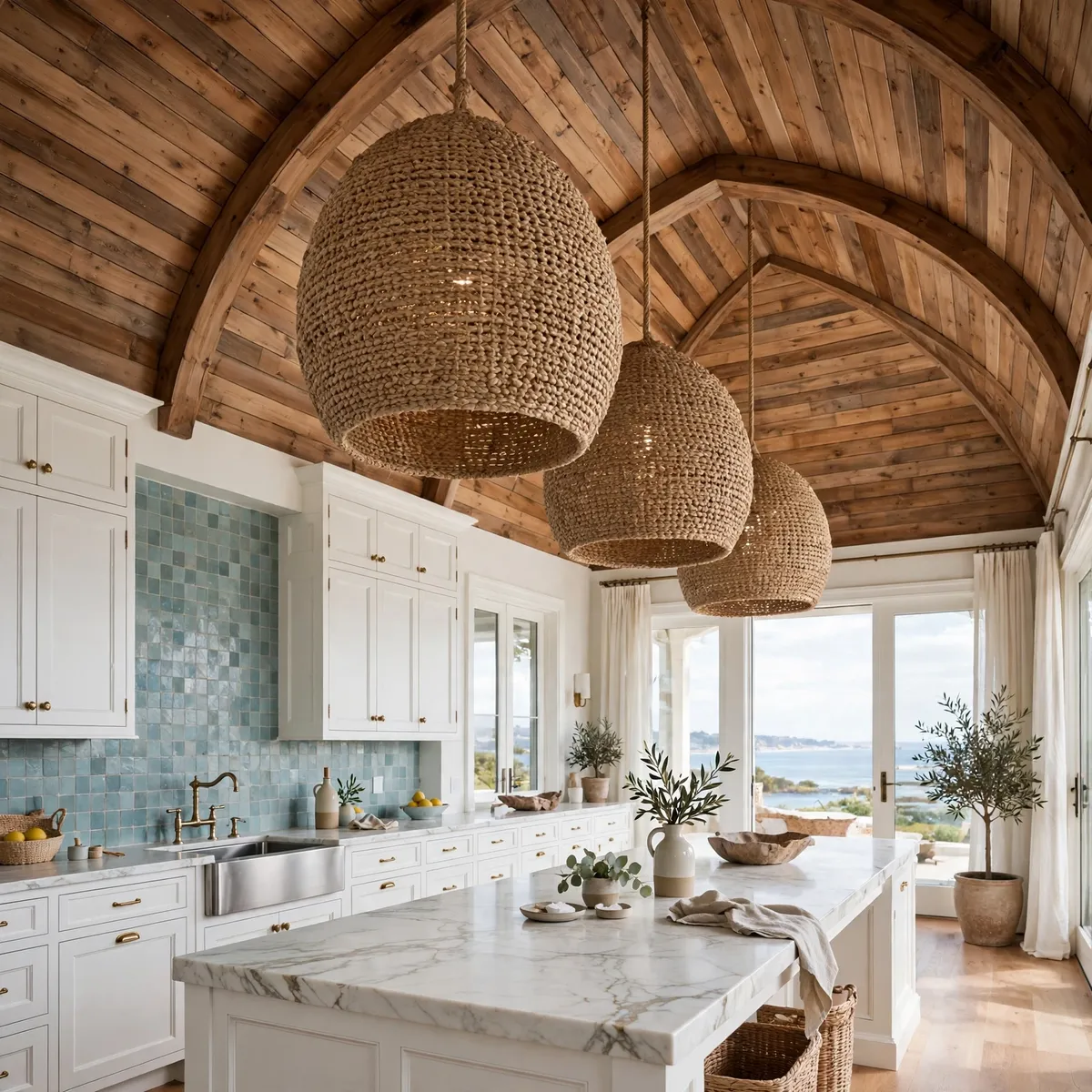
A vaulted or planked wood ceiling turns a standard white kitchen layered and dramatic in one move. Wood overhead balances cooler materials below — marble counters, a dusty aqua backsplash — while oversized woven pendants fill the vertical space. It is the fastest way to make a new build feel like it has history.
Quick tips
- Keep ceiling wood warm, not orange — whitewash if needed.
- One ceiling feature per kitchen is plenty.
5. Choose a Sculptural Island as the Conversation Piece
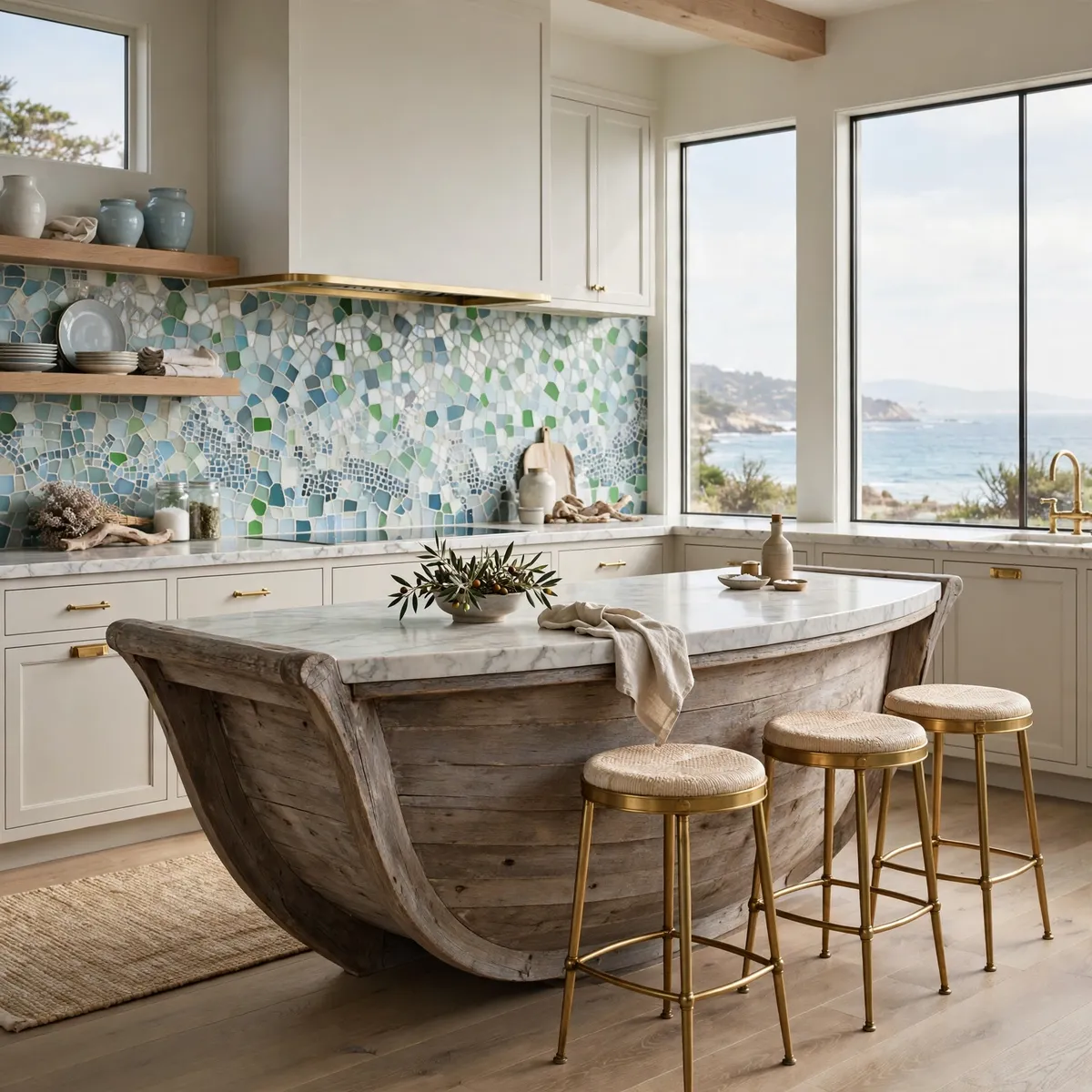
Give the island a boat-inspired curved silhouette and the whole kitchen gets a quiet sense of movement. The trick is restraint everywhere else: weathered medium-toned woods, brass stools, a sea-glass mosaic backsplash. Coastal kitchen ideas like this integrate the theme into architecture rather than hanging it on the wall.
Quick tips
- Curved edges and organic silhouettes suggest the sea without literal shapes.
- Keep surrounding cabinetry simple so the island stays the star.
6. Anchor All-White With One Deep Blue Island

One darker focal color preserves an all-white kitchen’s airiness while giving it a pulse. A deep navy island against bright white cabinetry, vertical shiplap walls that make the room feel taller, brass hardware warming the cool whites — then wicker seating and a natural runner to soften every polished surface. Of all coastal kitchen ideas, this one delivers the most drama for the least renovation.
Quick tips
- One bold color only; let everything else stay quiet.
- Echo the island color in small accessories for cohesion.
7. Let a Marble Island Carry Relaxed Nautical Elegance

A dramatic waterfall marble island can be the entire focal point of a coastal kitchen when everything around it stays soft and sandy — and this is where the layering matters most, because marble on its own can read cold and formal, which is exactly what coastal style refuses to be. Soften it deliberately: pale wood flooring that bounces natural light around the room, layered lighting that shifts the mood from day to night (cove lights for glow, pendants for focus, sconces for warmth, under-cabinet strips for task light), and a careful mix of materials that keeps a neutral palette from falling flat — the veined marble against woven rattan, brushed brass against warm wood, crisp stone against soft linen. Woven counter stools pull the island back down to earth, and styling stays restrained: a bowl of citrus, a stack of handmade ceramics, nothing that needs dusting. These coastal kitchen ideas prove that luxury and barefoot comfort are not opposites; the most expensive-looking coastal kitchens are the ones where every polished surface has a textured, touchable neighbor. When the light changes through the day, the room should change with it — bright and working at noon, golden and lingering at dinner.
Quick tips
- Layer at least three light sources for day-to-night flexibility.
- Pair every polished surface with one textured material.
8. Brighten a Small Kitchen With Sea-Glass Tile
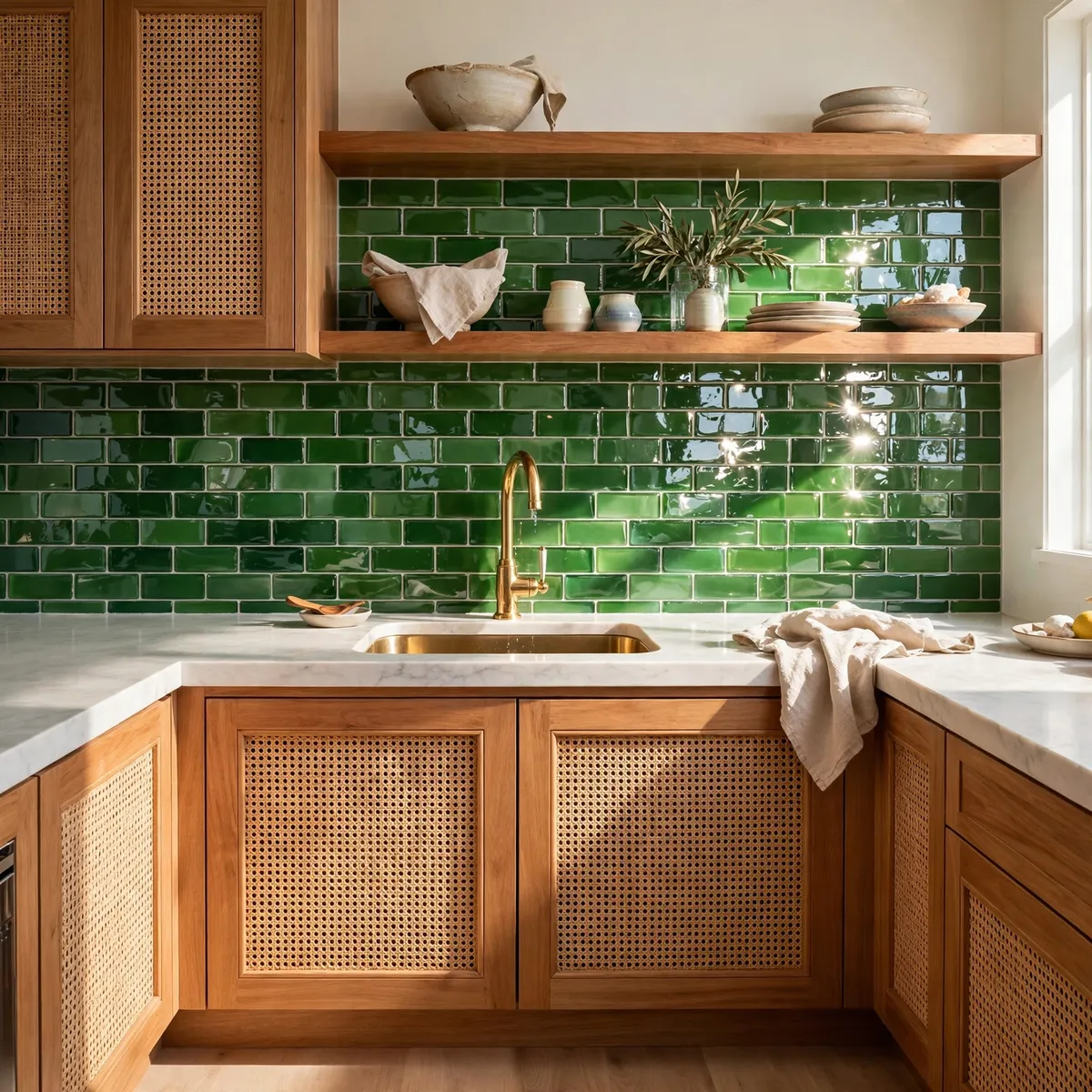
A glossy sea-glass backsplash gives a small kitchen movement, color variation, and light reflection all at once. Balance the cool minty tones with warm wood cabinetry and woven cane inserts, open the wall with floating shelves, and let a brass faucet connect every tone. Stay in one softened color story and let texture create the interest.
Quick tips
- Glossy tile doubles light in windowless corners.
- Keep grout lines thin so the glass reads as one surface.
9. Keep It Fresh With a Soft Sage Island
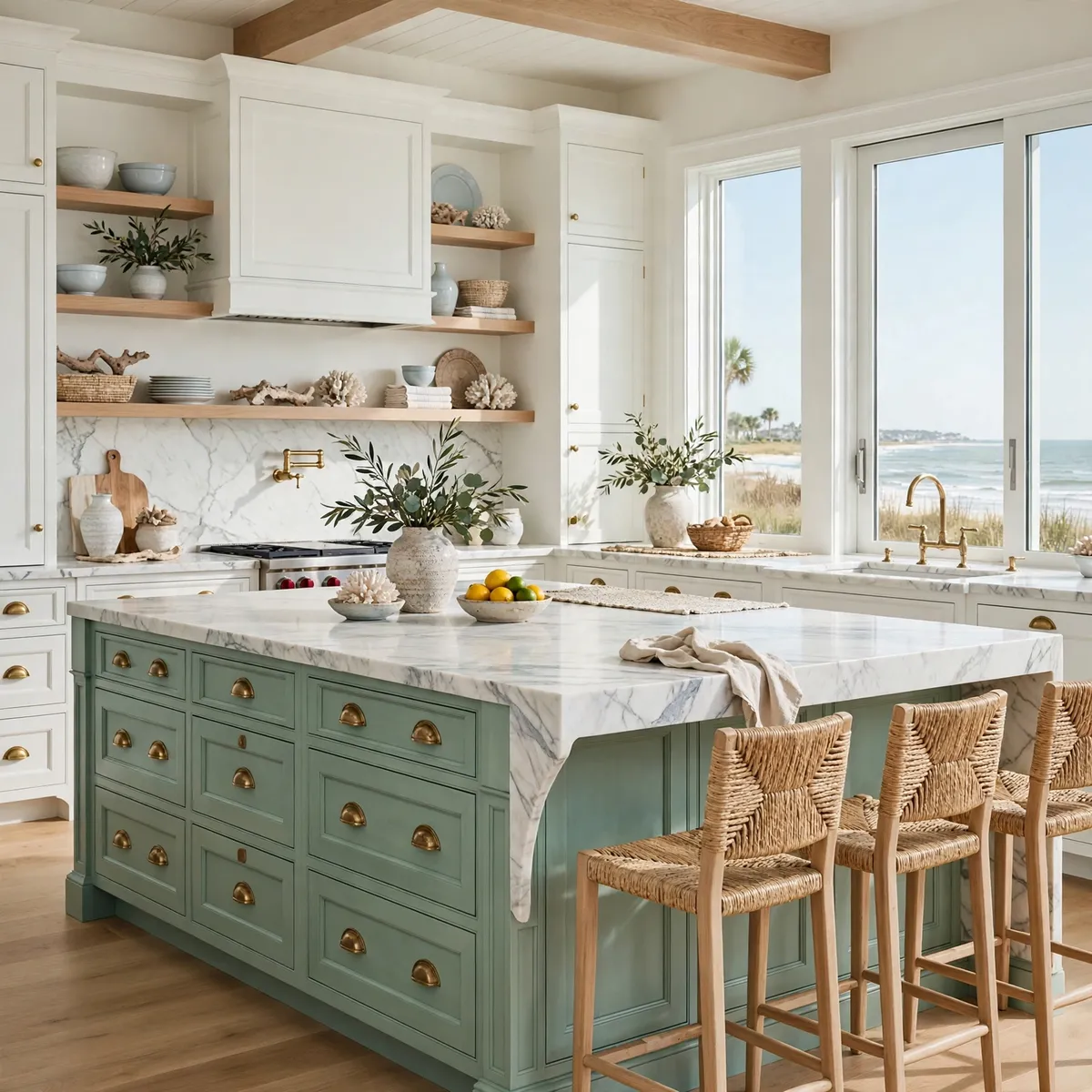
Soft sage against white cabinetry feels fresh without trying hard — and muted palettes age far better than trendy high-contrast ones. Rounded glass pendants soften the lines, woven stools warm the marble, and small repeated citrus-yellow accents energize the cool greens. Add coastal color through textiles, tile, or one painted island over layered neutrals.
Quick tips
- Repeat the accent color three times for a collected feel.
- Muted today still looks right in ten years.
10. Commit to One Bold Focal Feature
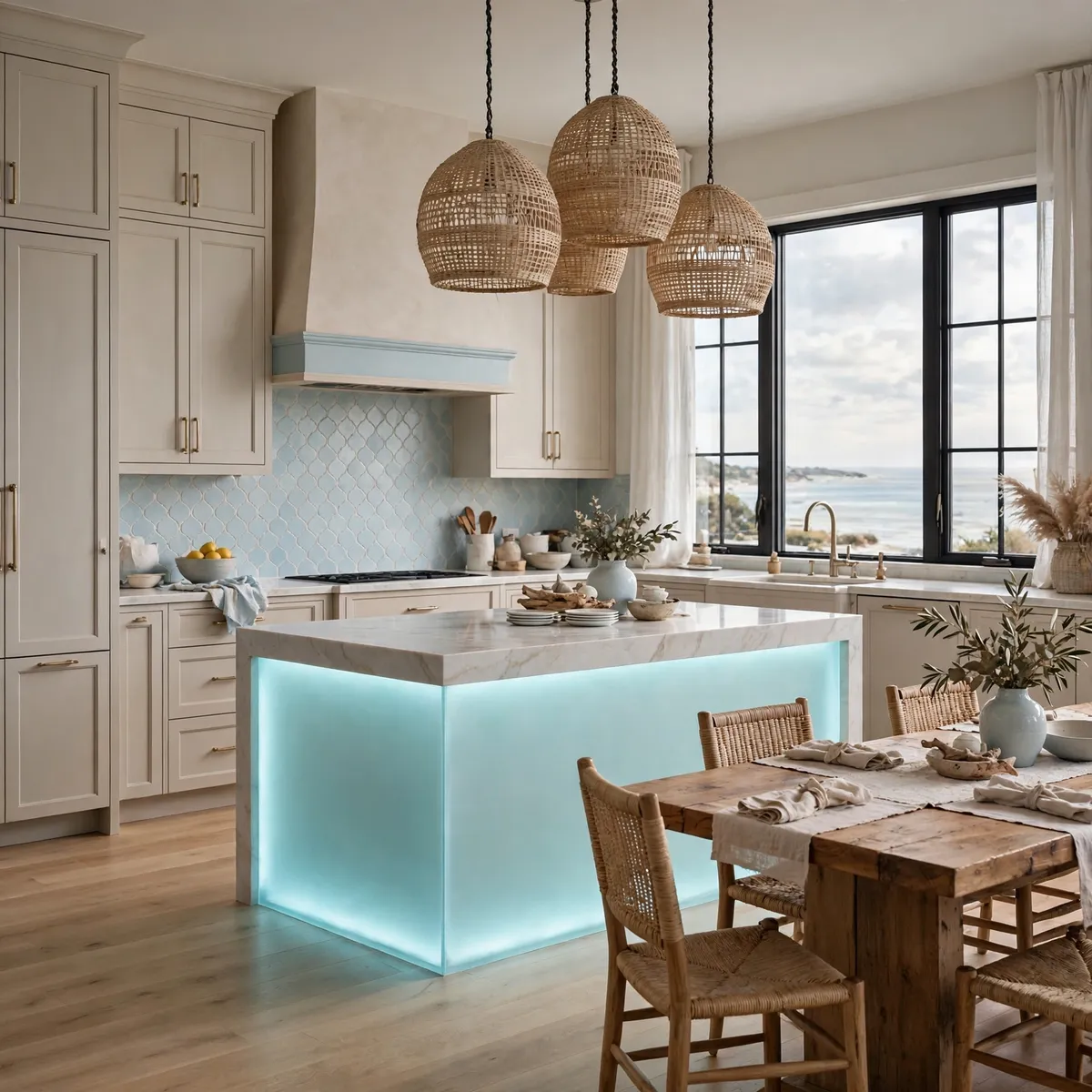
Pick one major visual moment — a softly glowing aqua island, backlit blue stone, sea-glass panels — and keep everything else calm: soft neutral cabinetry, quiet counters, gentle lighting. Pale blue cabinetry nearby connects the tones; woven pendants and a rustic wood table ground the drama. These coastal kitchen ideas work because restraint makes the bold move feel confident, not chaotic.
Quick tips
- One statement feature per room, never two competing.
- Support it with complementary materials, not more statements.
11. Whisper the Theme With Fish-Scale Tile
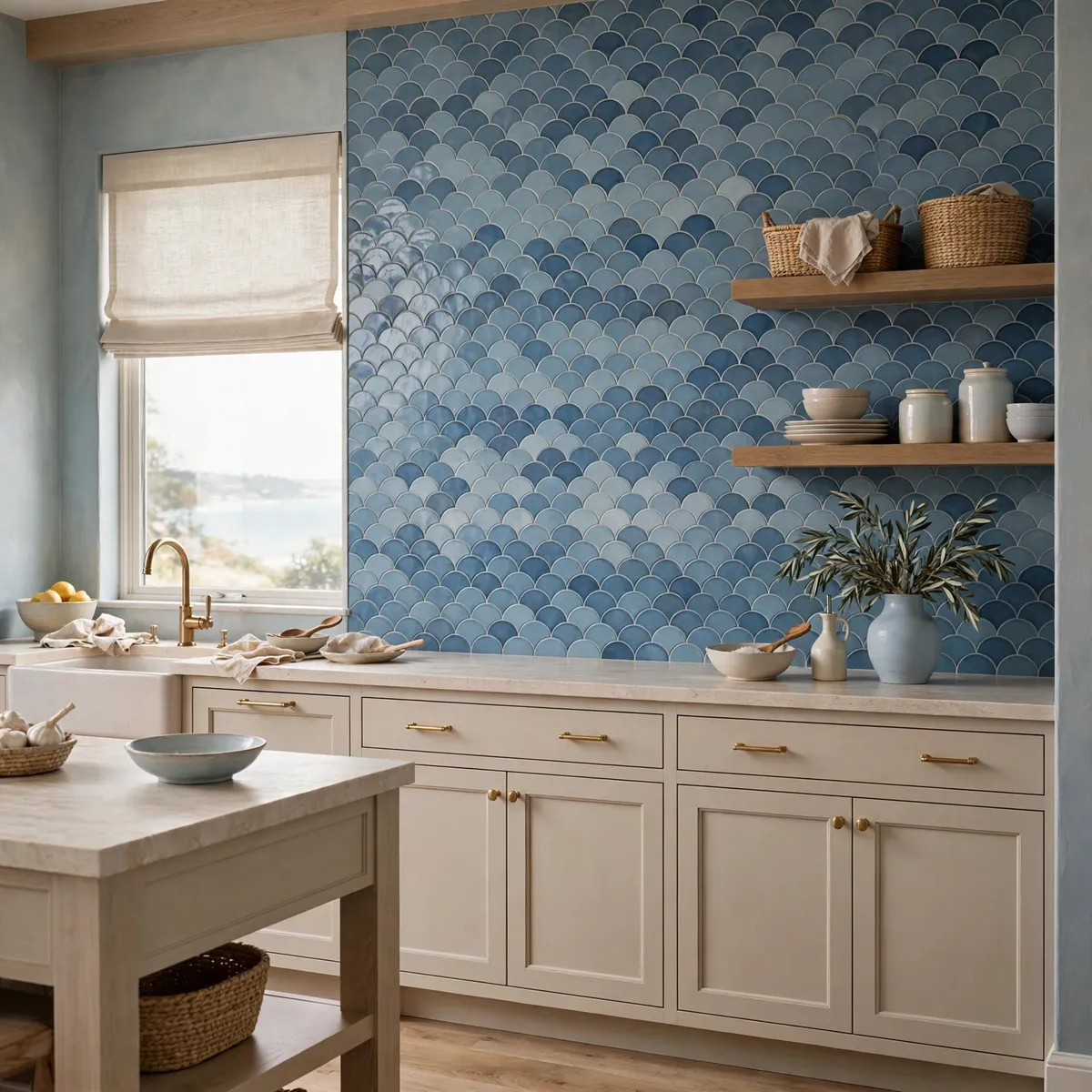
Layered blue fish-scale tile mimics ocean waves without a single seashell in sight. Keep it soft — muted dusty blues over hyper-saturated ones, warm beige cabinetry to keep the tile organic. Smaller scales read delicate and layered; oversized reads modern and graphic. Style open shelves nearby with restraint: baskets, pale ceramics, driftwood boards.
Quick tips
- Sample tiles in your own light; blues shift dramatically.
- Let the tile be the only pattern in the room.
12. Layer Whitewashed Wood, Not Just White Paint
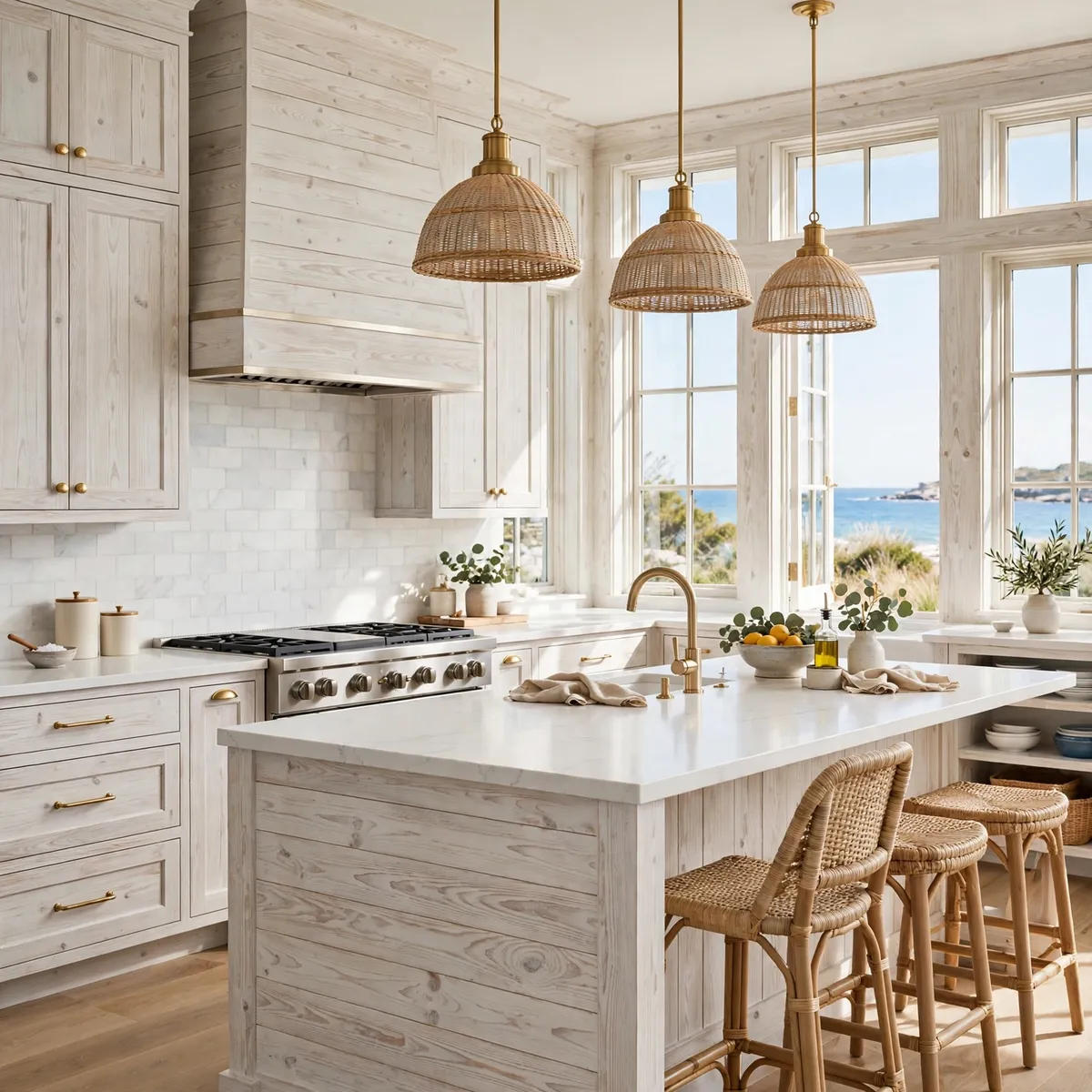
Flat white paint can feel sterile; whitewashed wood has grain, variation, and warmth. Use it on a feature wall, the island base, or open-shelf brackets — the texture catches light the way flat paint never does. These coastal kitchen ideas favor materials with a past over perfect newness every time.
Quick tips
- Whitewash lets the grain show; pick boards with character.
- Seal kitchen woodwork so it wipes clean.
13. Choose Stone Counters Like Sunlit Sand
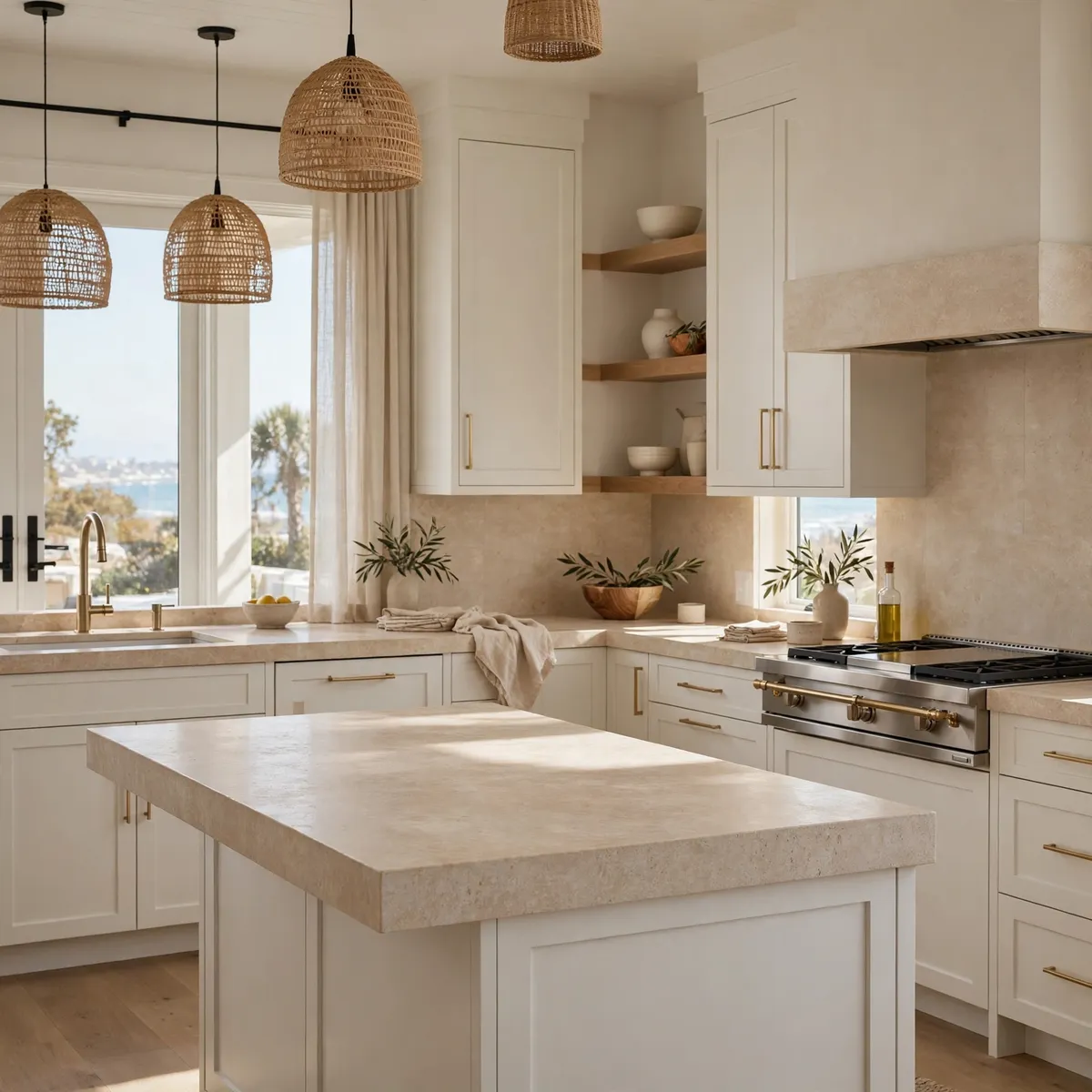
Honed limestone or sandstone in warm beige brings the beach to the worktop — soft, matte, and full of subtle movement. Unlike polished granite, it never shouts. Pair with simple cabinetry and let the stone be the quiet luxury of the room.
Quick tips
- Honed finishes hide etching better than polished.
- Seal natural stone yearly in a working kitchen.
14. Choose Brass Fittings Like Found Treasure
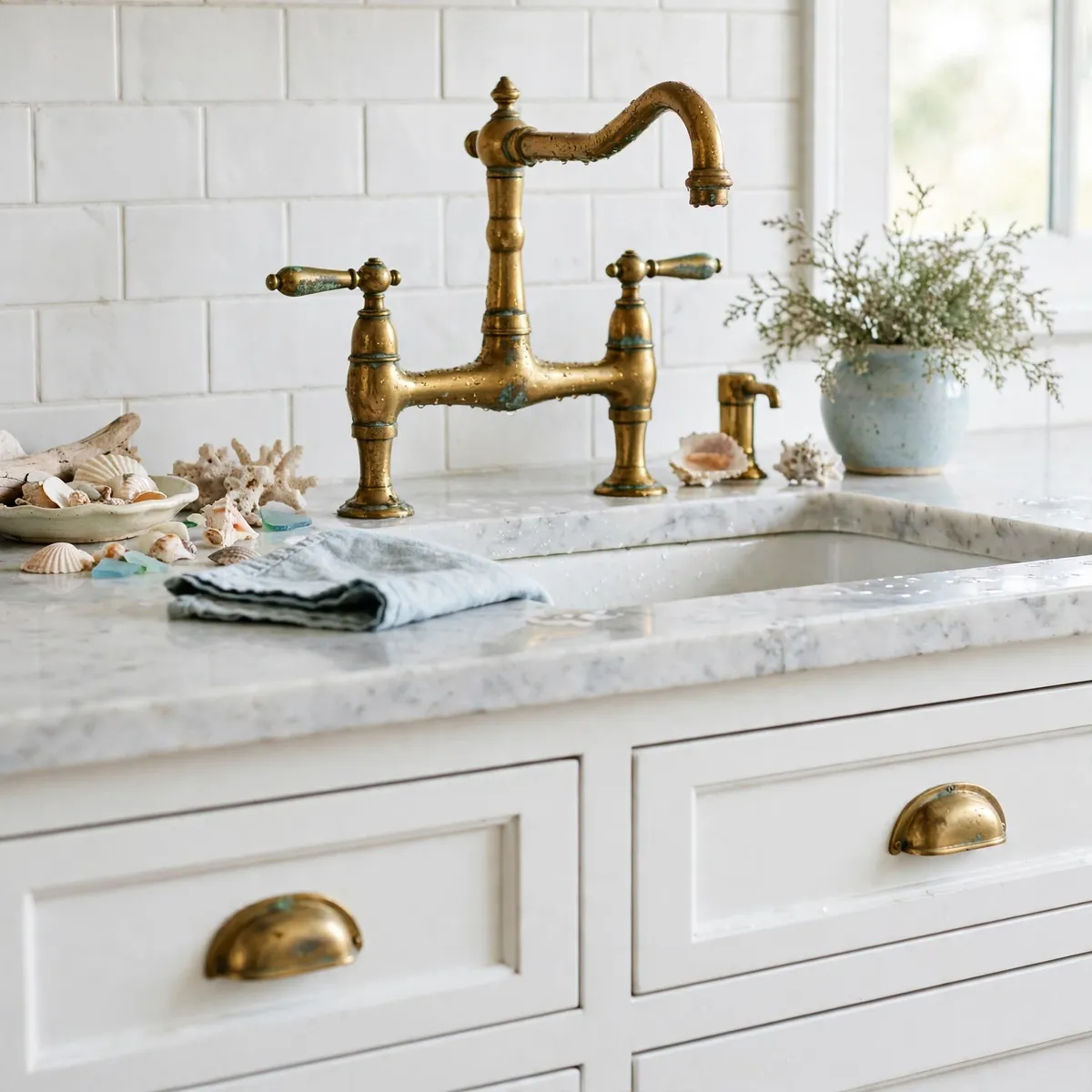
Unlacquered brass ages into a soft patina that looks collected rather than installed — exactly the energy coastal kitchen ideas aim for. A brass bridge faucet, cup pulls, and one brass picture light over open shelves tie the room together like jewelry found on travels.
Quick tips
- Unlacquered brass patinas; lacquered stays shiny — choose deliberately.
- Repeat brass three times minimum for a deliberate look.
15. Install a Glossy White Farmhouse Sink
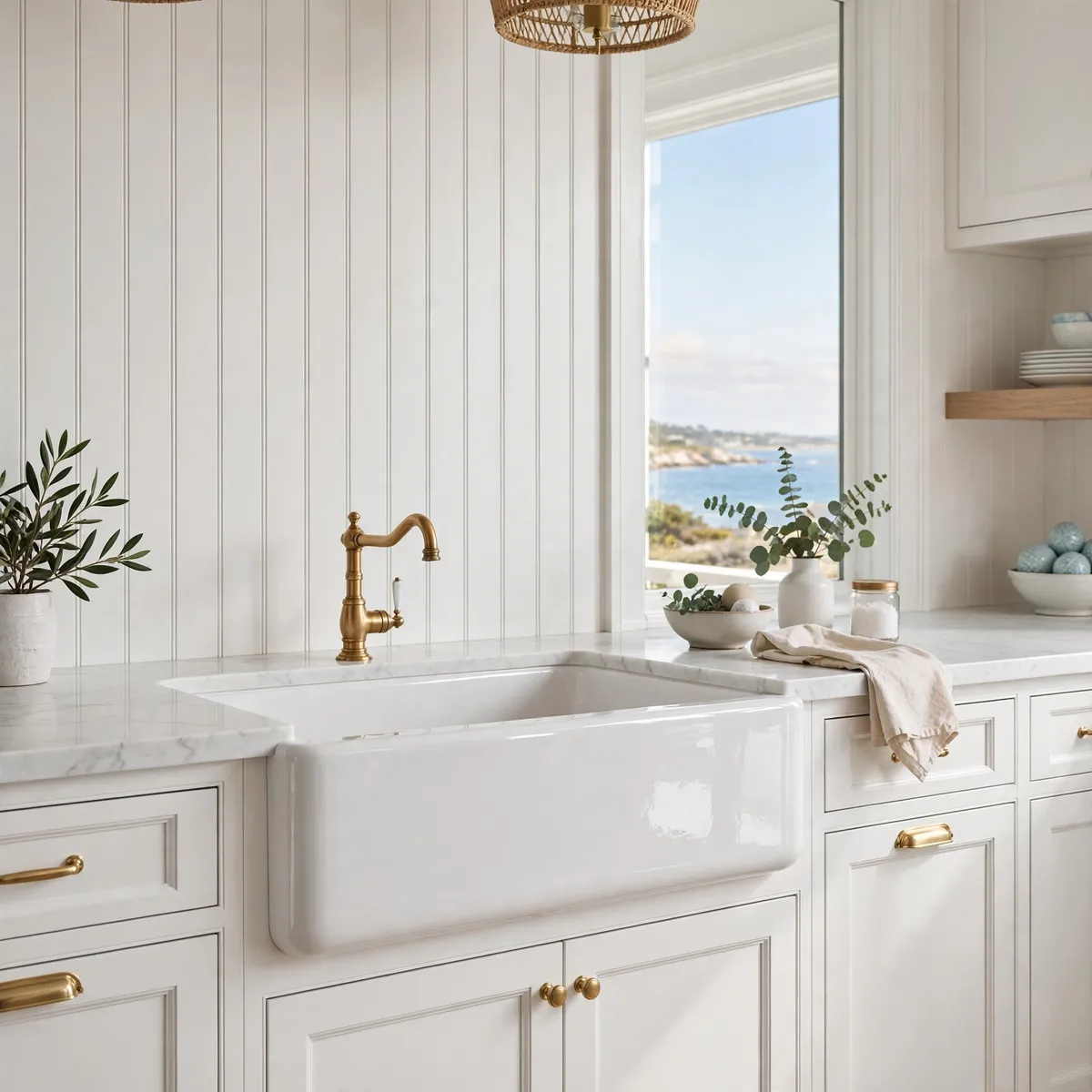
The apron-front sink is coastal’s hardest-working classic: deep enough for stockpots, glossy enough to bounce light. Set it against beadboard or shiplap paneling, add a simple brass faucet, and the washing zone becomes a focal point instead of an afterthought.
Quick tips
- Check cabinet depth before ordering — aprons need room.
- Fireclay resists chips better than porcelain.
16. Ground It With Weathered Oak Floors

Wide-plank weathered oak underfoot warms every cool tone above it — one of those coastal kitchen ideas that works as hard practically as it does visually. The gray-beige wash hides real life beautifully: sand, crumbs, paw prints. Run the boards in the room’s longest direction to stretch the space.
- Choose a matte, not glossy, finish for authenticity.
- Run boards toward the main light source.
- Keep rugs flat-weave so the wood still shows.
Quick tips
- Weathered finishes camouflage daily wear.
- One wood tone for floors; vary texture elsewhere.
17. Dress It in Linen and Stripes
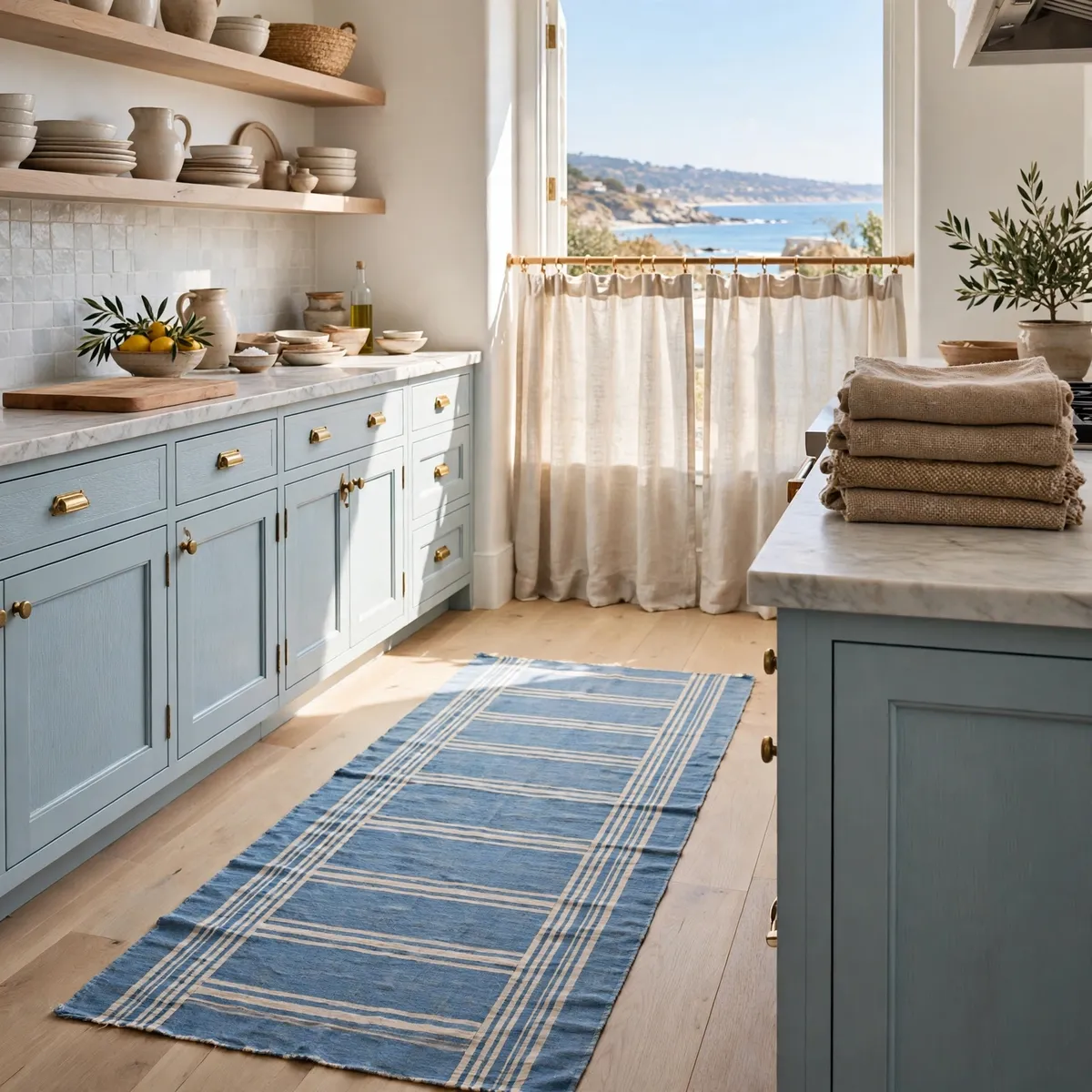
Textiles are the easiest coastal update: a striped linen runner, simple cafe curtains, a stack of grain-sack towels. Natural fibers wrinkle beautifully and wash endlessly — the opposite of fussy. Swap them seasonally for a kitchen that always feels fresh.
Quick tips
- Stick to two stripe scales maximum per room.
- Washable everything — kitchens are working rooms.
18. Build a Sunny Herb Corner by the Window
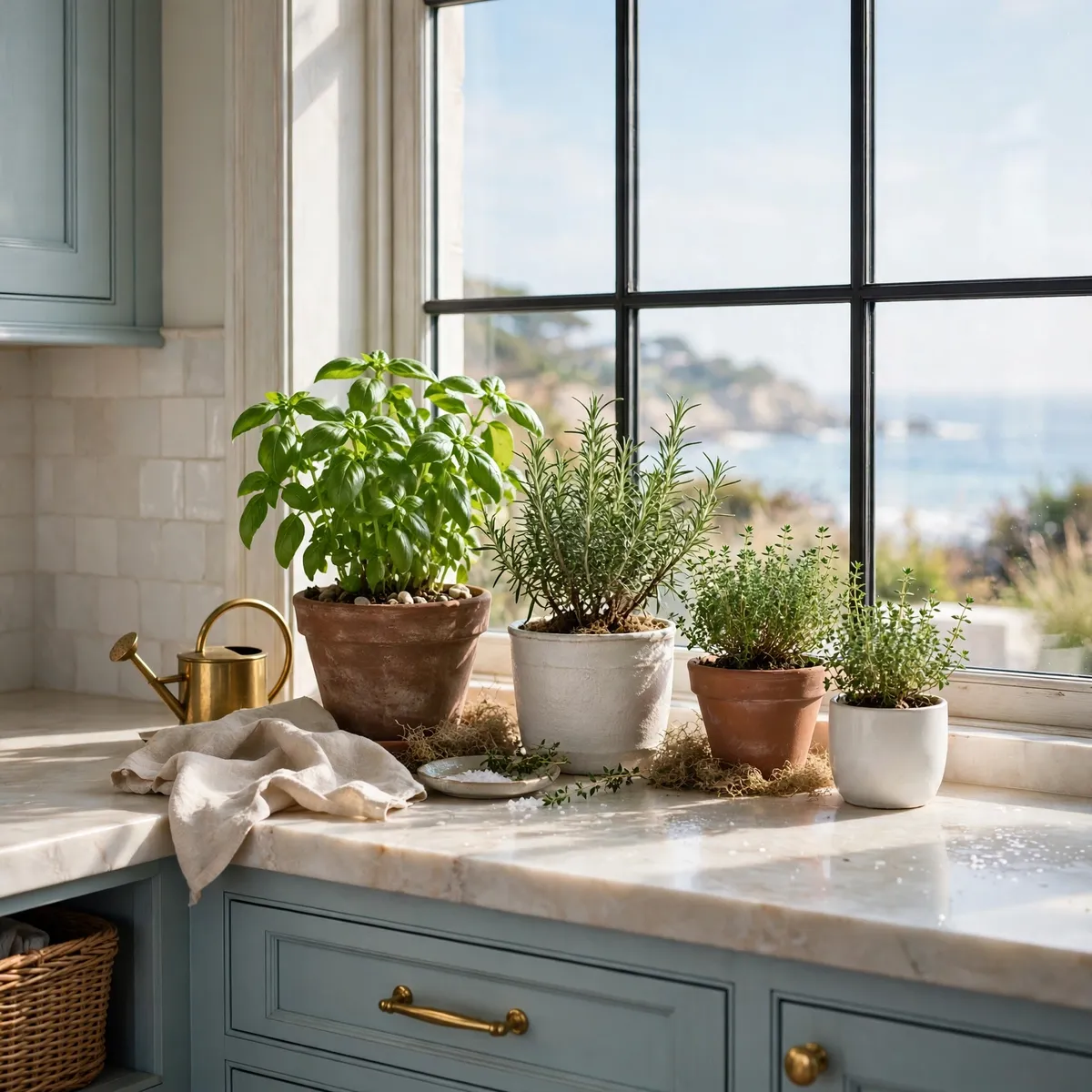
Give the sunniest window a living moment: potted basil, rosemary, and thyme on a deep sill or a slim wall shelf. Coastal kitchen ideas love living texture, and nothing is more effortless than greenery you can cook with. Terracotta pots keep it earthy; white ceramic keeps it crisp.
Quick tips
- South-facing sills grow the strongest herbs.
- Group odd numbers of pots for a natural look.
19. Open the Wall to the Outdoors

Nothing is more coastal than erasing the line between kitchen and terrace. Folding or sliding glass doors turn the island into the threshold — breakfast inside, lunch outside, no difference. Continue the flooring straight through the opening so the eye reads one continuous space.
Quick tips
- Match interior and exterior flooring tones for flow.
- Screen the opening if bugs are a reality.
20. Edit Like a Beach House

The final layer is restraint. Beach houses feel calm because every object earned its place — the same discipline behind great minimalist kitchen ideas. Walk the room with a basket and remove anything purely decorative, duplicated, or theme-shouty. What remains should feel collected, breathable, and ready for bare feet.
Quick tips
- If it needs dusting weekly, question whether it stays.
- Negative space is a design material — leave some.
Frequently Asked Questions
What colors define a coastal kitchen?
Sunwashed neutrals — soft white, warm sand, weathered gray-beige — plus one or two muted sea tones like seafoam, dusty aqua, or soft sage. Coastal kitchen ideas work best when the palette stays in one light, breathable family rather than jumping between bold colors.
How do I make a coastal kitchen look expensive, not themed?
Layer natural materials instead of decorations: woven lighting, pale woods, marble, brass, and linen. Keep any literal nautical references to zero or one, and invest the budget in texture and light rather than themed accessories.
Can coastal kitchen ideas work in a small kitchen?
Absolutely — small kitchens suit the style well. Use glossy sea-glass tile to bounce light, keep the palette light and tonal, choose floating shelves over heavy uppers, and let one woven pendant do the decorating. Restraint makes small coastal kitchens feel bigger.
What flooring is best for a coastal kitchen?
Wide-plank weathered oak or pale wood-look tile — warm underfoot, forgiving of daily wear, and firmly in the coastal family. Run boards in the room’s longest direction and keep the finish matte for an authentic, not glossy, feel.
The Shoreline Takeaway
A coastal kitchen is not a theme — it is a feeling: sunwashed, textured, and easy to live in. Start with the palette, layer natural materials, commit to one confident move, and edit until the room breathes. These coastal kitchen ideas prove that vacation calm is a design choice you can cook in every day. ♥