12 Stunning Kitchen Wall Decor Ideas That Make Your Kitchen Look Bigger, Brighter and More Expensive
Key Takeaways
What is the easiest way to decorate a blank kitchen wall?
Start with one large anchor — a leaning frame, a floating shelf, or a row of plates — then build outward in odd numbers. One anchor plus two smaller pieces reads finished without a full redesign.
How do I decorate kitchen walls without making the room feel cluttered?
Leave breathing room between pieces and repeat one material, like wood or brass, across the wall. Empty space is part of the design, not a gap waiting to be filled.
Can wall decor work in a small kitchen?
Yes — vertical pieces, slim shelves, and mirrored panels add interest without eating counter space. In a small kitchen, the wall is the one surface you can decorate for free.
What should I avoid hanging near the stove?
Keep paper, fabric, and dried plants away from open flames and heavy steam. Use tile, metal, glass, or sealed prints in the cooking zone, and save softer pieces for the dining end of the room.
Table of Contents
- Give Your Kitchen Walls Something to Say
- Where Should You Start With Kitchen Wall Decor?
- How Do You Decorate Kitchen Walls Without Cluttering a Working Kitchen?
- 1. Oak Open Shelving Display
- 2. Subway Tile and Framed Art
- 3. Blue and White Plate Wall
- 4. Living Herb Wall
- 5. Black Chalkboard Wall
- 6. Hanging Copper Pots
- 7. Sage Botanical Prints
- 8. Brass Floating Shelf
- 9. Rust Vintage Signs
- 10. Mirrored Backsplash Panels
- 11. Terracotta Tile Mural
- 12. Mustard Food Print Gallery
- Frequently Asked Questions
- Conclusion
Give Your Kitchen Walls Something to Say
Kitchen walls do more work than any other wall in the house — they frame the cooking, the coffee, and the conversations around the counter. These kitchen wall decor ideas treat the wall as part of the kitchen’s design, not an afterthought: warm oak shelves, framed prints, plate walls, and living herbs that earn their place by being useful as well as beautiful. If you are styling the room as a whole, our kitchen island decor ideas pair naturally with the wall treatments below.
Where Should You Start With Kitchen Wall Decor?
Start with the wall you see first when you walk in — usually the one behind the stove or above the sink. Hang one anchor piece there, then step back before adding anything else. A single strong piece beats five small ones scattered at random.
Next, measure before you buy. Note the wall’s width, cabinet height, and where steam and splashes reach. Those three numbers decide whether a print, a shelf, or a tile mural suits that spot.
How Do You Decorate Kitchen Walls Without Cluttering a Working Kitchen?
The trick is choosing pieces that serve the kitchen as well as decorate it. A shelf that holds daily dishes, a rail that hangs the pans you actually cook with, and a herb wall you snip from are decor that never becomes clutter, because every piece has a job. Compare the two approaches:
| Choice | Decor-Only | Decor That Works |
|---|---|---|
| Shelves | Styled objects you never touch | Daily dishes, glasses, and oils within reach |
| Wall rail | Decorative hooks with ornaments | Pans and utensils you cook with nightly |
| Wall art | Large canvas over the whole wall | Sealed prints sized to the free wall space |
| Plants | Faux trailing vines everywhere | Herbs by the window you snip for dinner |
| Cleaning | Dusty objects near the stove | Wipeable surfaces in the splash zone |
One practical rule ties it together: if a piece sits within arm’s reach of the stove or sink, it should survive steam, splashes, and a quick wipe-down. Softer pieces belong on the dining end of the kitchen, where they stay clean and calm.
1. Oak Open Shelving Display

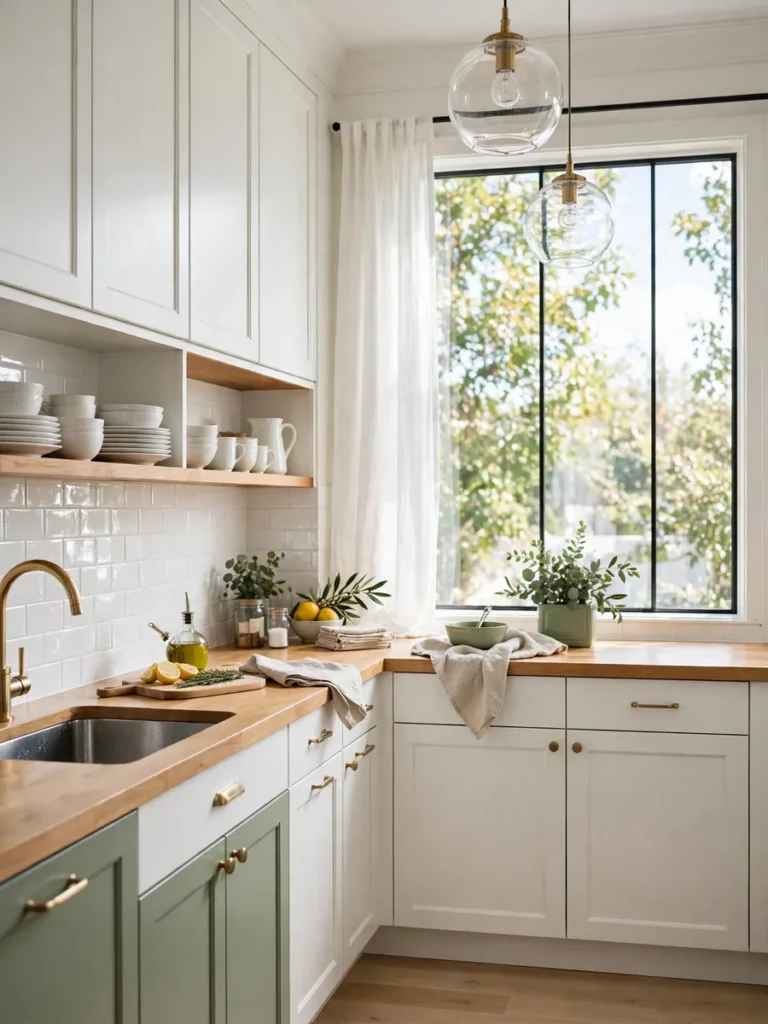
Oak open shelving warms up a plain kitchen wall in a single weekend project. Two thick oak boards on black brackets, spaced about 18 inches apart, give you a display that feels like furniture rather than storage — especially when the wood grain is left visible instead of painted over.
The concrete example: a top shelf holding three cream stoneware bowls, two glass jars of pasta, and one trailing pothos, with everyday white plates stacked below. For more shelf styling, our kitchen shelf decor ideas show how to balance open shelves with closed cabinets.
Quick tips:
- Anchor shelves into studs — dishes are heavier than they look.
- Leave one third of each shelf empty so the display breathes.
- Group by color, not by type, for a calmer look.
2. Subway Tile and Framed Art

White subway tile is the quiet backdrop that lets framed art shine in a kitchen. The tile handles splashes and steam without complaint, while a single framed print above the counter adds the color and personality that tile alone cannot provide.
The concrete example: a sage-green landscape print in a slim oak frame, hung centered above the coffee station, with the tile running up to the bottom of the upper cabinets. The green echoes a small potted plant on the counter, tying wall and worktop together.
Quick tips:
- Hang art at eye level, not at cabinet height.
- Use sealed or glass-fronted frames near the sink.
- One large frame beats three small ones on a narrow wall.
3. Blue and White Plate Wall

A blue and white plate wall turns a collection into the room’s centerpiece. Mix patterns — florals, stripes, and chinoiserie — inside one shared blue-and-white palette, so the wall reads as a collection rather than a jumble of souvenirs.
The concrete example: nine plates arranged in a loose diamond on the dining-end wall, the largest in the center and smaller ones stepping outward, each on a discreet plate hanger. Stand back from the doorway to check the shape before fixing the last two plates.
Quick tips:
- Trace paper templates on the wall first to test the layout.
- Mix plate sizes for a collected, not store-bought, feel.
- Keep plates out of the direct splash zone above the sink.
4. Living Herb Wall

A living herb wall is the rare kitchen decoration that pays for itself at dinner. Terracotta pots on a wall-mounted rail keep basil, mint, and parsley within arm’s reach of the chopping board, and the green softens hard countertops and cabinet lines.
The concrete example: five terracotta pots on two wall rails beside a bright window — basil and mint on the top rail where they catch the light, parsley and chives below. Snip from the outside of each plant so it keeps growing bushy.
Quick tips:
- Pick a wall that gets at least a few hours of daylight.
- Use pots with drainage and a drip tray behind them.
- Label pots if you grow lookalike herbs like flat-leaf parsley and cilantro.
5. Black Chalkboard Wall

A black chalkboard wall gives a kitchen a cozy, cafe-like personality and a genuinely useful surface. One wall — or one large framed chalkboard panel — becomes the weekly menu, the shopping list, and the place for notes.
The concrete example: a framed chalkboard panel beside the fridge, headed with the week’s dinners in neat chalk lettering and a small doodled border of coffee cups. Swap the menu every Sunday and the wall never goes stale.
Quick tips:
- Use chalk markers for crisp lines that still wipe off clean.
- Prime a new chalkboard by rubbing chalk over the whole surface first.
- Keep the board away from direct steam so writing stays readable.
6. Hanging Copper Pots

Hanging copper pots bring warmth and a professional-kitchen feel to a cream kitchen wall. The copper glow does the decorating, while the rail frees up an entire cabinet — a practical win that also looks beautiful from the doorway.
The concrete example: a matte black wall rail with five copper pieces — two saucepans, a sauté pan, a small stockpot, and a ladle — hung by their handles with the largest pan in the center. Polish the two most visible pans monthly and let the rest develop a lived-in patina.
Quick tips:
- Hang pans you actually use, not a matching set bought for show.
- Keep the rail clear of the stove’s direct heat.
- Space hooks evenly so pans don’t knock together.
7. Sage Botanical Prints

Sage botanical prints are the calmest way to add color to a kitchen wall. The soft green suits cream cabinets, wood counters, and white tile alike, and a row of botanical prints reads intentional without demanding attention the way a bold poster would.
The concrete example: three botanical prints in matching light-wood frames, hung in a straight row above a sideboard — eucalyptus, olive branch, and fern, each matted in cream. The matching frames and mats make three different plants look like one deliberate set.
Quick tips:
- Match frames and mats across the set for a unified look.
- Space prints a hand’s width apart, no more.
- Choose prints with cream backgrounds for light kitchens.
8. Brass Floating Shelf

A brass floating shelf is a small piece with an outsized effect on a white kitchen wall. The slim brass rail and brackets catch the light, while the shelf holds just enough — a few jars, a tiny plant, a favorite mug — to feel styled rather than stored.
The concrete example: a single 24-inch brass shelf above the coffee corner, holding two glass jars of coffee beans, one small trailing plant, and a cream ceramic mug on a brass hook beneath. The arrangement takes one minute to reset after the morning coffee rush.
Quick tips:
- One shelf styled well beats three shelves stuffed full.
- Keep shelf items to one color family plus green.
- Wipe brass monthly to keep the shine even.
9. Rust Vintage Signs

Rust vintage signs give a kitchen wall a flea-market soul without a full renovation. The weathered metal and faded lettering suit cream walls and wood counters, and a couple of signs can set the tone for a farmhouse-style corner.
The concrete example: two rust-finished metal signs above the baking counter — a faded “Fresh Bread” sign and a smaller market-style sign — hung slightly off-center so the arrangement feels found, not arranged.
Quick tips:
- Limit rust signs to one wall so the look stays charming, not themed.
- Pair rust metal with wood, not more metal, for balance.
- Seal real rusted pieces so they don’t stain the wall.
10. Mirrored Backsplash Panels

Mirrored backsplash panels are the smartest trick for a kitchen that feels dark or cramped. The mirror doubles the light from the window and the room beyond, and panels read as a deliberate backsplash choice.
The concrete example: antiqued mirror panels run between the counter and the upper cabinets on the windowless wall, reflecting the opposite window and the pendant lights. The antiquing softens the reflection so you notice light and movement, not yourself while chopping onions.
Quick tips:
- Choose antiqued or smoked mirror to soften reflections.
- Seal panel edges so steam can’t creep behind them.
- Keep mirrored panels out of the direct cooking splash zone.
11. Terracotta Tile Mural

A terracotta tile mural turns the wall behind the stove into the kitchen’s artwork. Hand-painted or patterned terracotta tiles bring earthy warmth that plain tile cannot, and because tile is heat- and steam-proof, the cooking wall is exactly where a mural belongs.
The concrete example: a four-by-three-foot panel of patterned terracotta tiles centered behind the range, framed by plain cream tiles on either side. The plain border is what makes the mural look like art rather than a tile sample board.
Quick tips:
- Center the mural on the range, not on the whole wall.
- Seal terracotta tiles so tomato splashes wipe off easily.
- Carry one mural color into a counter accessory for cohesion.
12. Mustard Food Print Gallery

A mustard food print gallery is the warmest way to fill a long, empty kitchen wall. Mustard yellows — lemons, cheese boards, pasta illustrations — glow against cream walls and black frames, and a gallery wall lets you add prints over time instead of committing to one large piece.
The concrete example: six mustard-toned food prints in slim black frames, arranged in two rows of three along the wall leading to the dining area, with the largest lemon print at the center of the top row. Start with four prints and add more later; a gallery that grows looks collected.
Quick tips:
- Keep frame style identical across the whole gallery.
- Align the top row and let the bottom row vary slightly.
- Use mustard as an accent, not the wall color itself.
Frequently Asked Questions
How do I decorate the wall above my kitchen cabinets?
Work with the gap, not against it: if the gap is tall, use large baskets, tall vases, or oversized platters; if it is shallow, a slim garland or a low row of small plates is enough. Dust the tops monthly, since grease and dust settle there faster than anywhere else in the house.
What is the best renter-friendly way to decorate kitchen walls?
Leaning art, adhesive hooks rated for the weight, and freestanding shelves that rest on the counter need no drilling at all. Strips hold light frames well on tile and painted walls, and a tension rod inside a window frame can hang a small herb rail without a single hole.
How can I decorate a small kitchen wall without shrinking the room?
Choose one vertical arrangement — a tall slim shelf, a stacked pair of frames, or a single tall print — and keep the rest of that wall bare. Light colors, glass-fronted frames, and a mirror or two bounce light around, while dark, busy wallpaper on every wall tends to close a small kitchen in.
What wall decor is safe near the stove?
Tile, metal, stone, and glass are the safest materials beside a range, since they handle heat and wipe clean after cooking splashes. Keep anything paper, fabric, or plastic at least a full arm’s length from burners, and never hang dried flowers or loose fabric above an open flame.
Conclusion
The best kitchen wall decor ideas prove a kitchen wall can be both beautiful and hardworking — a shelf that holds your daily dishes, a rail that frees a cabinet, a mural that survives the stove, and prints that brighten the morning coffee. Start with the wall you see first, pick one idea that fits your space, and let the wall grow from there.