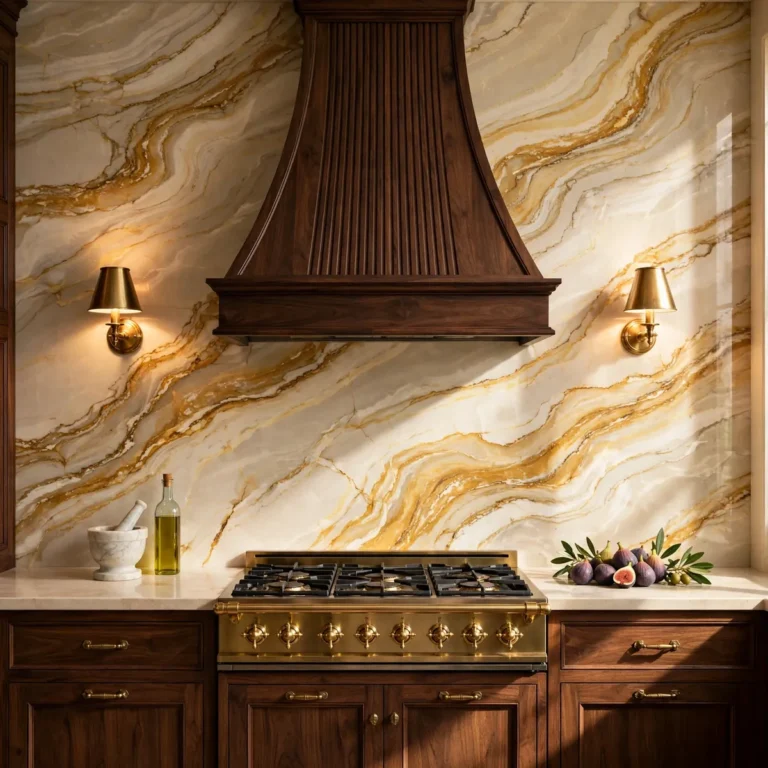
12 Stunning Kitchen Shelf Decor Ideas
Key Takeaways
What is the simplest formula for styling kitchen shelves?
One tall anchor (a cutting board, pitcher, or stack of bowls), one medium piece (mugs or a jar), and one small detail (a plant or candle) per shelf — then repeat that rhythm down the wall with slight changes.
How many items should go on one kitchen shelf?
Three to five groupings per shelf, with real breathing room between them. A full-width stack of plates counts as one grouping; the empty space is what keeps the whole thing from looking crowded.
What can I put on kitchen shelves besides dishes?
Glass canisters of dry goods, a small potted herb, one framed print, cookbooks you actually cook from, and a candle or lantern. If it isn’t useful or genuinely pretty, it doesn’t earn the spot.
Do open kitchen shelves work in a small kitchen?
Yes — they make a small kitchen feel bigger. Keep them shallow, around 10 inches deep, stick to daily dishes, and don’t add more shelf than your storage needs.
Table of Contents
- Why Your Shelves Deserve a Styling Plan
- What Are the Best Kitchen Shelf Decor Ideas for Open Shelving?
- How Do You Style Kitchen Shelves Without Clutter?
- 1. Sage Stoneware on White Oak
- 2. Moody Black Shelves with Brass and Amber
- 3. Blush-and-Walnut Farmhouse Layers
- 4. Crisp Navy with White Ceramics
- 5. Gray Shelves, Rattan Baskets, and Greenery
- 6. Emerald Plates on a Deep Green Wall
- 7. Dusty Blue Mediterranean Layers
- 8. Ivory and Brass on Dark Green
- 9. Lemon, Honey Wood, and Bright White
- 10. Copper and Linen on Soft Gray
- 11. Terracotta with Cream and Iron
- 12. Slate Shelves with Fresh Herbs
- Frequently Asked Questions
- Conclusion
Why Your Shelves Deserve a Styling Plan
Kitchen shelves are the one part of your kitchen that works like a gallery wall — visible from everywhere, touched daily, and dead easy to get wrong. The good news is that great kitchen shelf decor ideas aren’t about buying more stuff; they’re about editing what you already own into groupings that look intentional. This post walks through the formulas stylists use — anchors, odd-numbered groups, breathing room — then gives you twelve complete looks, from moody black shelves to sunny Mediterranean blue, each with a concrete styling recipe and quick tips. If your island is next on the list, our kitchen island decor ideas show how to pull the same palette down to counter level.
What Are the Best Kitchen Shelf Decor Ideas for Open Shelving?
The best kitchen shelf decor ideas for open shelving mix daily-use items with a few decorative pieces: stacked white bowls, one wooden board, glass canisters, and a small plant per shelf — heavy pieces low, decor high, and every grouping earning its place.
| Shelf type | Best for | Styling rule | Watch out for |
|---|---|---|---|
| Floating oak shelf | Modern and Scandinavian kitchens | Keep silhouettes simple; the invisible bracket is the look | Weight limits — stoneware, not cast iron |
| Bracketed wood shelf | Farmhouse and rustic kitchens | Let the brackets show; match them to your hardware | Chunky brackets eat shelf space |
| Painted shelf, wall-matched | Small kitchens that need airiness | Go tone-on-tone so dishes are the star | Too many colors breaks the calm |
| Corner wrap shelf | Dead corners and small kitchens | Use it for daily glasses, not decor | Hard to reach — keep it functional |
| Above-sink single shelf | Everyday hand soap, plant, small art | One low grouping only; nothing tall | Water splashes — wipeable items only |
How Do You Style Kitchen Shelves Without Clutter?
Style in groups of three, leave a quarter to a third of each shelf empty, hold to two or three colors, and display only what you use weekly — anything that sits untouched for a month comes down off the shelf.
1. Sage Stoneware on White Oak
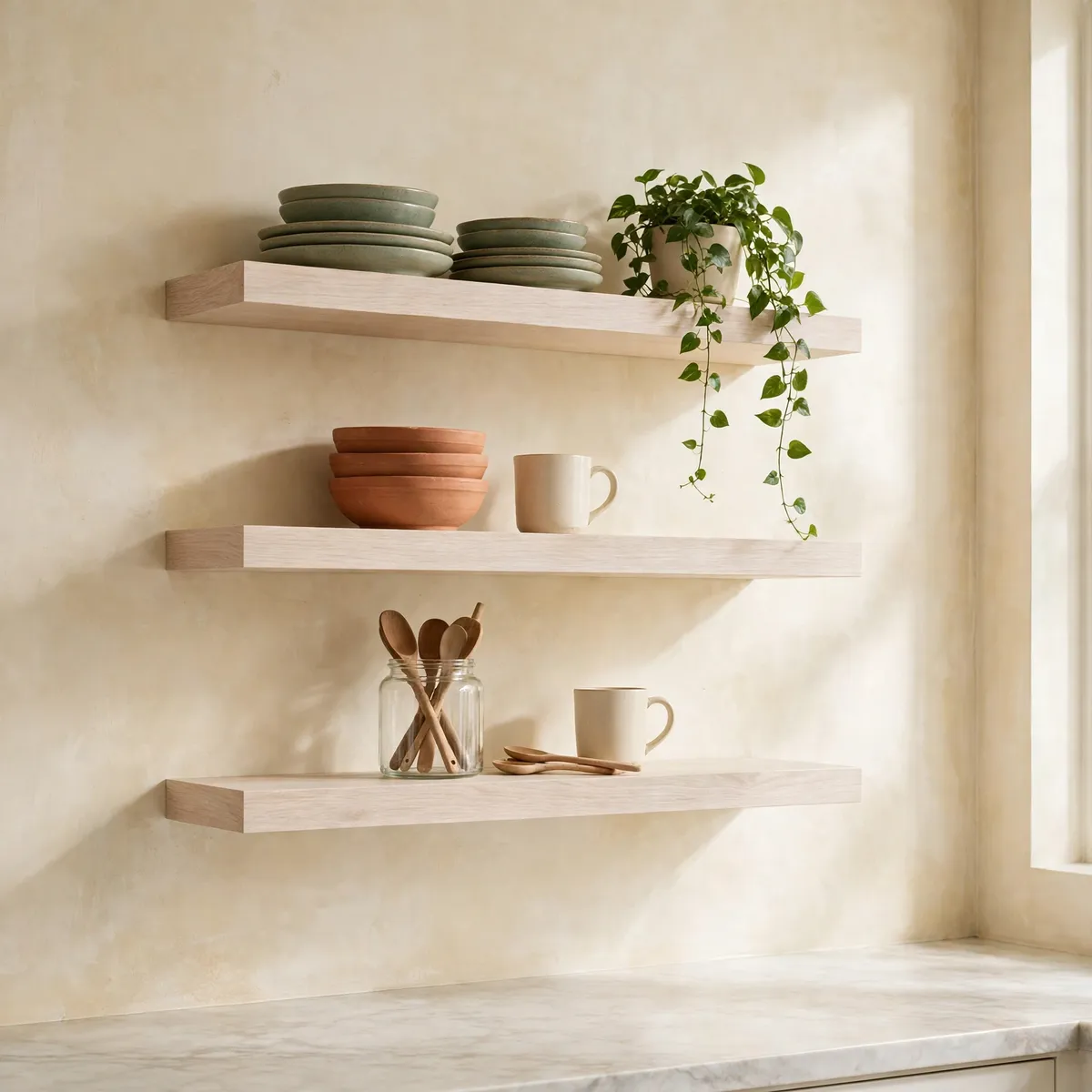
White oak shelves are the quiet luxury of kitchen styling: pale, warm, and forgiving. Stack sage green stoneware plates in two staggered piles, add a pair of small terracotta bowls, and hang cream mugs from underside hooks so the shelf surface stays uncluttered.
The concrete move: one glass jar of wooden spoons on the right end, one trailing pothos in a cream pot on the left. The plant softens the straight lines of the plates, and the whole palette stays inside white, sage, terracotta, and oak.
Quick tips:
- Stagger plate stacks instead of centering them — offset reads styled, centered reads showroom.
- Underside mug hooks double your storage without visual weight.
- Wipe oak shelves monthly with a barely damp cloth; standing water stains them.
2. Moody Black Shelves with Brass and Amber
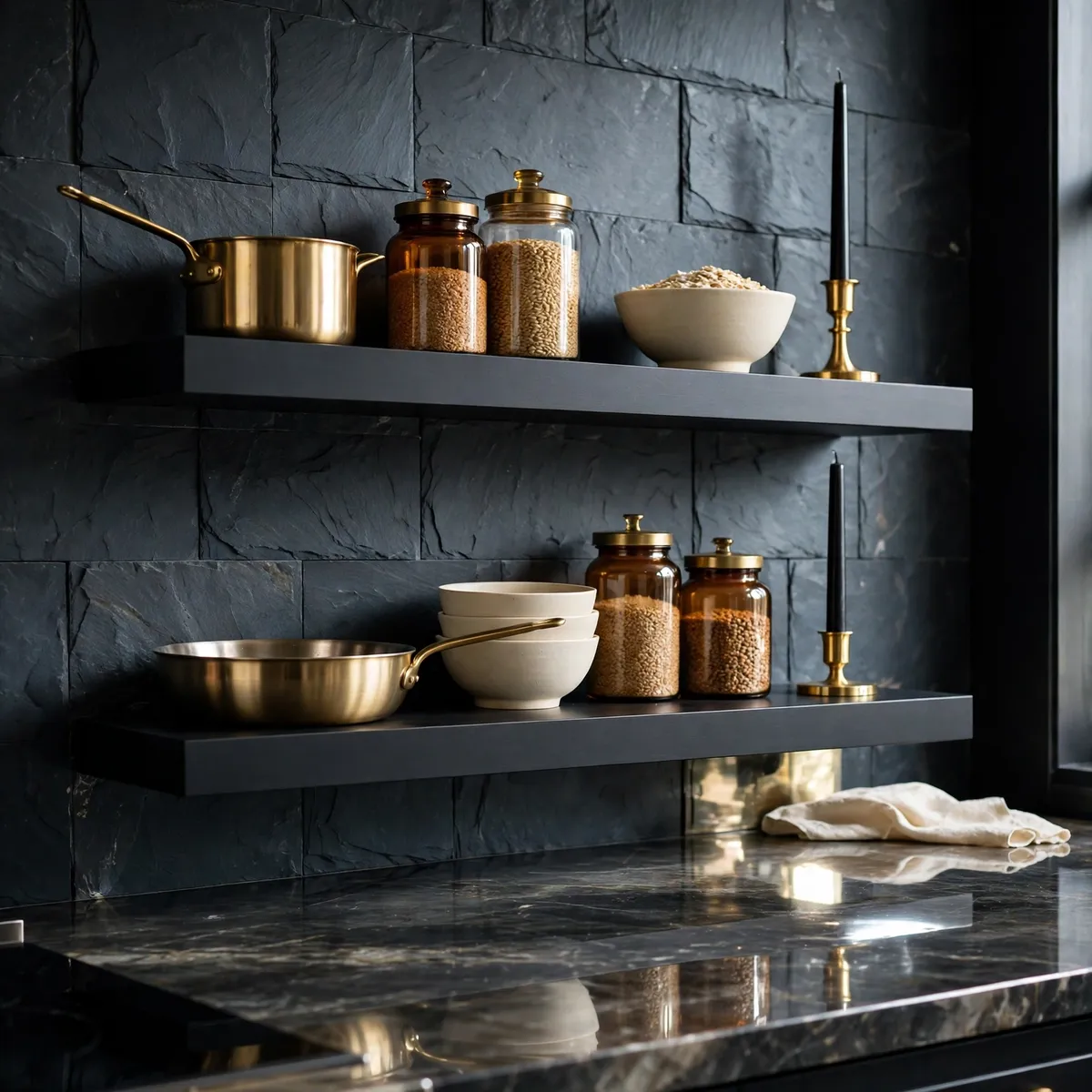
Black shelves make everything on them look like it was chosen on purpose. Against a moody slate wall, group cream stoneware bowls on the lower shelf and move the decorative weight up top: brushed brass pans hung from a low rail, amber glass jars of grains and pasta, and two tall black tapers in brass holders.
The concrete example: three amber apothecary jars in descending sizes filled with lentils, rice, and pasta, their warm glow pulling the whole arrangement together under evening light. Brass is the hinge here — it bridges the black shelf and the cream dishes so the look never goes cold.
Quick tips:
- Black shelves show dust fast; a weekly microfiber pass takes two minutes.
- Keep one metal finish only — brass here — or the moody look turns busy.
- Amber glass hides contents better than clear, so half-empty jars still look good.
3. Blush-and-Walnut Farmhouse Layers
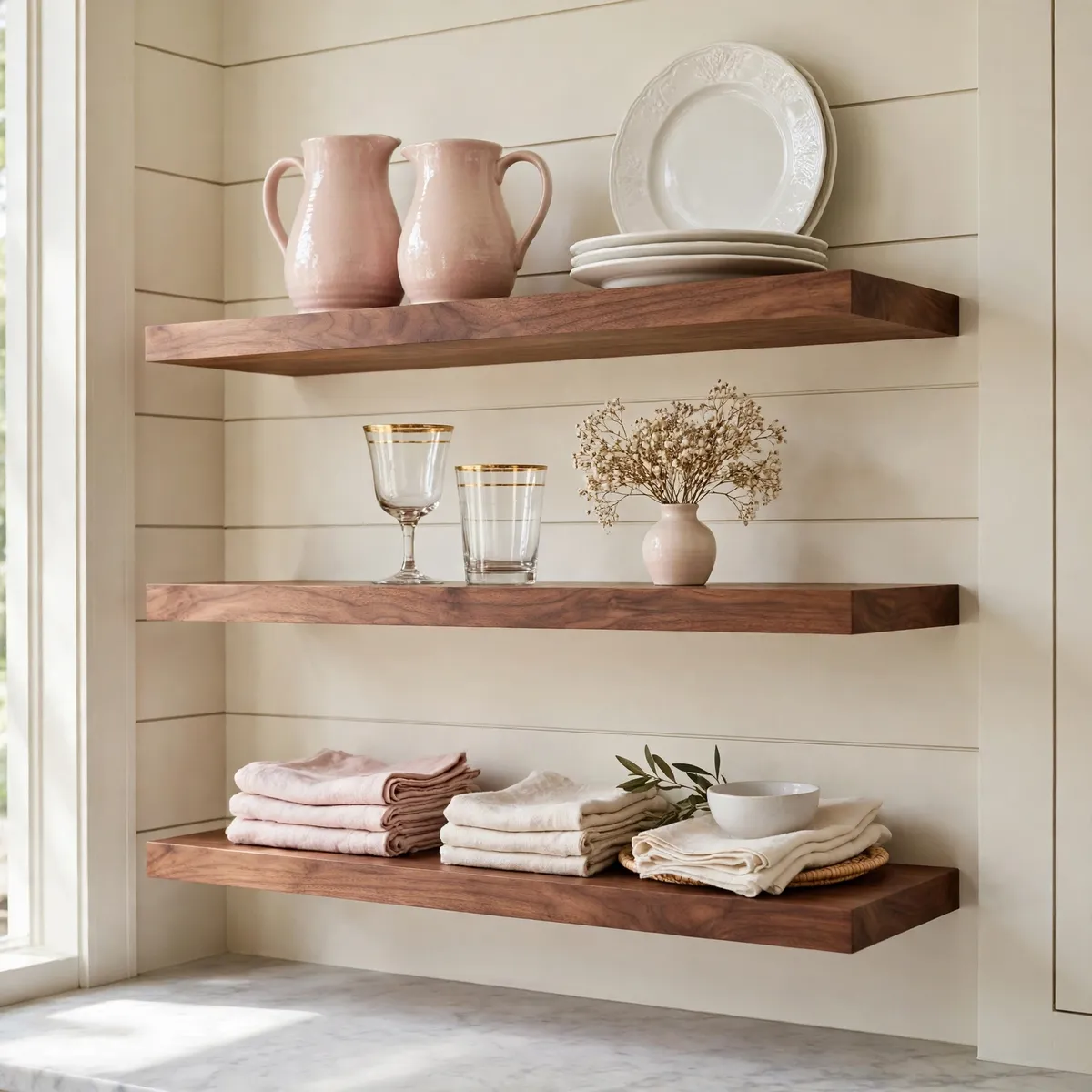
Walnut shelves on cream shiplap are farmhouse without the clichés, especially when pink enters the picture. A blush ceramic pitcher becomes the hero piece; flank it with stacks of white ironstone plates and a row of gold-rimmed glasses that catch the light.
The concrete move: lean a walnut cutting board behind the pitcher for height, then tuck a tiny vase of dried baby’s breath in front so something soft breaks up the hard ceramics. Fold two blush linen napkins into a low stack on the right end for a textile layer the ceramics alone can’t give.
Quick tips:
- Pink reads best in matte ceramic; glossy pink can tip into bubblegum.
- One pitcher is a hero; three pitchers is a collection — commit to one.
- Dried baby’s breath lasts months and costs almost nothing to replace.
4. Crisp Navy with White Ceramics
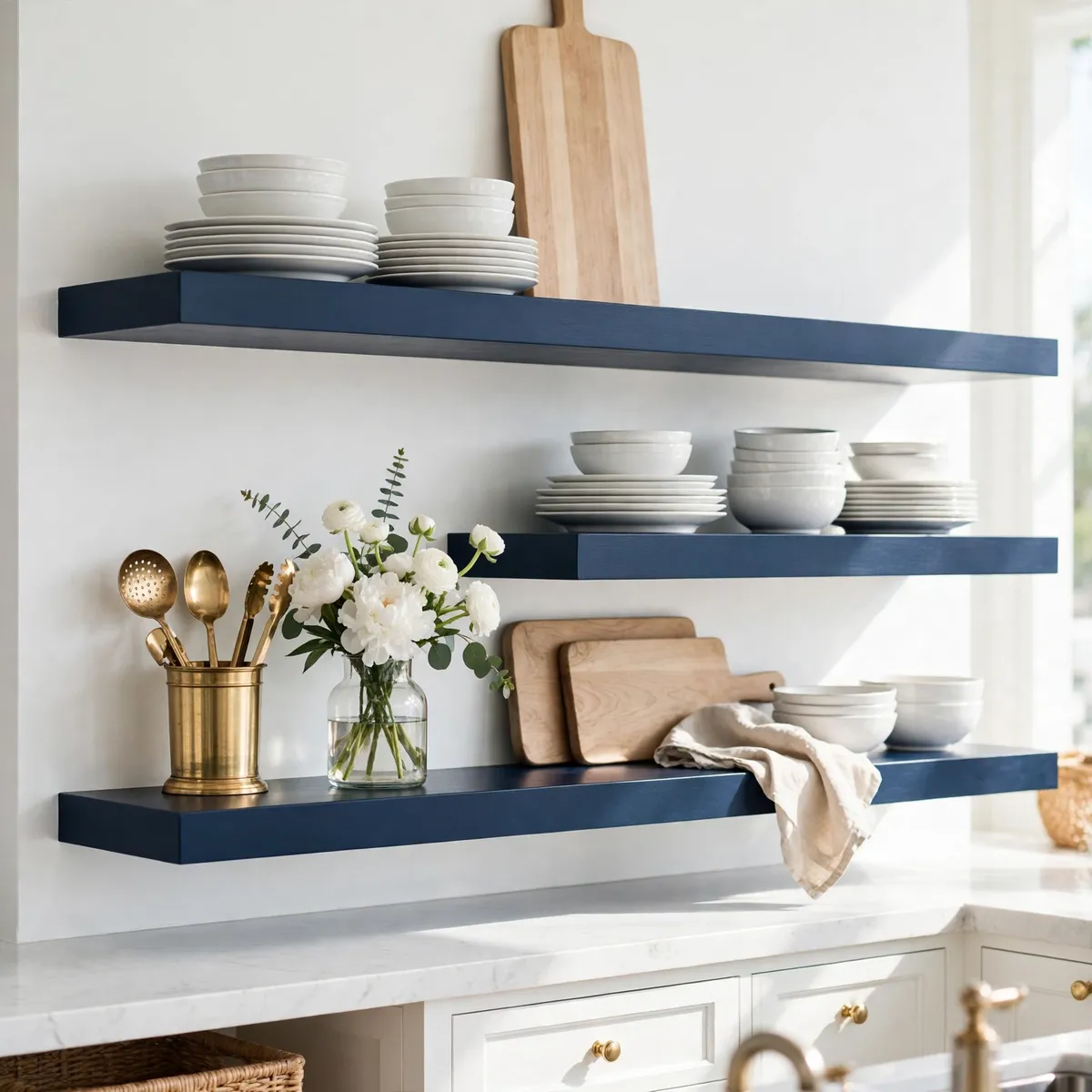
Navy shelves with white dishes are the coastal kitchen’s power move, and they work because the contrast is so clean. Stack crisp white dinnerware in generous piles — navy forgives an imperfect stack — and slide light-wood cutting boards vertically between groupings for warmth.
The concrete example: a brass utensil holder filled with wooden spoons on the middle shelf, a clear glass vase of white blooms on top, and white bowls nested inside each other below. The navy recedes, the white pops, and the wood and brass stop it feeling stark.
Quick tips:
- White dishes on dark shelves need less perfect styling — contrast does the work.
- Boards stored vertically add height without adding clutter.
- Keep brass small (one holder, one hook rail) so the navy stays dominant.
5. Gray Shelves, Rattan Baskets, and Greenery
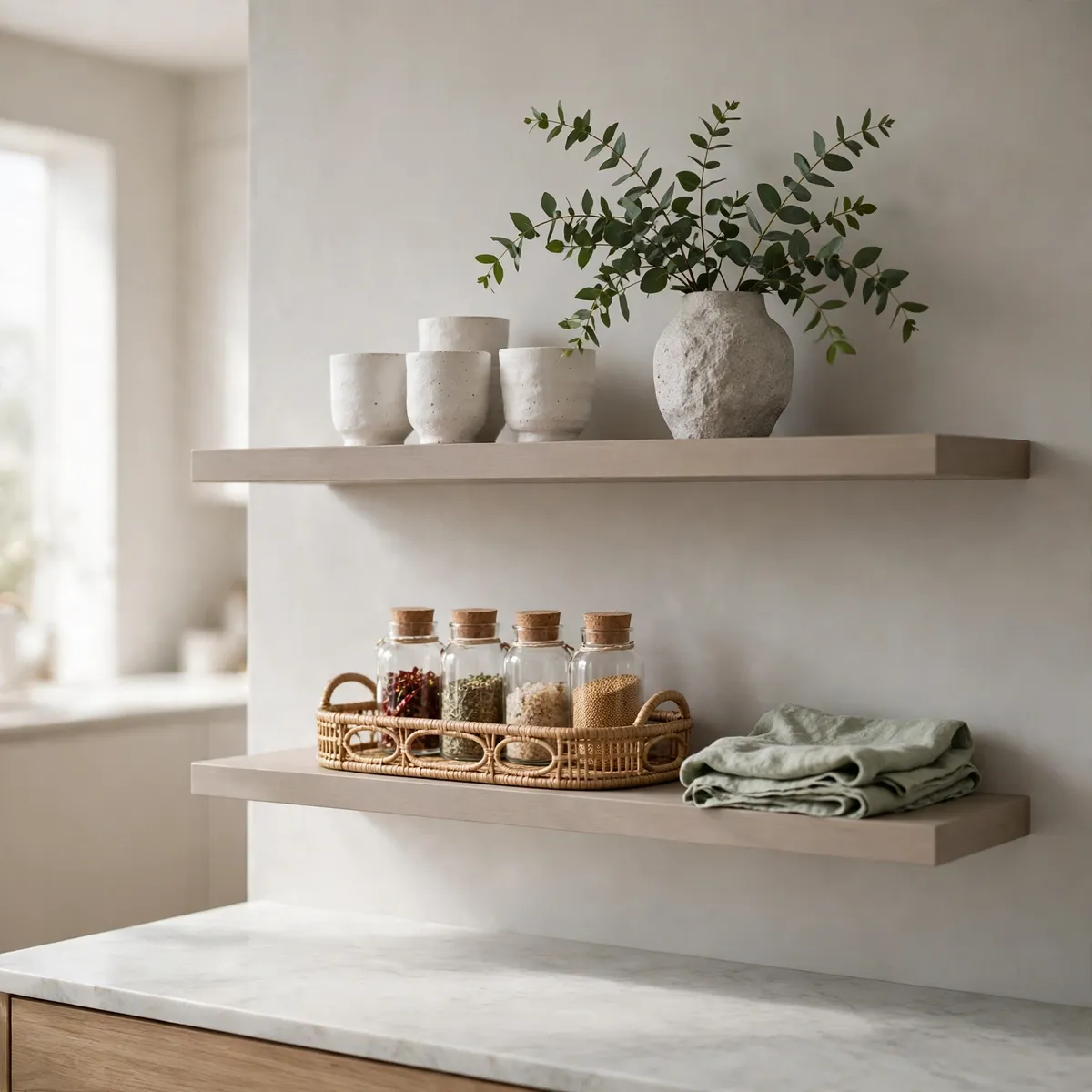
Warm gray shelves are the best backdrop for a kitchen that stores real things in plain sight. The trick is corralling: a woven rattan tray holds three glass spice jars, another holds folded sage linen towels, and suddenly loose items become one intentional grouping.
The concrete example: a rattan tray on the middle shelf with four matching glass jars of flour, sugar, rice, and oats, each with a simple label. White handmade cups fill the gaps, and a stone vase of eucalyptus sprigs finishes the top shelf. For the full system behind the pretty jars, our pantry organization ideas cover decanting, labeling, and rotation in detail.
Quick tips:
- Decant into matching jars — mixed packaging is what actually looks messy.
- Rattan loves kitchen humidity; synthetic weave lasts longer near the stove.
- One tray per shelf maximum, or the shelves start looking like storage bins.
6. Emerald Plates on a Deep Green Wall
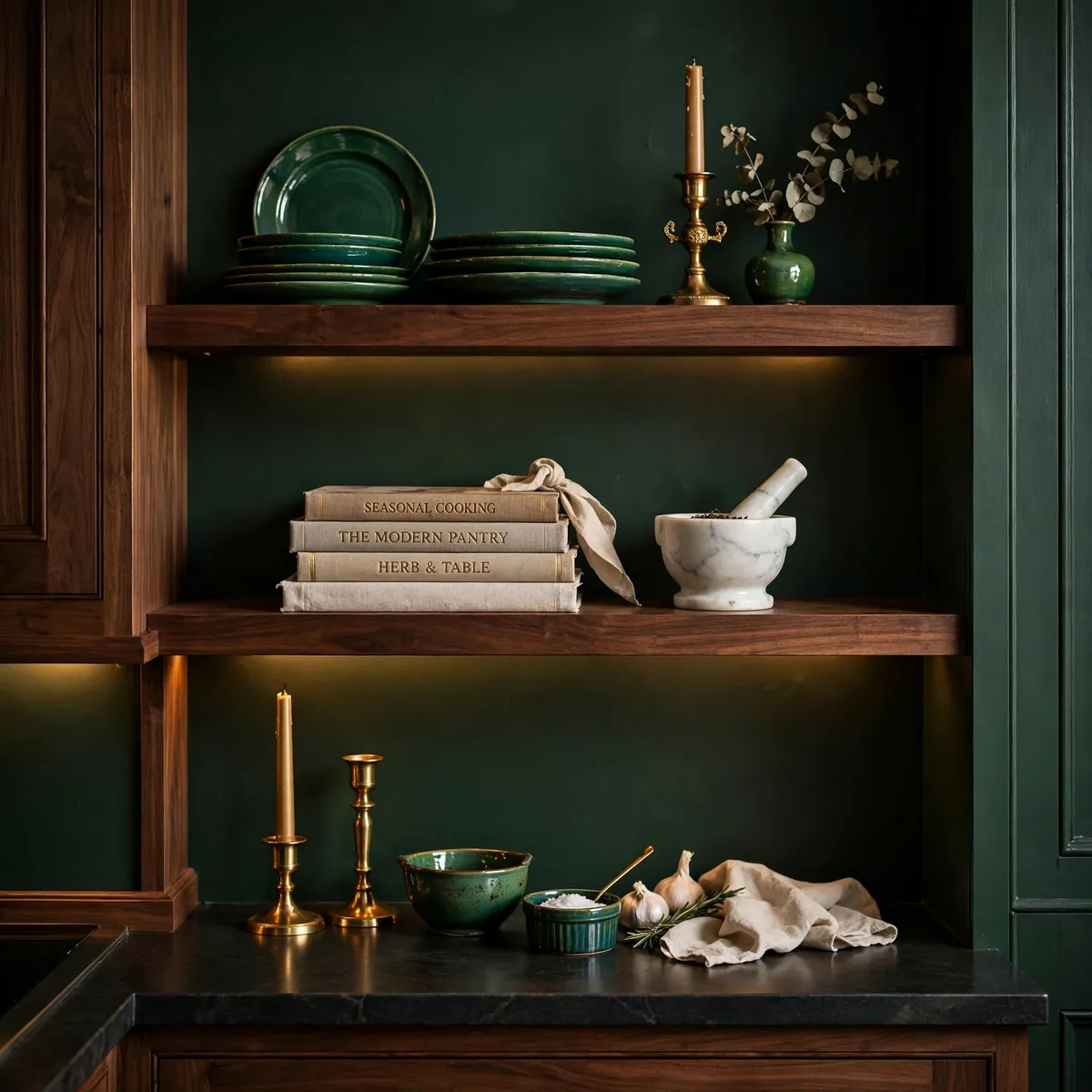
A deep green wall behind walnut shelves is unapologetically rich, and emerald ceramic plates lean straight into it. Stack them in pairs with a champagne brass candle holder between each pair, then place a white marble mortar and pestle at one end as the pale punctuation mark.
The concrete example: three linen-bound cookbooks stacked flat on the bottom shelf, topped with the mortar — a little still life that says someone actually cooks here. The brass picks up under-cabinet light and glows against the green, which is the whole point of this palette.
Quick tips:
- On a dark wall, one pale object per shelf keeps the arrangement readable.
- Champagne brass reads softer than yellow gold against green.
- Books stored flat are steadier than upright on a shallow shelf.
7. Dusty Blue Mediterranean Layers
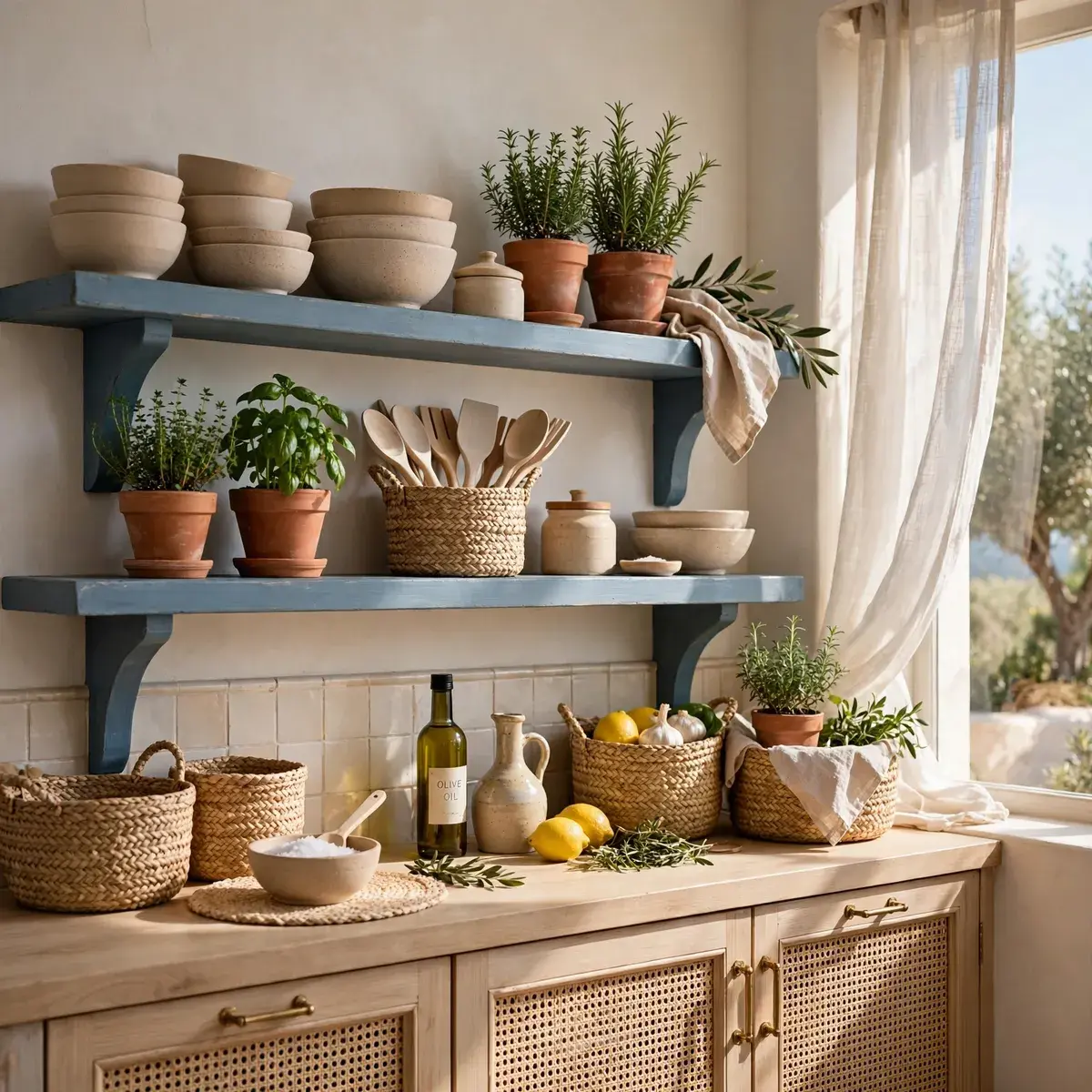
There is something about dusty blue shelves in a sunlit kitchen that makes even Tuesday dinner prep feel like a holiday, and the styling should lean into that ease: sand-colored ceramic bowls stacked casually, terracotta pots of basil and thyme lined up where you’ll actually snip them while cooking, pale wood utensils standing in a clay crock, and a seagrass basket on the end for the bread or the onions that never have a home. Because this look is built from working pieces rather than precious ones, it survives real life — the bowls get used, the herbs get watered, the basket gets emptied and refilled — and it still photographs beautifully at golden hour; just keep the palette honest (blue, sand, clay, wood, one green) and let the sun do the decorating.
Quick tips:
- Herbs on shelves need the brightest spot you have — rotate pots weekly.
- Terracotta pots drip; use saucers or a tray underneath.
- Sand-colored ceramics hide hard-water marks better than white.
8. Ivory and Brass on Dark Green
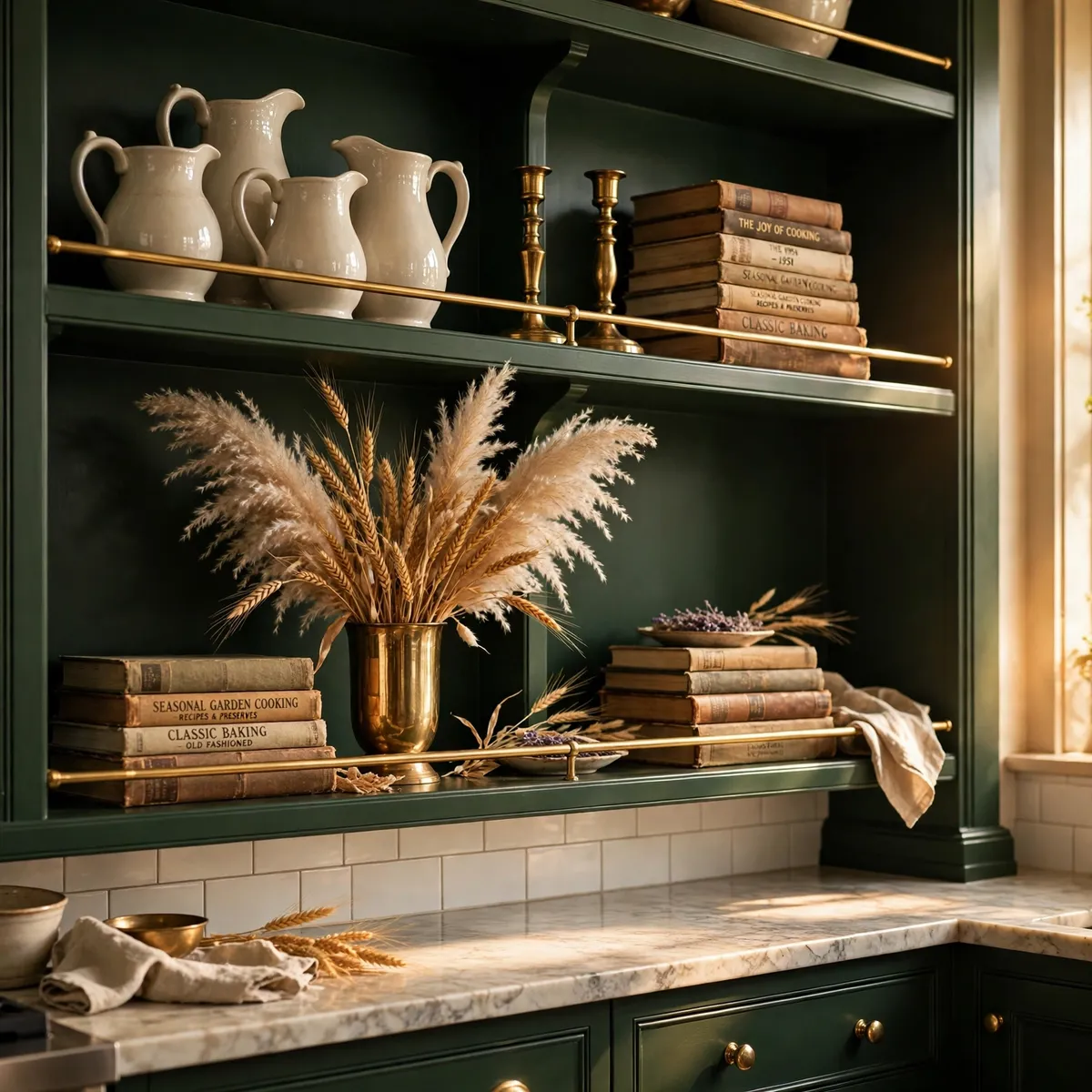
Hunter green shelves with a brass gallery rail are the traditional kitchen’s answer to open shelving, and they ask for old-soul styling. Ivory ceramic pitchers in two sizes, brass candlesticks with ivory tapers, and a tall brass vase of dried pampas grass and wheat — nothing here is trying to be modern.
The concrete example: a stack of three antique-look cookbooks with worn cloth covers, topped by one small ivory pitcher. The rail keeps everything corralled and adds the jewelry-box detail that makes green-and-brass feel deliberate instead of dark.
Quick tips:
- Dried stems near tapers mean LED candles only — never real flames.
- Ivory beats pure white here; it matches the aged mood.
- Gallery rails are also practical: they stop jars sliding on a busy shelf.
9. Lemon, Honey Wood, and Bright White
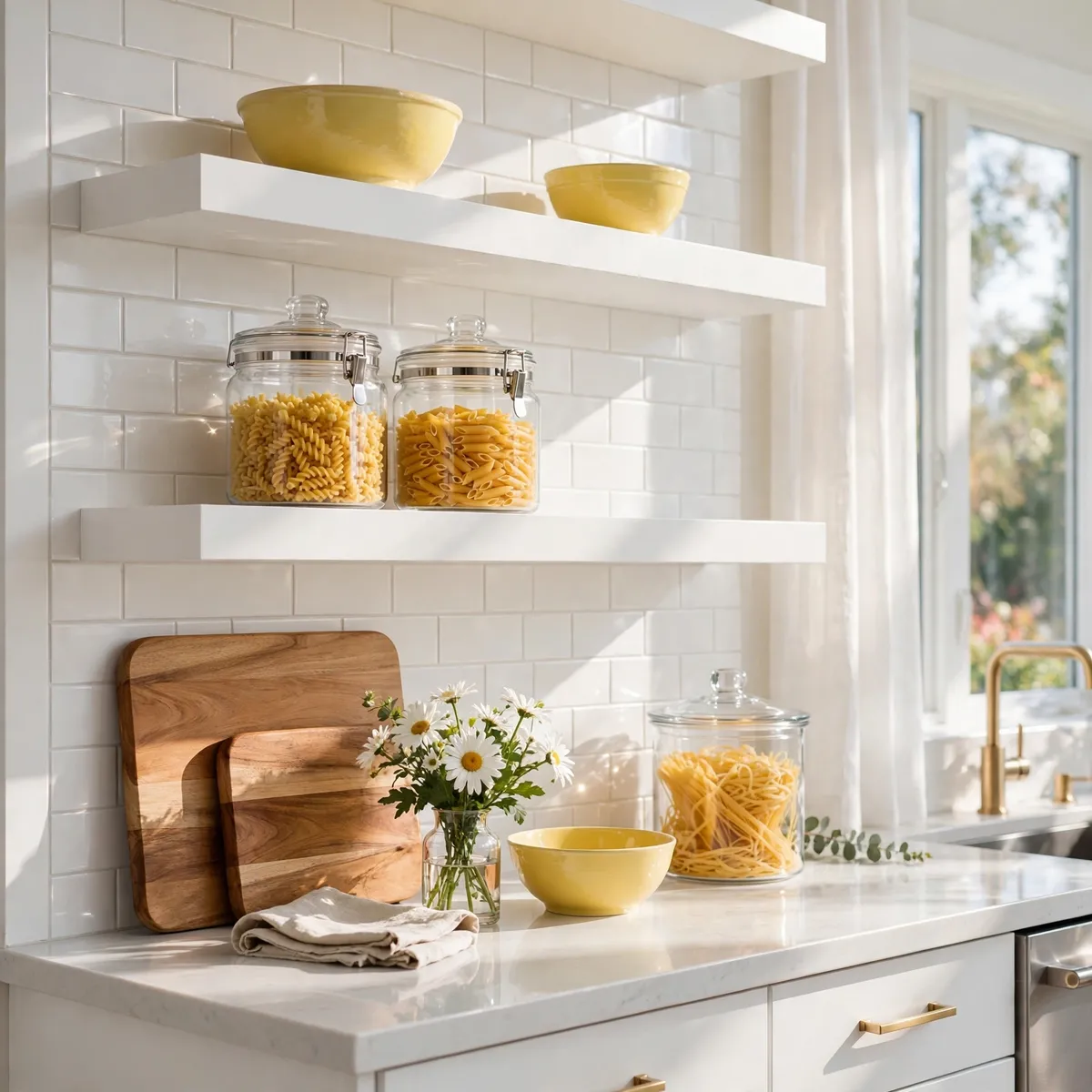
If your kitchen gets good morning light, say yes to it with lemon yellow. Bright white shelves, lemon ceramic bowls stacked in a sunny pile, honey-toned acacia cutting boards leaning behind, and clear glass canisters of pasta and grains that glow when the light hits.
The concrete move: a small glass vase of fresh daisies on the top shelf — the one living thing among all the hard surfaces, and the cheapest refresh in this entire post.
Quick tips:
- Yellow works in small doses: two or three pieces, then stop.
- Clear canisters need tidier contents; decant only what looks good.
- Honey-toned wood warms up white shelves that can feel clinical.
10. Copper and Linen on Soft Gray
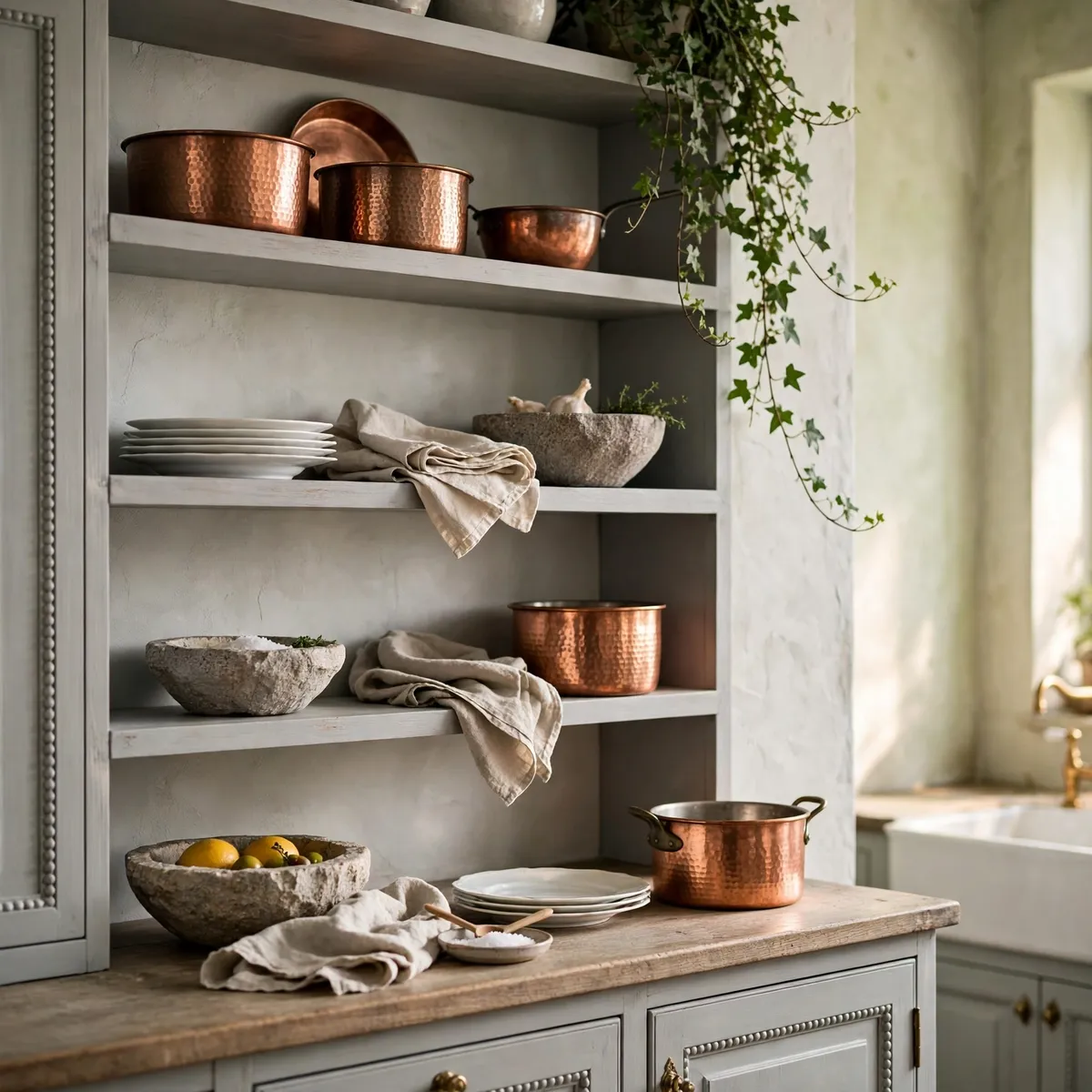
Hammered copper on soft gray is rustic French without the theme-park version. Hang two or three copper pots from hooks under the shelf — the hammered texture is the decoration — and stack white porcelain plates beside rough stone serving bowls for the smooth-against-rough contrast.
The concrete example: a folded natural linen towel draped over the shelf edge, a trailing ivy plant in a small stone pot on top, and one copper saucepan hung where it catches the window light. The linen softens every hard edge, which is exactly its job.
Quick tips:
- Copper needs polishing or it dulls — embrace the patina or commit to the cloth.
- Heavy pots need hooks screwed into studs, not just the shelf board.
- Linen towels on display should be the good ones, laundered often.
11. Terracotta with Cream and Iron
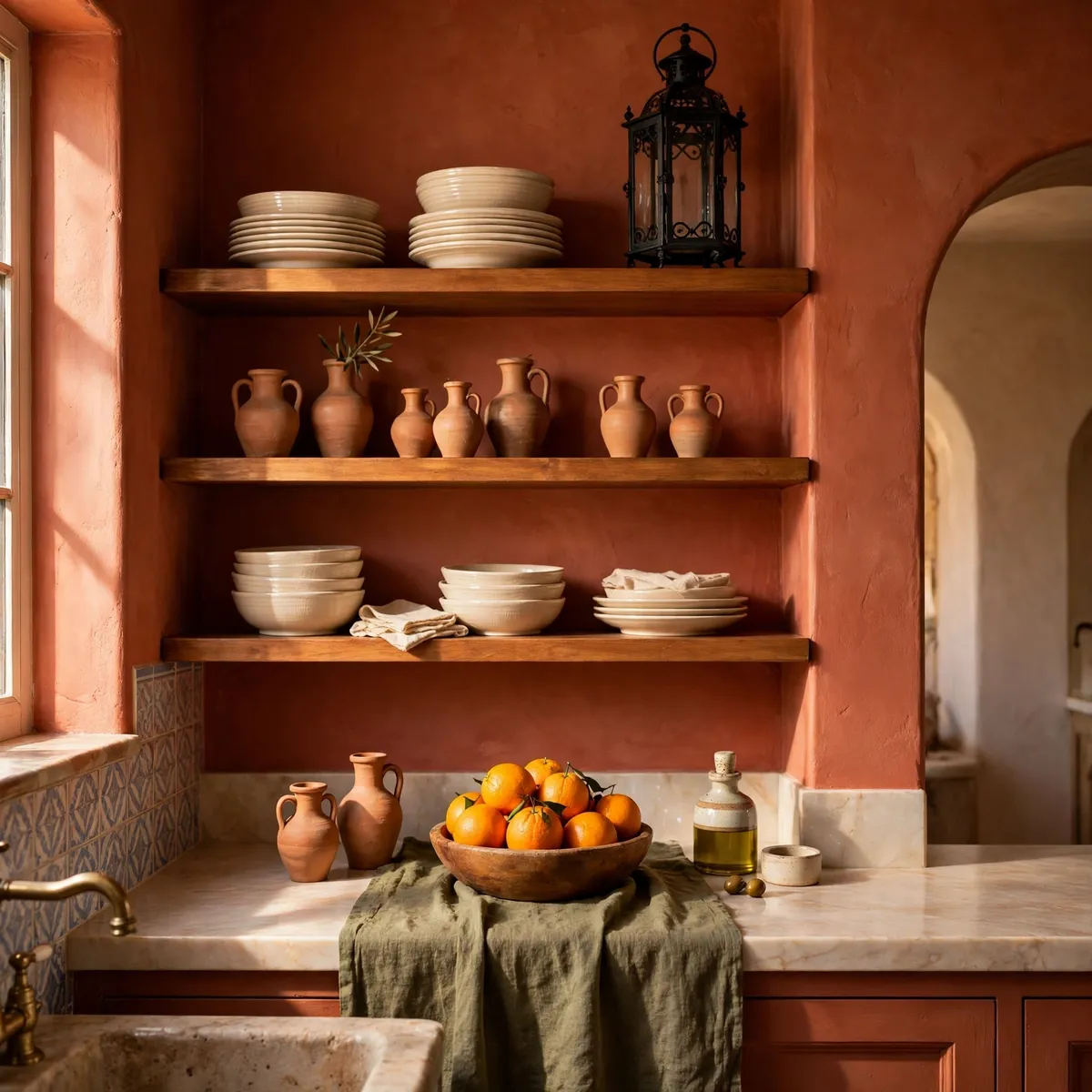
Terracotta-painted shelves bring the warmth of a Spanish kitchen, and cream dishware is their natural partner. Stack cream plates and bowls generously, then anchor the arrangement with a black wrought-iron lantern — the dark metal keeps all that warmth from going sleepy.
The dark green is the wall here, not the shelves — cream, clay, and iron do the rest.
The concrete example: small clay amphora vases in two sizes holding nothing at all (they’re sculptural enough), a wooden bowl of oranges for the one fresh color note, and an olive green linen runner laid along the shelf under the plates.
Quick tips:
- Fruit bowls are decor that gets eaten — oranges and lemons last longest.
- One dark metal piece per shelf is enough to ground warm palettes.
- A washable runner saves painted shelves from plate scuffs.
12. Slate Shelves with Fresh Herbs
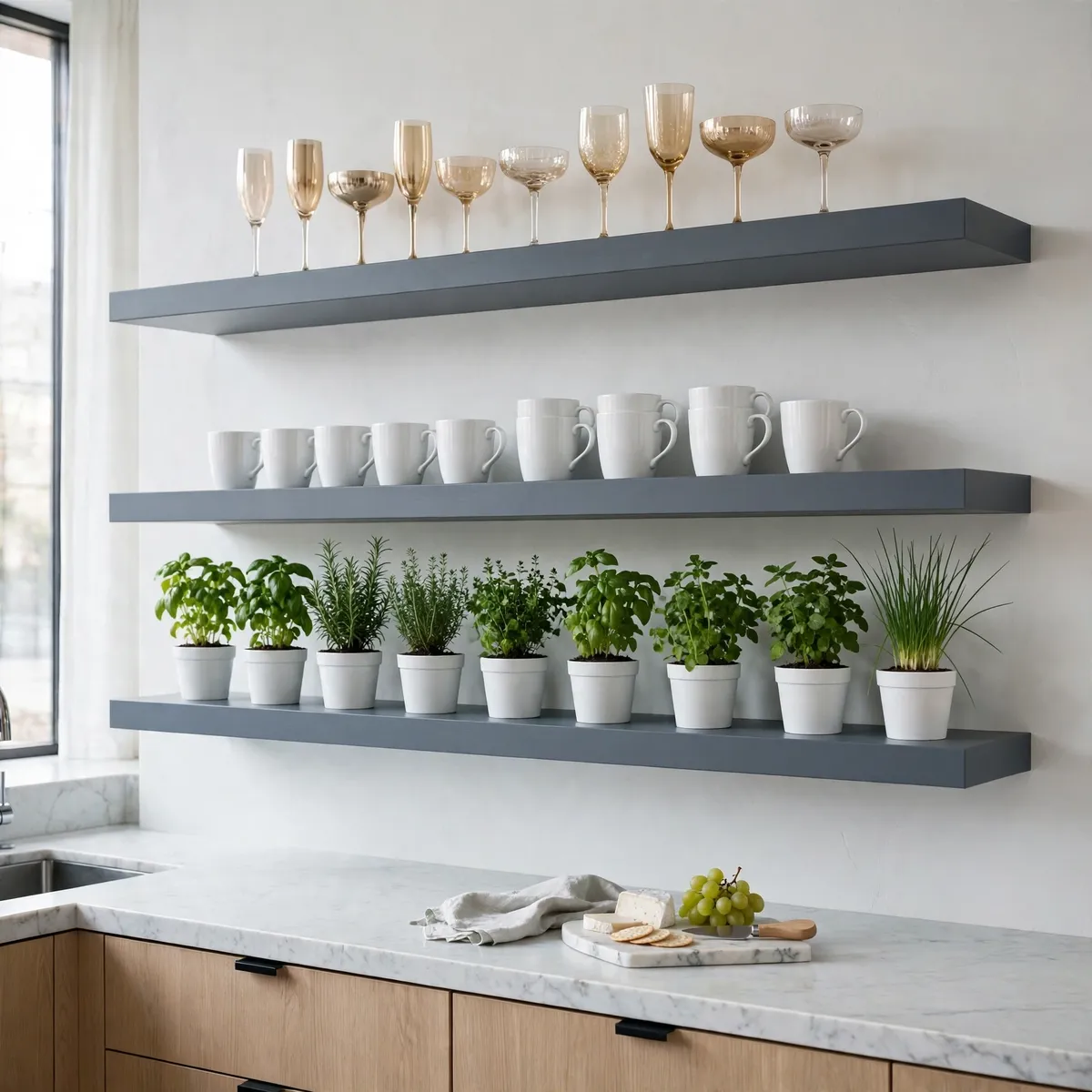
Cool slate shelves in a Scandinavian kitchen want styling that’s almost strict: champagne glassware in a clean row, crisp white mugs grouped in threes, and a long run of potted fresh herbs in identical white pots.
The concrete example: six white pots of basil, mint, chives, thyme, parsley, and rosemary in a row along the bottom shelf, with a small marble cheese board leaned behind them for the one contrasting texture. The herbs are the color story here — no other green needed, and dinner benefits too.
Quick tips:
- Identical pots make a herb row look designed, not accidental.
- Bottom shelf gets the herbs — easiest to water and snip.
- Champagne glassware photographs beautifully against slate.
Frequently Asked Questions
How far apart should kitchen shelves be spaced?
Twelve to fifteen inches between shelves suits most kitchens: enough for stacked bowls and tall pitchers, tight enough to keep the wall feeling layered rather than gappy. Measure your tallest everyday item — usually a pitcher or a cereal box decanted into a jar — and add two inches of clearance.
How do I keep open kitchen shelves free of grease and dust?
Display what you use and wash often; constant rotation is the real cleaning hack. Keep shelves at least a few feet from the stove where possible, and give everything a weekly wipe with a damp microfiber cloth. Decorative pieces that never get touched are the ones that go grimy, so keep those to a minimum near the cooking zone.
Can I install shelves directly above the stove?
It’s not ideal. Heat and cooking grease rise straight onto whatever sits above the hob, so displayed items need constant washing. A shelf above the stove works for a small plant that doesn’t mind warmth or a wipeable clock — save your pretty ceramics for the wall beside the range instead.
How deep should kitchen shelves be?
Ten to twelve inches handles dinner plates (which run about 10.5 inches) without jutting into the room. Shallower eight-inch shelves suit glasses, mugs, and decor in tight galley kitchens; deeper than twelve inches and items get lost at the back.
Conclusion
The best kitchen shelf decor ideas all run on the same quiet formula: group in threes, leave breathing room, hold a tight palette, and let daily dishes do most of the work. Pick the look that matches your kitchen’s light and your actual cooking life, style one shelf tonight as a test, and repeat what works down the wall. Your shelves will thank you every single morning.