20 Stunning Honey Oak Kitchen Cabinet Ideas That Feel Warm and Timeless ♥ [Golden Revival]
Why Honey Oak Kitchen Cabinets Are Having a Golden Moment
Honey oak kitchen cabinets are kitchen cabinets in oak wood finished with a golden, amber stain — the warm honey-toned wood that defined kitchens from the late 1980s through the 1990s and is now back as a deliberate design choice. The wood itself was never the problem: it is the cool grays, speckled beige granite and dated brass that surrounded it that made honey oak kitchens read as old.
This guide covers 20 honey oak kitchen ideas for updating the room without replacing a single cabinet — painted islands, marble and dark stone counters, brass and matte black hardware, zellige tile and warm white walls — so you can give your oak a fair shot before reaching for the paint sprayer.
Honey oak kitchen cabinets spent a decade as the thing everyone wanted to rip out — but warm golden wood is back, styled like the luxury feature it always was. What changed is not the wood, but what designers pair it with: dark stone, bold painted islands, veined marble, and handmade tile that make the honeyed grain glow.
Here is the quiet truth about living with honey oak kitchen cabinets: they are one of the most flexible backgrounds a kitchen can have. The amber undertones play beautifully with marble, deep green, inky blue, brass, copper, and black — so you rarely need to fight the wood. Start with one confident move, like a countertop swap or a bold island color, and give your oak a fair shot before reaching for the paint sprayer. These 20 ideas show you how. If you want the calmest version of this look, start with these minimalist kitchen ideas and let the wood grain do the talking.
1. Paint a Showstopping Island Next to Honey Oak Kitchen Cabinets

Keep the honey oak perimeter and paint the island deep navy, forest green, or oxblood red. The dark island grounds the room while the golden cabinets around it suddenly read as intentional and expensive. Tie both sides together with matching hardware. For example, paint a 36-inch-wide island in Benjamin Moore Hale Navy with 5-inch matte black bar pulls, then repeat the navy on two barstools and the pendant cords so the island reads as one deliberate piece against the honey oak perimeter.
Quick tips
- Start with the island only before painting anything else.
- Echo the island color in barstools, a runner, or pendant cords.
2. Let White Marble Cool the Warmth

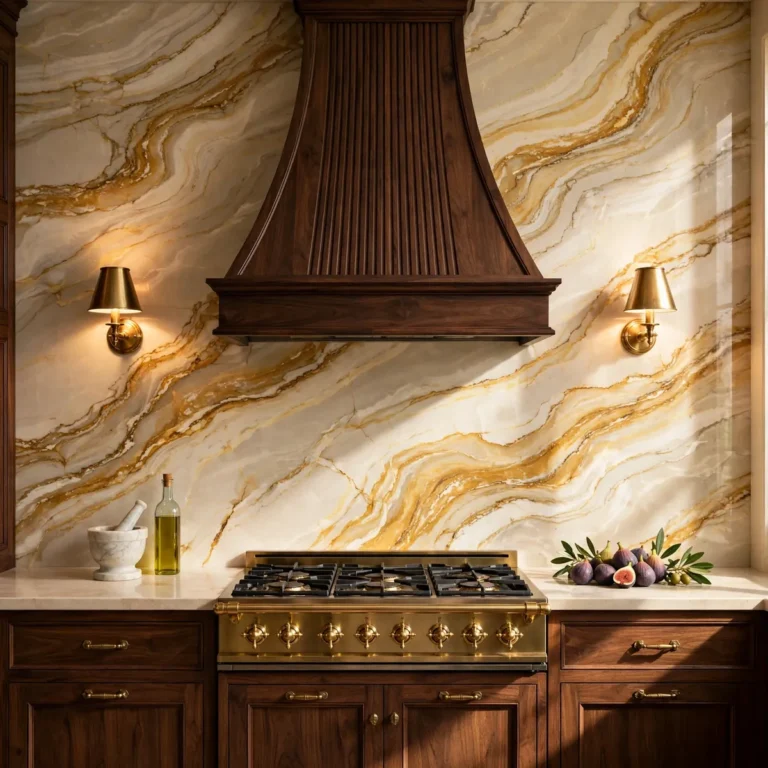
Run a full marble slab up the wall as a backsplash — even wrapping the range hood — and the crisp veining makes the oak feel calmer and more tailored. A marble waterfall island edge doubles the effect. Keep everything else quiet so the two materials can talk. For example, a honed white marble slab with soft gray veining run full-height behind the range — with the same marble as a waterfall edge on the island — cools a 10-foot run of honey oak uppers in one move.
Quick tips
- One full slab beats small marble tiles for impact.
- Choose honed marble for a soft, not flashy, finish.
3. Go All-In on Brass

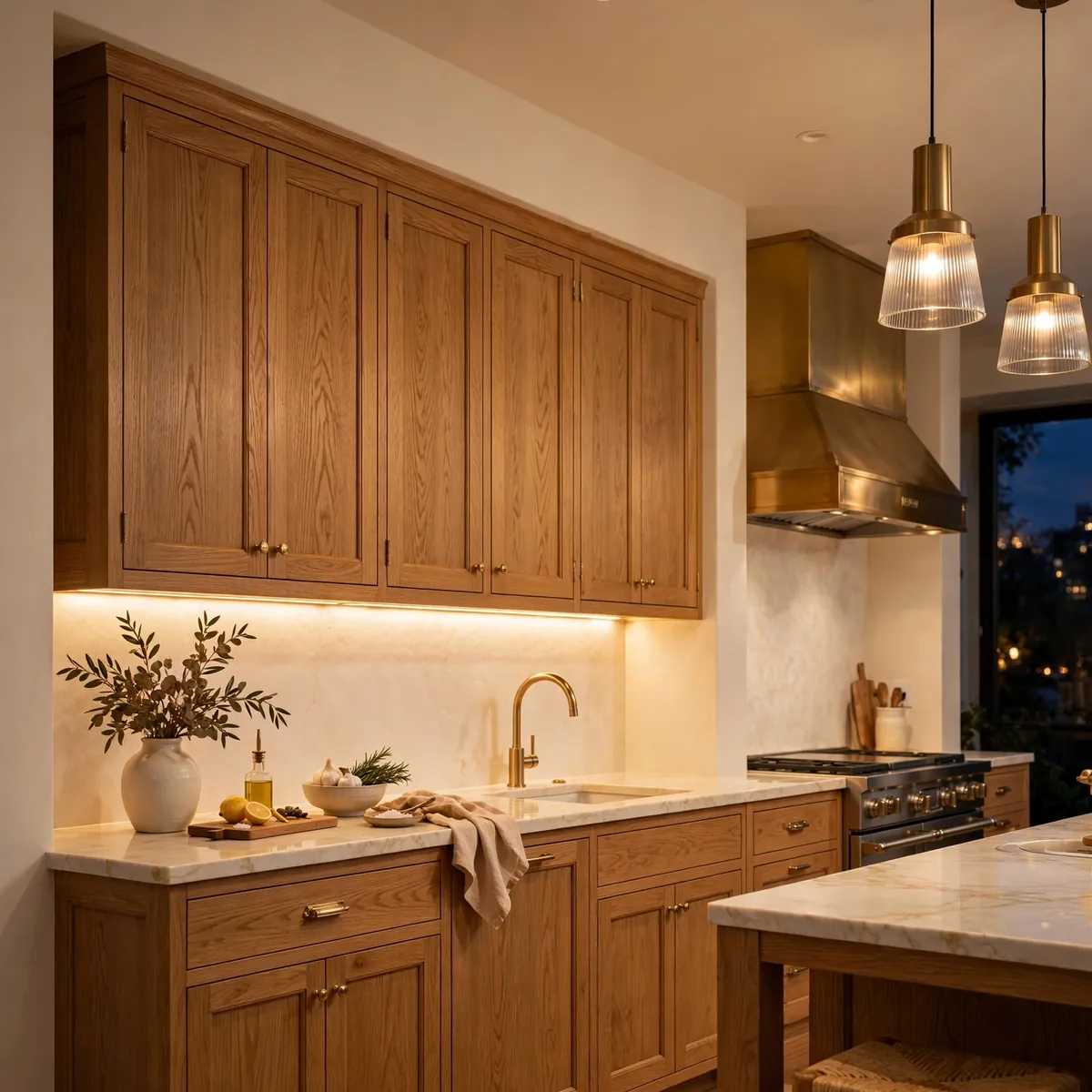
Brass picks up the golden undertones in oak and turns the whole kitchen more glamorous. Swap in unlacquered brass bin pulls, a brass bridge faucet, and oversized glass-globe pendants with brass fittings. The warmth compounds beautifully under warm-white light. For example, swap in unlacquered brass bin pulls on every drawer, a brass bridge faucet, and two glass-globe pendants with brass fittings, and keep the bulbs warm white so the brass and the oak glow at the same temperature.
Quick tips
- Repeat brass at least three times so it looks deliberate.
- Balance the shine with one matte element, like honed counters.
4. Split the Tones: Cream Uppers, Oak Lowers
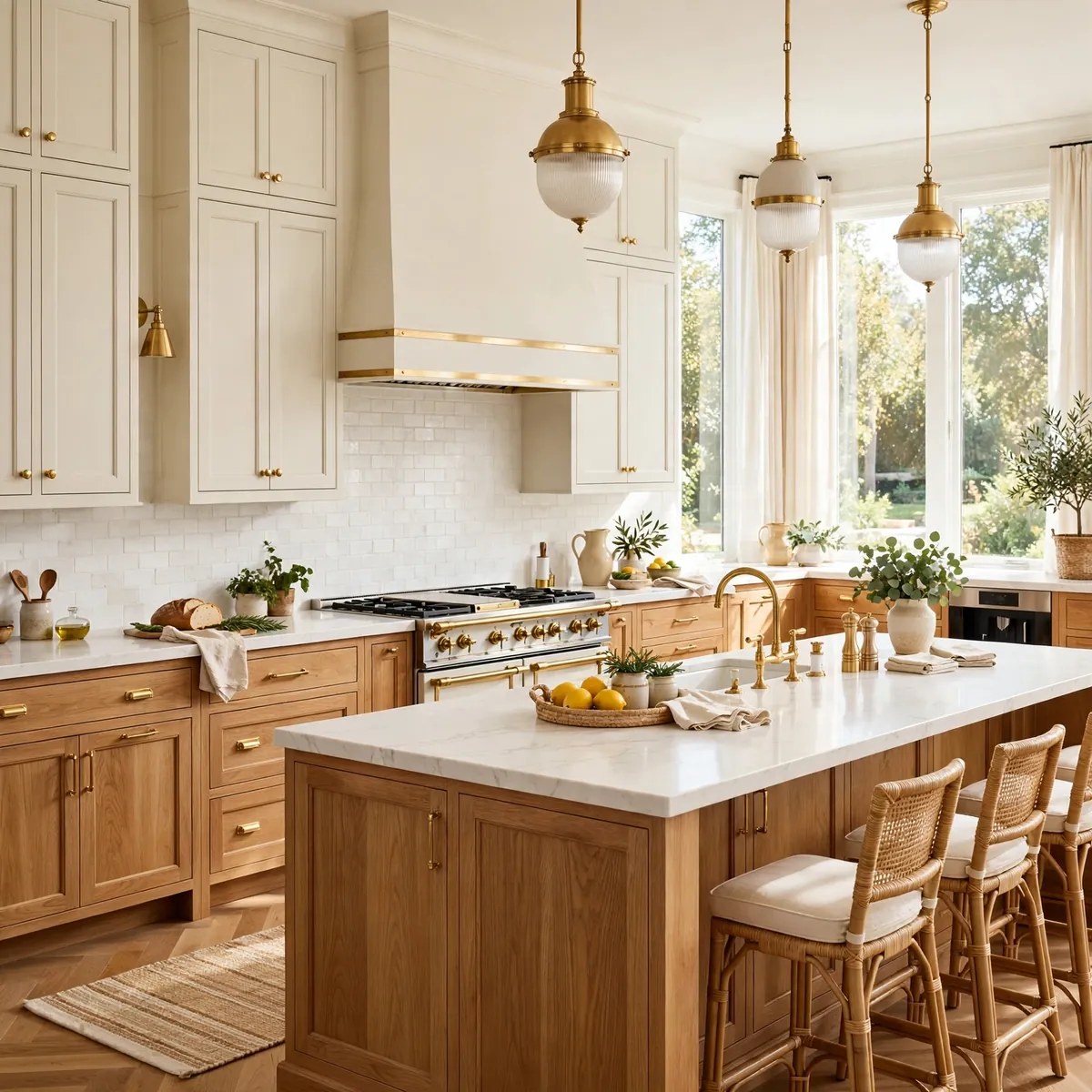
Keep the honey oak kitchen cabinets on the lowers where their warmth grounds the room, and paint the uppers soft cream so the top half feels light and airy. The eye reads the cream as breathing room, and the oak below looks richer by contrast. For example, paint the uppers Sherwin-Williams Alabaster in a satin finish and keep the honey oak lowers, then use the same Alabaster on the window trim so the top half of the room reads as one calm band.
Quick tips
- Pick a cream with warm undertones to harmonize with the oak.
- Keep the cream’s sheen satin so it doesn’t fight the wood grain.
5. Dark Stone Counters for Modern Drama

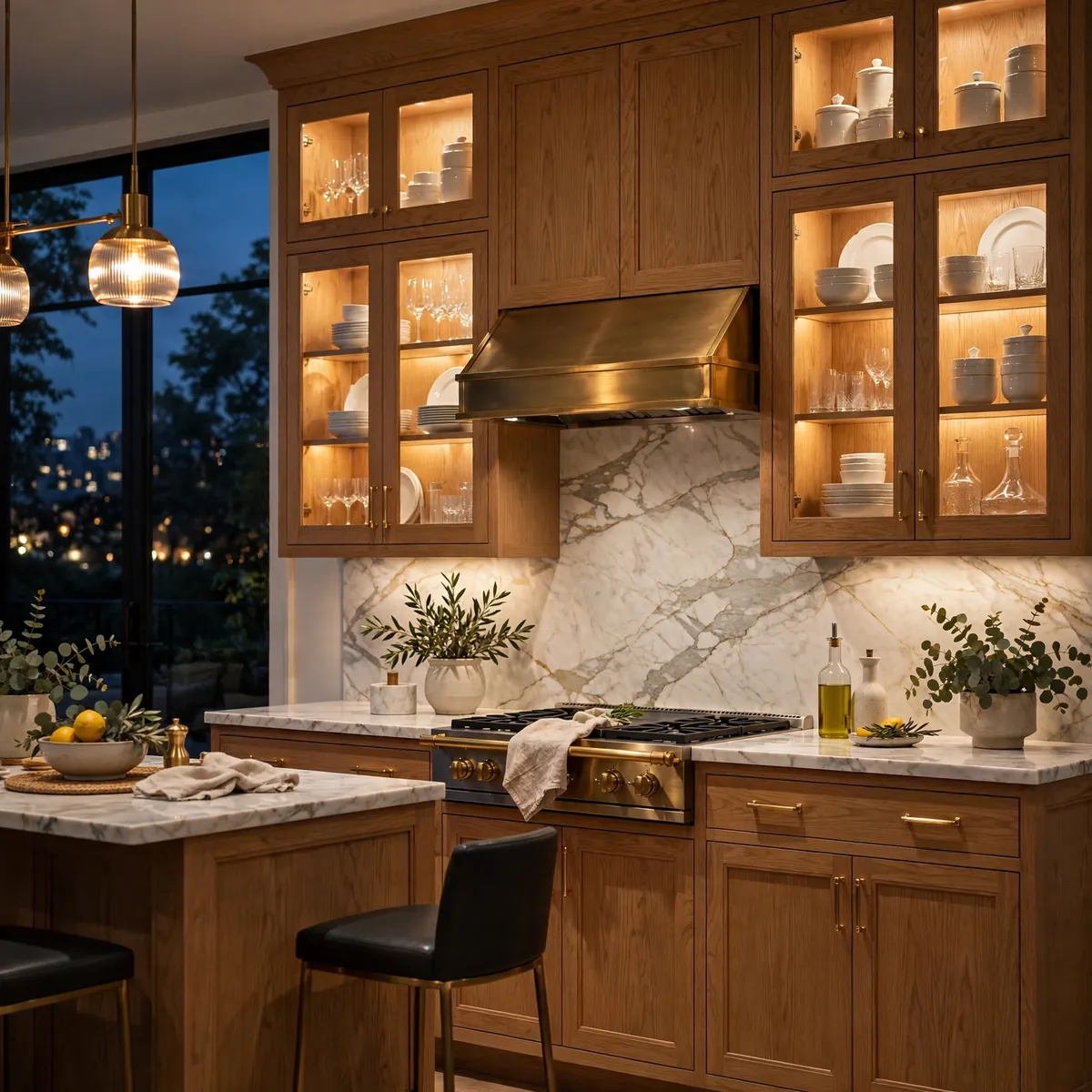
Pair the warm wood with honed black granite or dark soapstone and the contrast instantly modernizes honey oak kitchen cabinets. The dark stone grounds the golden tones, and simple matte black hardware finishes the look. Under-cabinet lighting keeps the stone from feeling heavy. For example, pair honed black granite counters with matte black 5-inch bar pulls and under-cabinet LED strips, and repeat the black once more in the faucet so the dark stone reads as a frame rather than a slab.
Quick tips
- Honed finishes hide fingerprints better than polished stone.
- Repeat the dark tone in at least two other elements.
6. Warm White Walls and Layered Lighting

Swap cool gray walls for a warm white and add layered lighting — pendants, under-cabinet strips, and a picture light over open shelves. Honey oak kitchen cabinets glow when the light around them is warm, turning a dated-feeling kitchen calm and inviting in an afternoon. For example, fit warm-white bulbs in a pair of pendants over a 6-foot island plus one LED strip under each upper cabinet run, so the light is the same temperature everywhere instead of pooling in patches.
Quick tips
- Use 2700K bulbs everywhere for one cohesive warm glow.
- Paint the ceiling the same warm white for a cocoon effect.
7. Coastal Blue Details for a Fresh Contrast

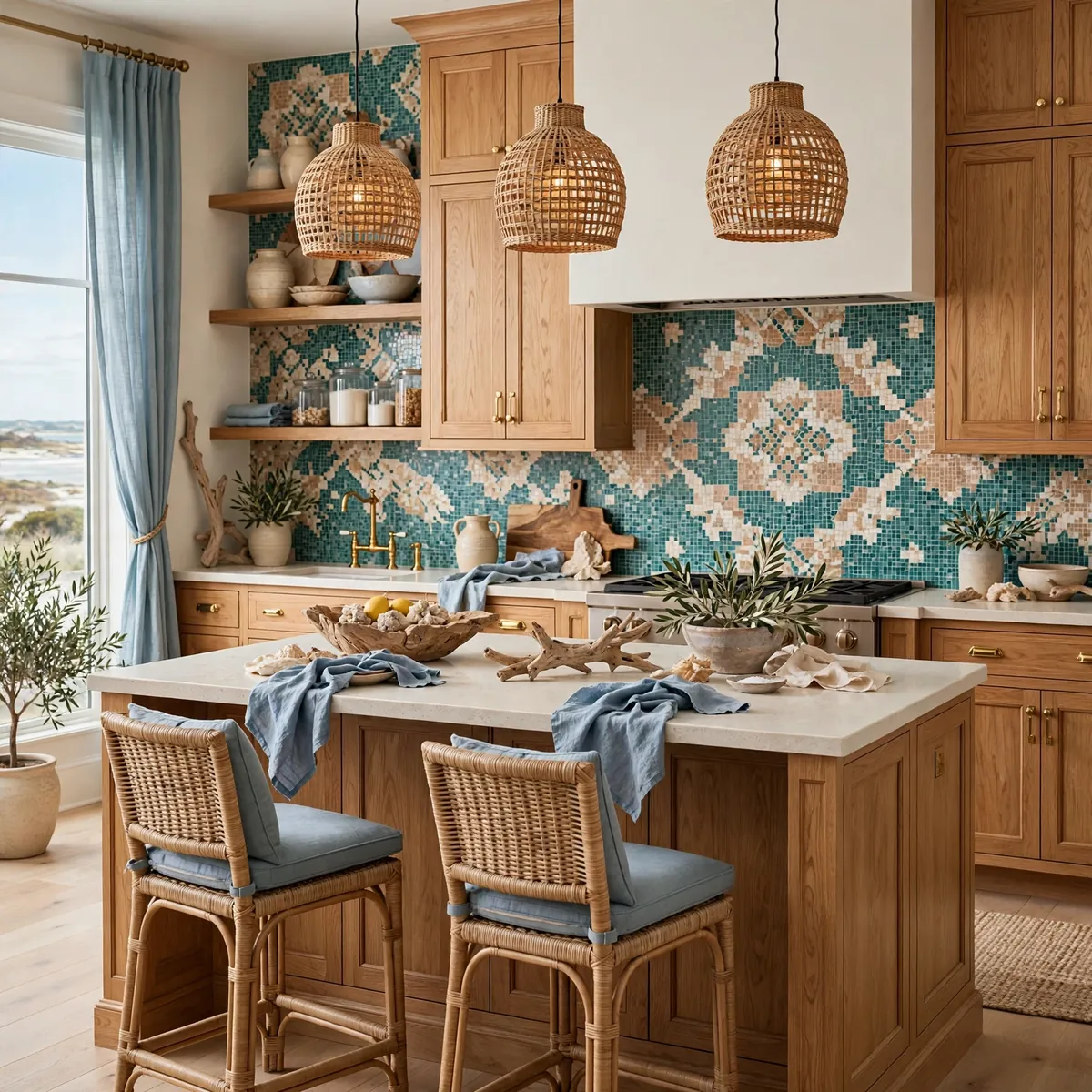
Golden wood and sea-blue are a natural pair, and the contrast is one of the freshest ways to style honey oak kitchen cabinets without a single renovation: paint a small pantry wall or the backs of glass-front cabinets in a coastal teal, add a runner in washed blue stripes, hang a woven pendant over the island, and set out simple white dishes on open shelves so the blue has company. The oak’s warmth keeps the blue from feeling cold, while the blue gives the wood a crisp, collected edge that reads current rather than country. You can go bolder with a mosaic backsplash in teal, cream, and sandy tones behind the range, or keep it subtle with just a few hand-thrown blue vases and a striped runner. Woven textures — a jute runner, rattan barstools, seagrass baskets on top of the cabinets — complete the coastal story and make the whole kitchen feel like a breezy retreat. The trick is restraint: two blue moments per sightline is plenty, and the honey oak stays the hero of the room. For example, paint the backs of two glass-front cabinets in a coastal teal, lay a washed-blue striped jute runner, and hang one woven pendant over the island — two blue moments per sightline, with white dishes on the open shelves to keep the blue company.
Quick tips
- Try removable wallpaper inside glass-front cabinets first.
- Keep countertop styling minimal so the blue moments shine.
8. Bring In a Skylight or More Natural Light
Nothing flatters honey oak kitchen cabinets like real daylight. A skylight over the work zone, wider window trim painted bright white, or simply swapping heavy curtains for sheers changes how the wood reads — warmer, lighter, more expensive. If a skylight is too much, a sun tunnel delivers similar daylight for less. For example, a single skylight over the sink run — or, for less cost, a sun tunnel over a dark prep corner — plus sheer linen panels instead of heavy curtains will lift a north-facing honey oak kitchen in a day.
Quick tips
- Sheer linen panels keep privacy without killing light.
- Bright white window trim makes the view feel bigger.
9. A Sage Green Hutch as the Bold Piece

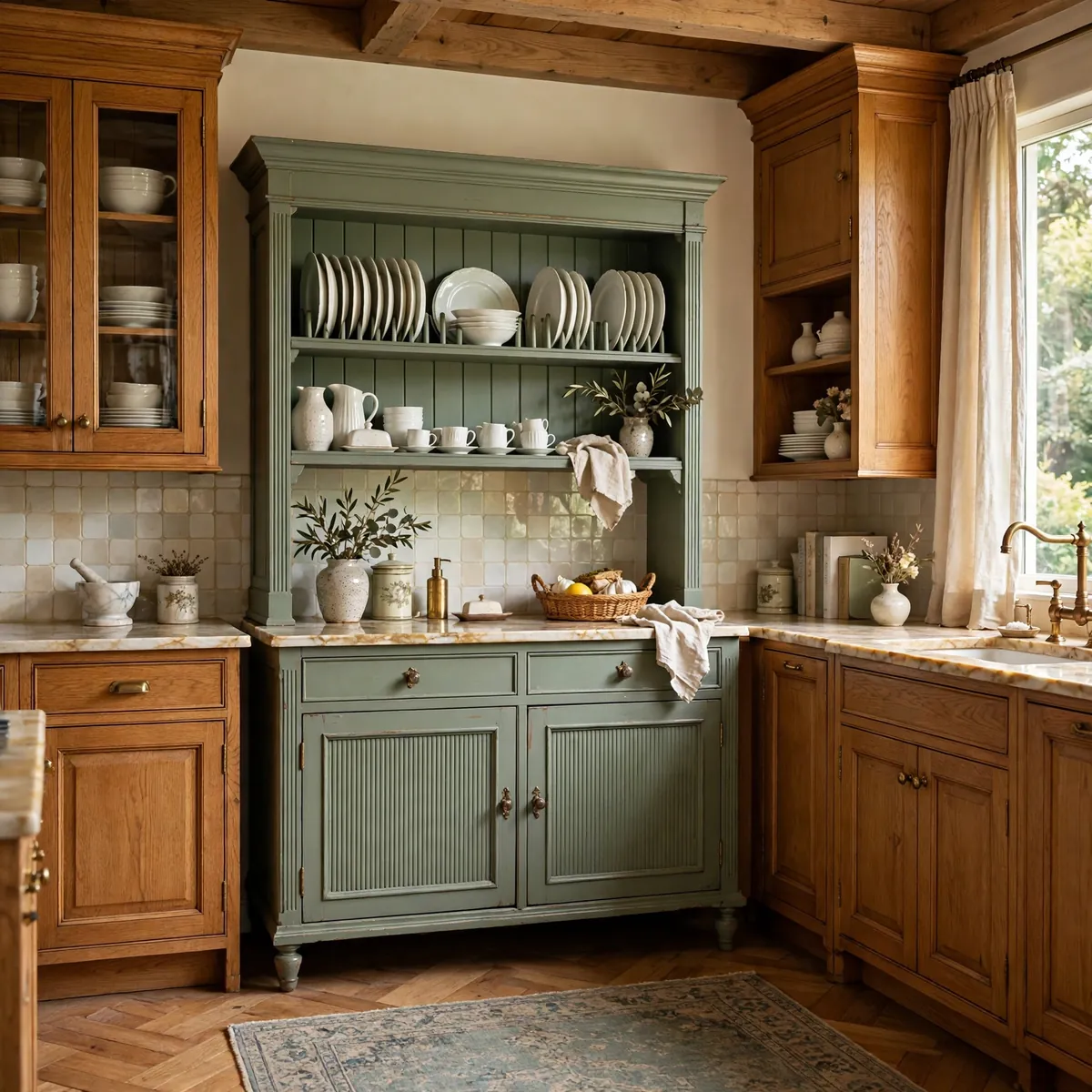
One painted piece can carry a whole kitchen. A freestanding sage green hutch against honey oak kitchen cabinets adds color and storage at once. Style it with white dishes and a few copper pieces for a collected, not decorated, feel. For example, set a sage green freestanding hutch against the longest oak wall, style it with white dishes and three copper pieces, and echo the sage in one runner so the hutch looks collected rather than dropped in.
Quick tips
- Freestanding furniture beats built-ins for flexibility.
- Echo the hutch color in one textile, like a runner.
10. Matte Black Fixtures for a Crisp Edge
Swap dated brass or chrome for matte black faucets, pulls, and pendant shades. The black gives honey oak kitchen cabinets a graphic, current edge — especially against dark stone or white quartz counters. Keep the black to fixtures and hardware so it reads as jewelry, not heaviness. For example, start with one matte black faucet and 5-inch matte black bar pulls on the drawers, keep the knobs on the doors the same black, and let the black stop there — fixtures and hardware only — so it reads as jewelry against white quartz counters.
Quick tips
- Matte black shows fewer fingerprints than glossy finishes.
- One black light fixture can start the whole update.
11. Handmade-Look Zellige Tile Backsplash
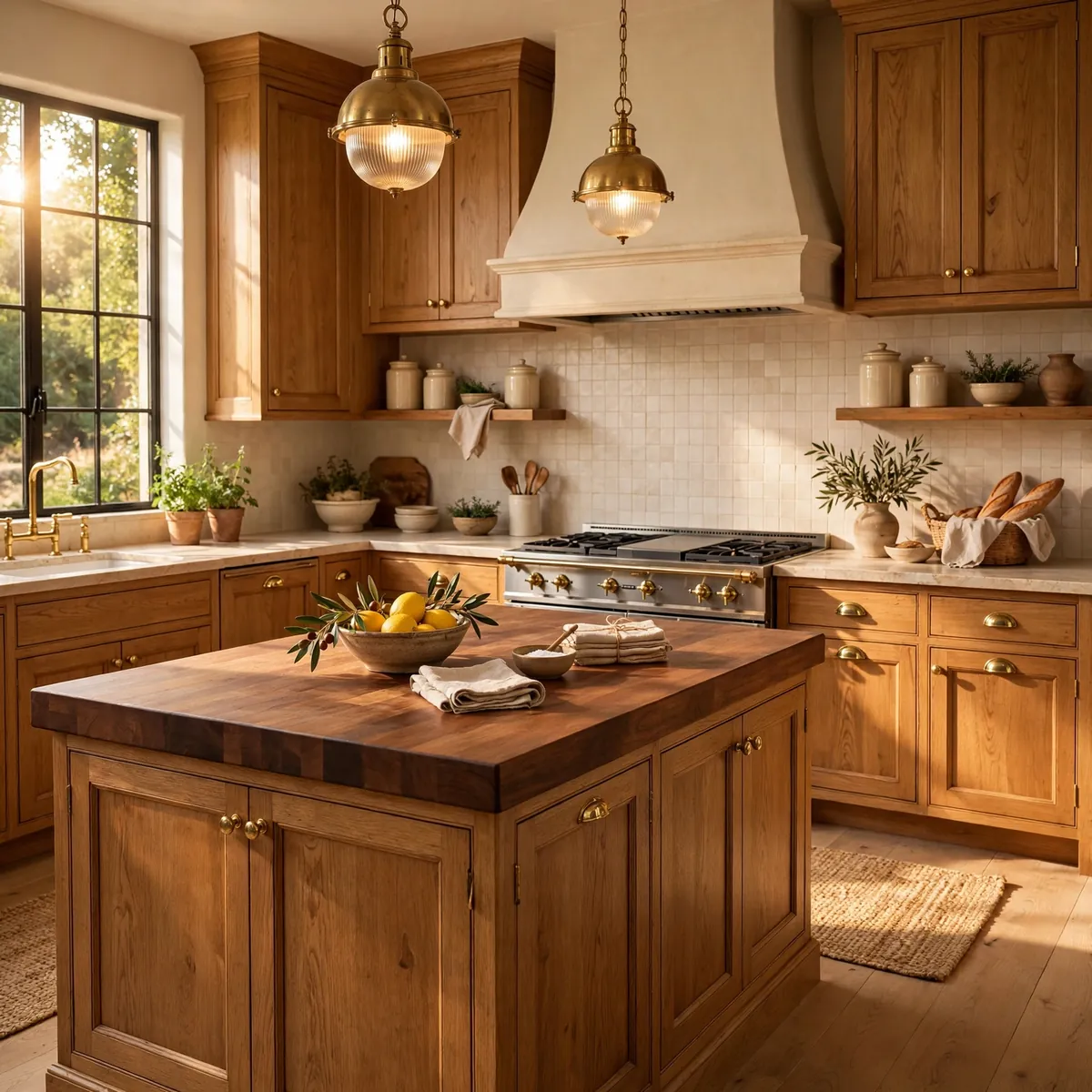
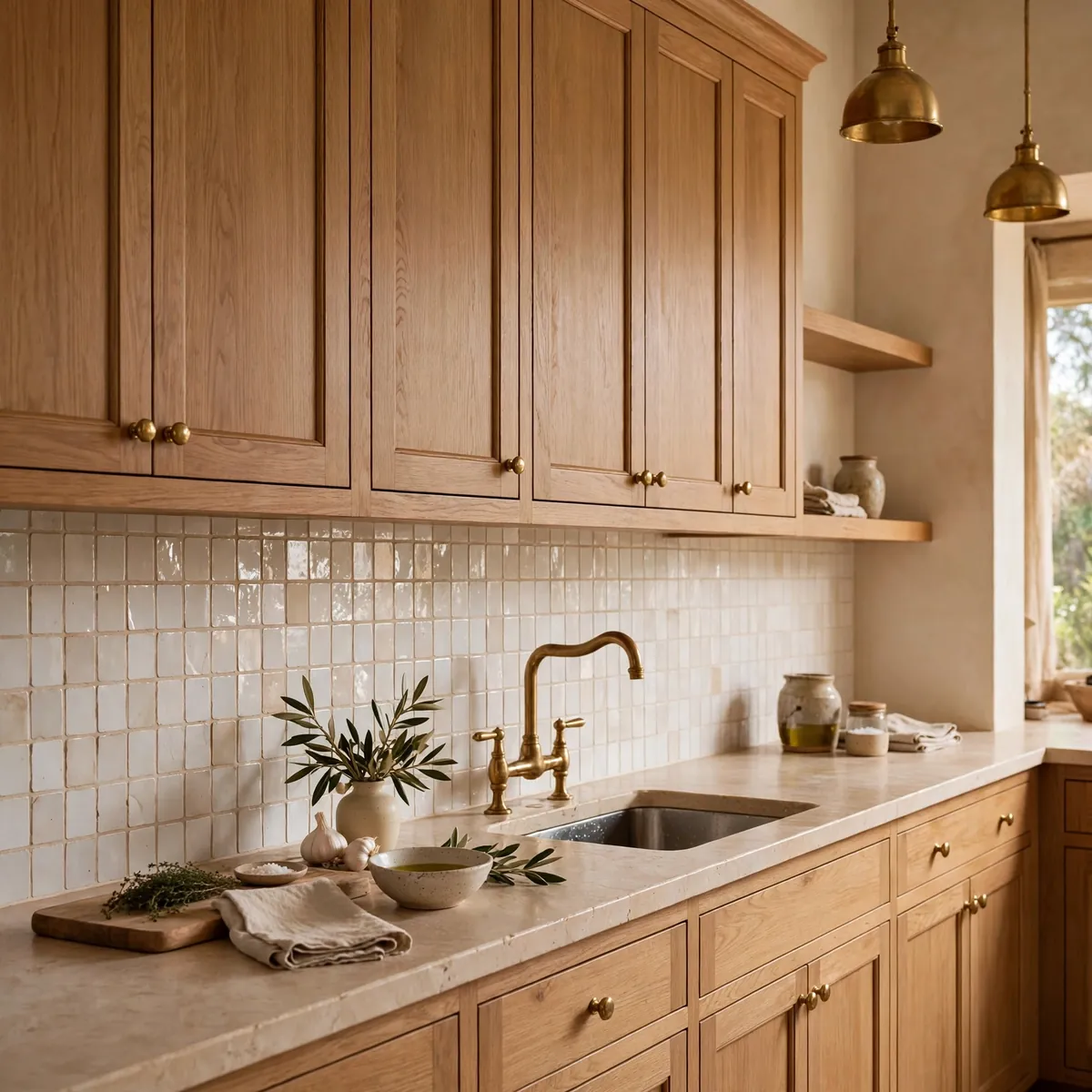
A glossy zellige backsplash in warm white or pale green catches the light and gives honey oak kitchen cabinets a handmade, artisan backdrop. The imperfect glaze plays beautifully against the wood’s straight grain. Run it to the ceiling behind the range for maximum effect. For example, run a warm-white handmade-look zellige tile in a 2-by-8-inch stacked pattern to the ceiling behind the range, with warm-gray grout in tight 1/8-inch joints, so the glaze catches the light without competing with the oak grain.
Quick tips
- Order samples first — zellige color shifts in different light.
- Stacked vertically, zellige makes low ceilings feel taller.
12. A Living Herb Planter on the Island
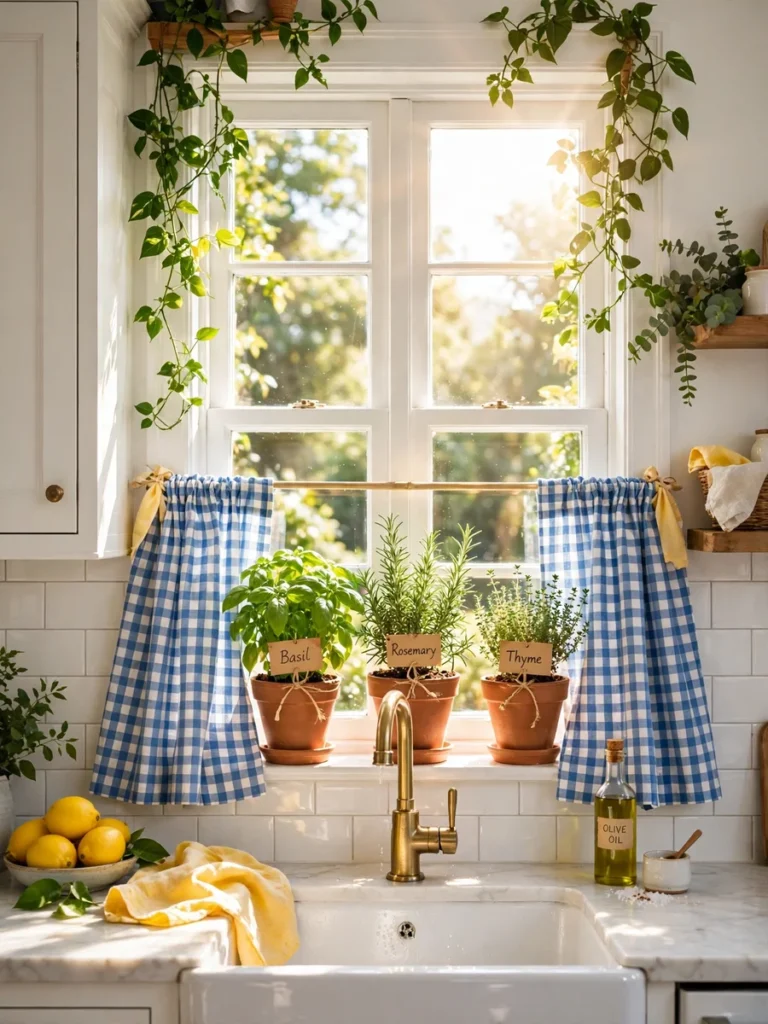
A built-in planter running down the island brings life to honey oak kitchen cabinets in the most literal way. Line it with basil, rosemary, and thyme, point small track lights at the greenery, and the kitchen smells as good as it looks.
- Line the planter with a waterproof insert first.
- Add grow lights on a timer for year-round herbs.
- Keep a small watering can nearby so care is easy.
For example, a 36-inch built-in planter down the center of the island, lined with a waterproof insert and planted with basil, rosemary and thyme on a grow-light timer, puts cooking herbs within arm’s reach of the prep zone.
Quick tips
- Rosemary and thyme survive indoor winters best.
- Trim herbs weekly to keep the planter full, not leggy.
13. Layer Wood on Wood, Beautifully
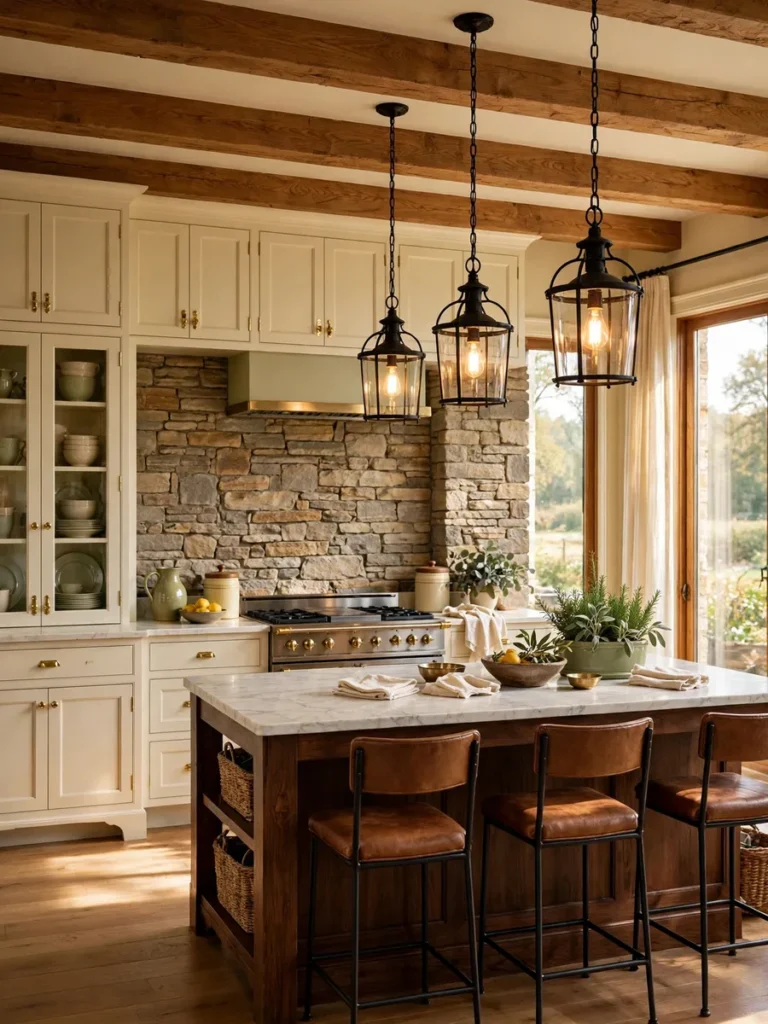
Matching tones make a small kitchen feel bigger. Pair honey oak kitchen cabinets with oak plank floors and a wood-clad range hood in the same warm family. Use one contrast — marble counters — to keep it from feeling flat. For example, pair honey oak cabinets with oak plank floors one shade lighter than the cabinets and a wood-clad range hood in the same warm family, then let a single white marble countertop be the one contrast that keeps the room from going flat.
Quick tips
- Stay within two shades on the wood spectrum.
- The single contrast element does the most work — choose it well.
14. One Bold Hero Piece Steals the Room

A saturated yellow pedestal table, a red island, a copper range — one confident piece makes honey oak kitchen cabinets look curated instead of default. Start with something movable before committing to paint, and let the room’s light be the judge. For example, a saturated yellow pedestal table with four chairs — movable, not built in — lets you test a bold color for a season, and a mirror on the opposite wall bounces light back if the piece darkens the corner.
Quick tips
- Movable first, permanent later — test bold with furniture.
- Bounce light with a mirror if the hero piece darkens the room.
15. Mustard Yellow Lowers for Tone-on-Tone Warmth
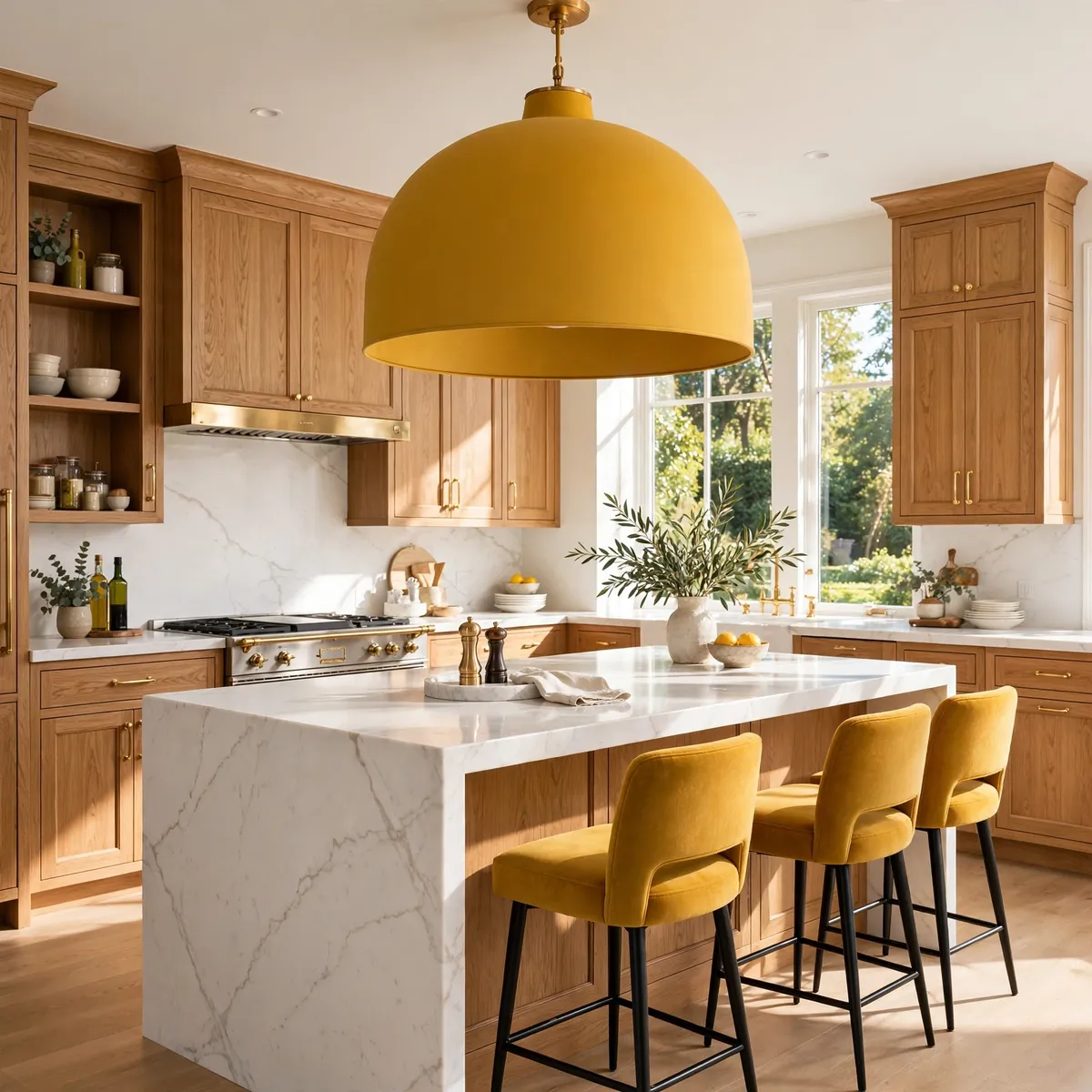
Mustard yellow sits close to oak on the color wheel, so painting lowers in that shade deepens honey oak kitchen cabinets instead of fighting them. Add a yellow zellige backsplash and one oversized pendant for a kitchen that glows. For example, paint the lowers mustard yellow, add a yellow zellige backsplash in the same warm family, hang one oversized pendant over the island, and keep butcher-block counters so the whole room stays in one glowing warm story.
Quick tips
- Tone-on-tone works best in rooms with strong natural light.
- Butcher-block counters continue the warm story.
16. Dark Green Lowers with Terracotta Tile

Deep green lower cabinets and a terracotta zellige backsplash turn honey oak kitchen cabinets into the warm anchor of a richly layered room. Keep the oak on the island or uppers so its golden tone bridges the green and the clay. For example, paint the lowers deep green, run a terracotta zellige backsplash behind the range, keep the honey oak on the island so the gold bridges the green and the clay, and hang two brass dome pendants to tie all three tones together.
Quick tips
- Glass-front uppers keep dark lowers from feeling heavy.
- Brass dome pendants tie green, clay, and oak together.
17. Concrete Walls for an Urban Edge
Board-formed concrete walls sound cold, but against honey oak kitchen cabinets they read as gallery-modern. The warm wood softens the gray concrete, and a few black accents plus track lighting finish the look. For example, one board-formed concrete wall behind the range — limewash on the second wall if full concrete is too much — honey oak barstools at the island and black track lighting overhead give the kitchen a gallery-modern edge without losing the wood’s warmth.
Quick tips
- Try limewash on one wall for the concrete look without the cost.
- Wood barstools soften the industrial edge.
18. Open Shelving with Copper Cookware

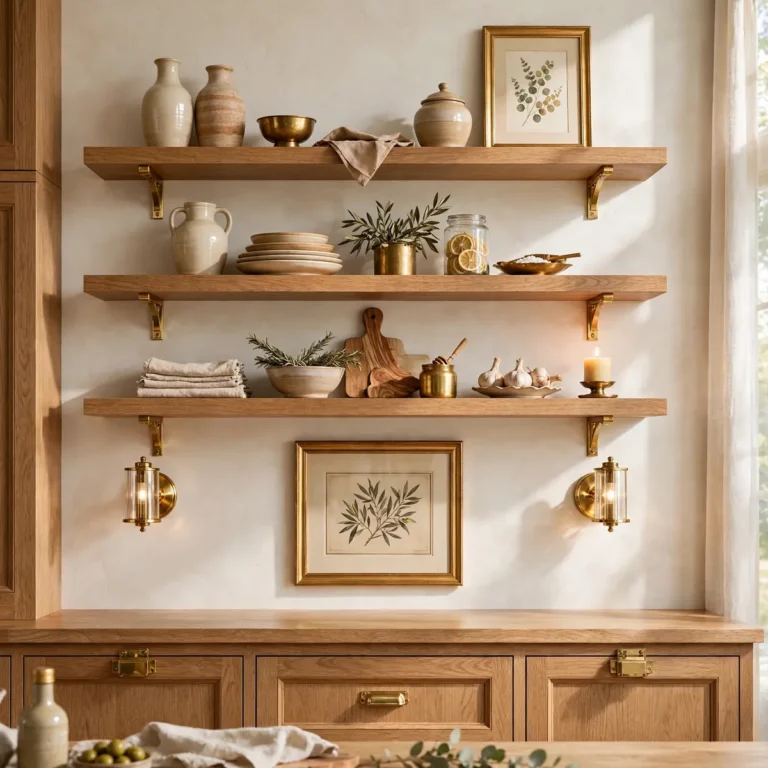
Remove a few upper doors, add open shelves, and display hammered copper pots as wall art. The copper’s warmth doubles down on the honey tones in the wood — and repeating the metal on the range hood and hardware makes it look intentional. For example, remove the doors from two upper cabinets, hang three hammered copper pots and one copper kettle as wall art, and repeat the copper once more on the range hood trim so the display looks intentional rather than improvised.
Quick tips
- Display only what you actually use — dust is the enemy.
- One repeated metal, everywhere, is the whole trick.
19. Keep It Calm Like Japandi
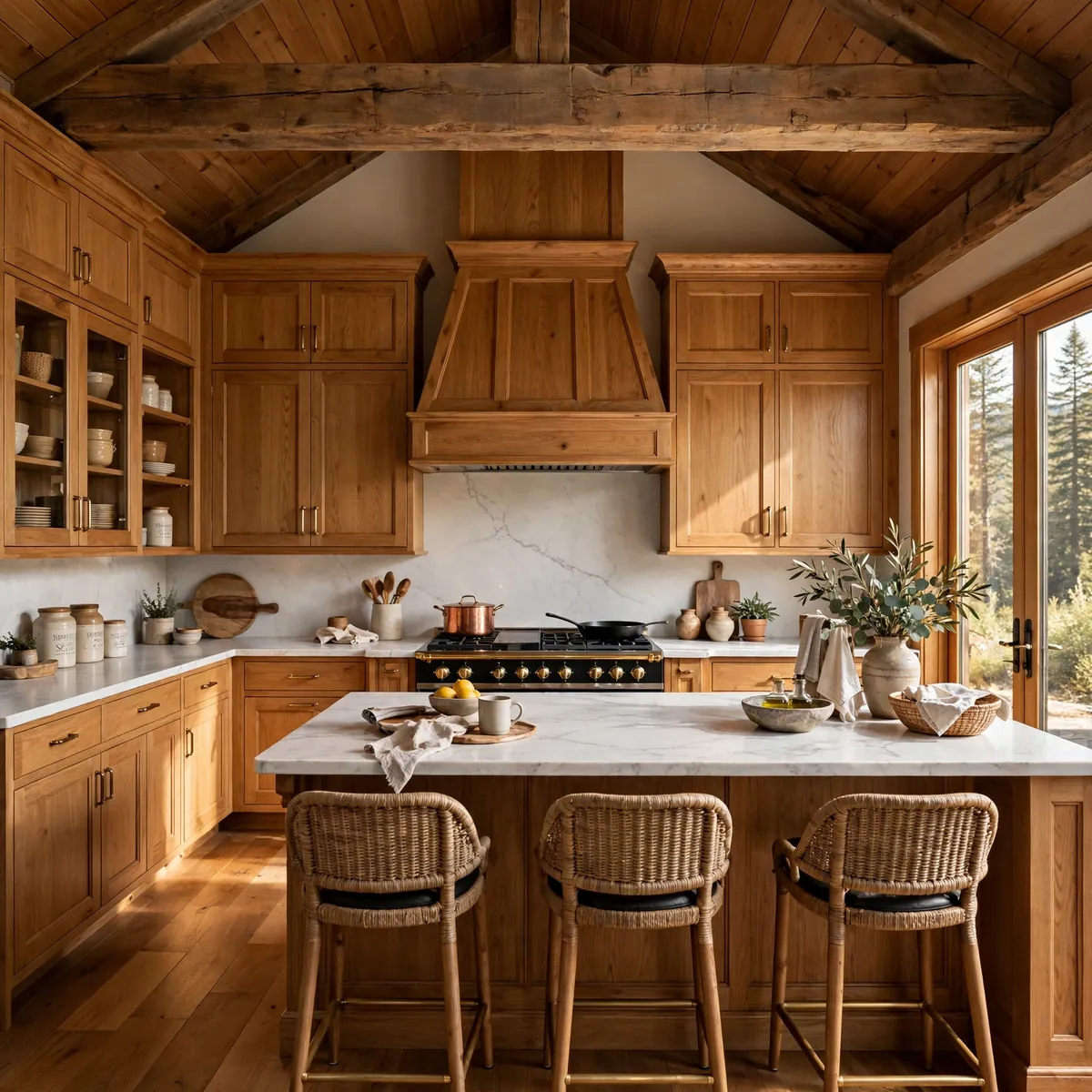
Honey oak’s warm minimalism pairs naturally with Japandi’s calm. Clear the counters, choose simple ceramics, and let the wood grain be the pattern. These Japandi kitchen ideas show how warm minimalism makes golden wood feel intentional and current. For example, clear one full counter run completely, leave a single green plant and three simple ceramic pieces on it, and let the honey oak grain be the only pattern in the room — one plant per counter run, not one per corner.
Quick tips
- Clear counters halfway — the wood needs breathing room.
- One green plant per counter run is enough.
20. Commit to Full Warmth, Galley Style
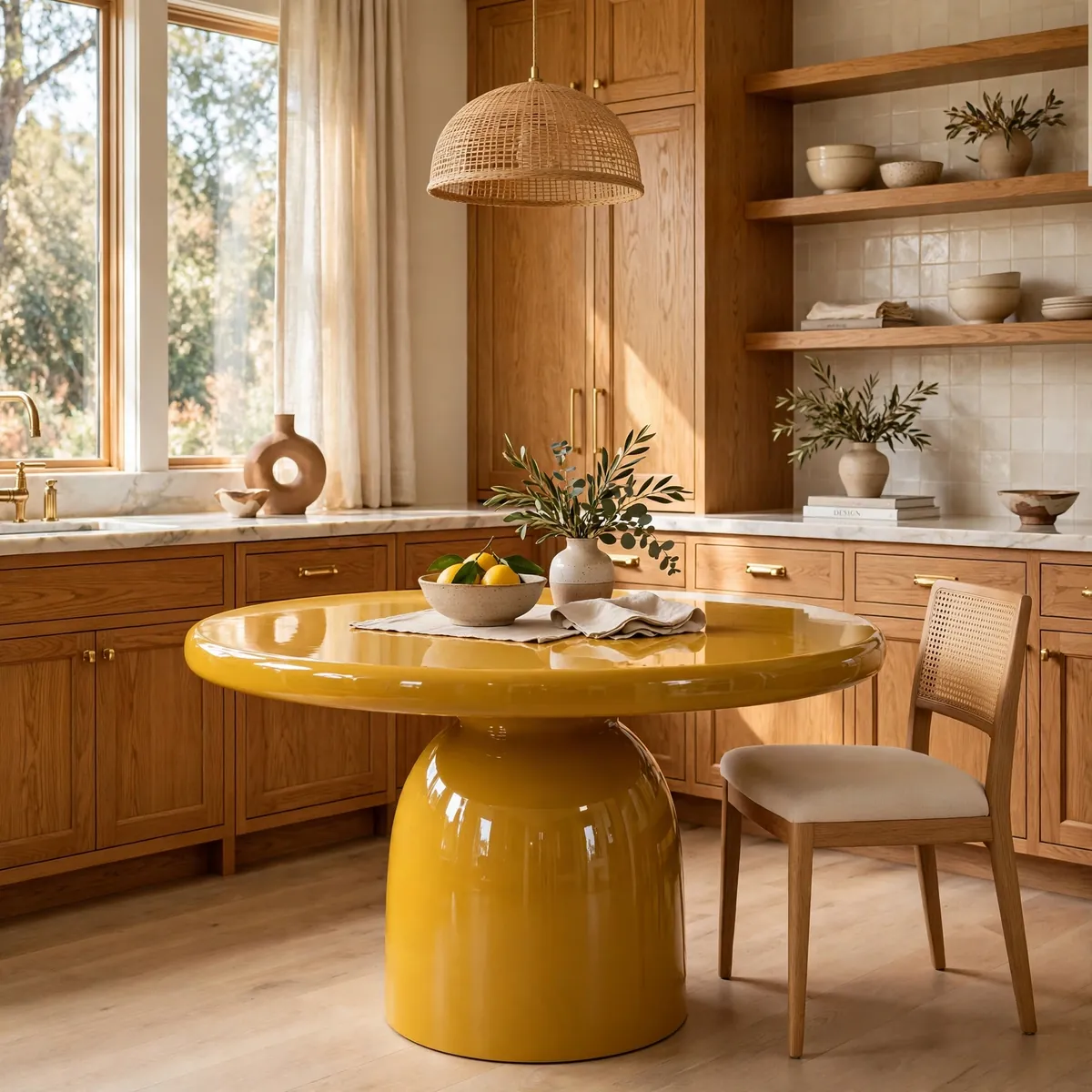
In a long galley, keep every surface in the warm family — oak cabinets, plank floors, wood-clad hood — and let one contrast (marble counters, stainless appliances) keep it crisp. Even recessed lights marching down the ceiling become part of the rhythm. For example, in a 12-foot galley, keep oak cabinets, plank floors and a wood-clad hood all in the warm family, choose white marble counters as the single contrast, and fit matching stainless appliances so the recessed lights marching down the ceiling become part of the rhythm.
Quick tips
- Keep appliances purely functional and uniform.
- One strong contrast element prevents the warmth from going muddy.
Should You Paint or Keep Your Honey Oak Cabinets?
The paint-or-keep decision is a cost ladder, not a yes-or-no question, and most honey oak kitchens never need to climb past the first rung. Honey oak cabinets are usually solid, well-built boxes with good bones — what dates them is the finish around them, not the grain — so the cheapest fix is to change everything except the cabinets, and only paint when the wood itself is the problem.
- Style around the oak first (lowest cost): change the countertop, backsplash, hardware, wall color and lighting, and leave the cabinets untouched. This solves a dated-looking kitchen when the cabinets are sound and the layout works.
- Paint or refinish the cabinets (low to moderate cost): a cabinet painter changes the color and sheen, or a gel stain tones the honey toward a darker walnut without stripping. This solves the orange finish itself, but not the layout, the storage, or the grain showing through the paint.
- Reface the cabinets (moderate cost): new doors, drawer fronts and exposed box surfaces from a refacing company. This solves worn doors and an old door style, but not the box interiors or the floor plan.
- Replace the cabinets (highest cost): new boxes, new layout, new everything. This is the right rung only when the cabinets are damaged, the storage does not work, or the kitchen layout itself is the problem.
Start on rung one and live with it for a month before deciding. A white quartz countertop, matte black hardware and a quiet backsplash transform most honey oak kitchens for a fraction of a paint job — and if you do climb to paint later, you will be painting a kitchen you already love, not one you are trying to rescue.
- Try the cheapest rung first: hardware and lighting can be swapped in a weekend.
- Never paint to fix a layout problem — paint changes color, not storage or flow.
- If the cabinets are damaged, warped or water-stained, skip straight to reface or replace.
What Paint Colors Go With Honey Oak Cabinets?
Paint colors that go with honey oak cabinets are the ones that either cool the orange down or give it a calm neutral to sit against. Honey oak has strong golden-orange undertones, so the color wheel does the deciding: blue and green sit opposite orange and balance it, while warm greige and warm white bridge the gap without fighting the wood. What fails is anything that adds more yellow or orange to the room — the oak then has nothing to play against and the whole kitchen turns one flat amber.
| Color family | Try these | Best for | Avoid pairing with |
| Greige | Sherwin-Williams Accessible Beige, Benjamin Moore Pale Oak, Benjamin Moore Balboa Mist | Walls in any light; the safest all-over choice | Cool gray walls in the same room — pick one neutral direction |
| Warm white | Sherwin-Williams Alabaster, Benjamin Moore White Dove | Walls, trim and uppers when you want the room bright | Stark, cool whites, which make honey oak look dingy |
| Muted sage green | A soft sage green on walls or a hutch | The farmhouse-modern look; it pulls the honey tones out | Yellow-based beige, which amplifies the orange |
| Deep navy | Benjamin Moore Hale Navy on an island or accent wall | A painted island next to honey oak perimeters | More dark colors everywhere — keep the rest of the room light |
| Charcoal blue-gray | A dark blue-gray on one accent wall or lowers | A modern, grounded contrast in large kitchens | Small, dark rooms, where it can close the space in |
Test before you commit: paint a large swatch on the wall right next to a cabinet door, and look at it in daylight and again in the evening under your kitchen lights. A color that looks perfect at noon can turn muddy or orange at night next to honey oak, and the swatch is cheaper than repainting a wall.
- Greige is the safest first try; warm white is the brightest; sage green is the most characterful.
- Avoid cool grays, stark whites, and yellow or cream paints — all three make the orange stronger.
- One bold color per room is enough: a navy island plus sage walls is two statements fighting.
Frequently Asked Questions
Are honey oak kitchen cabinets outdated in 2026?
No — warm wood tones have fully returned. What reads dated is honey oak paired with the cool grays of the 2010s; styled with warm whites, dark stone, brass, and rich color, honey oak kitchen cabinets look current and collected.
What countertop goes best with honey oak cabinets?
White or honed marble calms the warmth, while dark soapstone or black granite modernizes it through contrast. Butcher block deepens the warm story if you want a fully golden kitchen.
Should I paint my honey oak cabinets?
Try styling first: a countertop swap, bold island color, or new backsplash often transforms the room without paint. If you do paint, keep the oak on the island — its warmth bridges bold colors beautifully.
What hardware color works with honey oak?
Unlacquered brass picks up the golden undertones and reads luxurious; matte black gives a crisp modern edge. Both beat dated chrome or shiny brass from the 90s.
What backsplash goes best with honey oak cabinets?
A quiet one. White or off-white handmade-look zellige, matte white subway tile, or a full-height slab of the same quartz as your countertop all let the oak be the star, because the backsplash is the bridge between your uppers and lowers and it should calm the room, not compete with the grain. Use larger formats — 3-by-6-inch or 2-by-8-inch tile — with tight warm-gray grout, and run it to the ceiling behind the range for the most impact. Skip tiny 1-by-1-inch mosaics, travertine, tumbled stone and anything beige or gold: busy or warm-toned tile next to honey oak reads as dated rather than layered.
What paint color tones down the orange in honey oak cabinets?
Colors from the opposite side of the color wheel: muted sage green, soft blue-gray, and warm greige all cool the orange down without fighting the wood. Warm whites such as Sherwin-Williams Alabaster or Benjamin Moore White Dove also work, because they have just enough cream in them to sit next to the oak without turning it dingy — but a stark, cool white will do the opposite and make the honey tones look more orange. Avoid yellow-based beige and cream paints entirely: they add more yellow to a room that already has plenty of it, and the orange only gets louder.
How do I make honey oak cabinets work in a small kitchen?
Keep the oak to one run and lighten everything around it. Paint the walls a warm white or light greige, use a white quartz countertop to bounce light, and open up one wall — glass-front uppers or open shelving instead of solid oak doors — so the room stops feeling like one block of wood. Keep the counters nearly clear, choose reflective surfaces such as a glossy zellige backsplash, and let a single contrast (matte black hardware, one dark island) do the modernizing. What closes a small honey oak kitchen in is oak floors plus beige walls plus oak cabinets with nothing to break them up — one wood tone needs one cool or light partner.
The Golden Takeaway
Your honey oak kitchen cabinets were never the problem — only their pairings were. Start with one move: a marble slab, a painted island, brass pulls, or a handmade tile backsplash. Give the wood a fair shot before the paint sprayer comes out. ♥