Living Room Wall Decor Ideas: 24 Stunning Ways to Make Your Walls Shine
The best living room wall decor ideas turn blank walls into the warm, finished focal point of the room. A gallery wall, one oversized piece of art, a large mirror, floating shelves, or a painted accent wall can each anchor the space, reflect your style, and make the whole room feel complete. This guide shares 24 living room wall decor ideas that work in real homes, with a concrete example in every idea.
Start with one focal wall: the wall behind the sofa, the fireplace wall, or the TV wall, since those are the walls your eyes land on first. If you love collected, personal displays, explore these gallery wall ideas for layouts that suit a sofa wall, a hallway, or a full feature wall.
Key Takeaways: Living Room Wall Decor Ideas at a Glance
What is the easiest living room wall decor idea? A single oversized piece of art or a large mirror above the sofa, because one piece fills the wall without the measuring a gallery wall needs.
How big should wall art be above a sofa? About two-thirds the width of the sofa below it, hung with its bottom edge 6 to 8 inches above the sofa back.
What makes a living room wall look expensive? Correct scale, one clear focal point, a limited colour palette, and good lighting, such as picture lights or wall sconces.
Can renters decorate living room walls? Yes. Removable wallpaper, leaning art and mirrors, and picture ledges on adhesive strips give a finished look without drilling.
How Do You Choose the Right Living Room Wall Decor?
Choose wall decor by the wall, not by the object. A long sofa wall needs a wide arrangement, a tall narrow wall needs vertical art, and a fireplace wall needs decor that frames the mantel. Match the scale first, then the colour, and keep one focal point per wall.
| Placement | Rule | Why it works |
|---|---|---|
| Art above a sofa | Two-thirds the sofa width; 6 to 8 inches above the sofa back | Balances the furniture and sits at seated eye level |
| Art on an open wall | Centre about 57 to 60 inches from the floor | Sits at standing eye level for most people |
| Gallery wall spacing | 2 to 3 inches between frames | Keeps the group reading as one display |
| Mirror opposite a window | About two-thirds the furniture width below it | Bounces light deeper into the room |
| Shelves above a console | 8 to 10 inches above the console top | Leaves room for tall objects without crowding |
1. How Can a Gallery Wall Make Your Sofa Wall Feel Curated?
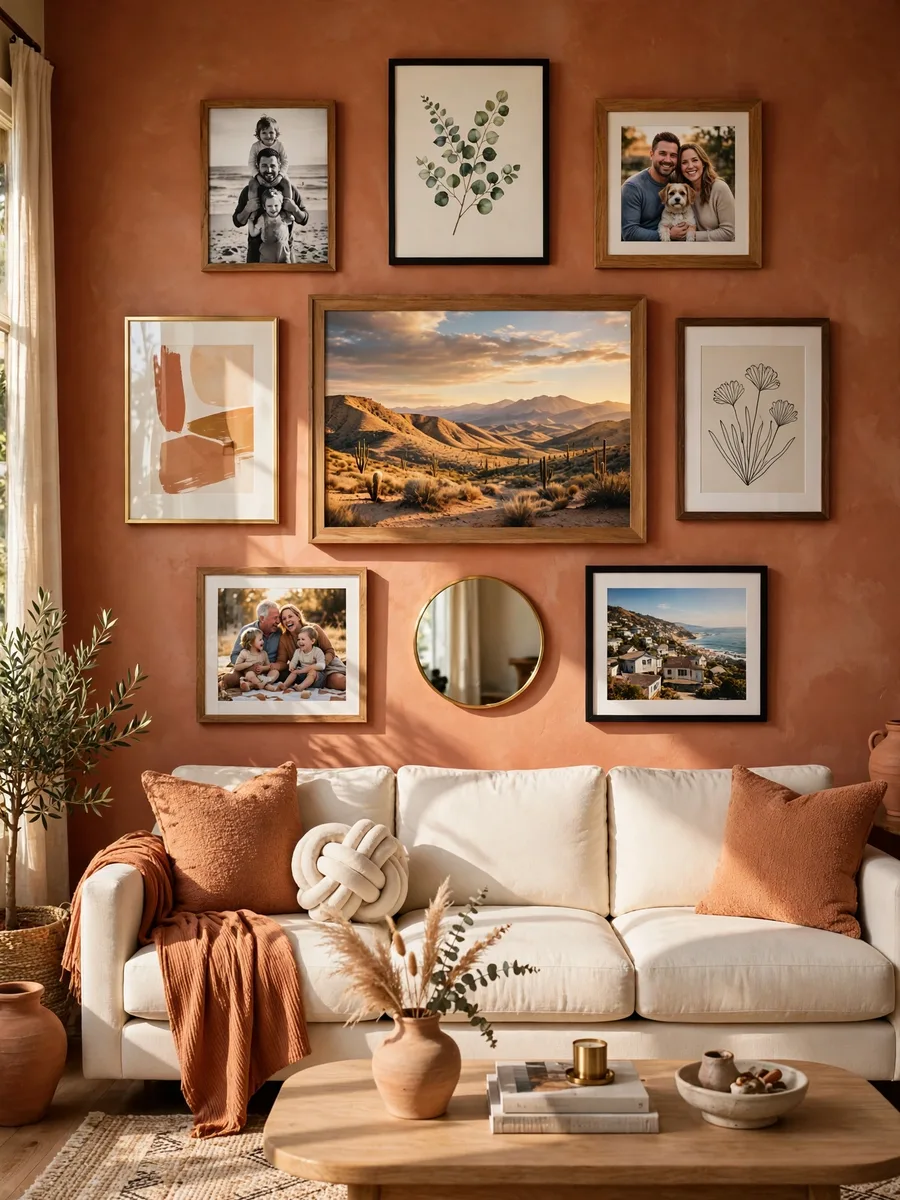
A gallery wall is a group of framed art, photographs, and small objects arranged as one display. It is the most personal of all living room wall decor ideas. Mix frame sizes and art styles, but hold the group together with one frame colour or one repeated colour in the art.
For example, hang nine frames in a loose grid above a three-seater sofa in warm cream and terracotta tones, with a large landscape print in the centre.
Quick tips:
- Start with the largest frame and build outward.
- Keep 2 to 3 inches between frames.
2. What Makes One Oversized Piece of Art Work So Well?
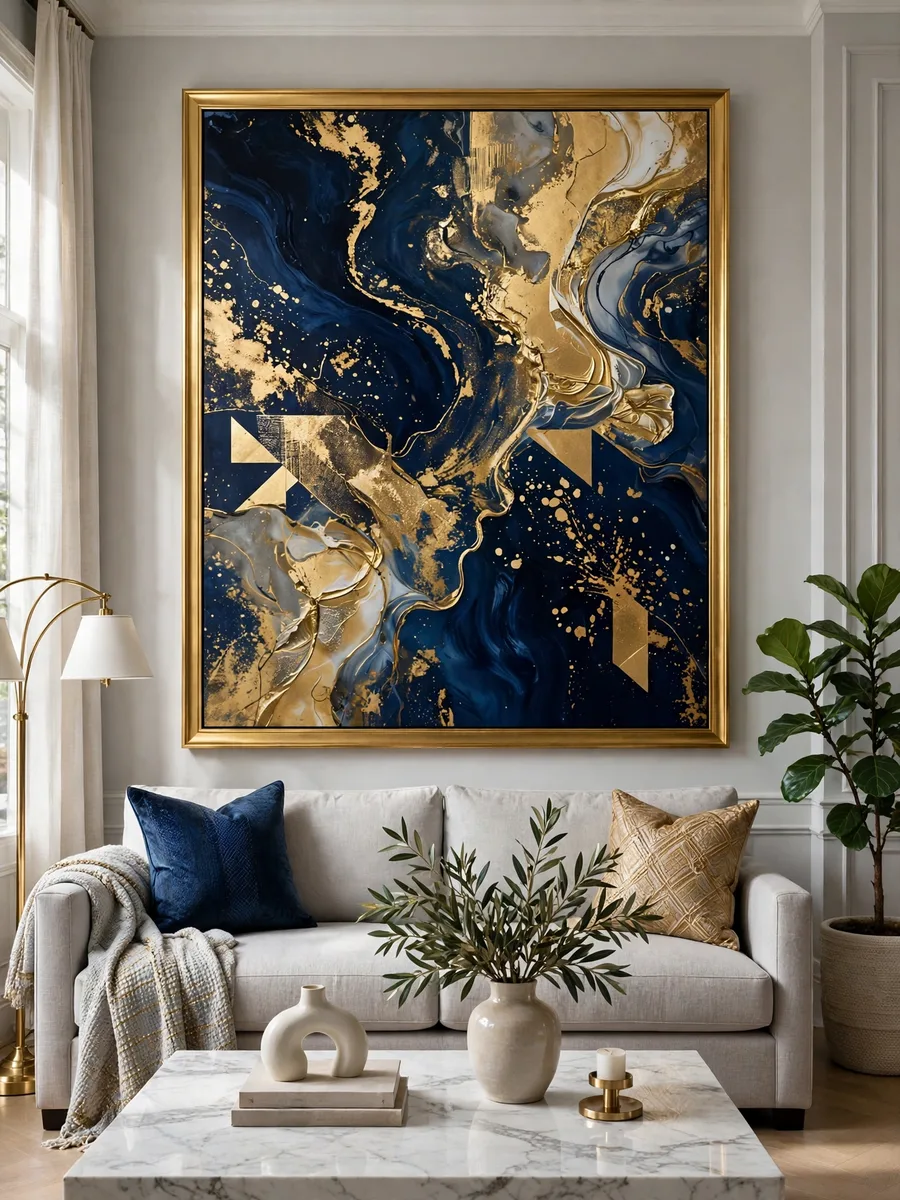
One oversized piece of art creates a calm, confident focal point without the visual noise of many small frames. It suits a large blank wall and anyone who wants impact with a single decision. Choose art at least two-thirds the width of the furniture below it.
For example, a single deep navy and gold abstract canvas, roughly 60 inches wide, above a light grey sofa gives the room a gallery feel at once.
Quick tips:
- One large piece beats four small pieces on a wide wall.
- Let the art set the room’s accent colour.
3. How Does a Large Arched Mirror Change a Living Room?
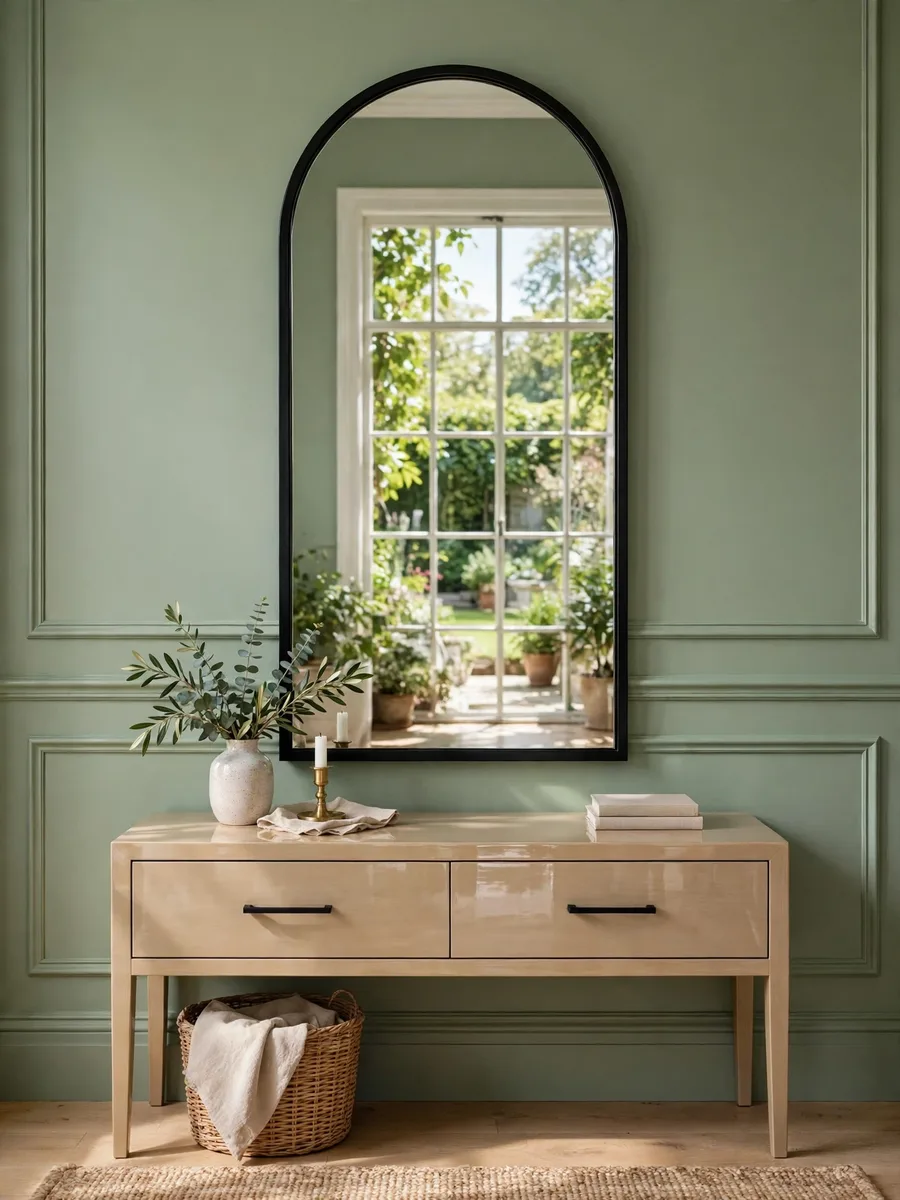
A large arched mirror adds light, height, and softness to a living room wall. Its curved top breaks up the straight lines of sofas and shelving, and its reflection makes a small or dark room feel larger and brighter. Hang it where it reflects a window or a pretty view.
For example, a tall black-framed arched mirror in a sage green living room, hung above a pale oak console, reflects the garden window opposite and doubles the sense of space.
Quick tips:
- Place mirrors opposite or beside windows for the most light.
- Check what the mirror reflects before fixing it.
4. How Do Floating Shelves Add Style and Storage?
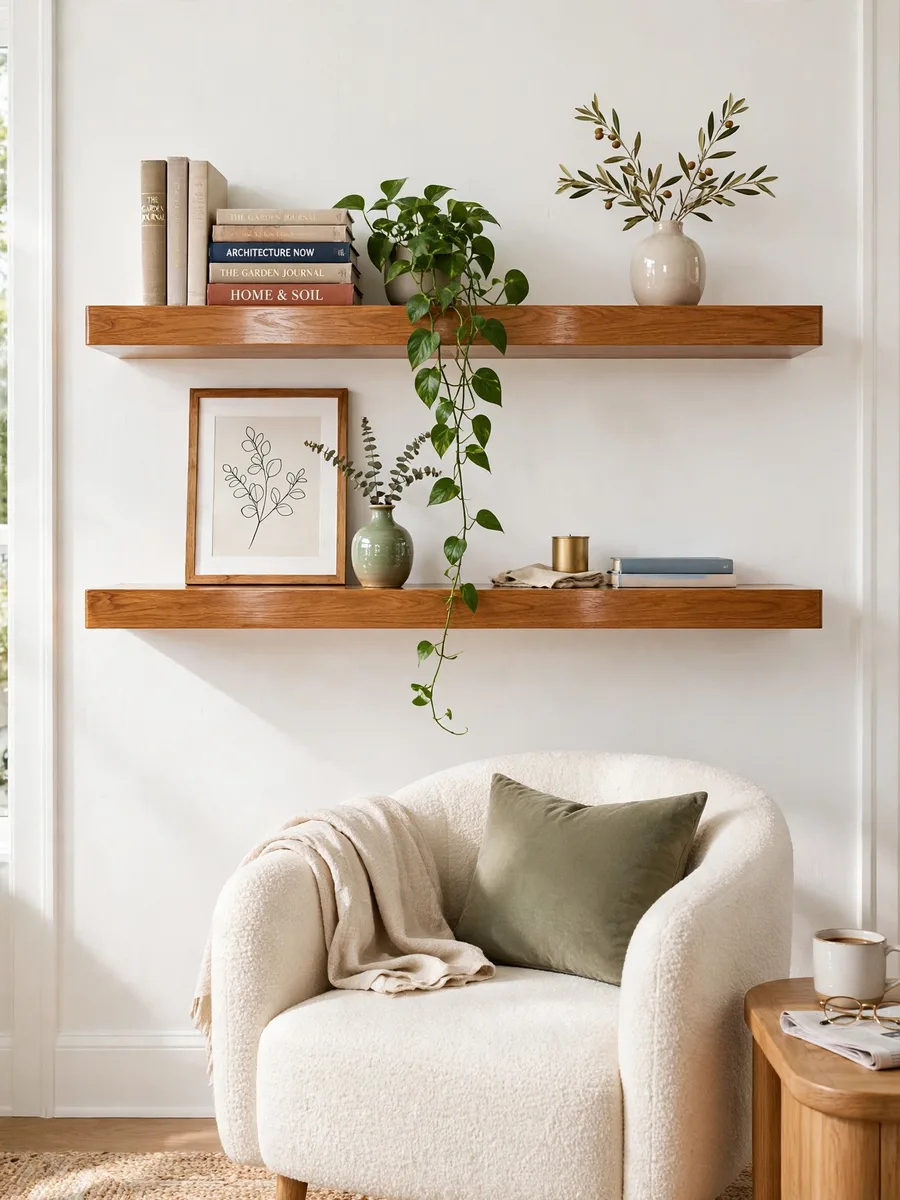
Floating shelves are wall-mounted boards with no visible brackets, and they give a living room wall both display space and storage. Use them for books, plants, framed photos, and decorative objects, styled in odd-numbered groups so the display looks relaxed rather than rigid.
For example, two warm oak floating shelves above a reading chair hold a stack of books, a trailing plant, and a ceramic vase, warming a white wall.
Quick tips:
- Mix heights and textures on each shelf.
- Leave empty space so shelves do not look cluttered.
5. Should You Paint an Accent Wall in Your Living Room?
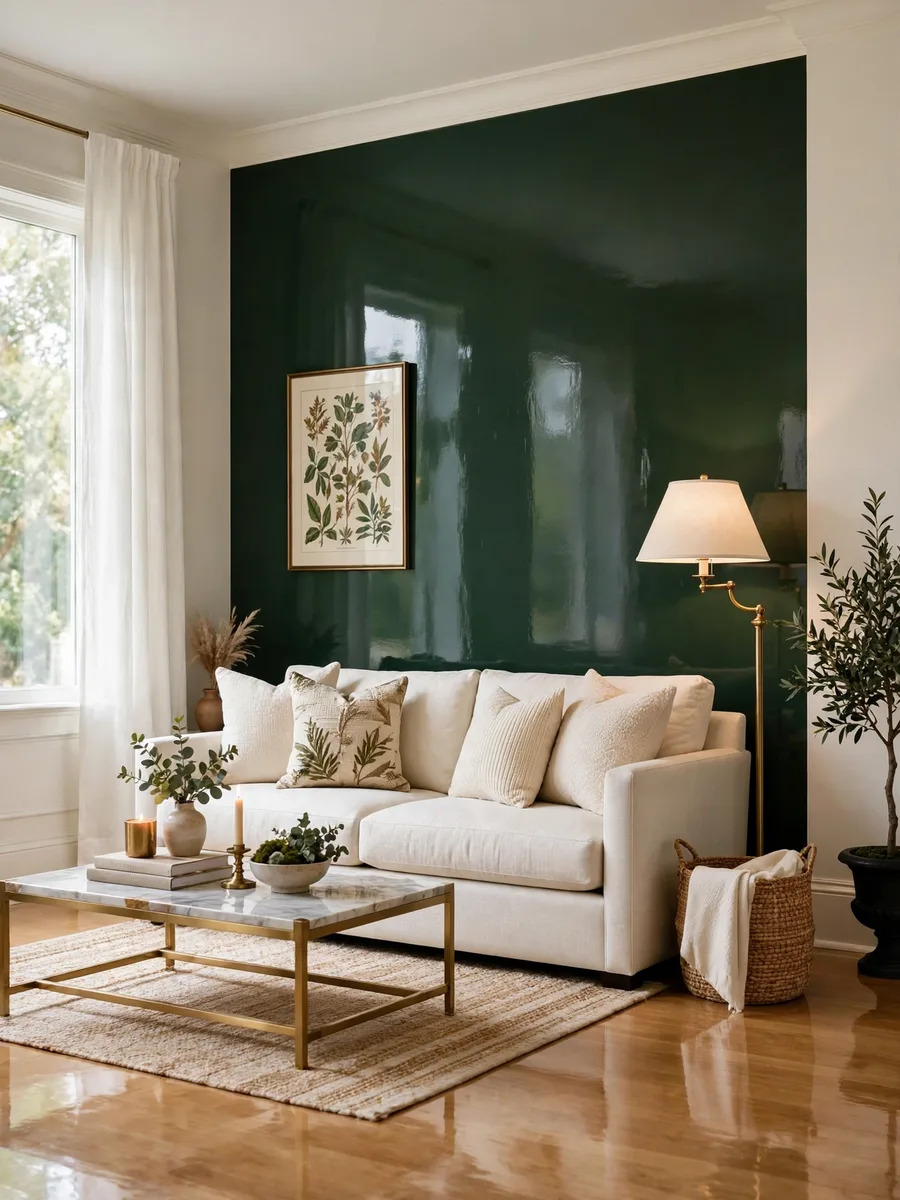
An accent wall is one wall painted in a deeper or bolder colour than the rest of the room, and it is the fastest way to create a focal point. It works best on the wall behind the sofa or the fireplace. Choose a colour already present in your rug or cushions.
For example, paint the sofa wall a deep forest green and keep the other walls warm white, so a cream sofa and brass floor lamp stand out against the green.
Quick tips:
- Paint only one wall to keep the room balanced.
- Test a large swatch in daylight and lamplight.
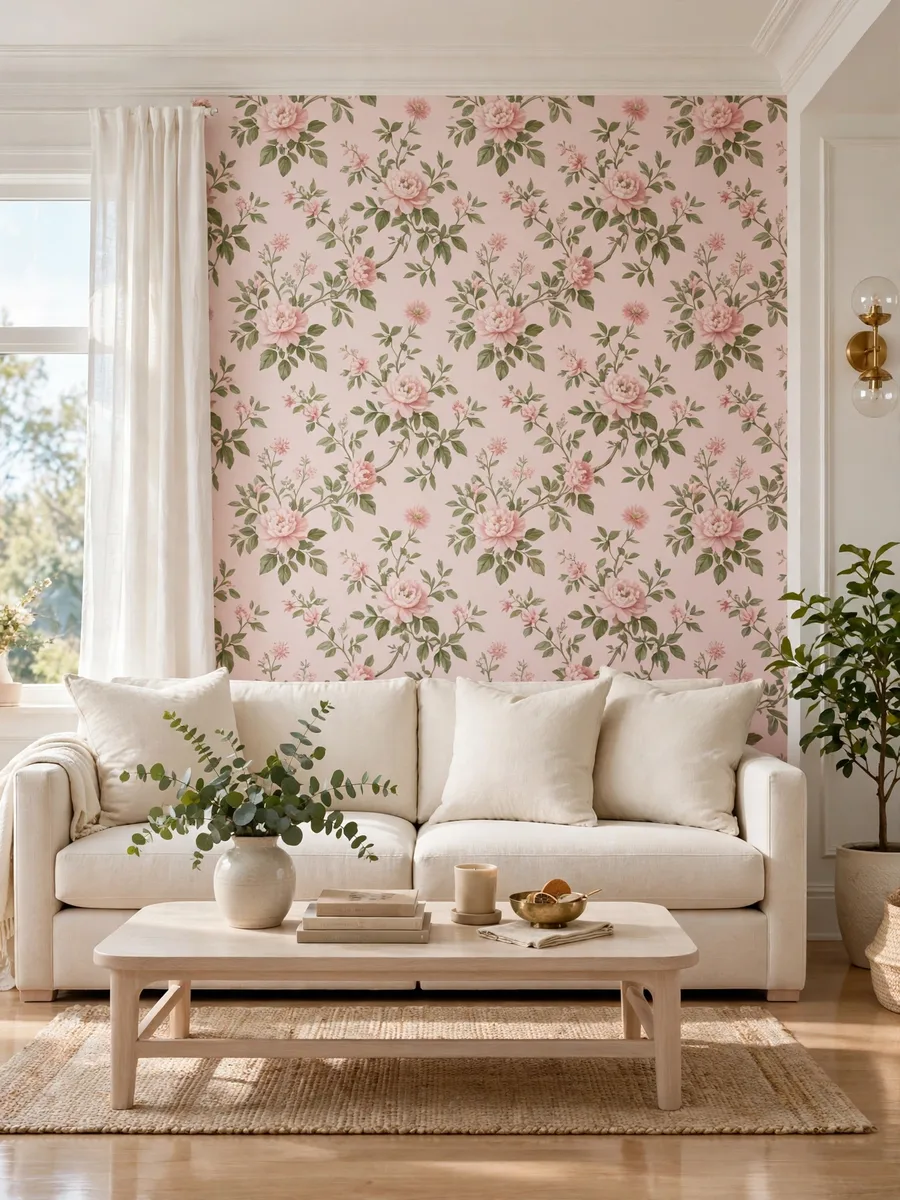
6. How Can Wallpaper Turn a Plain Wall Into a Feature?
Wallpaper adds pattern, colour, and texture that paint alone cannot, and a single feature wall is the easiest place to use it. Bold florals, geometrics, grasscloth, and mural-style papers all work, and removable wallpaper gives renters the same effect without a long-term commitment.
For example, a blush pink floral wallpaper on the wall behind a cream sofa, paired with plain linen cushions and a pale wood coffee table, makes the wall feel like art itself.
Quick tips:
- Paper one wall only if the pattern is bold.
- Match the wallpaper’s background to your wall colour.
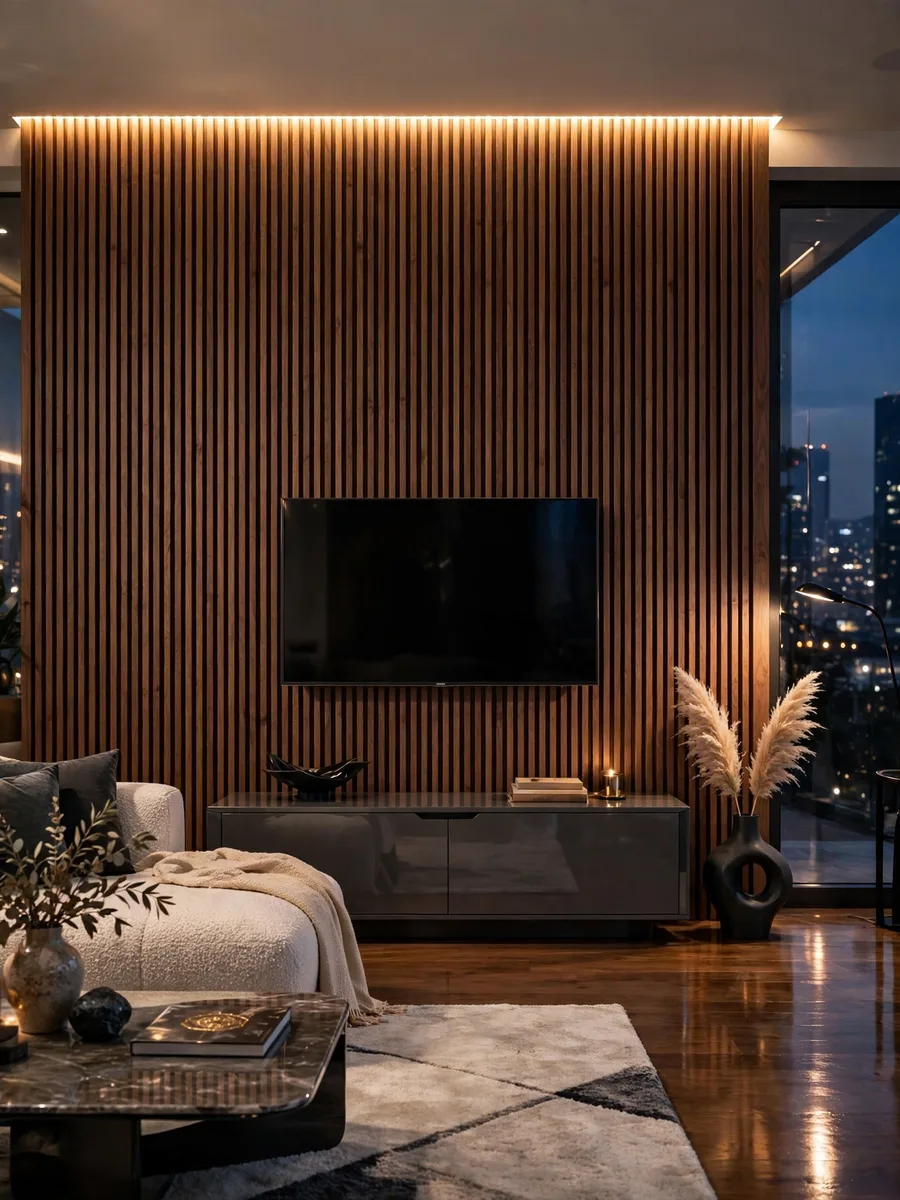
7. What Does a Wood Slat Wall Add to a Living Room?
A wood slat wall is made of thin vertical timber battens fixed to the wall, and it adds warmth, rhythm, and texture in one move. It suits modern and Scandinavian living rooms, and it works well behind a television or a sofa.
For example, a walnut slat wall behind a low charcoal media unit, with a slim television mounted in the centre, turns a plain TV wall into a designed feature.
Quick tips:
- Run slats floor to ceiling for the tallest effect.
- Keep furniture low so the slats stay visible.
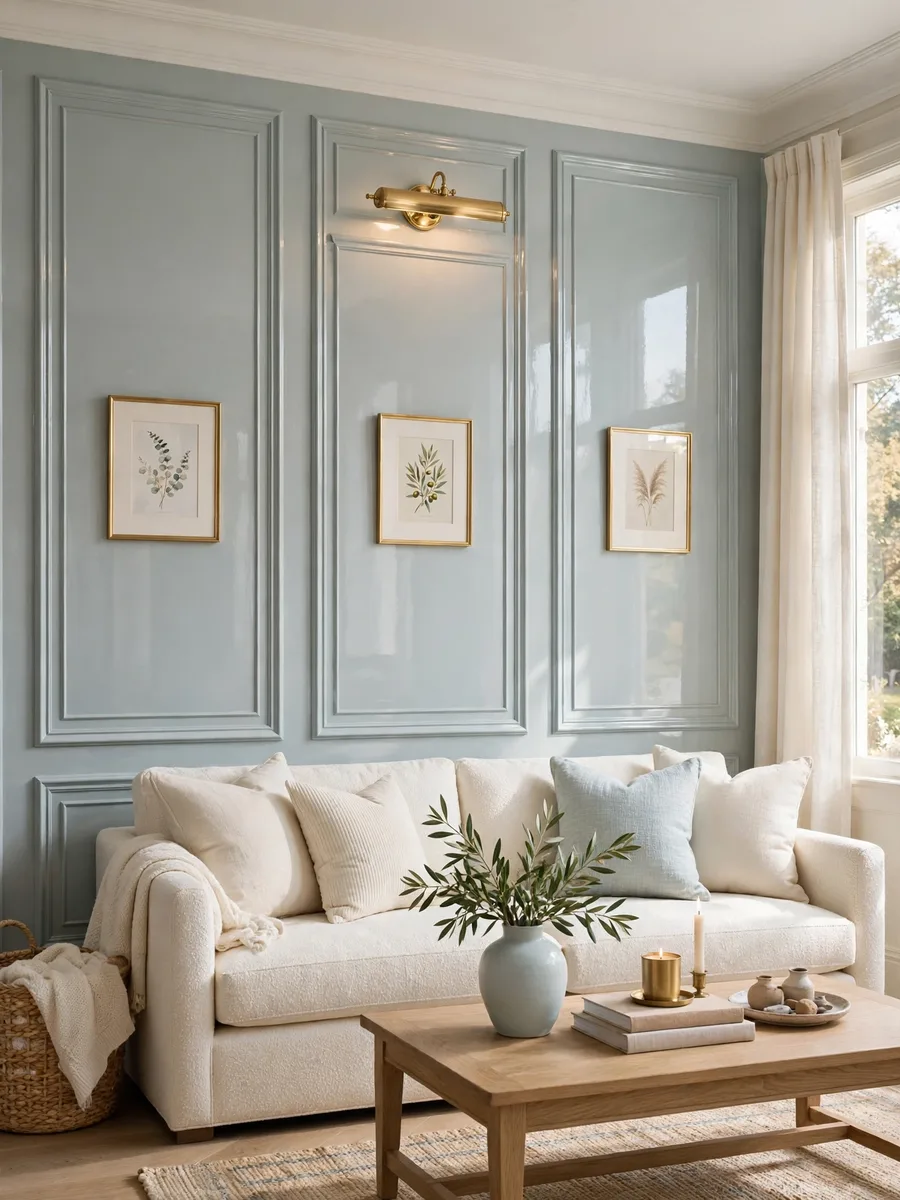
8. How Does Picture-Frame Moulding Make Walls Look Custom?
Picture-frame moulding is thin trim fixed to the wall in rectangular panels, then painted the same colour as the wall. It adds architectural detail to plain drywall for very little cost, and it makes a living room feel custom-built, framing art beautifully.
For example, pale blue-grey moulding panels on the wall behind a cream sofa, each panel holding a small framed print or left empty, give a flat wall the look of panelled wainscoting.
Quick tips:
- Paint trim and wall the same colour for a seamless look.
- Keep panel sizes even and spacing consistent.
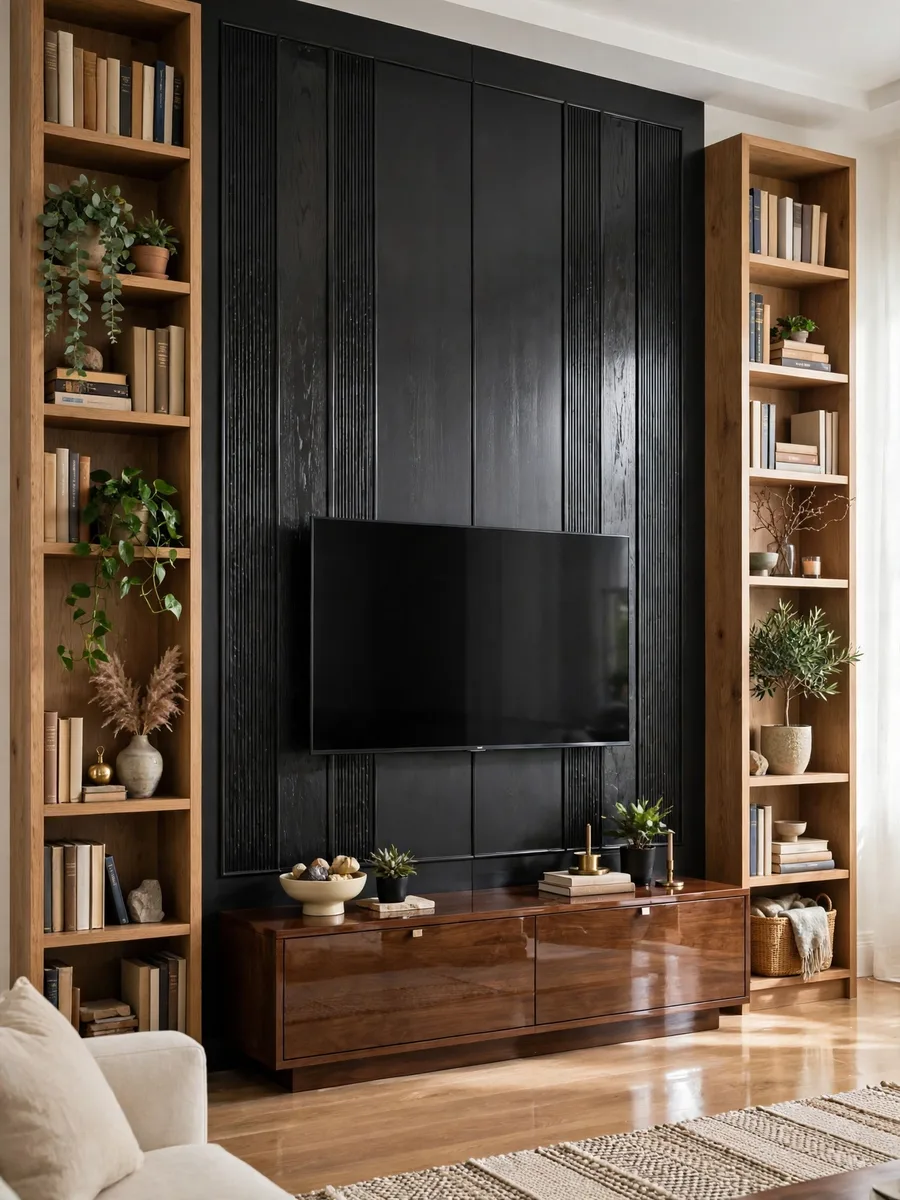
9. How Do You Decorate a TV Wall Without It Looking Bare?
A television is a large black rectangle, so a TV wall needs decor that softens it and makes it part of the room. Frame the screen with shelving, paneling, art, or a low media unit, and keep the decor balanced on both sides so the television does not dominate.
For example, mount the television on a charcoal panelled wall, flank it with two tall oak shelves, and place a low walnut media unit below. These TV wall decor ideas show how the same framing works with art and shelves.
Quick tips:
- Mount the TV at seated eye level.
- Hide cables inside the wall or a trunking channel.
10. How Should You Style the Wall Above a Fireplace?
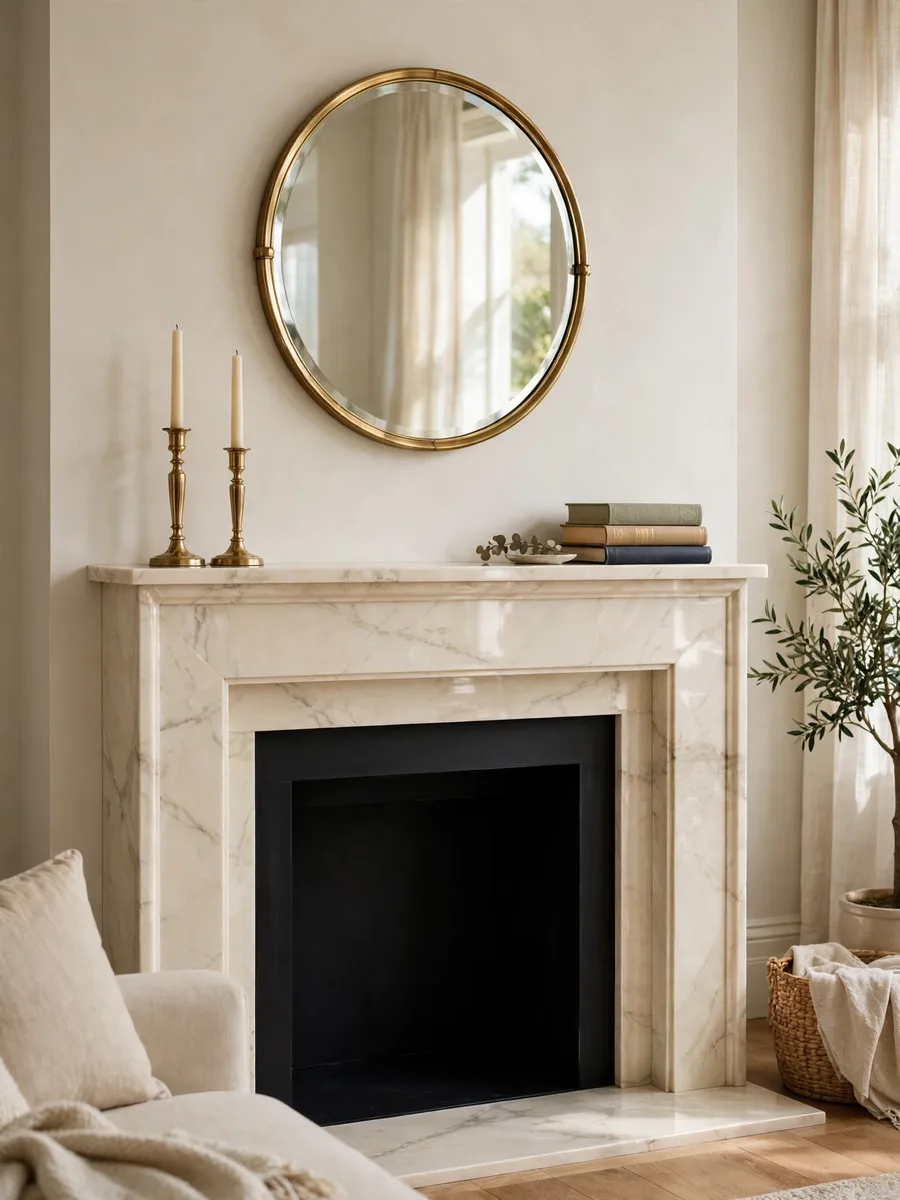
The fireplace wall is the natural focal point of many living rooms, so its decor should frame the mantel rather than fight it. A large mirror or one piece of art above the mantel, plus a few objects on the mantel itself, is usually enough, because the fireplace already draws the eye.
For example, a round brass mirror above a cream marble fireplace, with candlesticks on one side of the mantel and books on the other, feels elegant without clutter.
Quick tips:
- Hang art or a mirror 6 to 8 inches above the mantel.
- Use odd-numbered groups on the mantel itself.
11. What Is Sculptural 3D Wall Art?
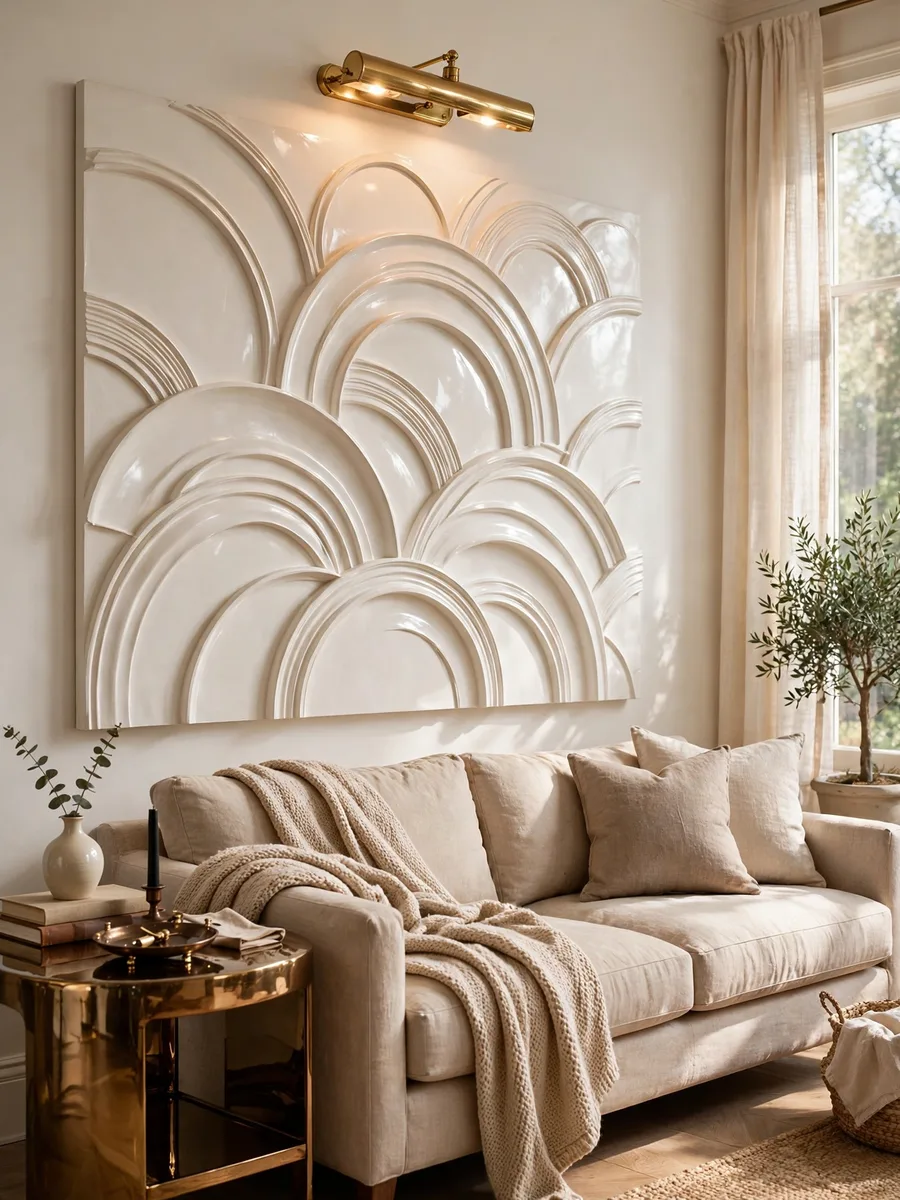
Sculptural wall art is three-dimensional decor, such as metal shapes, carved wood panels, plaster reliefs, or ceramic forms, that casts shadows and adds depth a flat print cannot. It suits a wall that already has enough colour but needs texture.
For example, a large ivory plaster relief of overlapping arcs on a warm white wall, lit by a picture light, creates soft shadows that change through the day, while a bronze side table below keeps the palette calm.
Quick tips:
- Light 3D art from above or the side to show its shadows.
- Give it empty wall space around it.
12. How Do Woven Baskets and Textiles Warm a Wall?
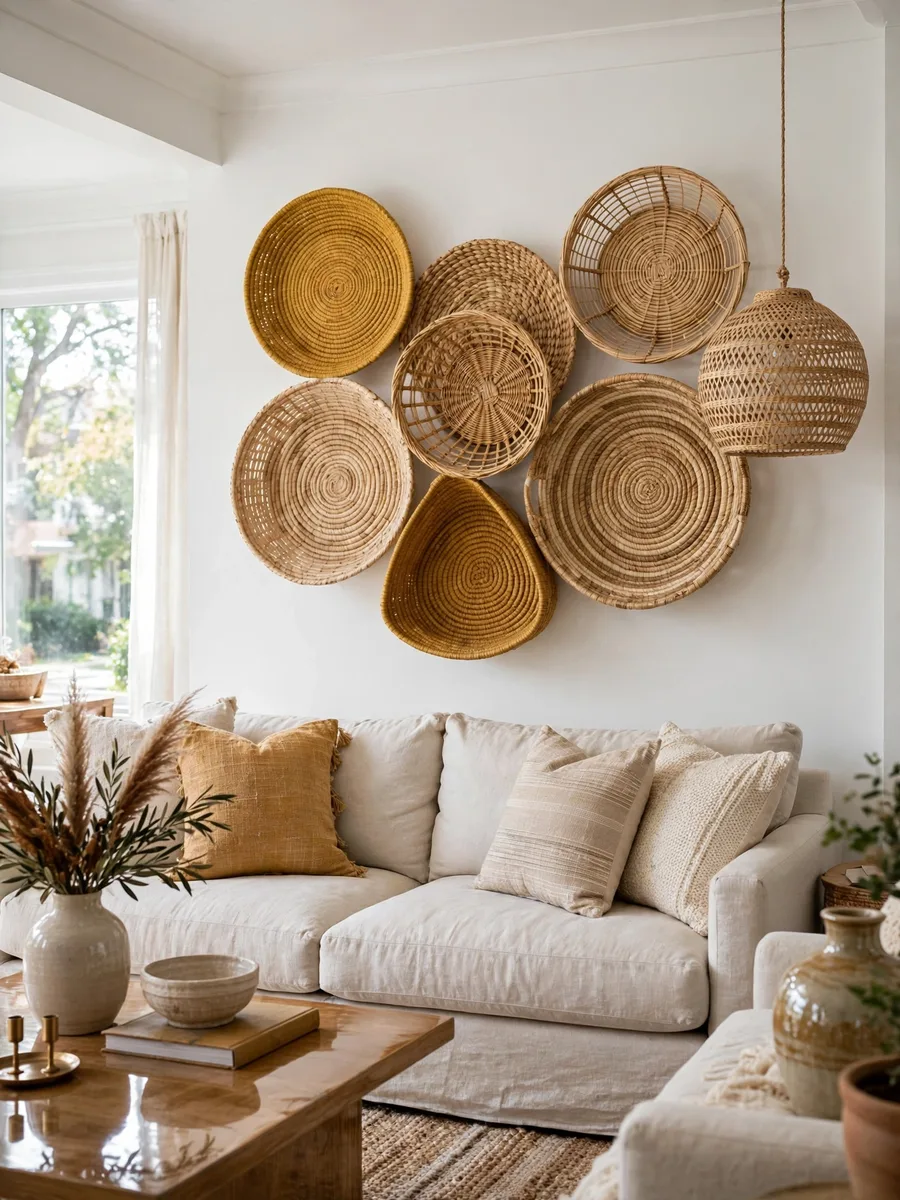
Woven baskets, flat-weave hangings, and macramé add softness and texture to a living room wall, and they suit bohemian, coastal, and global styles. A basket wall works best when the baskets vary in size but share a warm natural palette, while a single large textile can fill a tall wall on its own.
For example, a cluster of seven seagrass and rattan baskets in mustard, sand, and natural tones on a white wall above a linen sofa adds warmth without any colour clash.
Quick tips:
- Arrange baskets on the floor first to find the shape.
- Mix sizes but keep one colour family.
13. Can a Plant Wall Work in a Living Room?
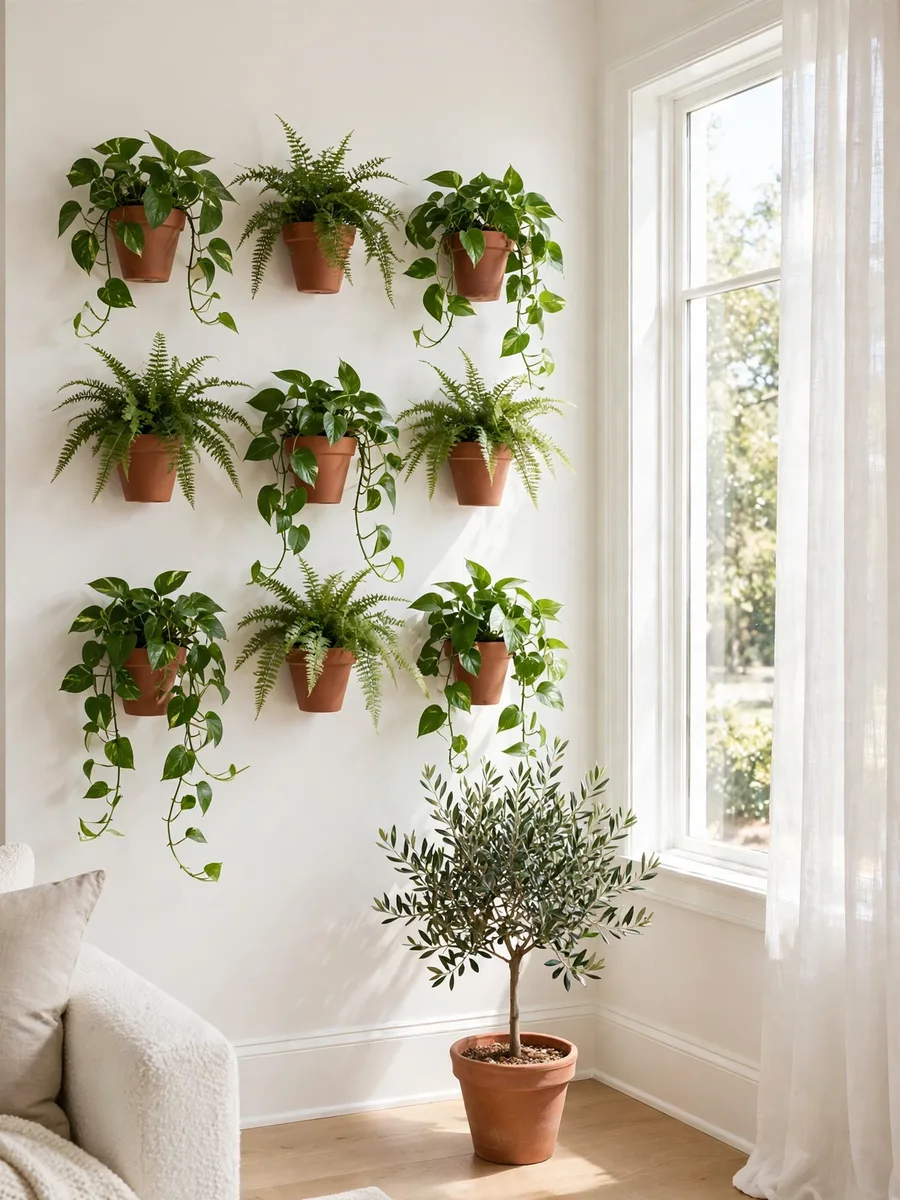
A plant wall brings living greenery onto a blank wall, and it suits bright living rooms with good natural light. Mounted planters, a grid of small pots, or a tall plant shelf each create the effect, and trailing plants soften hard edges beautifully.
For example, a grid of nine small terracotta pots on a white wall beside a window holds trailing pothos and ferns, the emerald green fresh against warm white.
Quick tips:
- Start with easy plants such as pothos and snake plants.
- Use planters with drainage or a drip tray.
14. How Do You Build a Black-and-White Photo Wall?
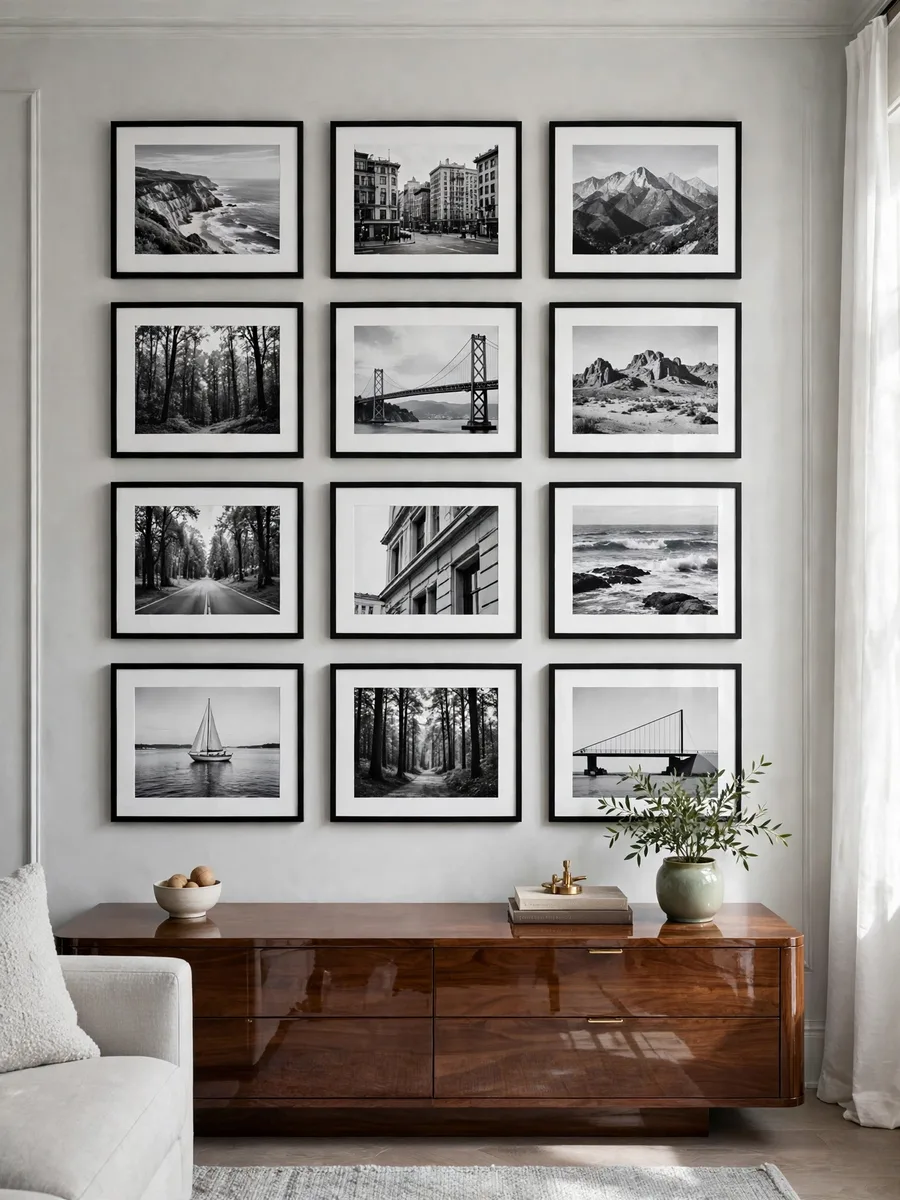
A black-and-white photo wall uses monochrome prints in matching frames to create a timeless, gallery-style display. It suits almost any living room because black and white works with every colour scheme, and it keeps family photos looking cohesive rather than busy.
For example, twelve black-and-white photographs in slim black frames form a neat grid above a walnut console in a light grey living room, with a small green plant adding the only colour.
Quick tips:
- Use identical frames for a tidy grid look.
- Print photos at the same size for even spacing.
15. How Do Wall Sconces and Picture Lights Transform a Wall?
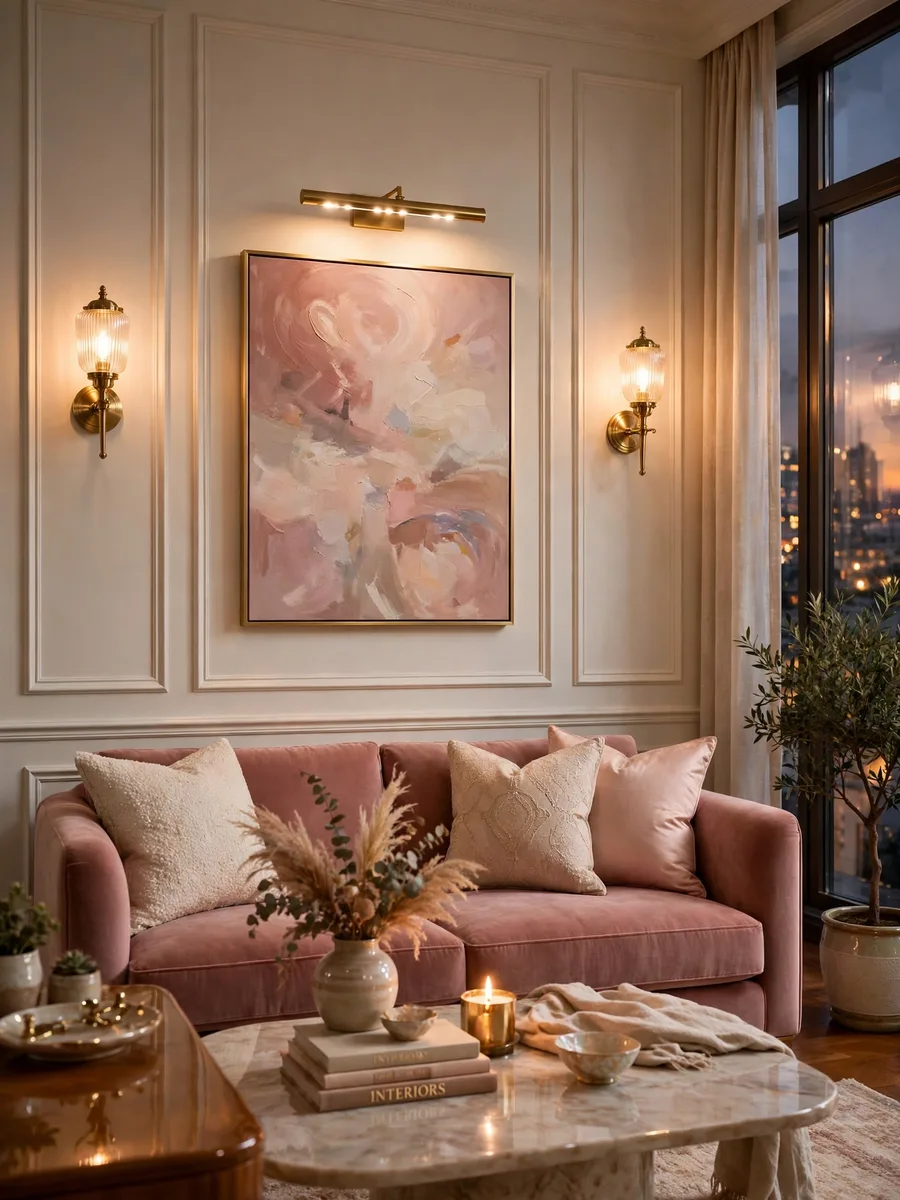
Wall sconces and picture lights add a layer of warm light that makes wall decor look intentional after dark. Sconces flank art or a mirror, while a picture light mounted above a painting washes it in soft light and makes colours glow, adding a finished, gallery-like feel.
For example, two brass sconces flank a dusty rose abstract painting above a sofa, with a slim brass picture light above the frame, so in the evening the painting glows and the wall becomes the warmest spot in the room.
Quick tips:
- Choose warm white bulbs for a cosy glow.
- Flank art symmetrically for a balanced look.
16. What Can a Built-In Bookcase Wall Do for a Living Room?
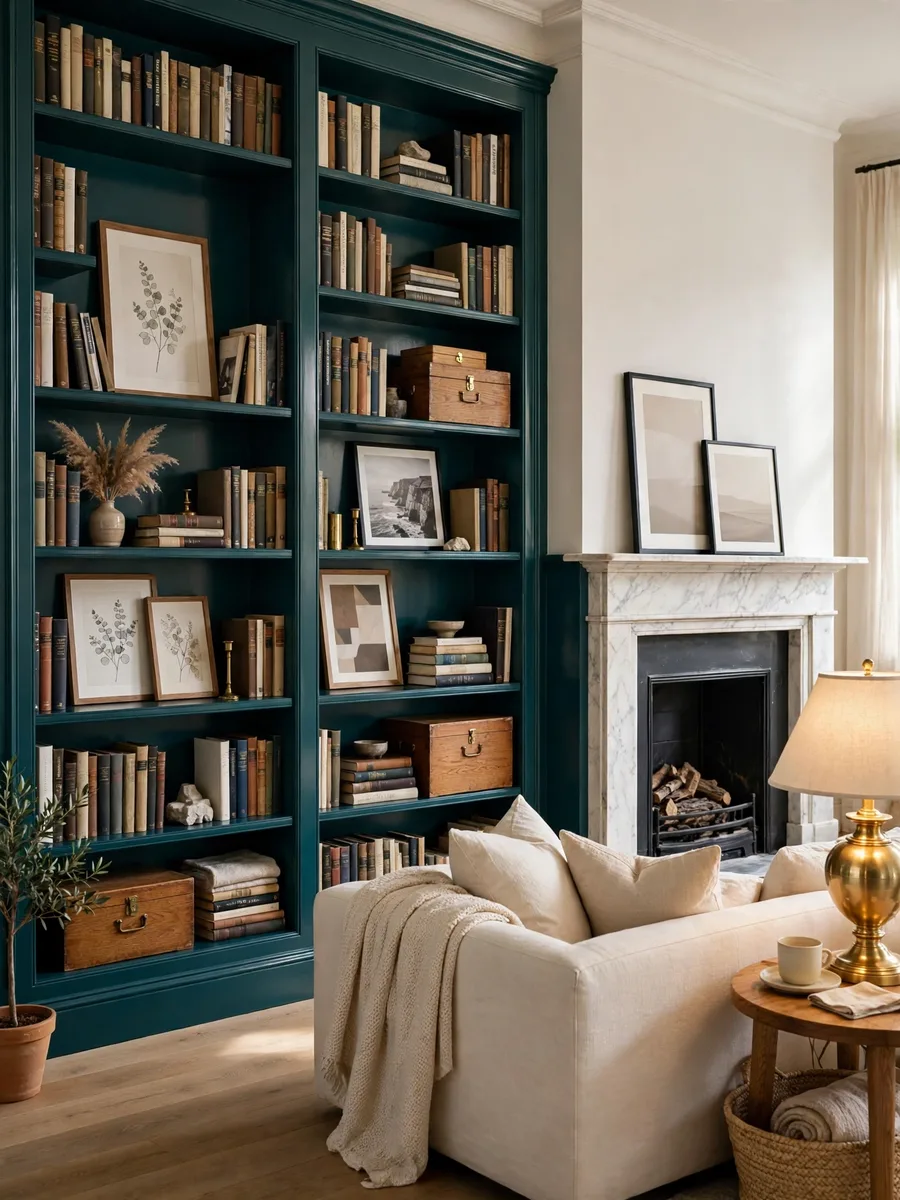
A built-in bookcase wall turns a whole wall into storage and display, and it makes a living room feel tailored and complete. Fill the shelves with books, art, plants, and decorative objects, and leave some shelves partly empty so the display can breathe.
For example, a deep teal built-in bookcase fills the wall beside a fireplace, with books in stacks and rows and oak boxes hiding clutter.
Quick tips:
- Mix books, art, and objects on every shelf.
- Leave one shelf partly empty for breathing room.
17. How Do You Style a Decorative Plate Wall?
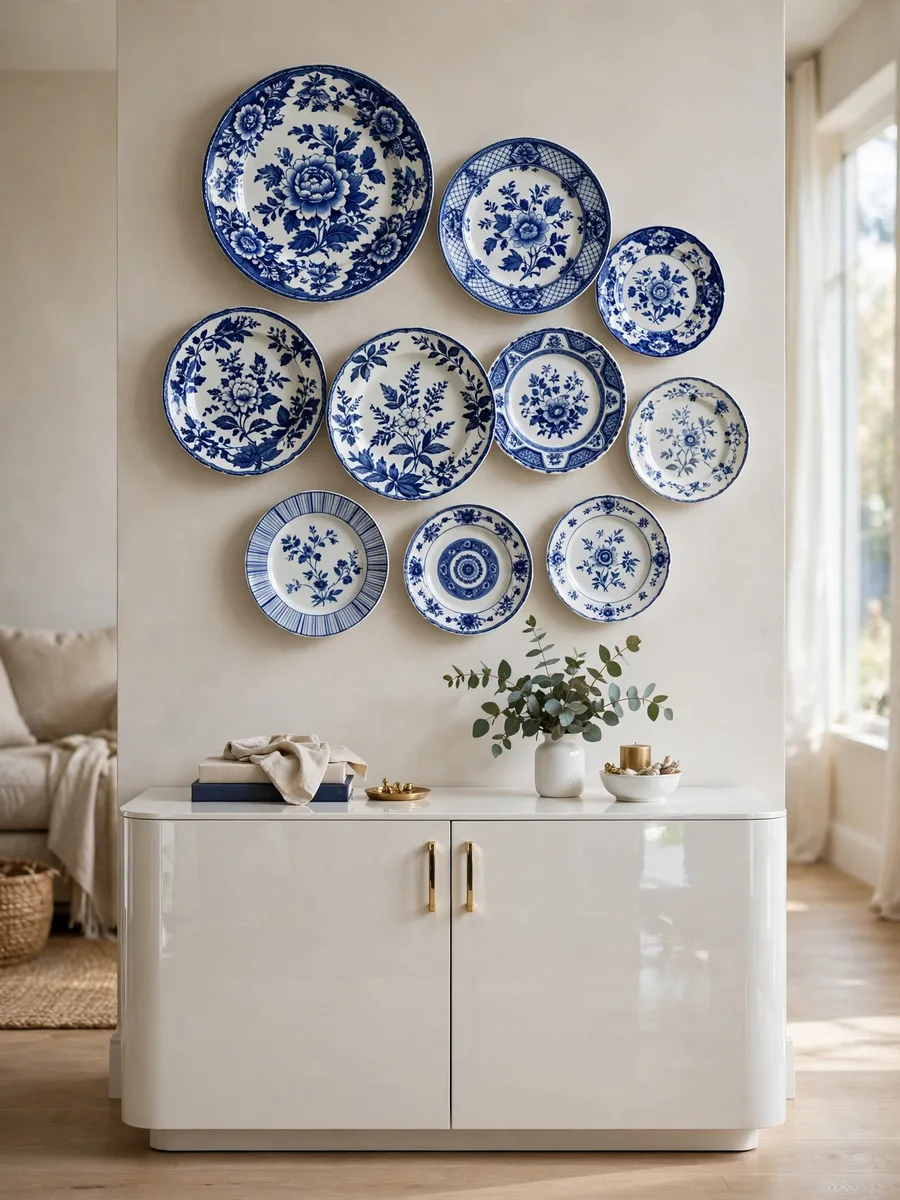
A decorative plate wall is a collection of ceramic plates hung as art, and it adds colour, pattern, and a collected feel to a living room. It suits traditional, cottage, and eclectic rooms, and it works well above a sideboard. Mix sizes and patterns, but keep one colour running through the plates.
For example, nine cobalt blue and white plates in different sizes form a loose cluster above a white sideboard, with a small vase of eucalyptus below, the blue repeating in the rug.
Quick tips:
- Use plate hangers rated for each plate’s weight.
- Trace plates on paper to plan the layout first.
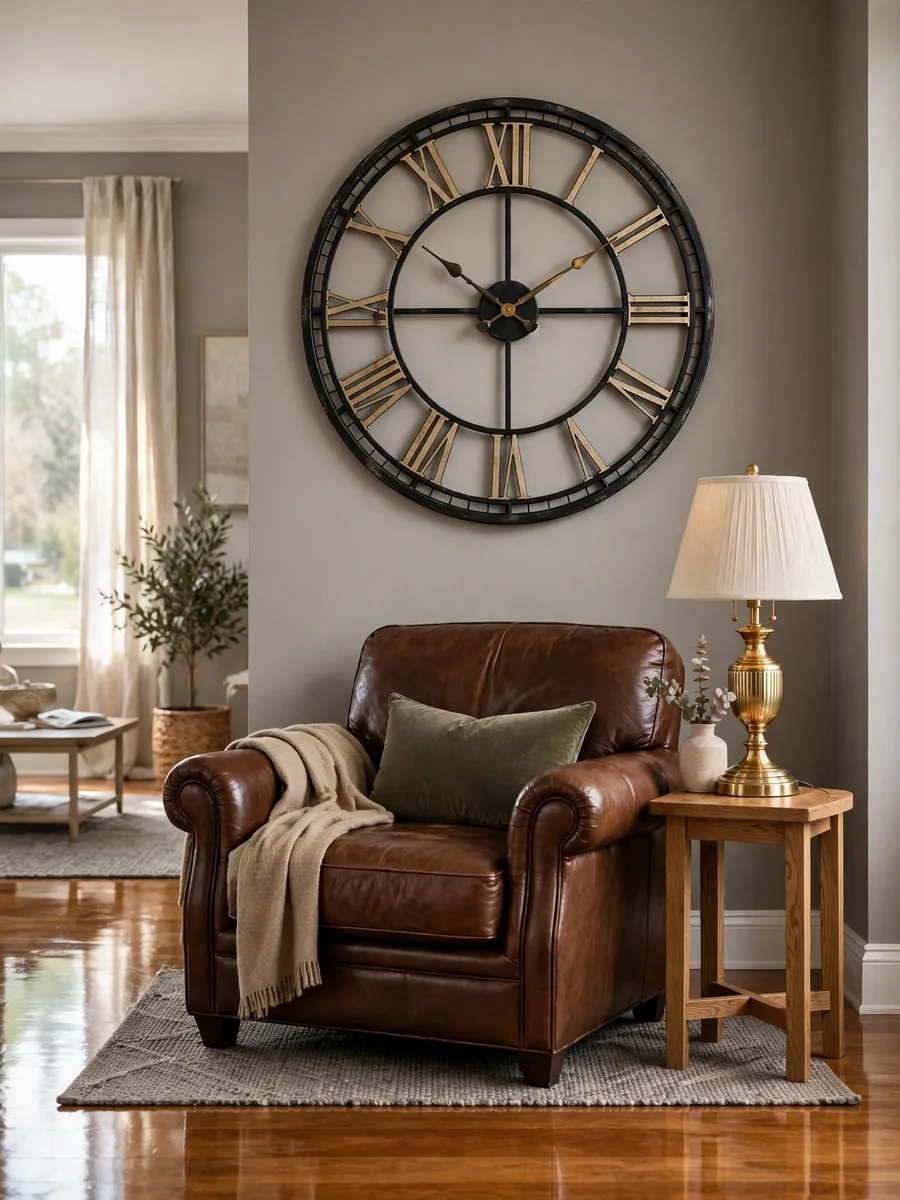
18. Can a Large Wall Clock Be the Focal Point?
A large wall clock is both useful and decorative, and it can anchor a living room wall on its own. Oversized clocks suit farmhouse, industrial, and modern rooms, and they work well above a console or beside a fireplace. Choose a clock large enough to read across the room.
For example, a 36-inch black metal clock with roman numerals hangs above a leather armchair in a warm grey living room, with a small oak side table and brass lamp below, giving the room a clear focal point.
Quick tips:
- Size the clock to the wall, not the furniture.
- Keep the wall around it clear.
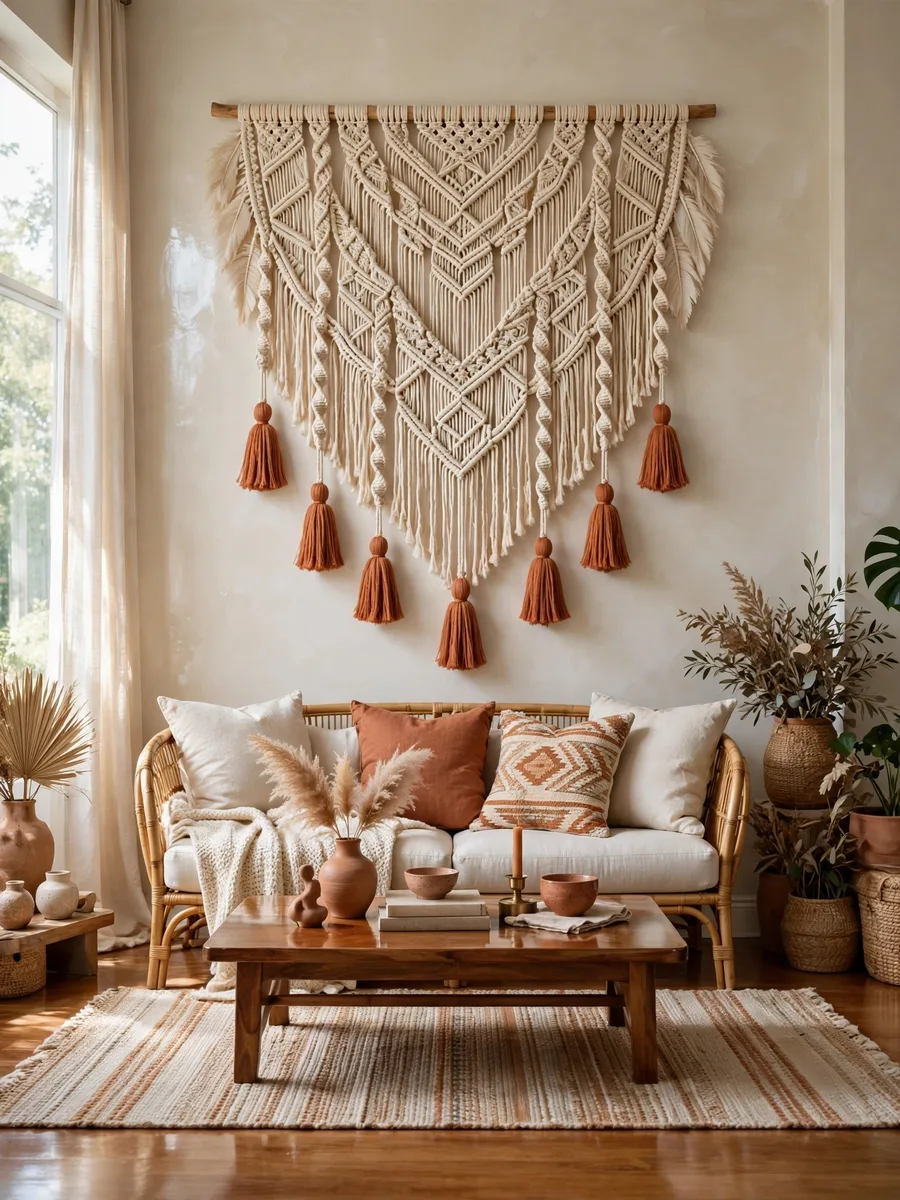
19. How Does a Tapestry or Macramé Hanging Soften a Wall?
A tapestry or macramé hanging softens a hard wall with fabric texture, and it suits bohemian, relaxed, and coastal living rooms. A large woven piece can fill a tall wall by itself, while a smaller macramé hanging adds texture above a sofa or a reading chair.
For example, a large cream and sand macramé hanging with terracotta tassels fills the wall above a rattan sofa, making the corner feel warm and handmade.
Quick tips:
- Hang textiles high enough to clear the sofa back.
- Choose natural fibres for the softest drape.
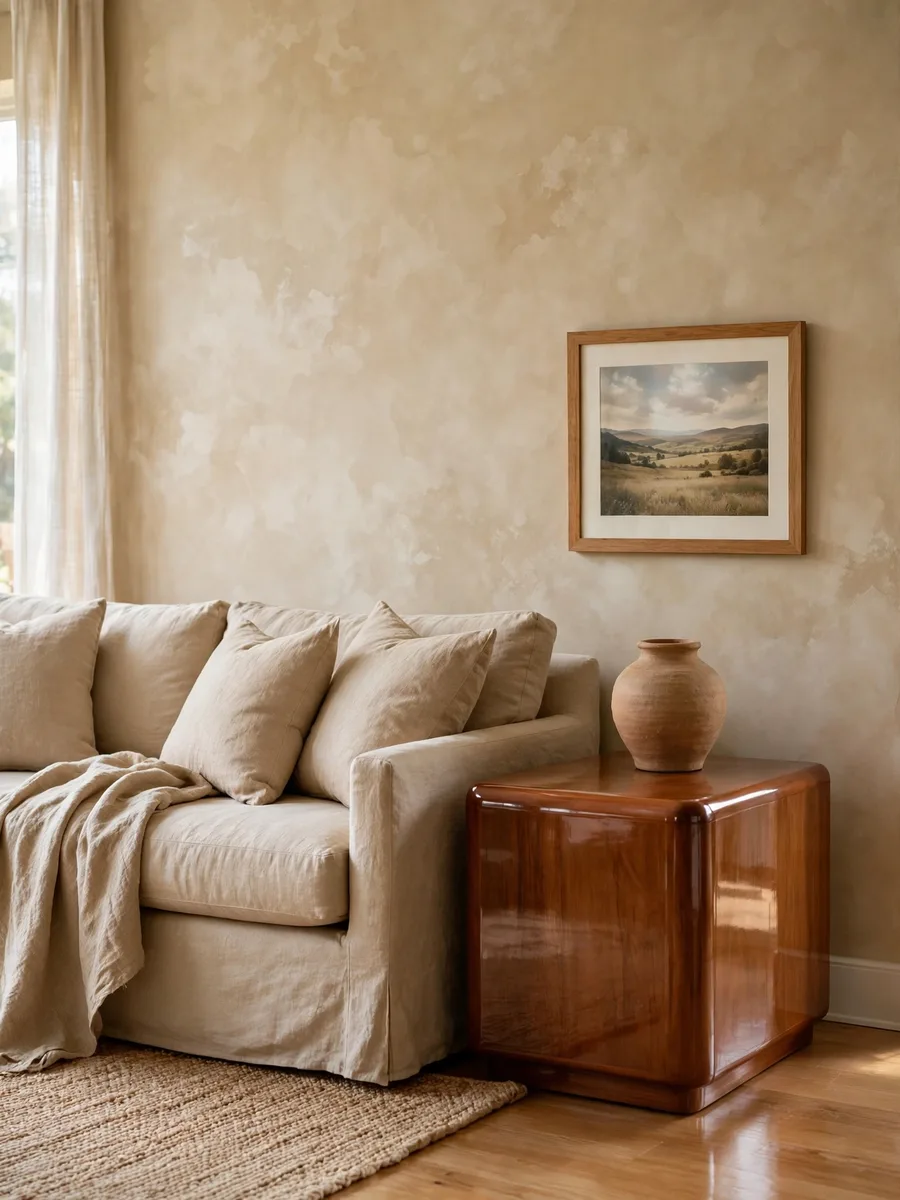
20. What Is Limewash Paint, and Why Does It Suit Living Room Walls?
Limewash paint is a mineral paint applied in thin layers that dries with a soft, cloudy, textured finish. It gives a living room wall depth and movement that flat paint cannot, and it suits Mediterranean, modern rustic, and calm minimalist rooms.
For example, a warm stone-beige limewash wall behind a linen sofa, with a single wooden-framed landscape print and a clay vase on the side table, feels earthy and serene, its texture catching the light differently through the day.
Quick tips:
- Apply limewash in thin, crossed layers.
- Test it on a large board before painting the wall.
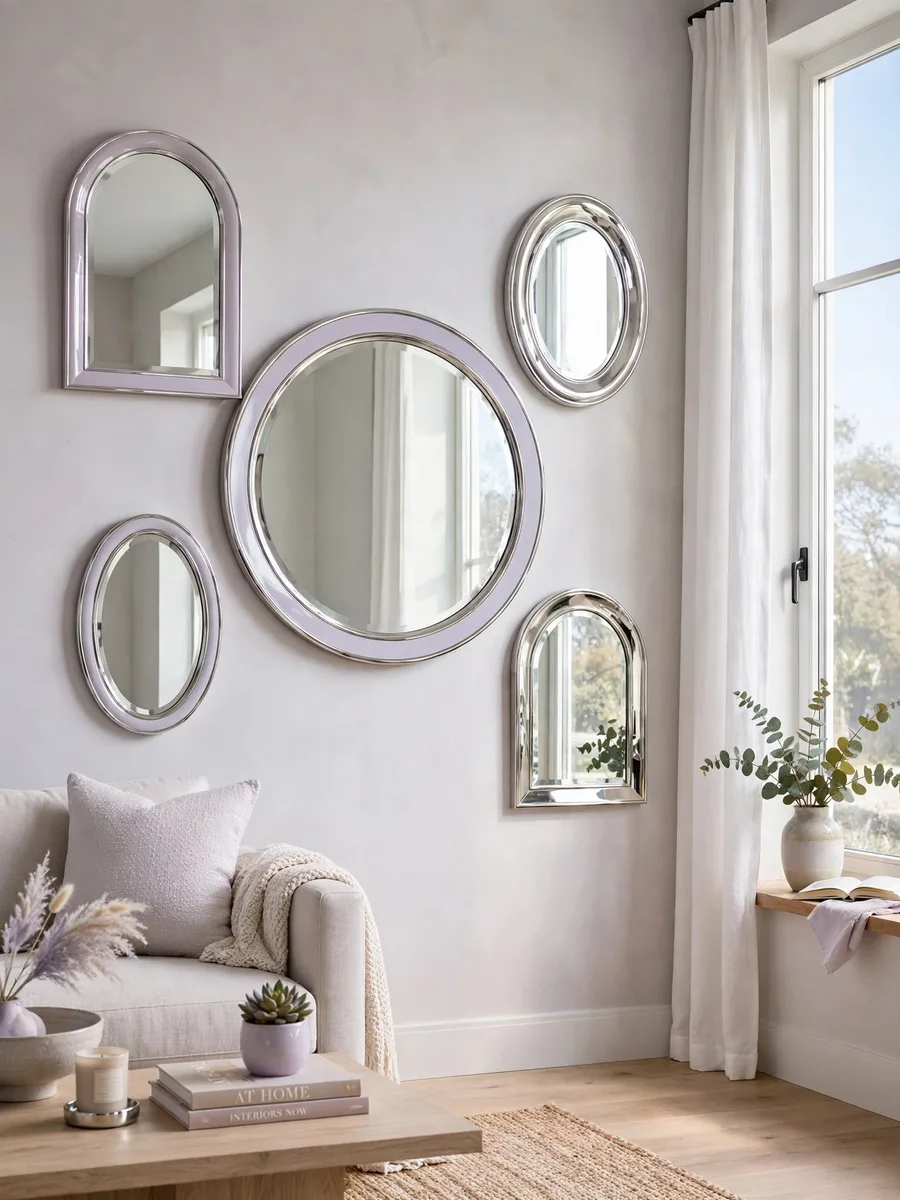
21. How Do You Arrange a Mirror Gallery Wall?
A mirror gallery wall is a group of mirrors in different shapes and sizes hung together as one display. It reflects light from several angles, makes a small living room feel larger, and adds a decorative sparkle that art alone cannot. Keep the frames in one metal finish for cohesion.
For example, five mirrors in pale lavender and silver tones — one large round mirror in the centre, four smaller ones around it — hang beside a window, catching the daylight.
Quick tips:
- Mix mirror shapes but keep one frame finish.
- Hang mirrors where they reflect light, not clutter.
22. How Can You Decorate a Reading Nook Wall?
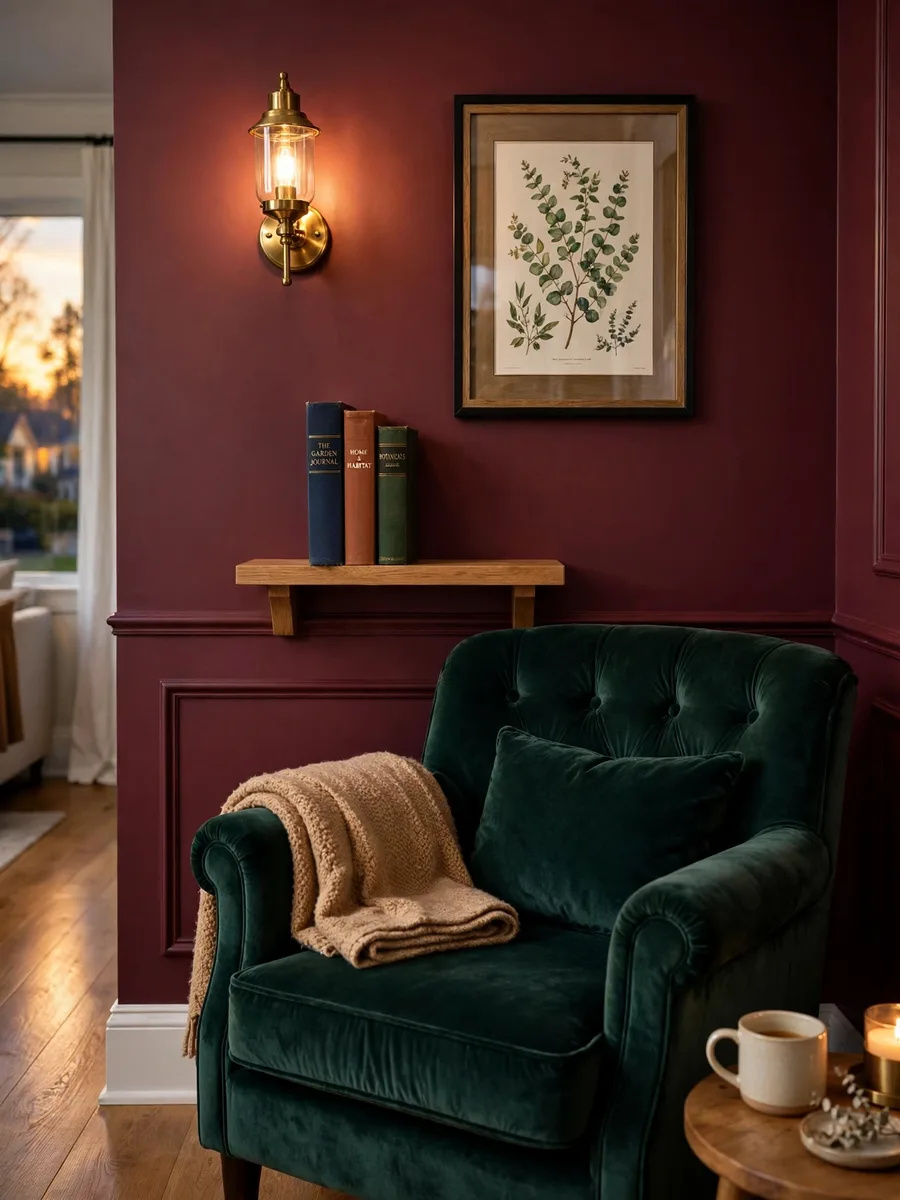
A reading nook wall is a small, dedicated corner for reading, and its decor should make the spot feel cosy and separate from the rest of the room. A small shelf for books, a sconce for reading light, and one piece of art above the chair are usually enough.
For example, a burgundy-painted nook wall holds a brass sconce, a small oak shelf with three books, and a framed botanical print above a velvet armchair, with a folded throw completing the corner.
Quick tips:
- Paint the nook wall a deeper colour than the room.
- Add a sconce at reading height.
23. What Is an Art Ledge, and When Should You Use One?
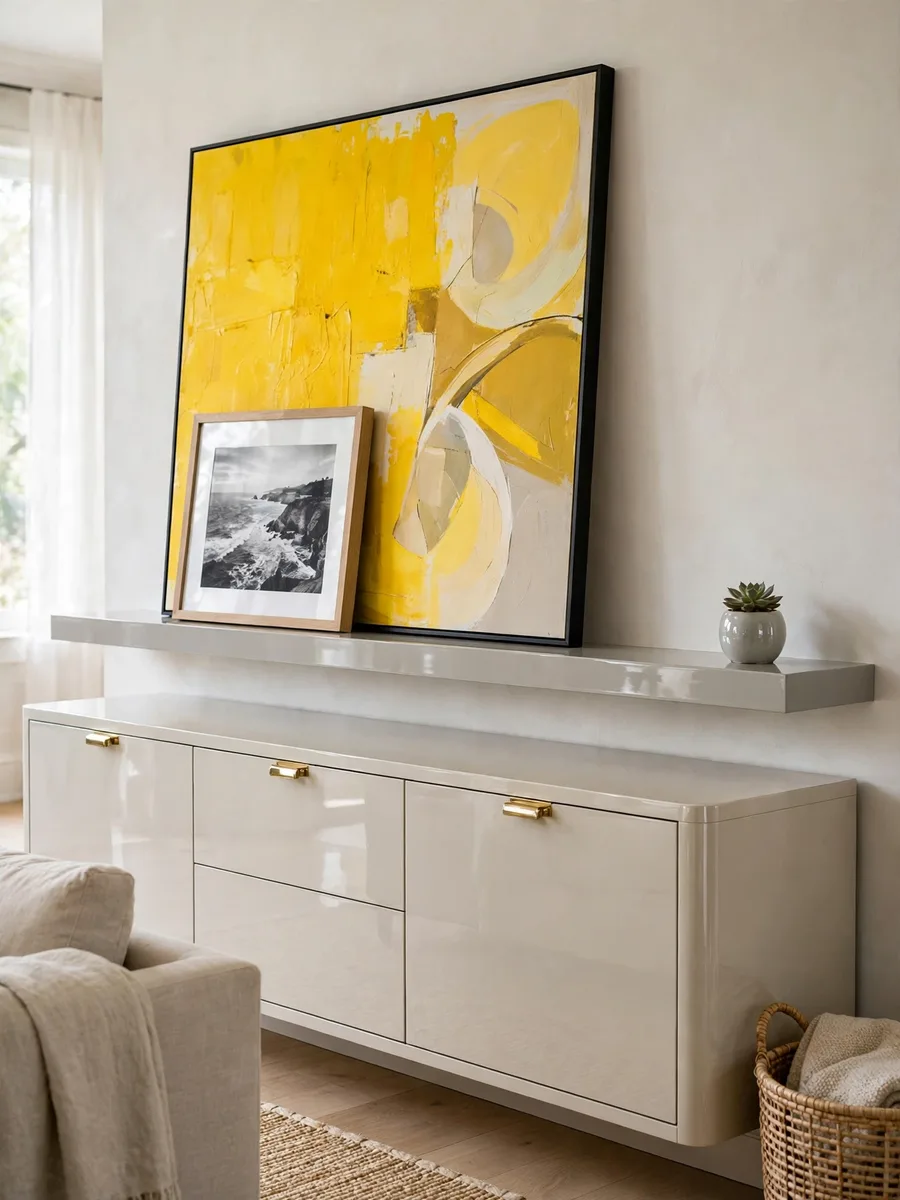
An art ledge is a narrow shelf with a lip that lets framed art lean against the wall instead of being nailed in place. It suits renters, people who change art often, and anyone who wants a layered, gallery look without many holes. Lean two or three frames at different heights and overlap them slightly.
For example, a long light grey art ledge above a console holds a large yellow abstract print, a smaller framed photograph leaning in front of it, and a tiny potted succulent at the end.
Quick tips:
- Lean larger frames at the back, smaller ones in front.
- Overlap frames slightly for a layered look.
24. How Do You Create a Rotating Art Wall for the Seasons?
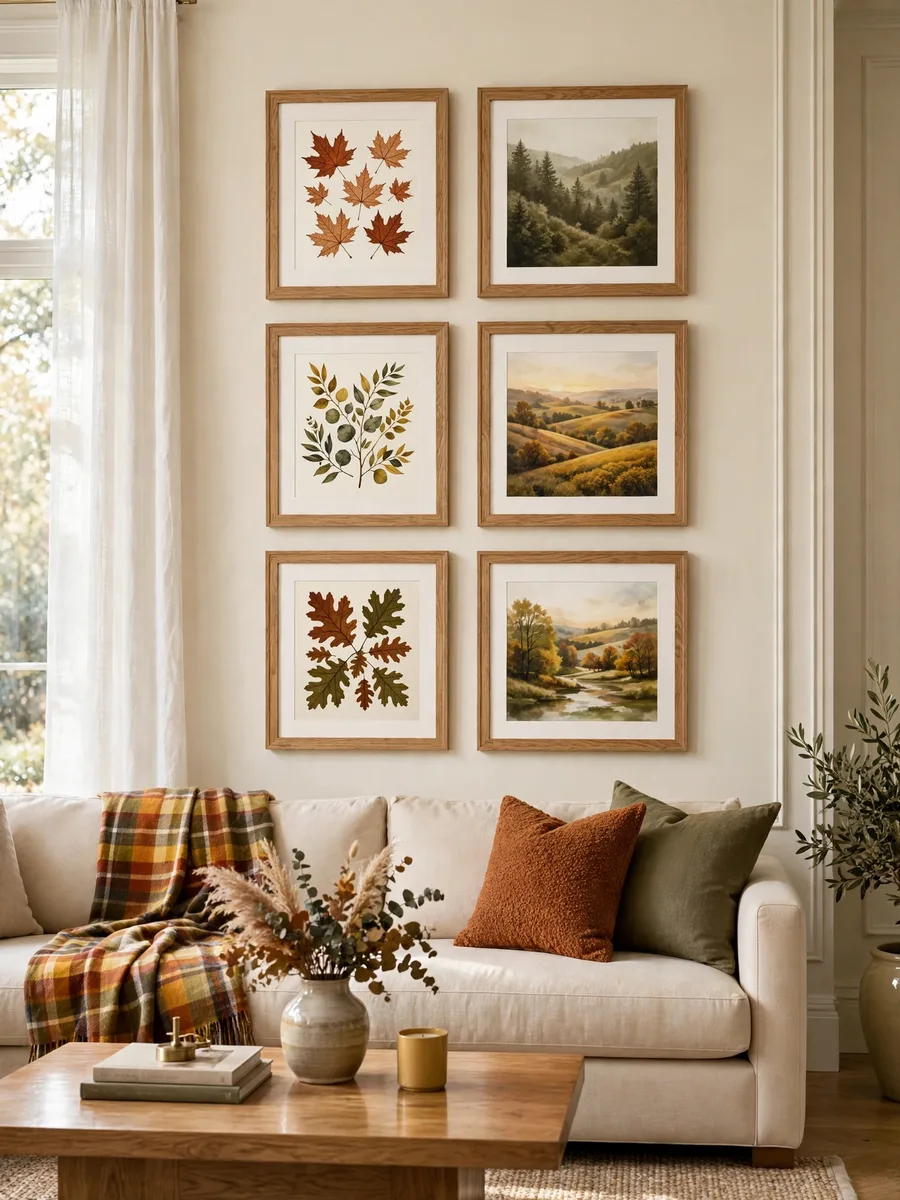
A rotating art wall is a display you change with the seasons, using a gallery rail, picture ledges, or matching frames with swappable prints. It keeps a living room feeling fresh without repainting or buying new furniture, and it is an easy way to try bold colours in small doses.
For example, in autumn six matching oak frames on a cream wall hold rust, olive, and mustard prints of leaves and landscapes, with a plaid throw on the sofa below. In spring the same frames hold pale green botanical prints.
Quick tips:
- Keep frames identical so only the art changes.
- Store off-season prints flat in a portfolio.
Frequently Asked Questions
What are the best living room wall decor ideas?
A gallery wall, a single oversized piece of art, or a large mirror are among the best living room wall decor ideas, because each one creates a clear focal point. The best option depends on the wall size and the furniture below it.
What can I put on my walls besides pictures?
Besides pictures, you can use mirrors, floating shelves, wall sculptures, tapestries, decorative plates, woven baskets, or an oversized clock. Mix flat art with at least one three-dimensional piece.
How do I decorate a large, empty wall?
A large wall is perfect for a statement piece: an oversized piece of art, a gallery wall, a statement mirror, or a tapestry, or an accent wall in bold paint or wallpaper. Start with one large element, then add smaller pieces only if the wall still feels empty.
How do you arrange wall decor?
Lay out your frames on the floor first to find an arrangement you like. The centre of the arrangement should be at eye level, about 57 inches from the floor, and art above a sofa should be centred over the sofa and hung 6 to 8 inches above it.
Should wall art be centered over furniture?
Yes, if you are hanging art above a sofa, coffee table, or console, it should be centred with that piece and hung 6 to 8 inches above it, which connects the two pieces and makes the wall look intentional.
What is the easiest way to create a gallery wall?
Use matching frames and prints for a cohesive look. Lay the frames on the floor first, use paper templates on the wall, and start with the largest frame in the centre.
How can I decorate my living room walls on a budget?
Use DIY art, wall stickers, and affordable frames. A homemade abstract canvas, pressed botanical prints in thrifted frames, or a black-and-white photo grid all look polished for very little cost.
Is it okay to leave a wall blank?
Yes, a blank wall can provide visual rest and help other elements in the room, like area rugs or furniture, stand out. Leaving one wall blank often makes the decorated walls look stronger.
How can I decorate my walls if I’m a renter?
Use removable decor like wallpaper, decals, or adhesive strips for hanging art. Lean a large mirror or framed piece against the wall for a no-nails-required look.
Conclusion
Good living room wall decor starts with one clear focal point, the right scale, and a colour that already lives somewhere else in the room. Whether you choose a gallery wall, one oversized piece of art, a large mirror, or floating shelves, the 24 ideas above give you a starting point for every wall and budget. Pick the wall that bothers you most and try one idea.