12 Beautiful Hallway Decor Ideas
Key Takeaways
What is the fastest way to make a hallway look decorated?
A properly sized runner plus one mirror at the far end changes the whole space in an afternoon.
How do you decorate a narrow hallway without crowding it?
Keep decor on the walls, use a narrow runner, and let mirrors and sconces do the work so the floor stays clear.
Should a hallway match the rooms it connects?
Borrow one color or material from each adjoining room so the transition feels calm instead of random.
What lighting works best in a dark hallway?
Evenly spaced sconces beat a single ceiling fixture — they remove shadows without glare.
Contents
- Introduction
- How Do You Decorate a Narrow Hallway Without Crowding It?
- What Makes a Wide Hallway Feel Designed Instead of Empty?
- 1. Light-Doubling Mirror Wall
- 2. The Runner That Actually Fits
- 3. A Rhythm of Wall Sconces
- 4. Slim Console, Styled Twice
- 5. Paneling With Paint
- 6. One Restrained Gallery Moment
- 7. Threshold Zones That Welcome
- 8. The Wide-Hall Double Act
- 9. Borrowed Window Light
- 10. A Statement Pendant
- 11. Hidden Storage, Visible Calm
- 12. One Big Art Moment
- Frequently Asked Questions
- Conclusion
Introduction
The best hallway decor ideas share one goal: making a pass-through space feel like a room you chose, not a corridor you tolerate. Hallways get walked through a hundred times a day and decorated never — so small, deliberate moves (a mirror at the dead end, a properly sized runner, light at intervals instead of one harsh ceiling fixture) pay off visibly.
A hallway also has a job no other room has: it connects. Where the entryway makes the first impression, the hall carries it forward — if you are starting at the front door, these small entryway decor ideas pair naturally with everything below. Paint, mirrors, rugs, and lighting do the heavy lifting. Pick three or four ideas below, keep the palette consistent end to end, and the corridor reads as finished.
How Do You Decorate a Narrow Hallway Without Crowding It?
Keep everything on the walls and off the floor: mount mirrors and sconces, choose a runner that leaves a few inches of floor visible on each side, and skip deep furniture so the walkway stays genuinely walkable.
In a narrow hall, the eye needs a reason to travel forward rather than stop at the side walls. One oversized mirror at the far end does this better than any artwork, because it borrows the reflection’s depth and gives the corridor a destination. A warm white keeps things open, while one deep cocooning shade makes a dark hall feel intentional: commit fully either way.
What Makes a Wide Hallway Feel Designed Instead of Empty?
A wide hallway needs zoning: anchor the center with a rug and a seating pair, treat one long wall as a display wall, and repeat the same finish two or three times so the extra width reads as generous, not unfinished.
Wide halls fail with one thin runner and nothing else — they read as lobbies waiting for furniture. Treat a wide hall as a long, skinny room: bench, real rug, layered lighting, wall-sized art. The table shows how each choice shifts with width.
| Element | Narrow hallway | Wide hallway |
|---|---|---|
| Runner rug | Narrow runner, 2–3 in. of floor showing each side | Wide flatweave rug, or two runners end to end |
| Mirrors | One large mirror at the far end | Matching pair facing each other to bounce light |
| Lighting | Small sconces, one wall, evenly spaced | Sconces on both walls or a central pendant |
| Furniture | None, or one wall-mounted shelf | Slim console, bench, or seating nook |
| Wall color | Warm white, or one deep cocooning shade | Two-tone: paneling or chair rail |
1. Light-Doubling Mirror Wall
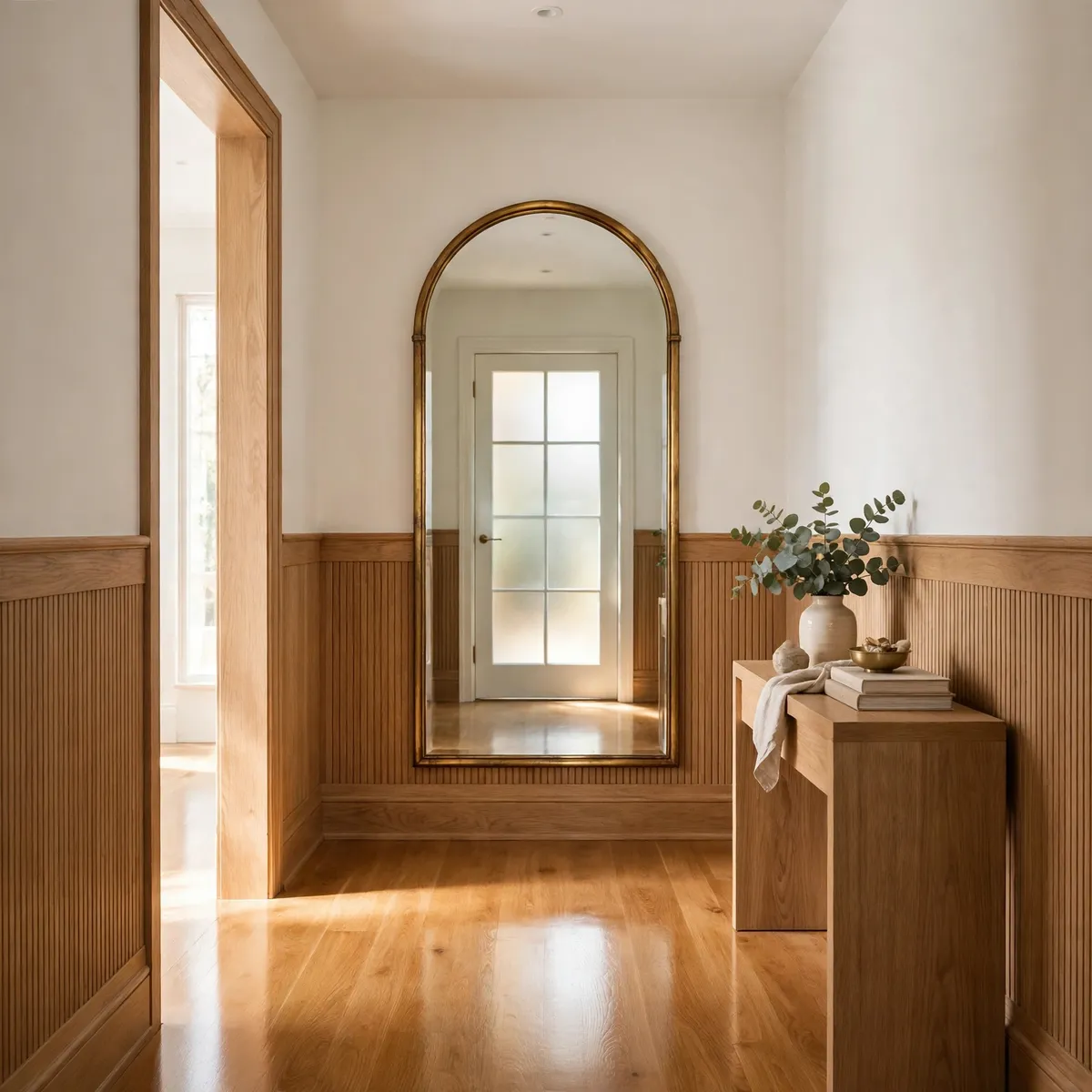
A mirror at the end of a hallway is the single highest-impact move you can make: it visually doubles the corridor and borrows whatever light exists at the far end. An arched brass mirror facing a frosted-glass door at the end of the hall reads as a deliberate focal point rather than a space-filling trick.
Size the mirror to the end wall — most of its width, a few inches above the baseboard. For a hall that turns a corner, hang it opposite the longest straight run so it catches the traveling light.
Quick tips:
- Go big at the dead end; a small mirror looks lost on a large wall.
- Angle it slightly downward to catch floor light, not the ceiling.
2. The Runner That Actually Fits
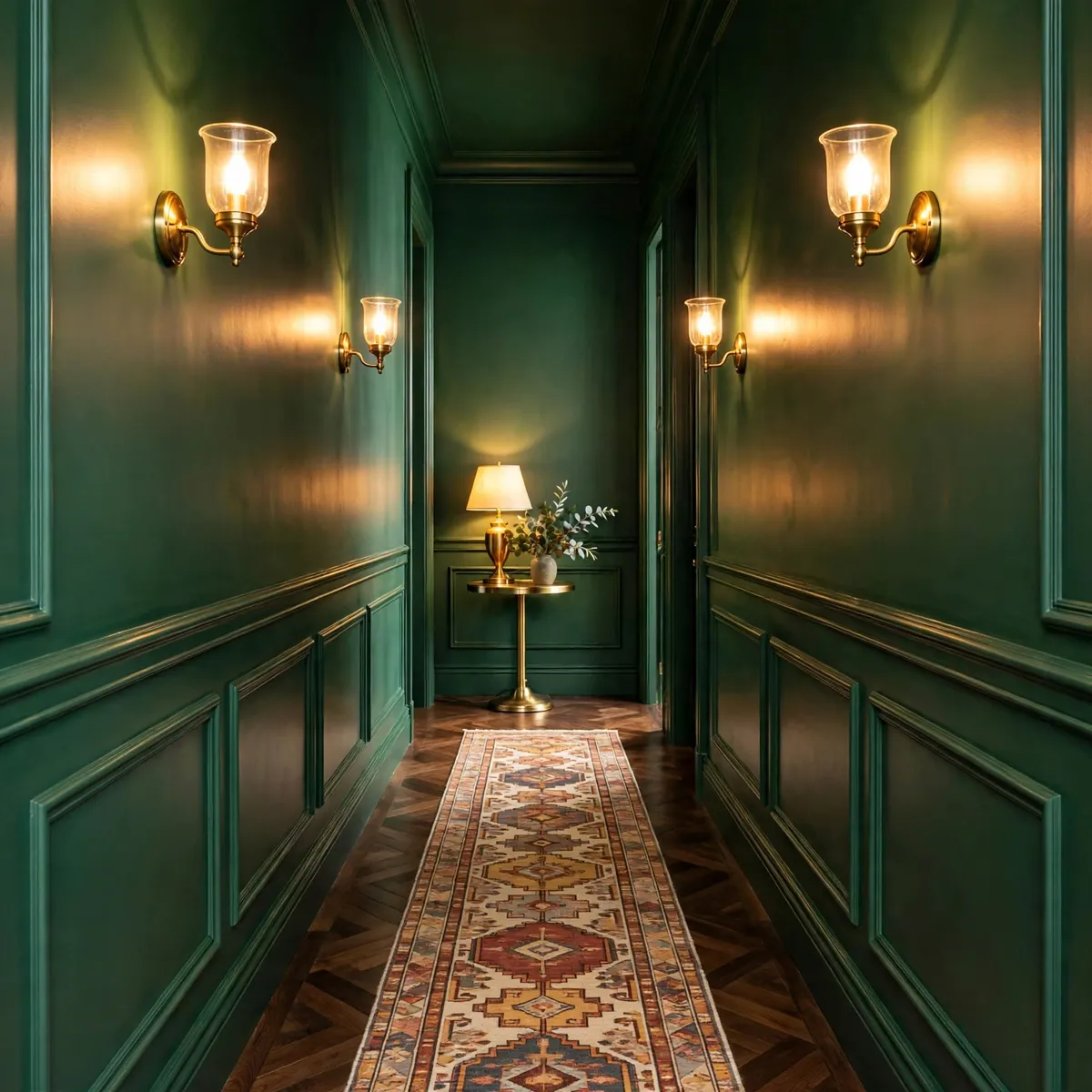
The runner is the hallway’s area rug, and most fail on proportion: too short, too narrow, or floating in the middle of the floor. Choose one that runs nearly the hall’s full length, leaving a hand’s width of bare floor on each side. A patterned wool runner in a narrow deep-green hallway with brass sconces shows how the rug’s border can echo the wall color and make the corridor feel wider.
Low pile is non-negotiable: doors open over runners, and high pile bunches or blocks them. A wool or wool-blend flatweave wears best, with a thin rug pad underneath to stop sliding.
Quick tips:
- One long runner beats two short ones — avoid a gap in the middle.
- In a lightless hall, a lighter-toned runner does some of a window’s work.
3. A Rhythm of Wall Sconces
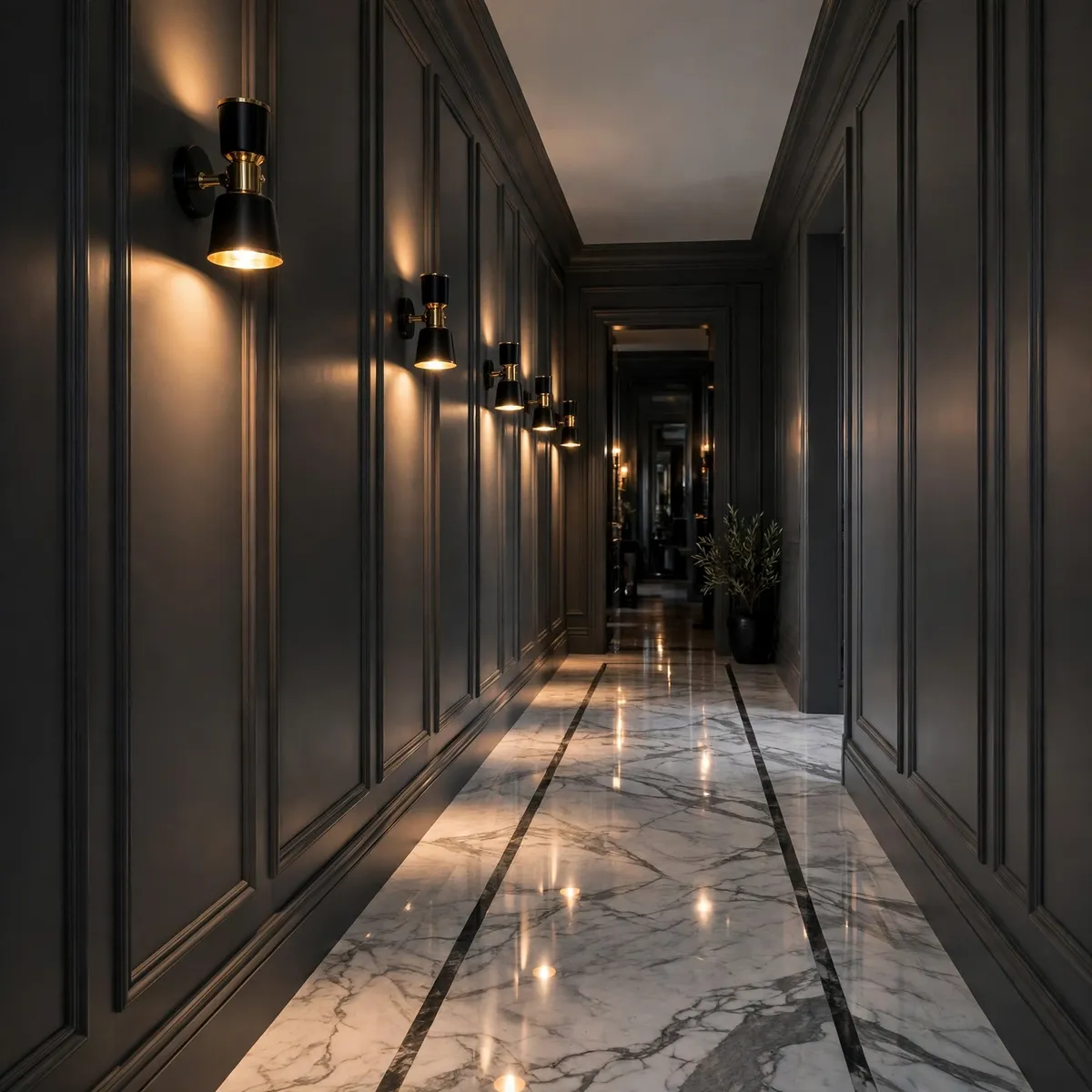
Hallways almost always suffer from bad light — one ceiling fixture in the middle throwing shadows at both ends. A row of small sconces spaced evenly along one wall replaces that harsh pool with a rhythm of warm light. The same spacing logic used in the best bedroom lighting ideas applies here: even intervals, consistent shades, and warm bulbs around 2700K for an evening glow rather than office glare.
Mount sconces 60 to 66 inches to the shade’s center, on the same side as artwork for gentle raking light. Battery or plug-in sconces now look genuinely good — in a rental, that is the difference between doing the project and abandoning it.
Quick tips:
- Space sconces 6–8 feet apart so the light pools just overlap.
- Match the metal finish to your door hardware for instant cohesion.
4. Slim Console, Styled Twice
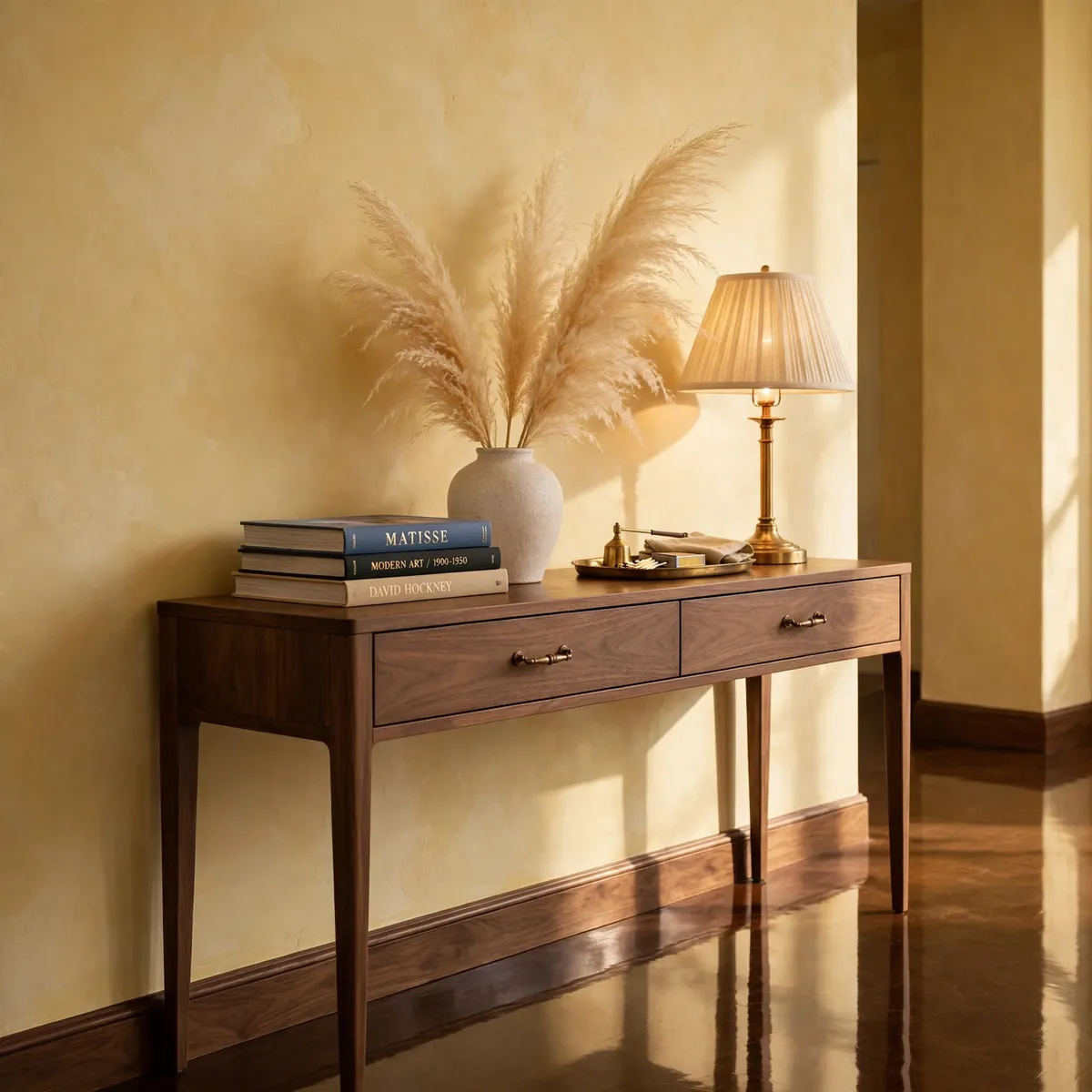
At 42 inches of hall width or more, a slim console gives the corridor a job: keys, mail, a lamp, a tray for daily clutter. Keep it 10 to 12 inches deep — anything deeper turns a walkway into an obstacle course.
Style the top in two height zones: something tall at one end (lamp or branchy vase), something low at the other (stacked books with a small bowl). A walnut console with art books, pampas grass, and a brass tray against a butter-yellow wall shows the formula — one basket underneath hides the rest of the clutter.
Quick tips:
- Anchor it with a mirror or frame above; never leave that wall bare.
- Keep the daily-drop tray small so it empties easily.
5. Paneling With Paint
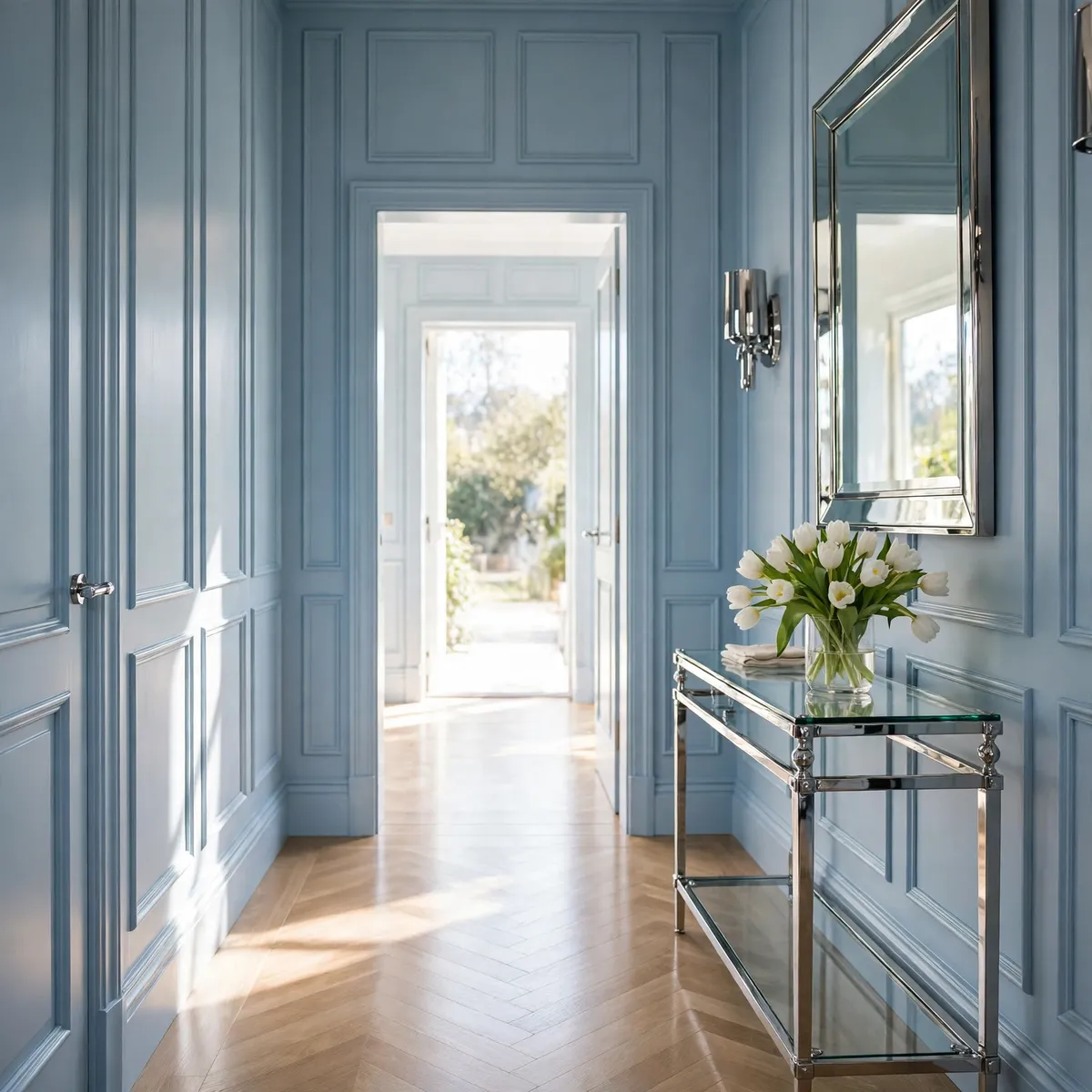
Wall paneling is the hallway’s secret weapon, because a long corridor has so much uninterrupted wall — and bare, flat walls are what make halls feel cheap. Board-and-batten or simple picture-frame molding, painted the same color as the wall, adds shadow lines and depth without a single picture hung. Powder-blue paneling with a chrome mirror shows how one confident color turns a plain corridor into a designed one.
Paint paneling and wall in one shade for a seamless modern look, or go a shade darker on the molding for traditional wainscot. Either way, run the color to the ceiling — stopping short chops up the hall’s length.
Quick tips:
- Self-adhesive molding strips give a convincing look in rentals.
- Same-color painting hides imperfect molding joints.
6. One Restrained Gallery Moment
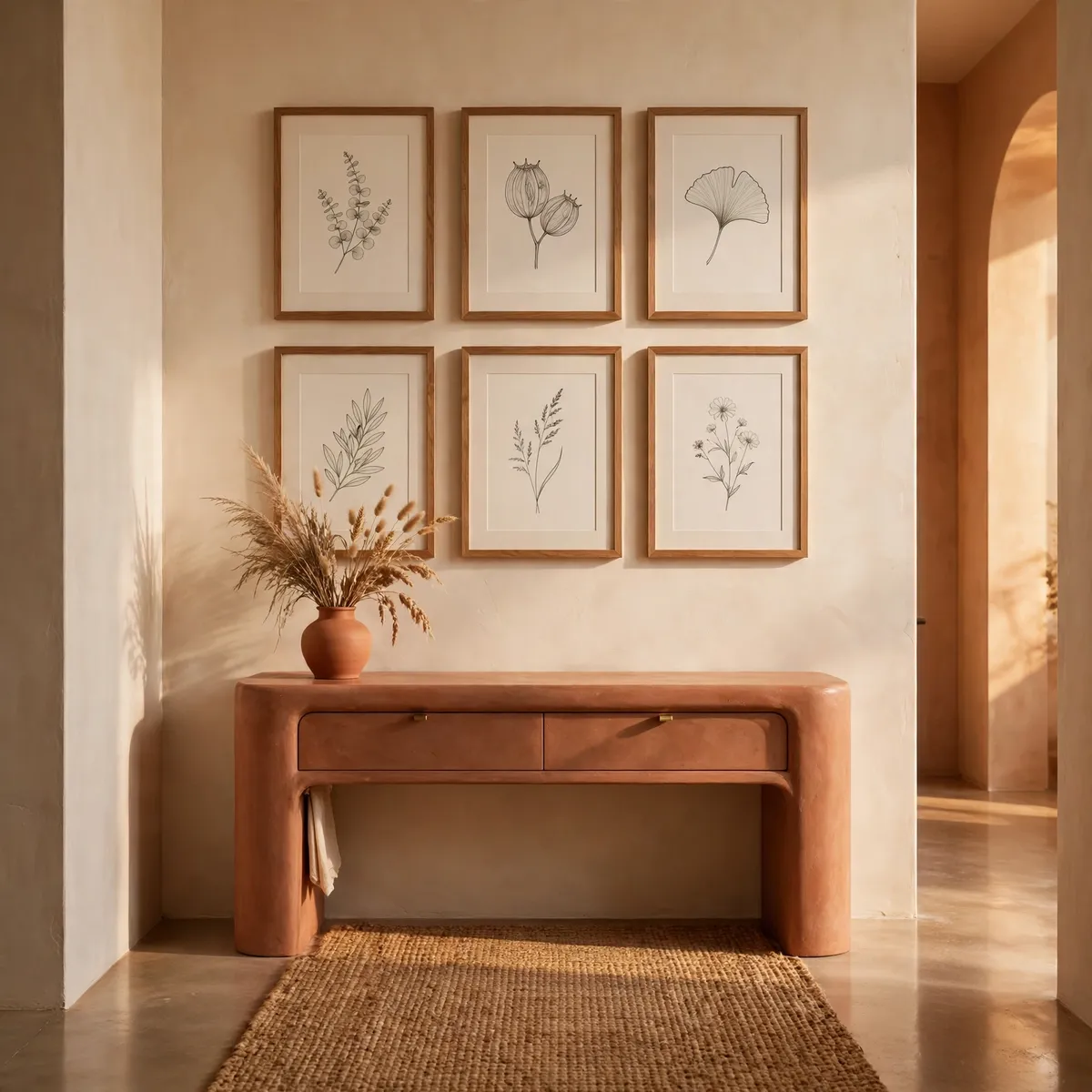
A hallway can carry a gallery wall — but restraint is the difference between a curated moment and visual noise in a tight corridor. Keep it to one disciplined arrangement: a tidy grid of six matching wood-framed prints, two rows of three with even spacing, gives the hall rhythm without closing in the walls.
Keep frames identical and mats consistent — mixed frames read as clutter from ten feet away. A terracotta console below with one dried-grass arrangement grounds the grid. (A full hallway gallery wall deserves its own plan — treat this as the appetizer version.)
Quick tips:
- Six matching frames in a grid beat twelve mismatched ones.
- Keep the lowest frame at least 8 inches above furniture.
7. Threshold Zones That Welcome
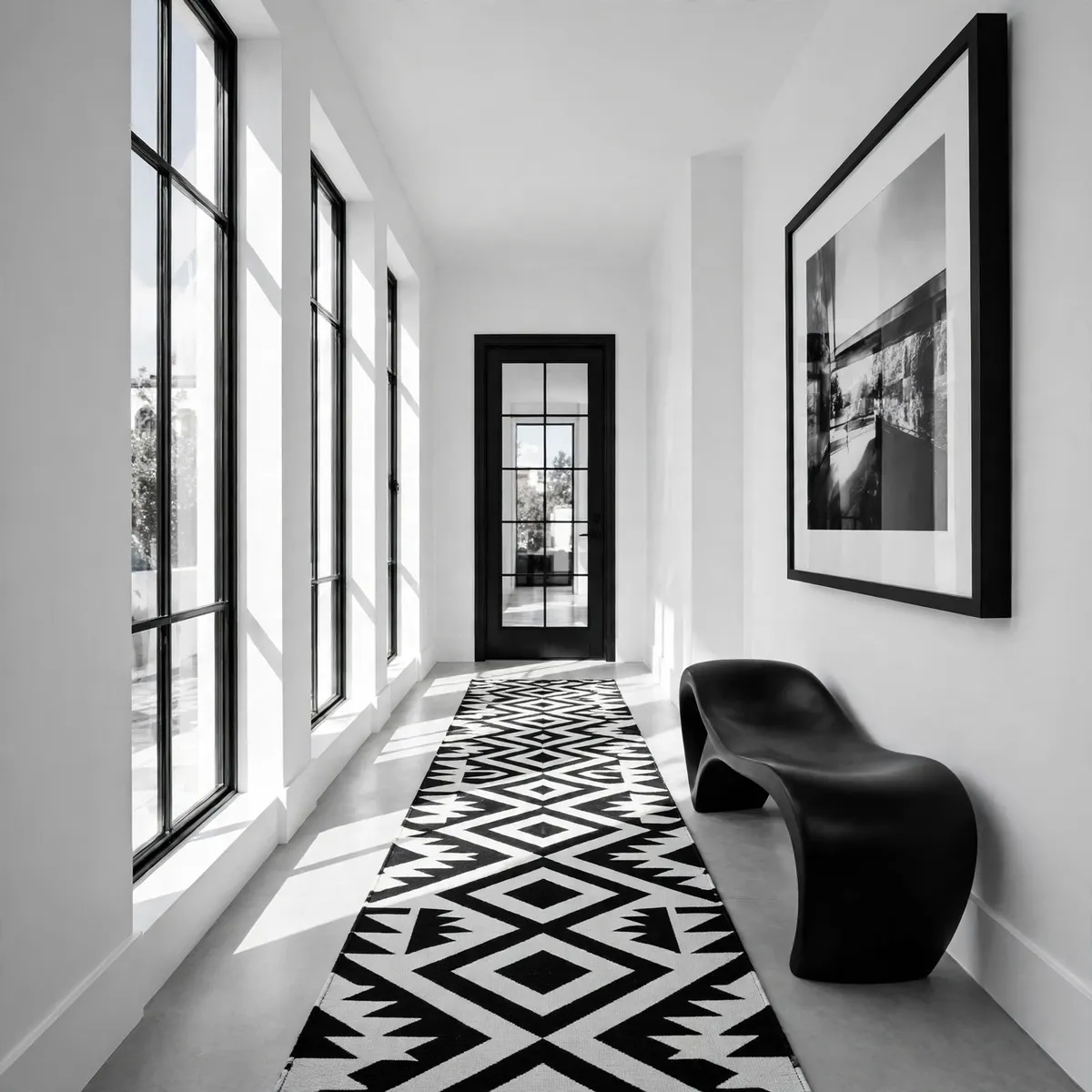
Where the hallway meets the front door, it needs a small piece of entryway choreography: somewhere to pause, set things down, and switch mental gears. A sculptural bench just inside the hall’s start — like the black bench against the white wall in a monochrome hall — signals the corridor is a room with a purpose, not a tunnel.
Let the first few feet borrow the entryway’s language: a small rug distinct from the runner, a hook or two at sitting height, warmer light than the rest of the corridor. This is where the hall’s story begins — worth slightly more styling effort than the middle stretch.
Quick tips:
- A bench doubles as a shoe-changing seat — practical wins.
- Switch the rug at the threshold so the zone change reads clearly.
8. The Wide-Hall Double Act
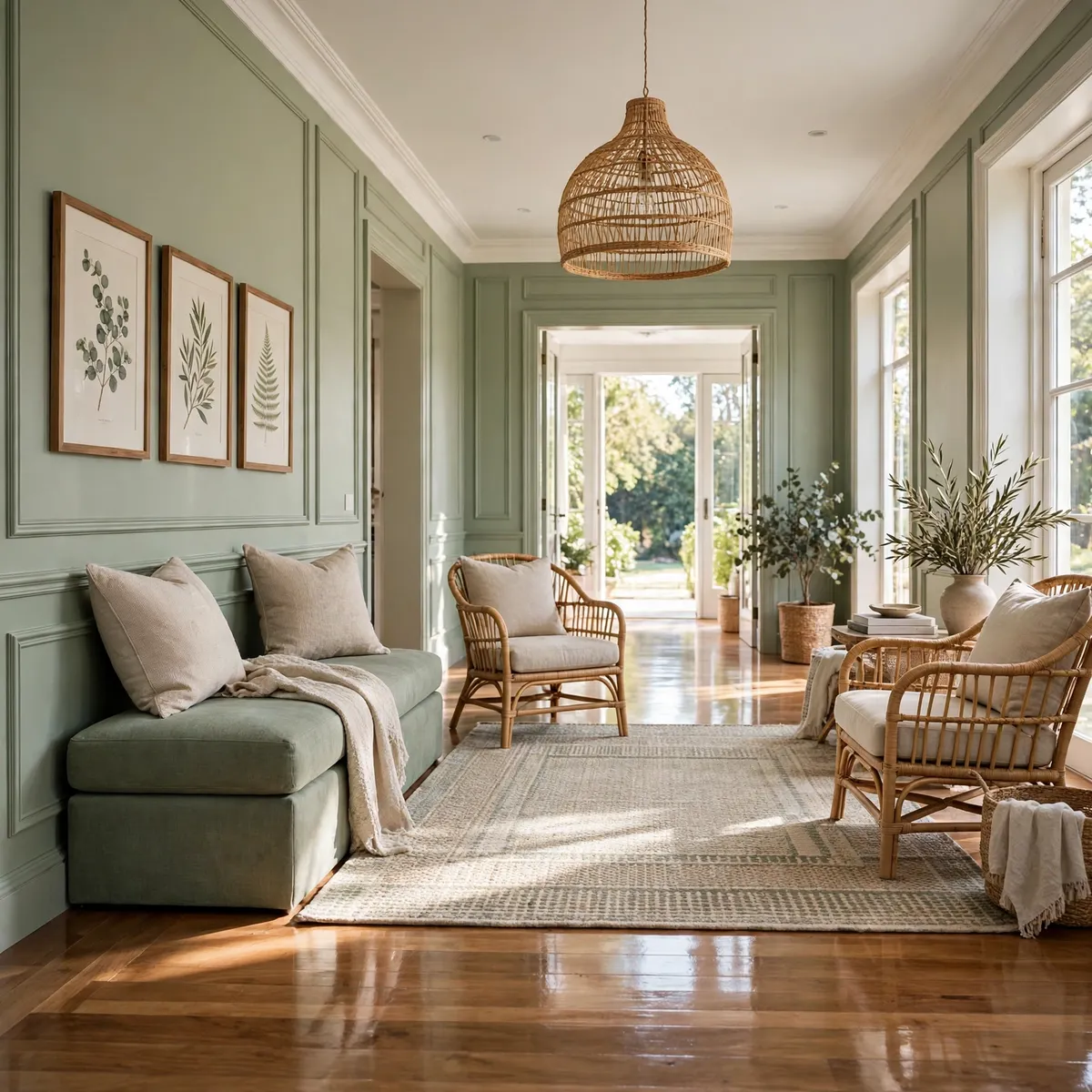
A wide hallway earns a seating pair: a bench plus chairs on a generous flatweave rug turns dead corridor space into the home’s quietest reading nook. The formula mirrors a small living room — rug first to define the zone, seating angled toward a window, one shared light source like a rattan pendant overhead.
A sage-green bench with two rattan chairs on a large flatweave rug shows how a calm palette lets textures do the talking. Hug one wall with the seating so foot traffic flows past in a straight line.
Quick tips:
- Use a rug, not a runner — width signals “room,” not “corridor.”
- Keep 30 inches of clear walkway past the seating.
9. Borrowed Window Light
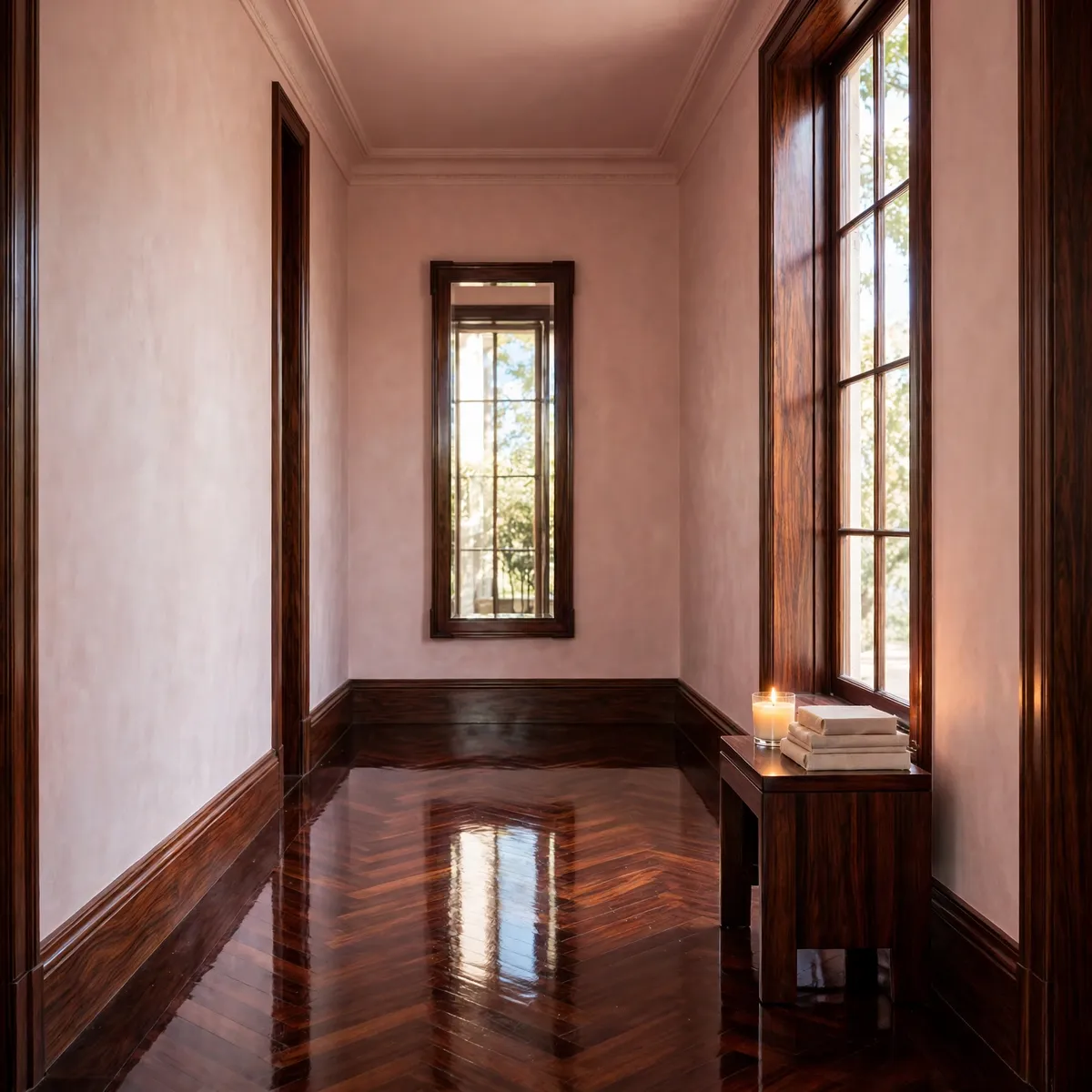
Most hallways have no windows, so borrow someone else’s: hang a mirror directly opposite an open doorway or a window at the hall’s end, and it throws light down the corridor like a second window. A tall rosewood mirror opposite a bright window in a blush-toned hall practically relocates daylight.
Stand where you want the light to land and have someone hold the mirror until the window’s reflection appears. Glossy finishes nearby — a lacquered console top, a polished door — keep the borrowed light bouncing.
Quick tips:
- Reflect the brightest opening you have, even a bedroom window.
- Clean the mirror often — hallway dust dulls the bounce fast.
10. A Statement Pendant
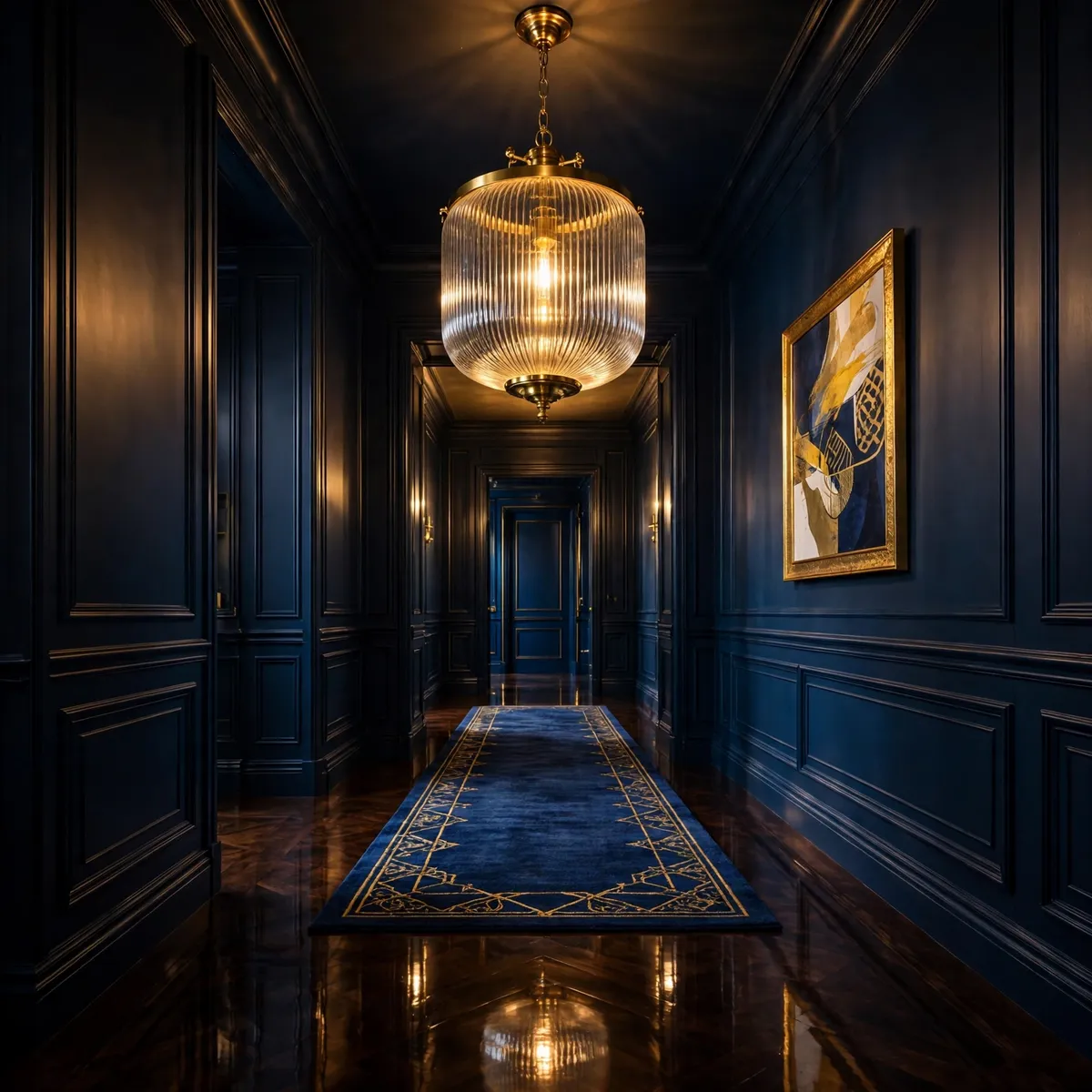
In a hall with real ceiling height, one oversized pendant does what sconces cannot: it gives the corridor a centerpiece and a sense of occasion. The scale should surprise you slightly — a pendant that feels a touch too large reads as confident; a small one gets lost in the volume above.
A ribbed-glass and gold pendant over a navy runner shows the drama: textured glass throws patterned light, and the warm glow keeps dark paint from feeling heavy. Hang it about seven feet from the floor — walkable, yet part of the room.
Quick tips:
- Match pendant diameter to hall width: roughly half the corridor’s width.
- In long halls, hang two or three smaller pendants in a line.
11. Hidden Storage, Visible Calm
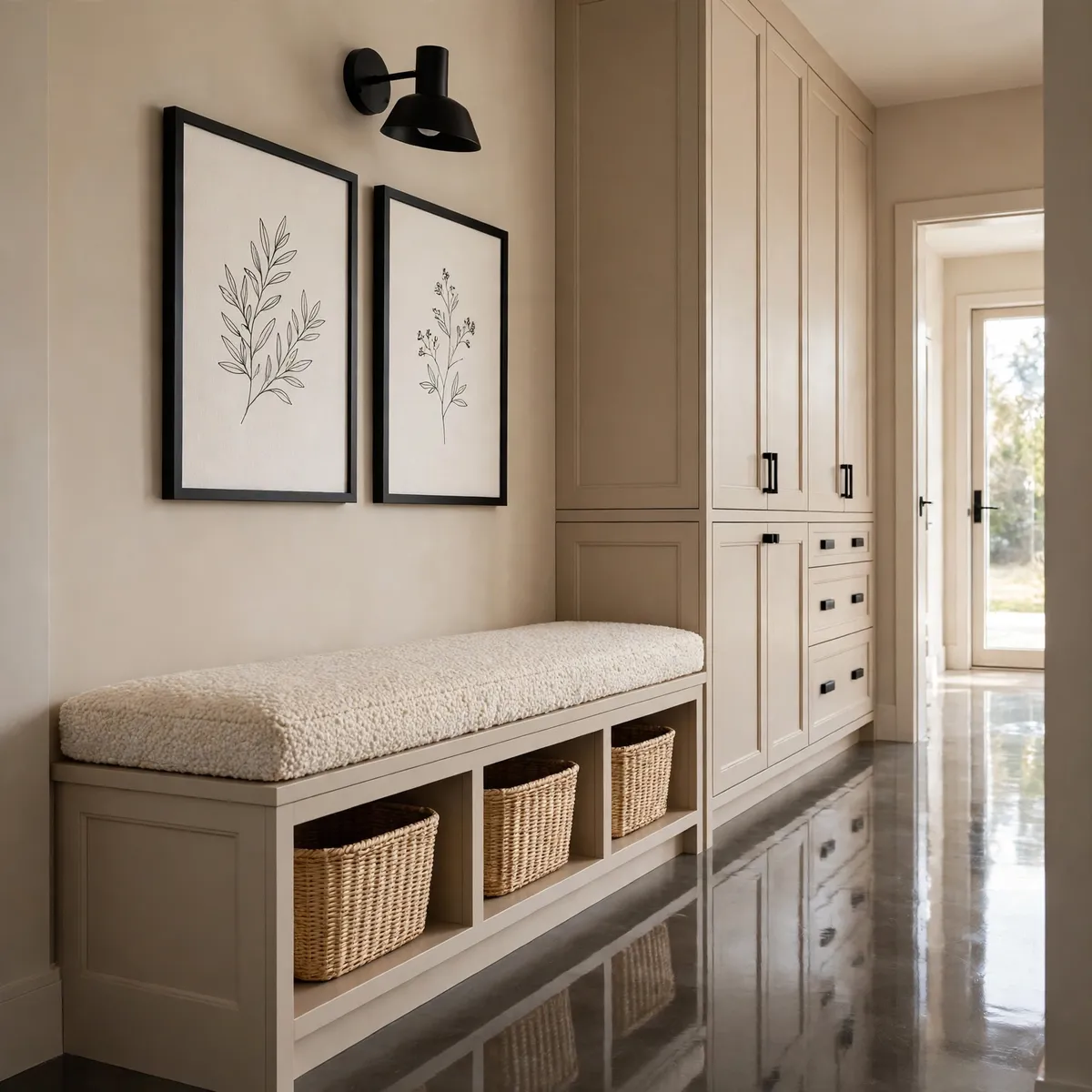
Hallways collect the home’s overflow — shoes, bags, sports gear, the vacuum — and visible clutter is the fastest way to make a corridor feel stressful. Built-in cabinetry along one wall solves it while looking like architecture: a greige storage bench with matte-black pulls, a bouclé cushion, and baskets tucked underneath hides the chaos.
Closed storage beats open shelving here — you pass at close range and see everything. On a budget, a row of identical lidded baskets on a low bench gives a similar calm; the uniformity does the work.
Quick tips:
- Closed fronts only — open hallway storage looks messy up close.
- Keep one basket per person so sorting happens automatically.
12. One Big Art Moment
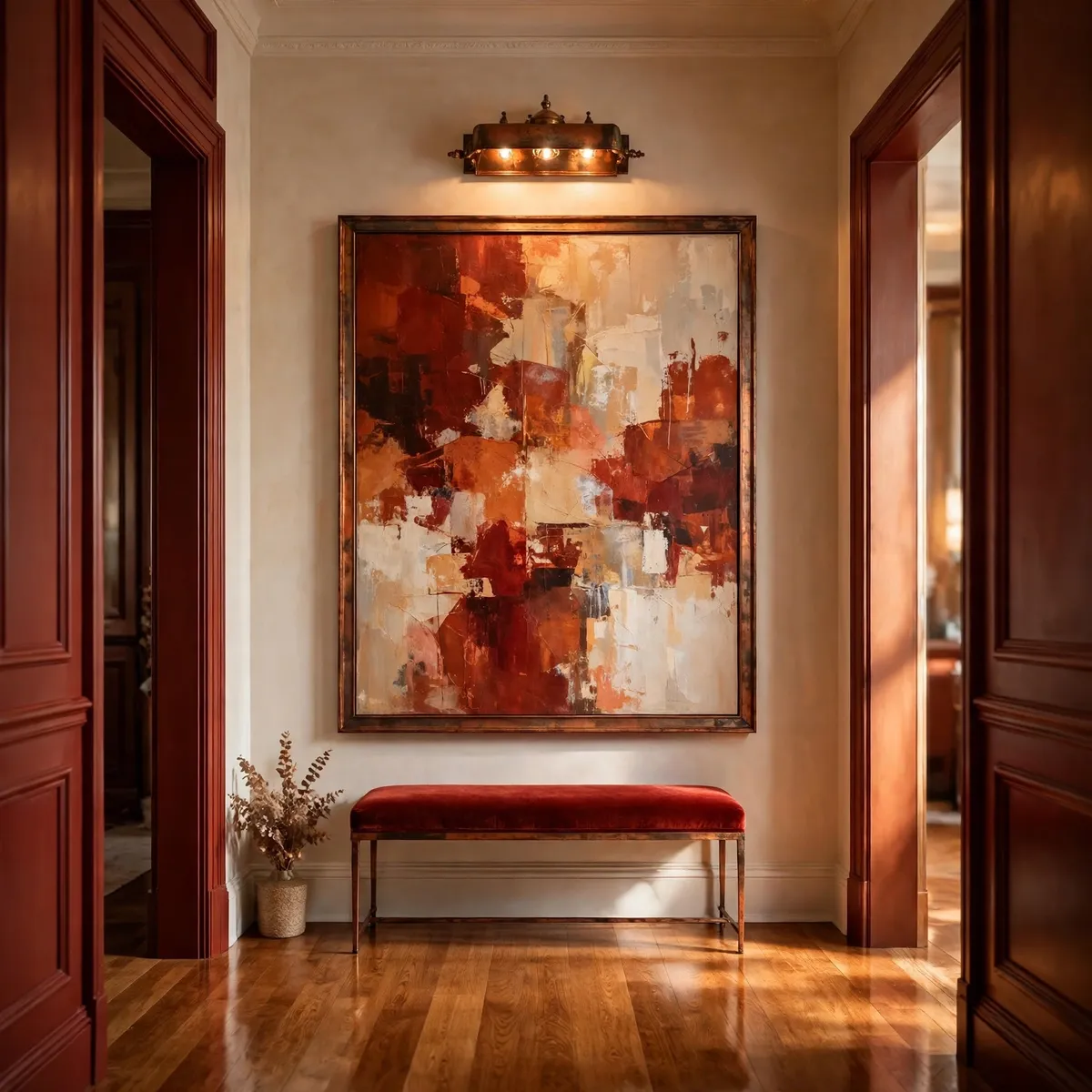
A single oversized artwork can carry an entire hallway — in a long corridor, one confident piece beats a scattering of small frames the eye skips over. Size it to the wall: roughly two-thirds of the width, hung with its center around 57 inches from the floor, the gallery height that keeps it in the natural sightline.
An oversized oxblood abstract under an aged-copper picture light, with a slim copper-legged bench beneath, shows the recipe: scale, light, one grounding piece. Choose bold color or strong shapes — subtle art disappears in a corridor’s motion; a painting you register in three seconds will stop you every time.
Quick tips:
- One large piece beats many small ones in a long hall.
- A picture light signals “gallery,” even in a family hallway.
Frequently Asked Questions
What color should I paint a hallway with no windows?
Commit to a warm, light-reflecting white or a deep shade — the muddy middle reads as dingy. Warm whites bounce artificial light; deep greens and navies make a windowless hall feel deliberate.
How wide should a hallway runner rug be?
Leave 2 to 3 inches of floor showing on each side — usually a 2’6″ runner for a 3-foot-wide hall, running nearly the corridor’s full length.
Are mirrors or artwork better for a hallway?
Mirrors win at the dead end and opposite light sources; artwork wins on the long walls, where a mirror would only reflect the opposite wall. Most halls use one large mirror and one large piece of art.
How high should hallway sconces be mounted?
Mount them 60 to 66 inches to the shade’s center, spaced 6 to 8 feet apart so the light pools overlap. Battery-operated sconces give the same effect in a rental.
Conclusion
Great hallway decor ideas all answer one question: how do you make a space people pass through feel worth looking at? Start with the big, cheap wins — a properly sized runner, one oversized mirror at the dead end, light in a rhythm instead of a single fixture — then layer in paneling, a console, or one bold piece of art. Keep the floor clear, the palette consistent, and the finishes repeated: the most overlooked room becomes the one that ties the others together.