28 Beautiful Coastal Living Room Ideas for a Calm, Light-Filled Home
Coastal living room ideas work best when the sea shows through light, colour and texture rather than anchors and shells. A calm coastal living room starts with a soft neutral base, ocean-toned accents, natural fibres and sheer window treatments, then layers woven pieces, weathered wood and matte finishes until the room feels breezy. These 28 ideas follow that texture-first rule, so you can build the look without it ever feeling themed.
Start with warm white walls, sandy neutrals and pale greige, with dusty blue, soft teal, faded sea green or weathered navy as accents. A popular starting combination is Sherwin-Williams Sea Salt SW 6204 walls with Extra White SW 7006 trim, a flat-woven jute rug underfoot and linen sheers at the windows, giving colour without heaviness and texture without clutter. The same calm thinking carries through the house, and if you want the look to flow from room to room, these Coastal bedroom ideas use the same soft neutrals, natural fibres and sheer layers, so the bedroom feels like a quieter version of the living room. Keep shelving sparse, choose matte finishes, and let daylight do most of the decorating.
Key Takeaways
What makes a living room look coastal without looking themed? Texture carries the look: linen, cotton, jute, rattan, weathered wood and woven seating, set against a soft neutral base with ocean-toned accents. The sea shows through colour and texture, never through anchors or shells.
What is the best coastal living room colour palette? Warm white, off-white, warm sand and pale greige for the base, with dusty blue, soft teal, faded sea green or weathered navy as accents. Sea Salt SW 6204 walls with Extra White SW 7006 trim is a reliable start.
How is coastal different from nautical and Hamptons style? Coastal is light, relaxed and texture-led, with soft neutrals and natural fibres. Nautical is bolder and more literal, with navy, stripes and maritime motifs. Hamptons is more polished and structured, with crisp white, tailored upholstery and classic detailing.
What are the six foundations of a coastal living room? A soft neutral base, ocean-toned accents, natural-fibre textiles, sheer window treatments, sparse curated shelving, and matte finishes such as aged brass, weathered wood and rattan pendants.
1. How Do Sheer Linen Curtains Change the Light?
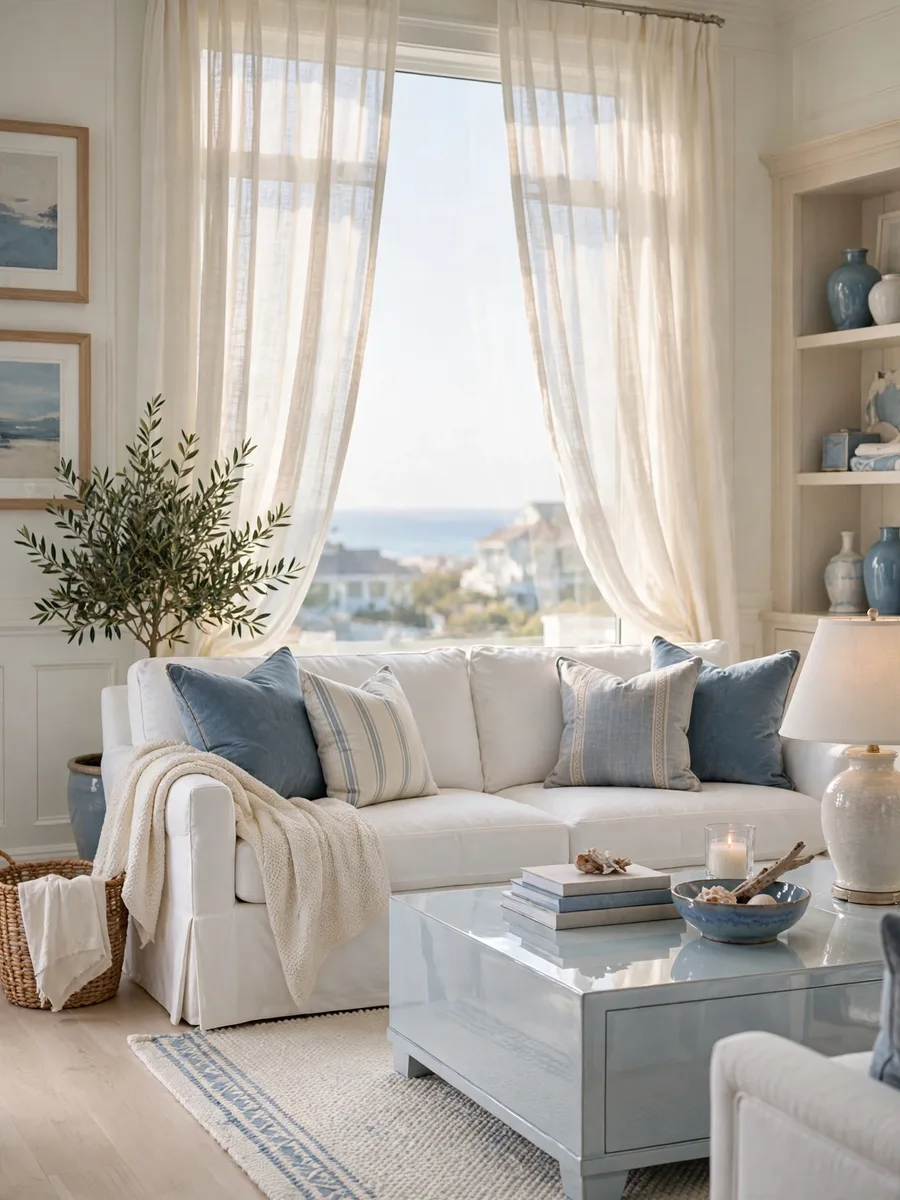
Sheer linen curtains are the fastest way to make a living room feel coastal, because they soften daylight without blocking it. Choose white or warm ivory sheers, hung high and wide so the window reads larger.
A concrete example is ivory linen sheers on a slim aged-brass rod, puddling slightly on a pale wood floor, with a white sofa and a dusty-blue cushion catching the filtered light.
Quick tip: Hang sheers a few inches above the window frame for a taller, airier look.
2. Why Does a White Slipcovered Sofa Anchor the Room?
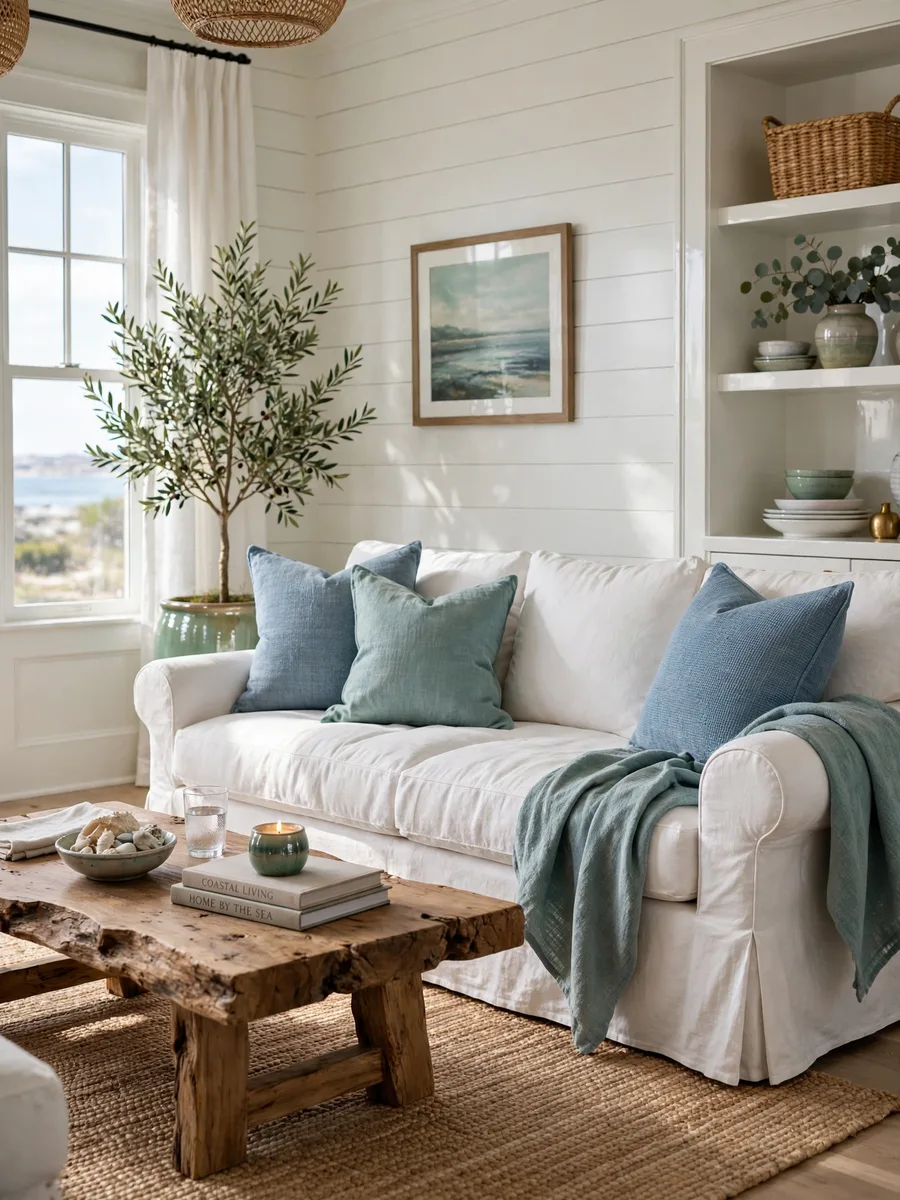
A white slipcovered sofa gives a coastal living room its relaxed, washable heart. Cotton or linen slipcovers in warm white invite bare feet and sandy afternoons, and they can be removed and laundered, which keeps the pale palette practical.
A concrete example is a three-seat white linen slipcovered sofa with rumpled cushions, two dusty-blue pillows and a faded sea-green throw, facing a raw wood coffee table on a jute rug.
Quick tip: Choose a washable cotton-linen blend so the white stays fresh.
3. What Colour Should Coastal Living Room Walls Be?
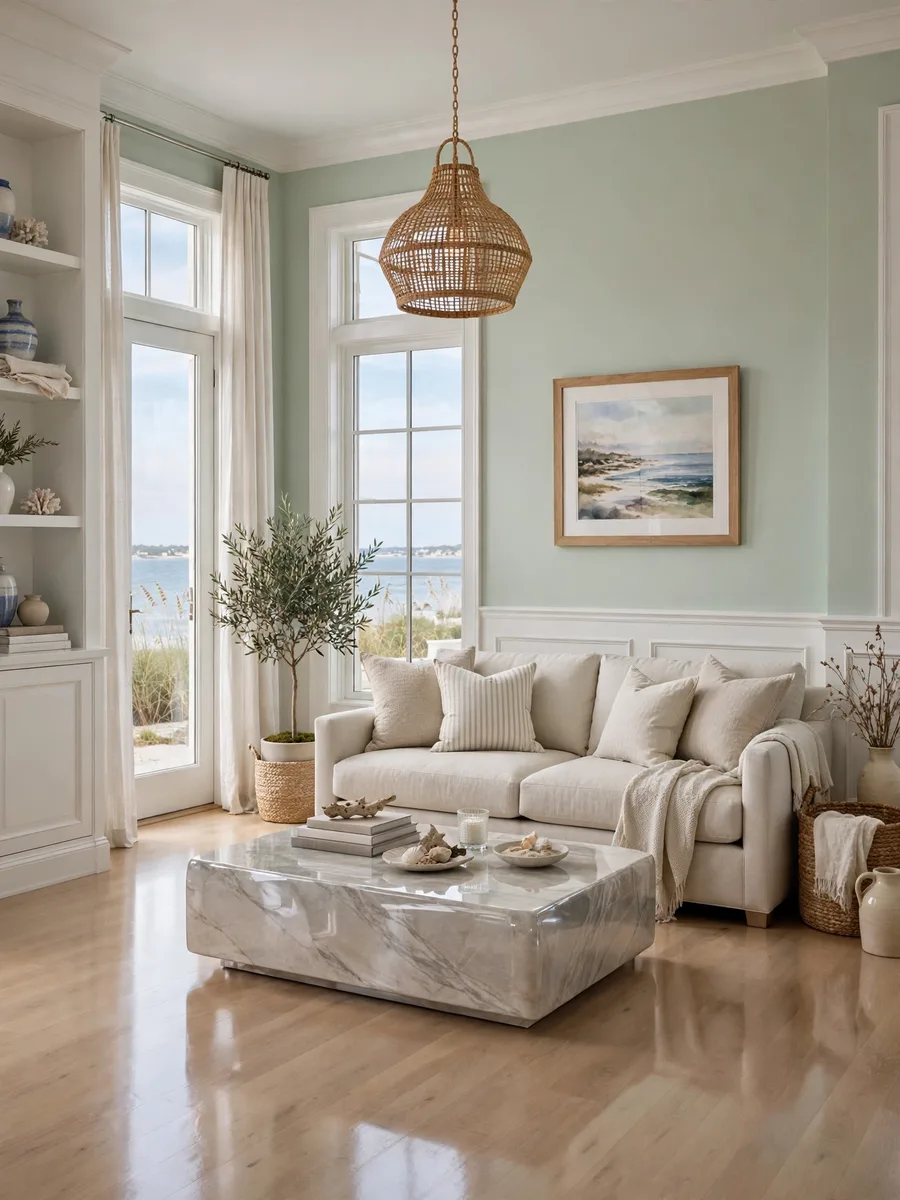
Coastal walls work best in soft, warm neutrals with a hint of the sea. Sherwin-Williams Sea Salt SW 6204, a pale blue-green, is a much-used starting point, paired with Extra White SW 7006 trim.
A concrete example is a living room painted in Sea Salt with crisp white trim and a pale sand sofa, where the colour shifts gently as the daylight changes. A rattan pendant and a light oak floor keep it soft, never cold.
Quick tip: Test the paint on a large board and check it in morning and evening light.
4. How Does a Flat-Woven Jute Rug Ground the Space?
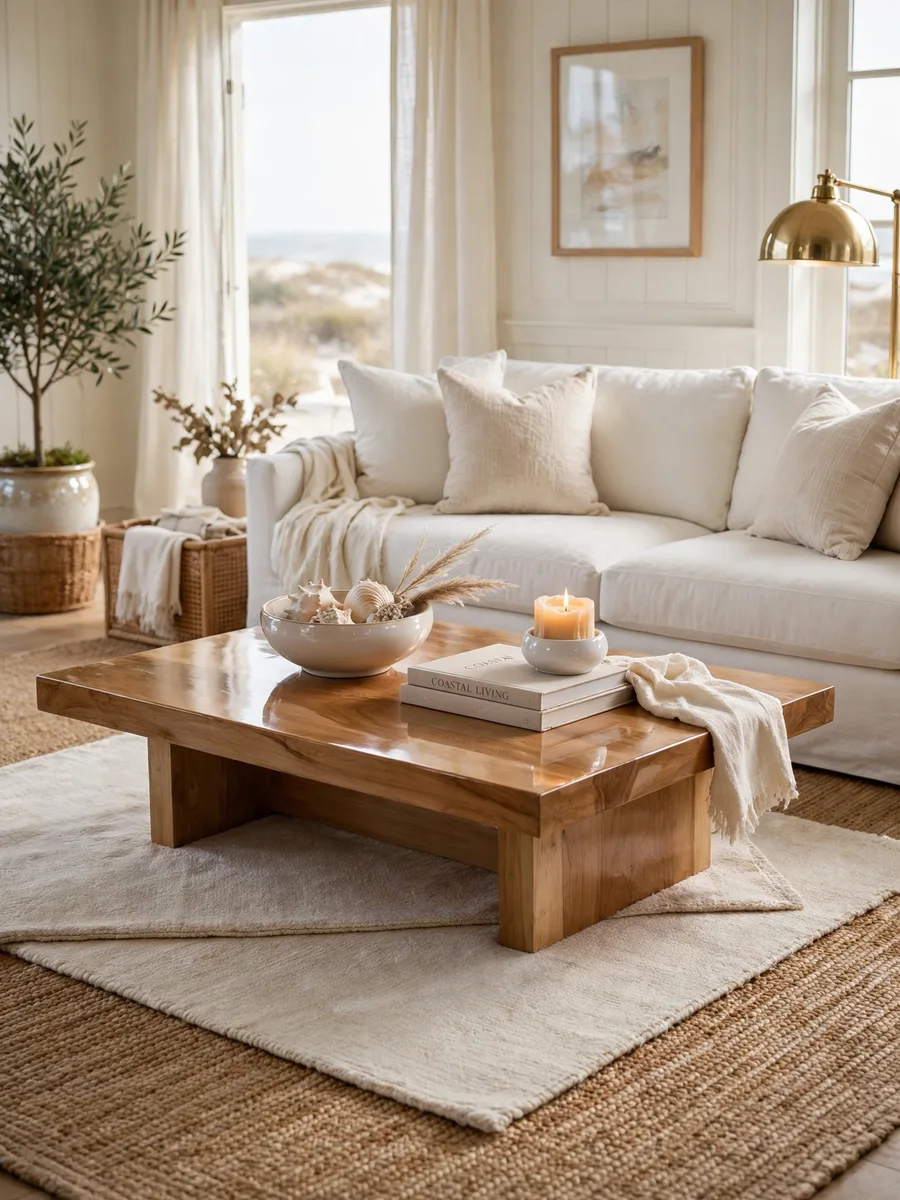
A flat-woven jute rug grounds a coastal living room with natural texture underfoot. Its sandy surface suits bare feet, defines the seating area, and adds warmth to pale floors without pattern or colour that fights the palette.
A concrete example is a large flat-woven jute rug under a white sofa and a raw wood coffee table, with a smaller cotton rug on top for comfort, and for more ways to layer texture underfoot, browse these Living room rug ideas before you choose a size.
Quick tip: Size the rug so the front legs of every seat sit on it.
5. Why Is a Rattan Pendant the Perfect Focal Point?
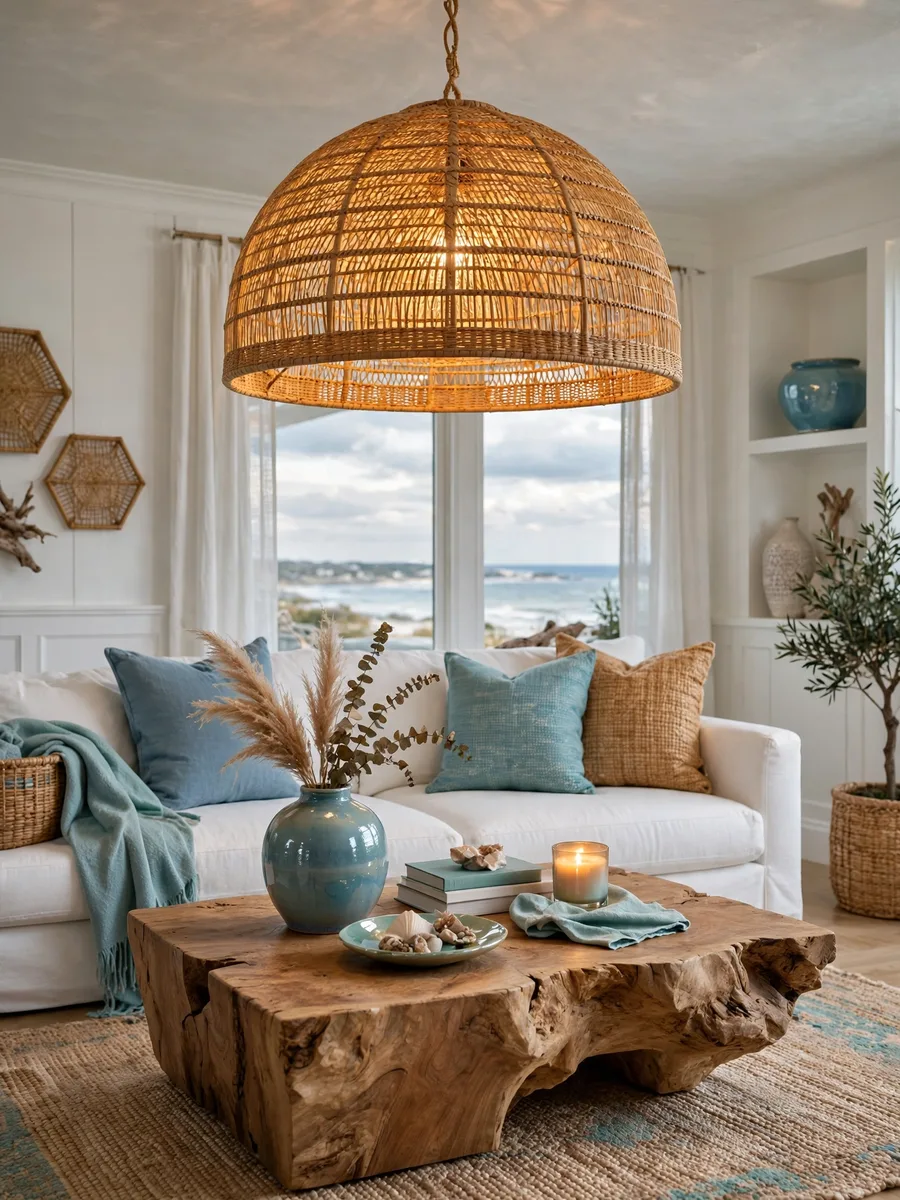
A rattan pendant gives a coastal living room a woven focal point that feels handmade and light. Its open weave casts soft shadows, draws the eye upward, and adds texture at ceiling height.
A concrete example is a large dome-shaped rattan pendant hung low over a raw wood coffee table, its warm glow falling on a white sofa and dusty-blue cushions. At night it becomes the room’s warmest feature.
Quick tip: Hang the pendant 30 to 36 inches above the coffee table.
6. How Does a Raw Wood Coffee Table Add Warmth?
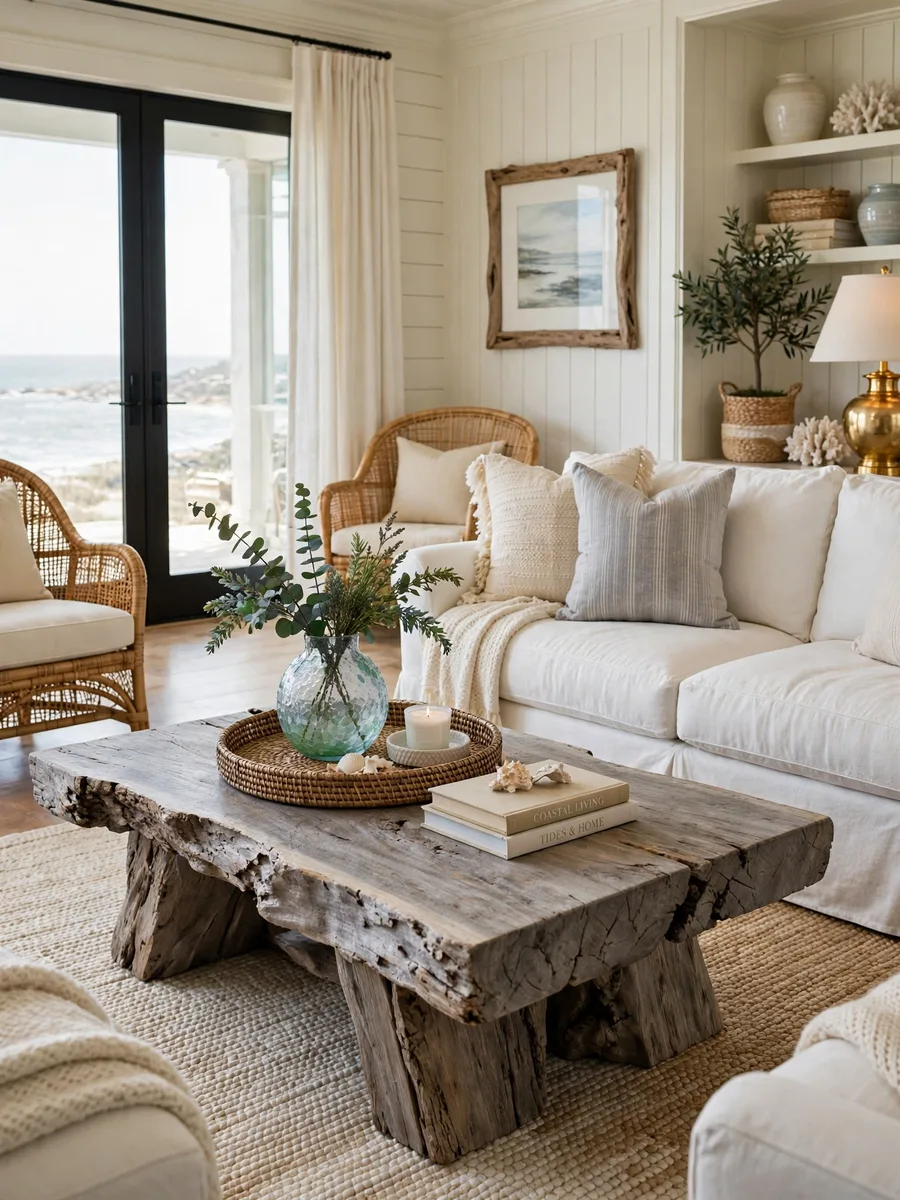
A raw wood coffee table adds the warmth that keeps a pale coastal room from feeling cold. Weathered oak, driftwood tones or whitewashed timber bring grain and a hand-finished feel that balances smooth linen and clean white walls.
A concrete example is a thick-slab driftwood coffee table with a live edge, styled with books, a sea-glass vase and a woven tray, between a white sofa and two rattan chairs.
Quick tip: Choose a matte or oiled finish, never high gloss, for a natural look.
7. How Do You Layer Woven Textures Without Clutter?
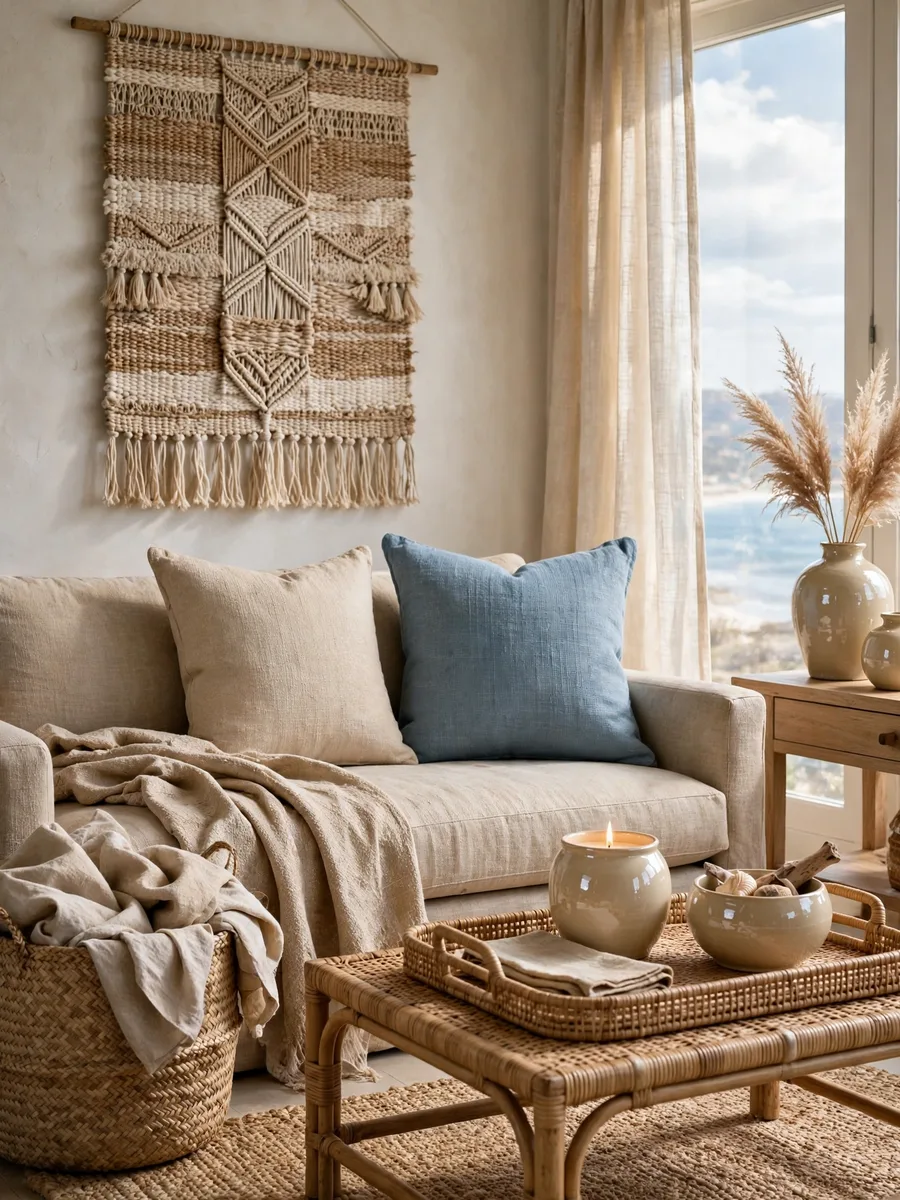
Layered woven textures make a coastal room feel collected rather than decorated. Jute, rattan, seagrass, wicker and woven cotton each add a different weave, creating depth without colour, pattern or clutter.
A concrete example is a seagrass basket of linen throws beside the sofa, a rattan tray on the coffee table, a woven hanging above a sideboard, and a jute rug underfoot, all in sandy tones with one dusty-blue cushion for contrast.
Quick tip: Limit woven pieces to three or four so the texture stays calm.
8. Where Do Soft Blue Accents Work Best?
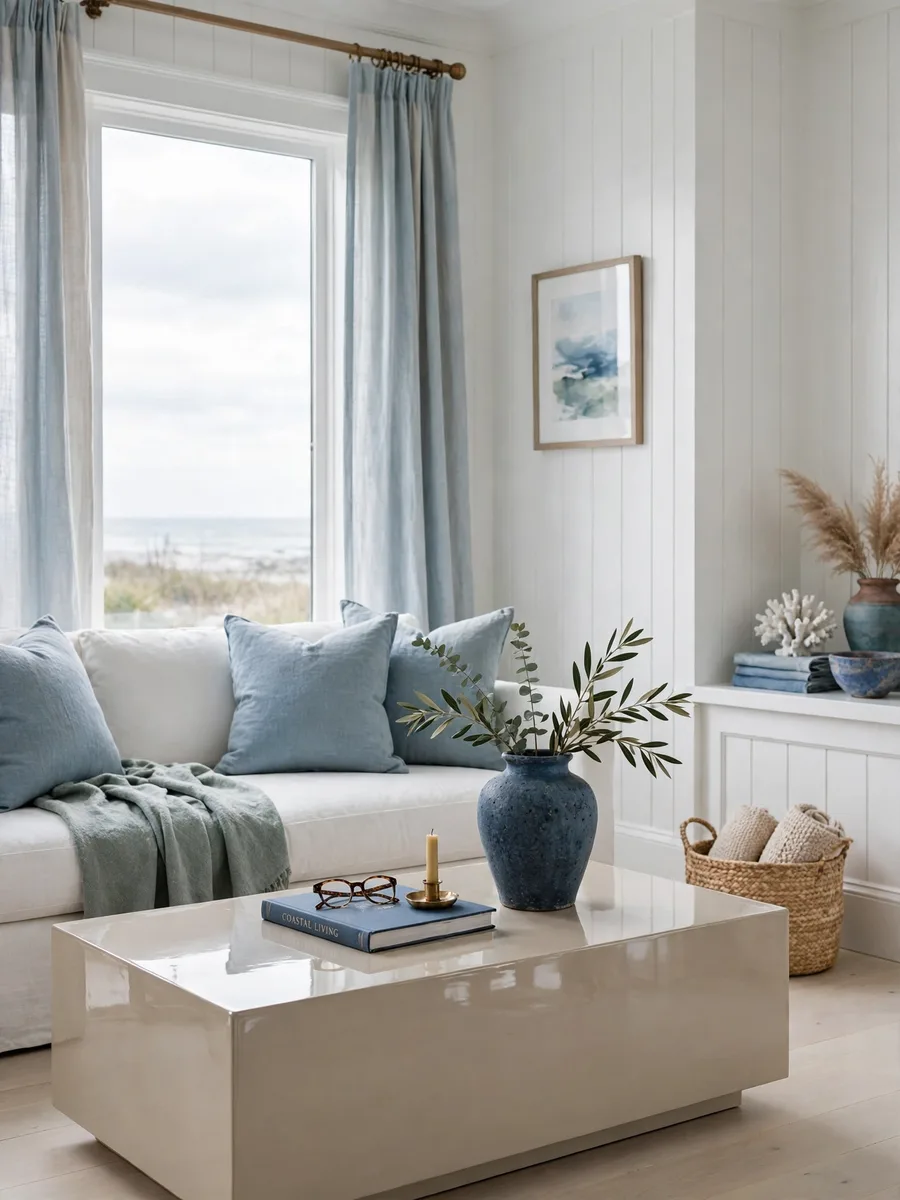
Soft blue accents work best in small, repeated touches rather than one big blue statement. Dusty blue, soft teal, faded sea green and weathered navy each echo the sea, and repeating one shade in cushions, a throw and a vase ties the room together.
A concrete example is a white living room with dusty-blue linen cushions, a faded sea-green throw over one sofa arm, and a weathered-navy vase on the sideboard, against warm white walls and a pale wood floor.
Quick tip: Pick one blue and repeat it three times, in three different textures.
9. Why Is Linen Upholstery So Suited to Coastal Rooms?
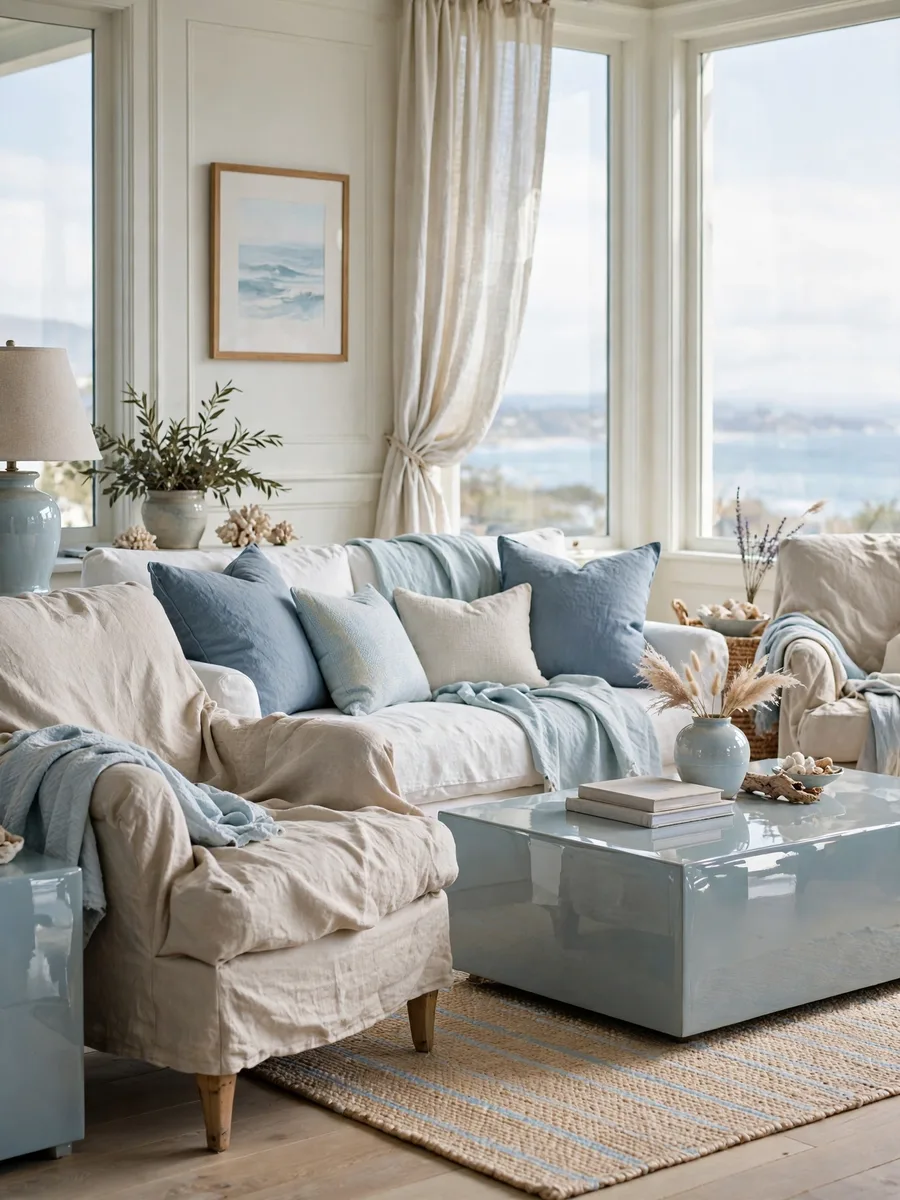
Linen upholstery suits coastal rooms because it looks relaxed the moment you sit on it. Its soft slub and gentle wrinkles read as effortless, and natural linen in ivory, oatmeal or pale sand never competes with the view.
A concrete example is a pair of natural linen armchairs with loose, rumpled covers flanking a white sofa, each with a dusty-blue cushion and a folded cotton throw.
Quick tip: Choose pre-washed linen so the relaxed look is built in.
10. How Does Weathered Wood Bring the Beach Indoors?
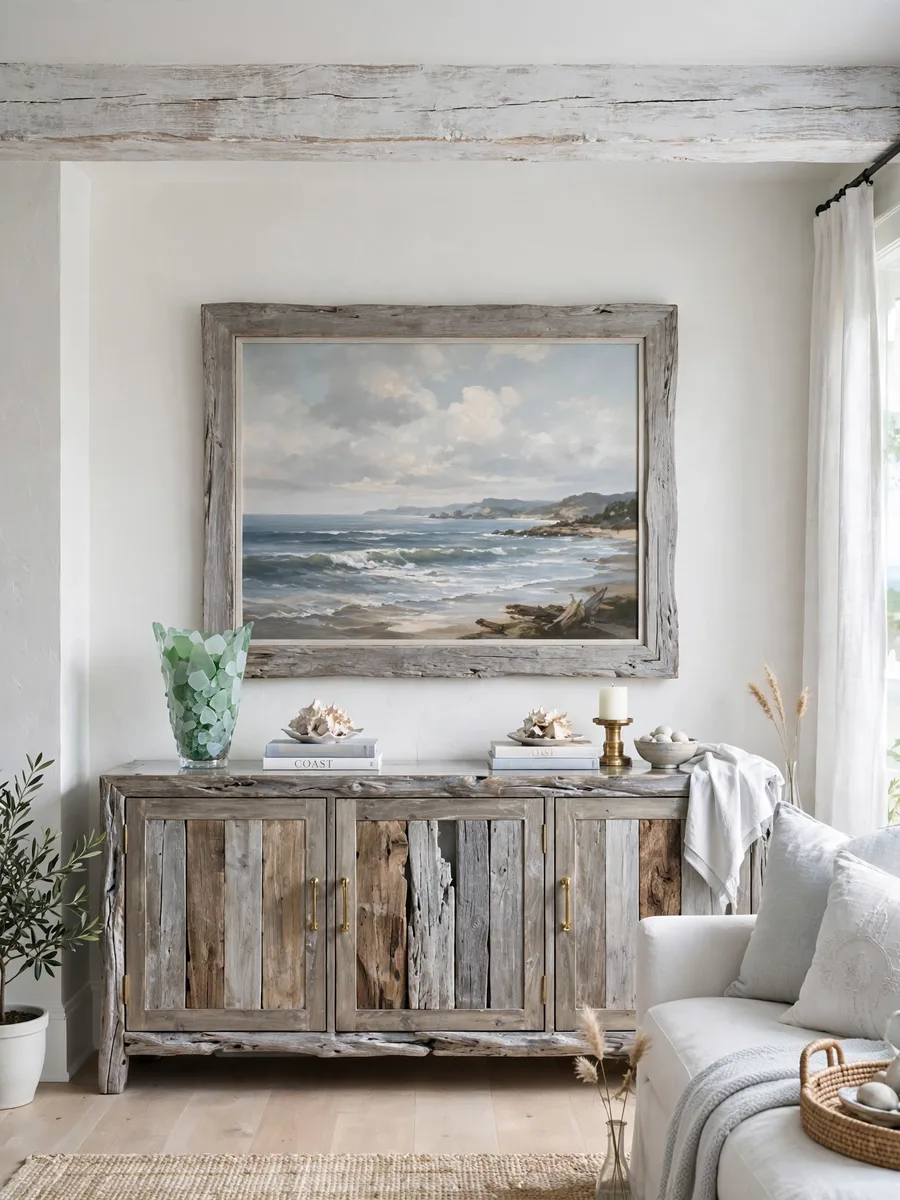
Weathered wood brings the beach indoors through colour and grain, not through beach props. Driftwood tones, whitewashed planks and aged oak carry the pale, sun-bleached feeling of the shore.
A concrete example is a weathered driftwood sideboard under a large seascape painting, its silvery-grey grain echoed by a pale oak floor, with a woven basket and a sea-glass vase on top. Nothing on it says beach, yet the room feels coastal.
Quick tip: Mix one weathered piece with one smooth pale wood piece for balance.
11. How Do You Style Sparse, Curated Shelving?
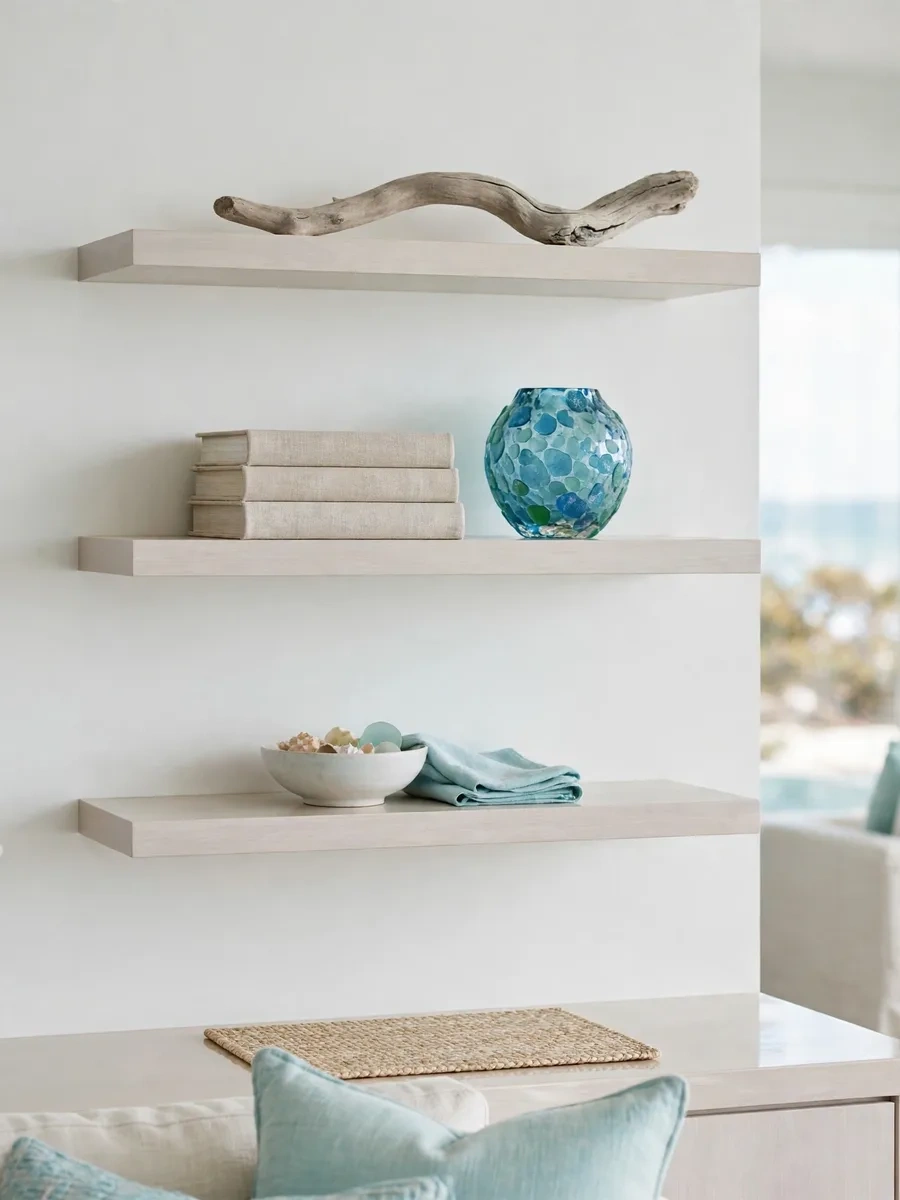
Sparse, curated shelving keeps a coastal room calm. One sea-glass vase, one woven basket and one driftwood piece, with breathing space between them, say more than a crowded shelf ever could.
A concrete example is pale wood floating shelves holding a blue sea-glass vase, linen-bound books and a single piece of driftwood, with generous empty space around each object.
Quick tip: Leave at least a third of every shelf empty.
12. How Do Coastal, Nautical and Hamptons Styles Differ?
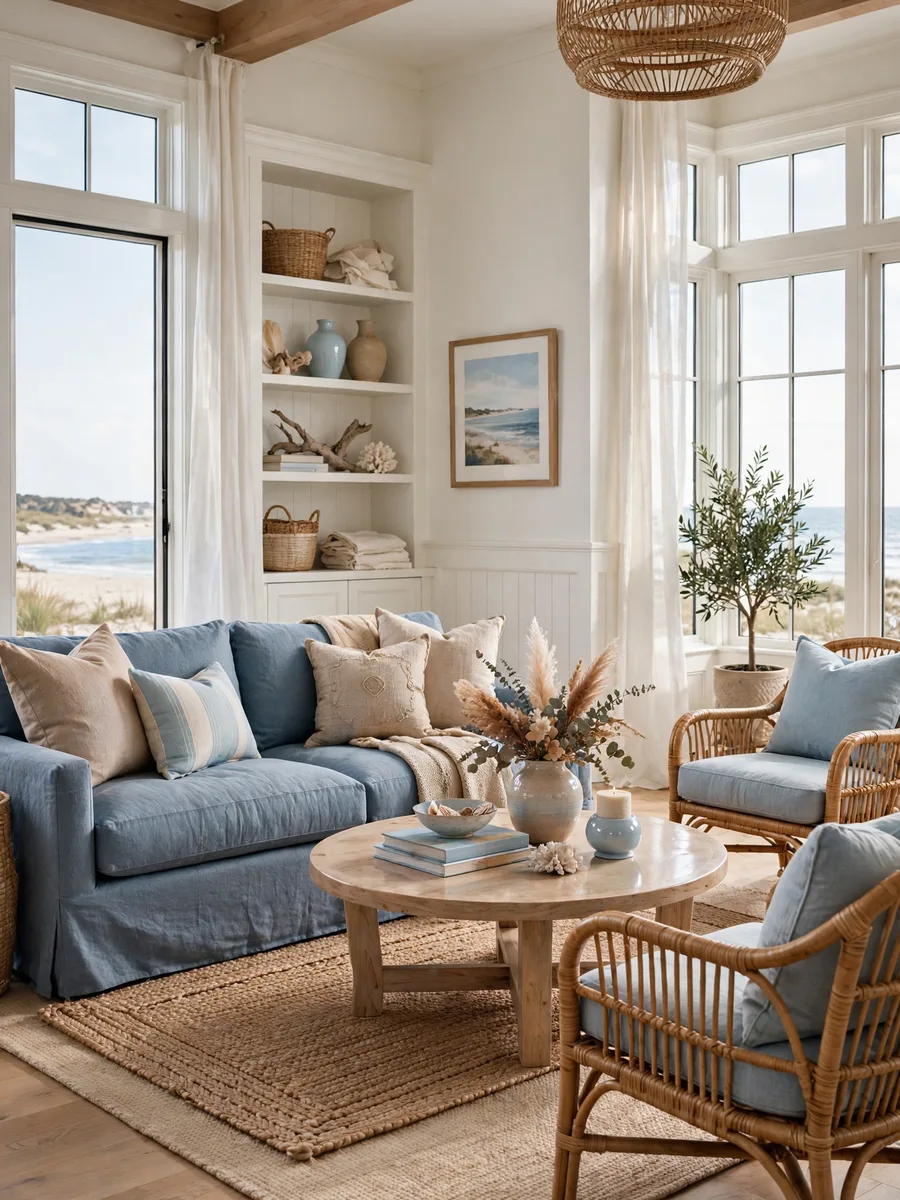
Coastal, nautical and Hamptons are three different looks, and knowing the difference stops a coastal room sliding into theme. Coastal is light and texture-led, nautical is bolder and more literal, and Hamptons is polished and classic.
A concrete example is a coastal room in warm white, sand and dusty blue with linen, jute and rattan, beside a nautical scheme in bold navy stripes and a Hamptons room in crisp white with tailored upholstery. The comparison below makes the choice clear.
| Style | Palette | Key materials | Mood |
|---|---|---|---|
| Coastal | Warm white, sand, dusty blue, sea green | Linen, cotton, jute, rattan, weathered wood | Light, relaxed, breezy |
| Nautical | Bold navy, crisp white, red accents | Stripes, rope, brass, maritime motifs | Bold, literal, seafaring |
| Hamptons | Crisp white, navy, natural timber | Tailored linen, dark wood, classic detailing | Polished, structured, elegant |
Quick tip: If a piece has an anchor or a shell on it, it belongs in a nautical room, not a coastal one.
13. Why Choose Light Wood or Whitewashed Flooring?
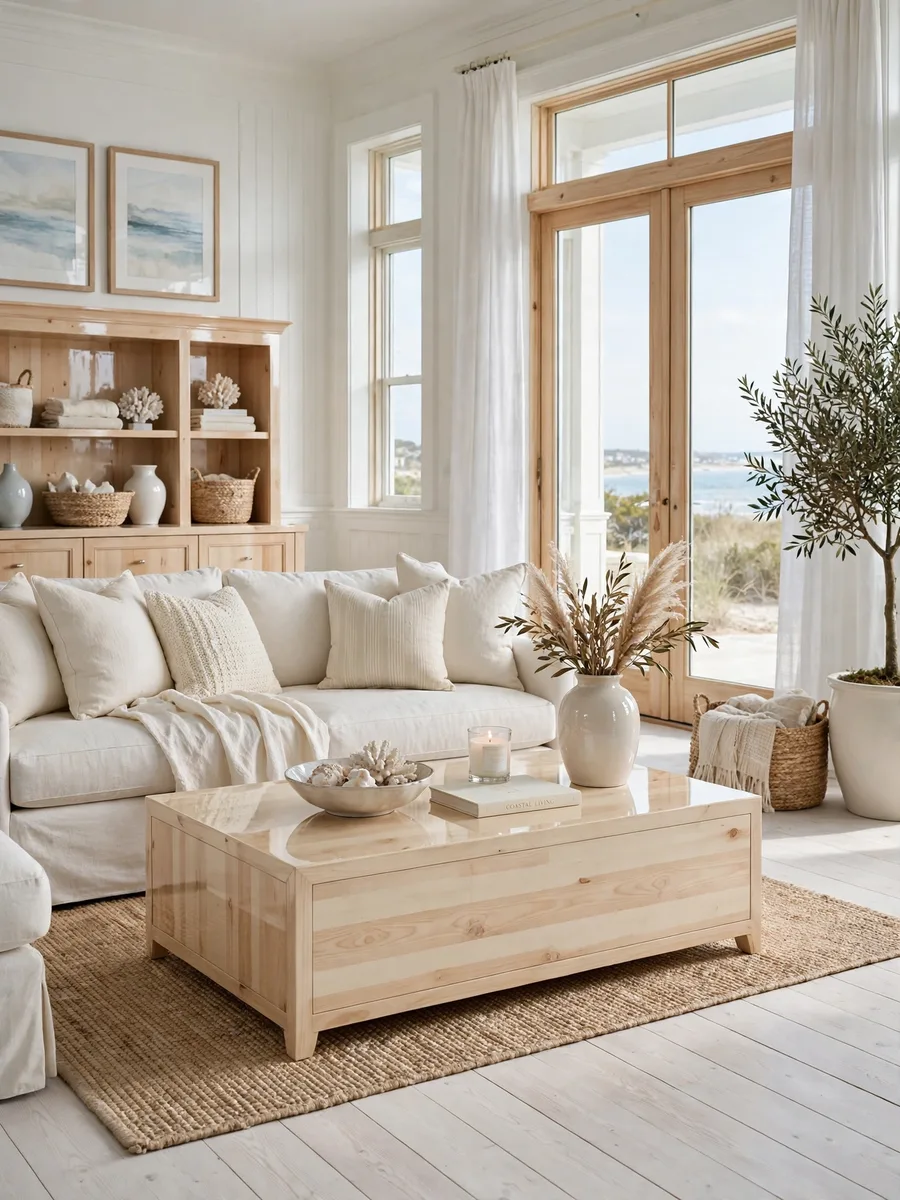
Light wood or whitewashed flooring lifts a coastal living room from the ground up. Pale oak, bleached pine or whitewashed planks reflect daylight, make small rooms feel larger, and give every texture a soft, sandy base.
A concrete example is a living room with wide-plank pale oak flooring and a jute rug in the seating area, where the pale timber meets white skirting and a linen sofa.
Quick tip: Choose a matte floor finish so the wood looks natural, not varnished.
14. How Does an Open Layout Make a Room Feel Breezier?
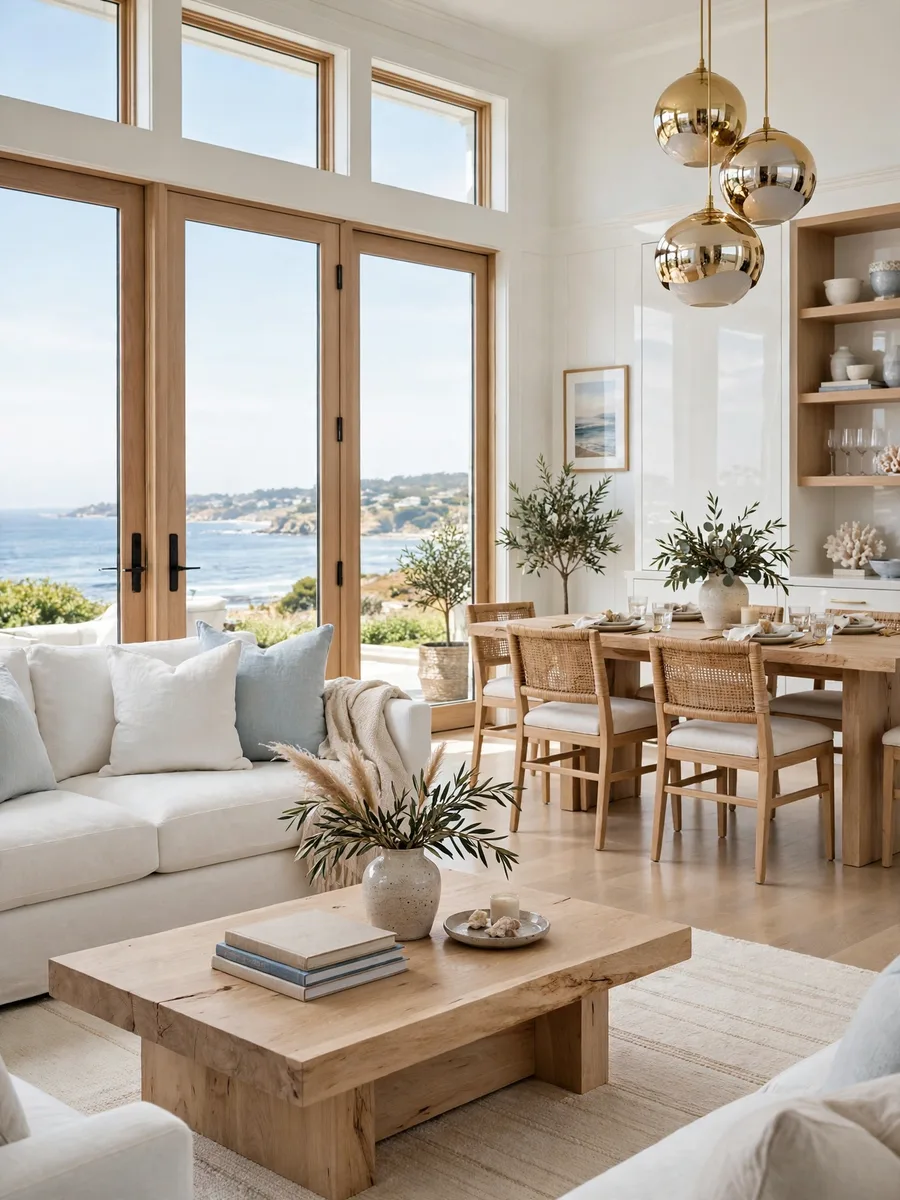
An open layout makes a coastal living room feel breezier because light and air move through it freely. Fewer walls, low furniture and clear sightlines to the window let the room breathe.
A concrete example is a living room flowing into the dining area with no wall between them, the sofa facing the window and a pale rug linking both zones, so the whole space reads as one light-filled room.
Quick tip: Float the sofa away from the wall to open up the flow.
15. How Do Indoor Plants Add Coastal Freshness?
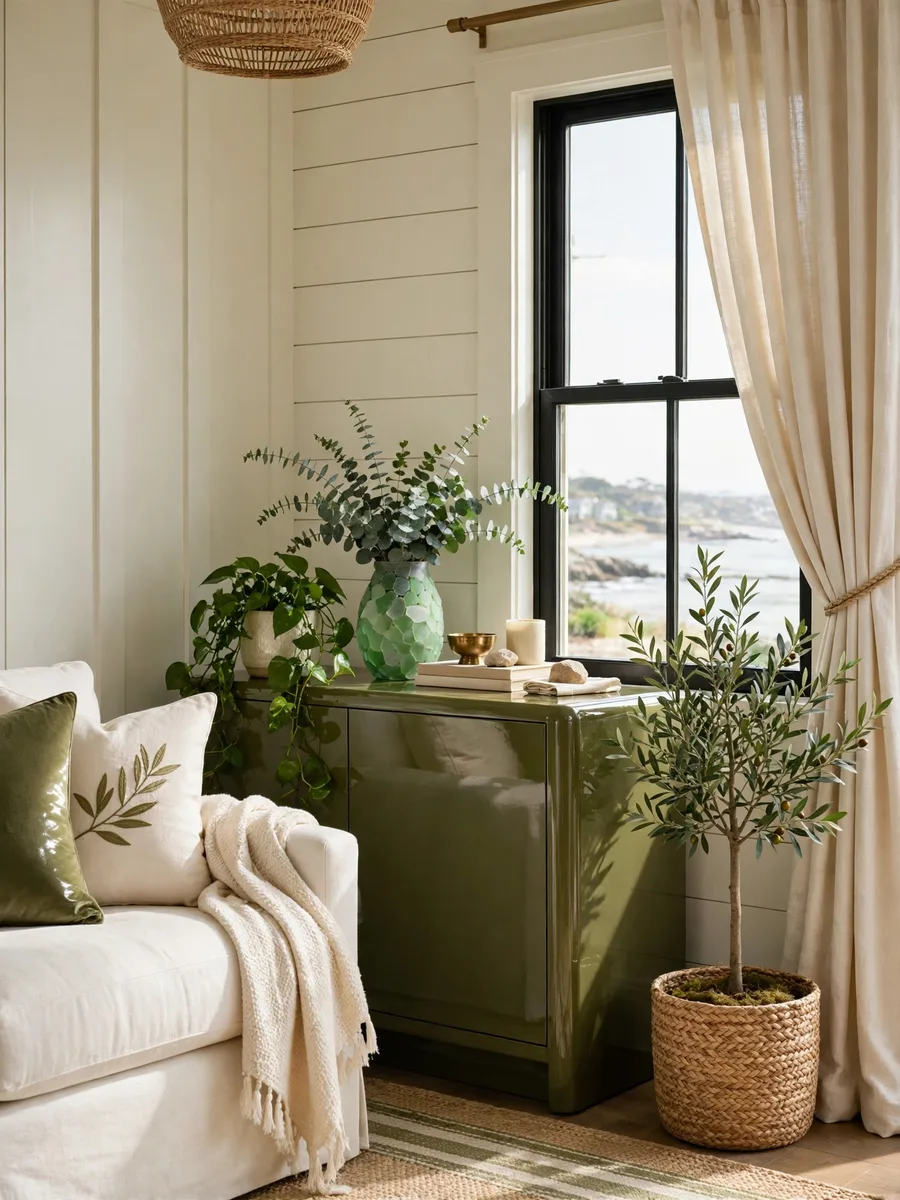
Indoor plants add coastal freshness with living green against a pale, sandy palette. An olive tree, a palm or a trailing plant softens hard edges and fills an empty corner without adding colour that fights the room.
A concrete example is a small olive tree in a woven seagrass basket beside the window, its silvery-green leaves above a white sofa, with a trailing plant on the sideboard and eucalyptus in a sea-glass vase.
Quick tip: Choose one large plant rather than many small ones for a calmer look.
16. How Can Blue and White Stripes Stay Subtle?
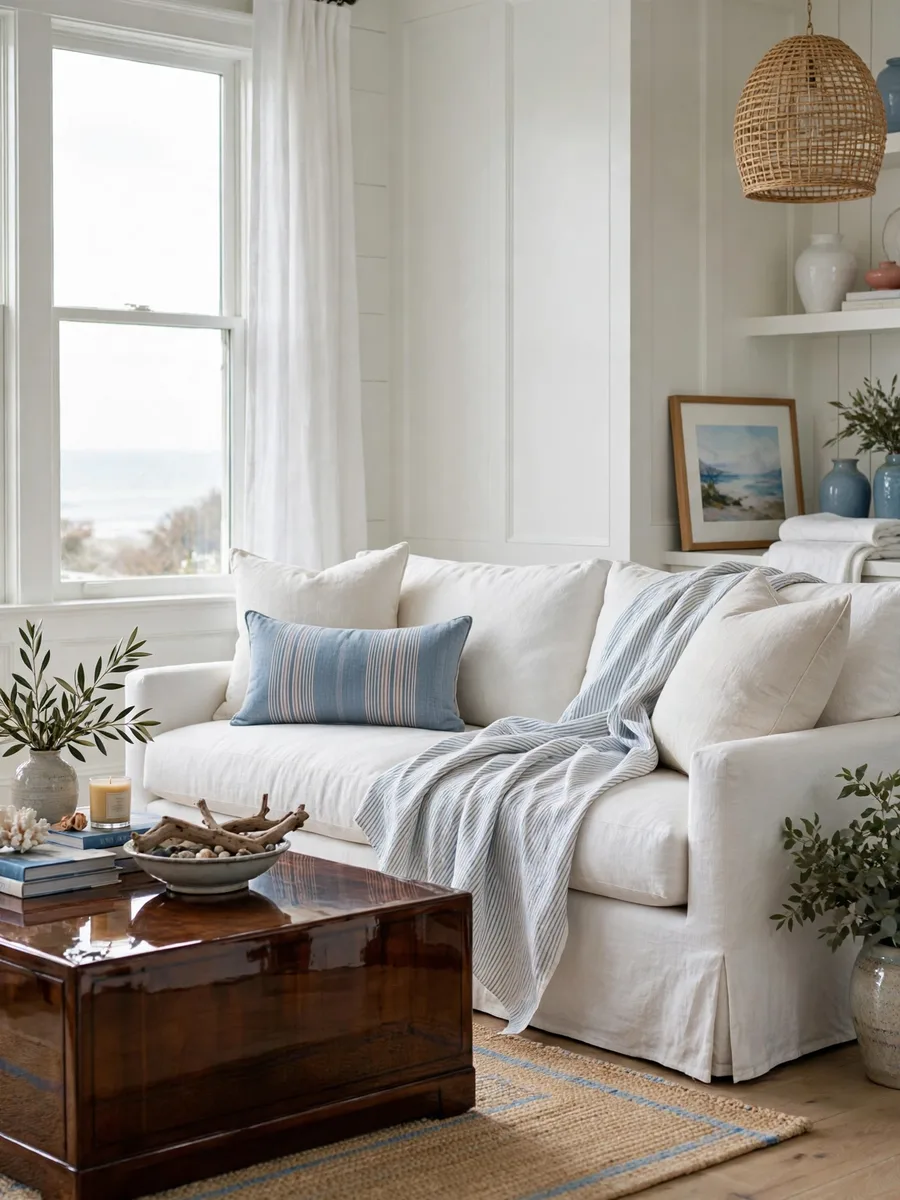
Blue and white stripes stay subtle when soft, narrow and used sparingly. A faded ticking stripe on one cushion, a thin-striped throw or a striped lampshade adds a coastal nod without turning the room into a sailor’s cabin.
A concrete example is a white linen sofa with one narrow dusty-blue striped cushion, a thin-striped cotton throw over the arm, and plain linen cushions beside them, so the stripe reads as texture rather than pattern.
Quick tip: Use stripes on one piece only, and keep them faded, not bold.
17. Why Add Wicker or Rattan Chairs?
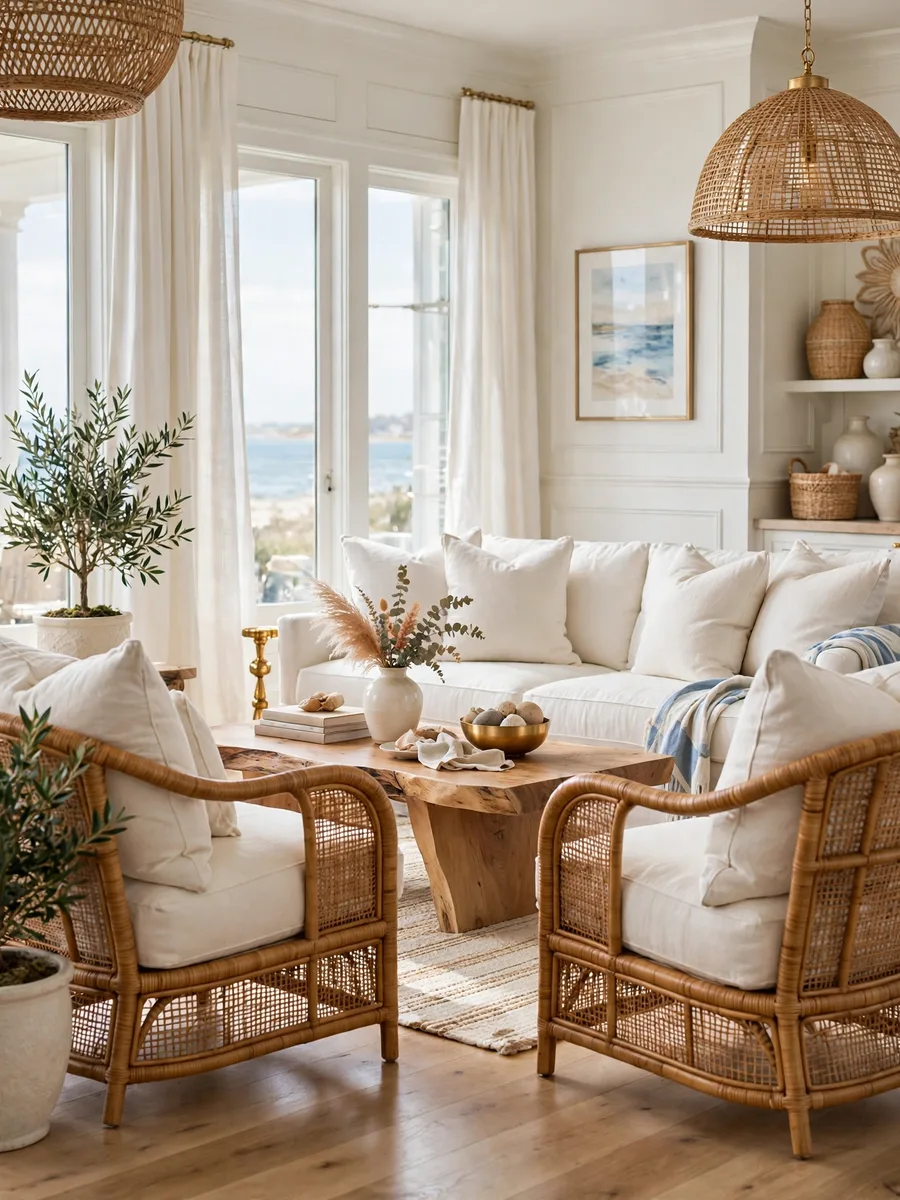
Wicker or rattan chairs add woven warmth and a relaxed silhouette to a coastal seating group. Their open weave lets light through, their curved frames soften straight-lined sofas, and they are light enough to move.
A concrete example is a pair of honey-toned rattan armchairs with plump ivory cushions facing a white sofa across a raw wood coffee table, the woven frames catching the afternoon sun on a pale jute rug.
Quick tip: Add a washable cushion so wicker chairs stay comfortable for long sits.
18. How Do You Create a Light-Filled Reading Nook?
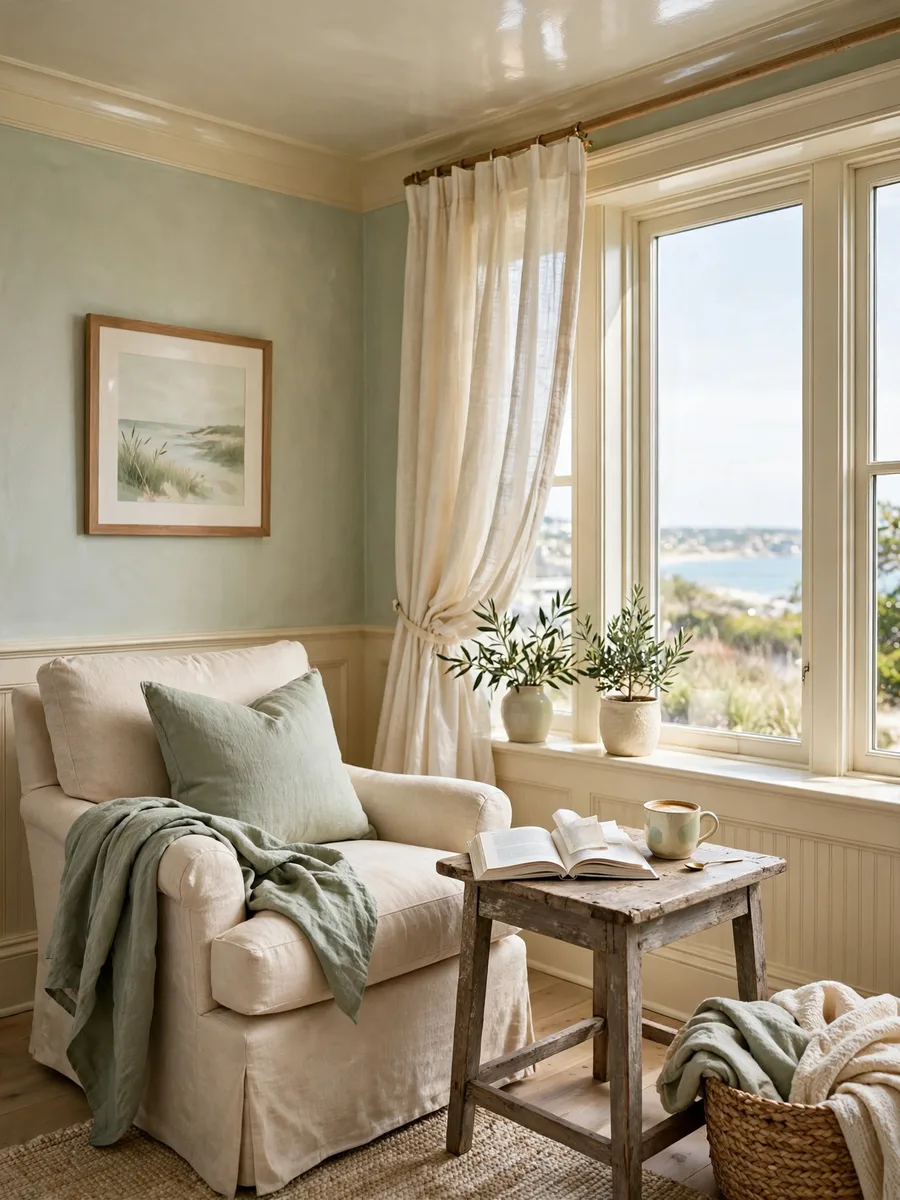
A light-filled reading nook turns an unused corner into the most loved seat in a coastal living room. A linen chair, a small side table, a reading lamp and a soft throw are all it needs, placed where the daylight is best.
A concrete example is a corner nook with a natural linen armchair angled toward the window, a weathered wood side table holding a book and a cup, and a woven basket of throws at its feet.
Quick tip: Place the chair at an angle to the window, not flat against the wall.
19. Why Swap Fish Decor for a Seascape Painting?
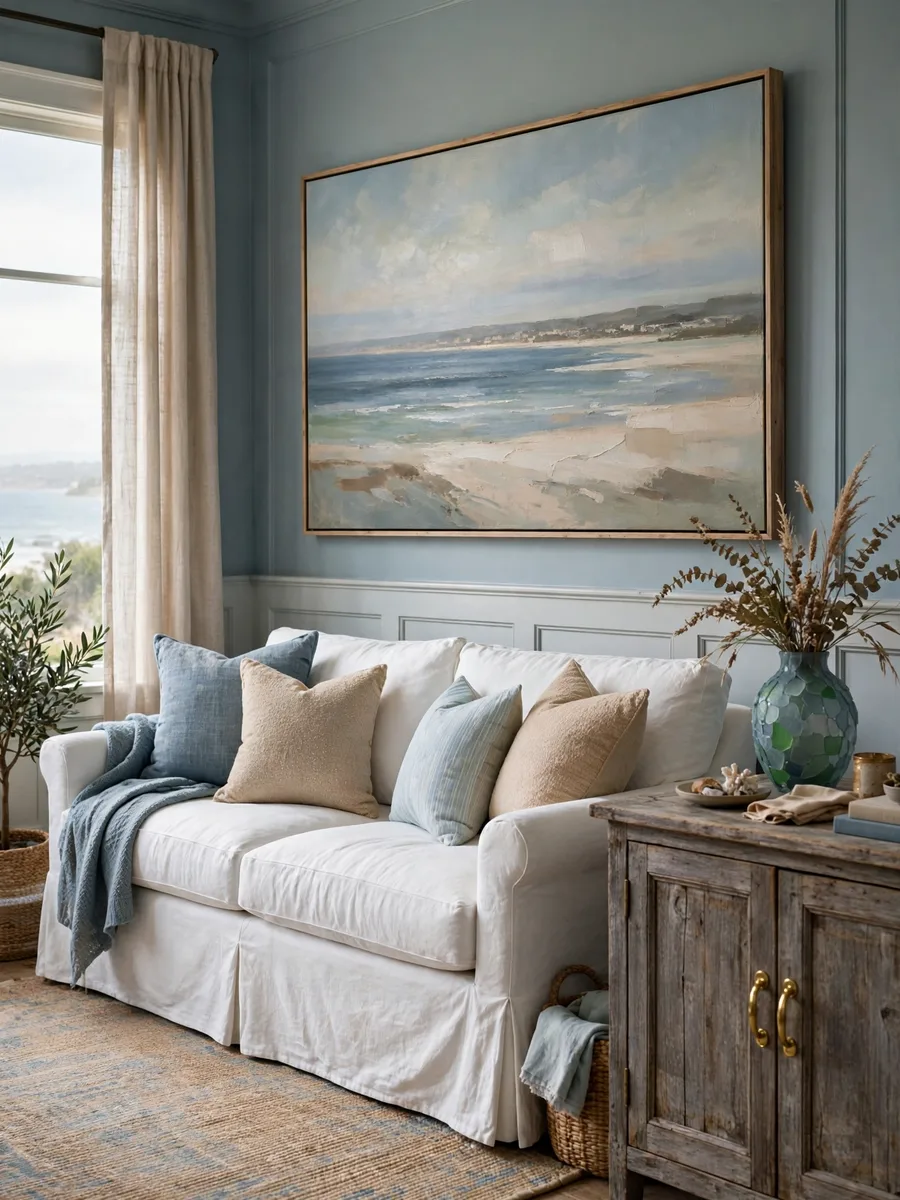
Swapping fish wall decor for a seascape painting is the kitsch test that separates a coastal room from a themed one. A large, soft seascape in dusty blue, sand and white brings the sea in as art, while a fish plaque turns the wall into a souvenir shop.
A concrete example is a wide seascape in muted blues and warm sand above a white slipcovered sofa, its horizon echoing the window light, with a weathered wood sideboard and a sea-glass vase below.
Quick tip: Hang one large seascape rather than a gallery of small beach prints.
20. How Do Textured Throw Pillows Finish a Sofa?
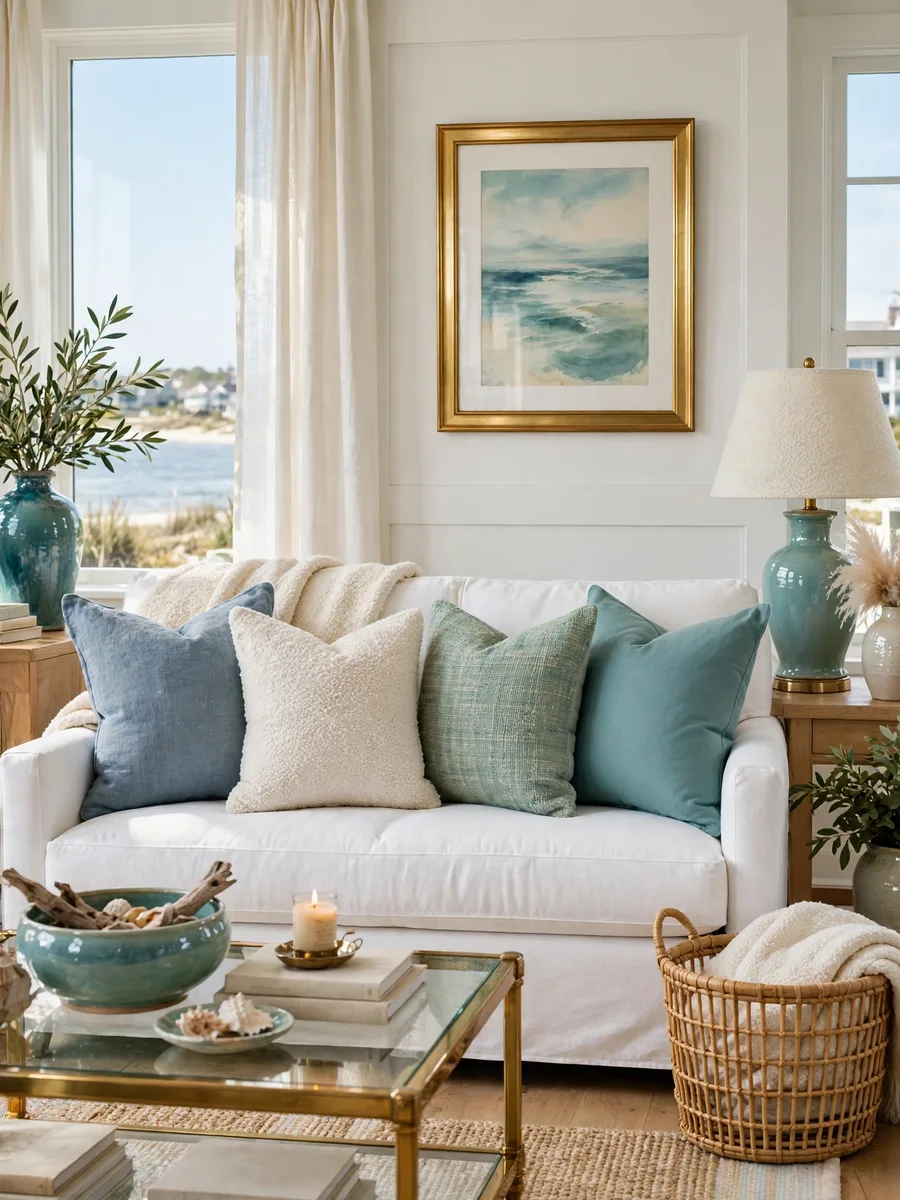
Textured throw pillows finish a sofa by adding touch, not pattern. Linen, boucle, woven cotton and slubbed wool in dusty blue, sea green and sand invite you to lean in, and mixing textures in one calm palette keeps the sofa interesting.
A concrete example is a white sofa dressed with a dusty-blue linen pillow, a cream boucle pillow, a faded sea-green woven pillow and one livelier solid in soft teal, all in different textures and none patterned.
Quick tip: Mix three textures in one colour family, then add one livelier solid.
21. Where Does Aged Brass Fit in a Coastal Room?
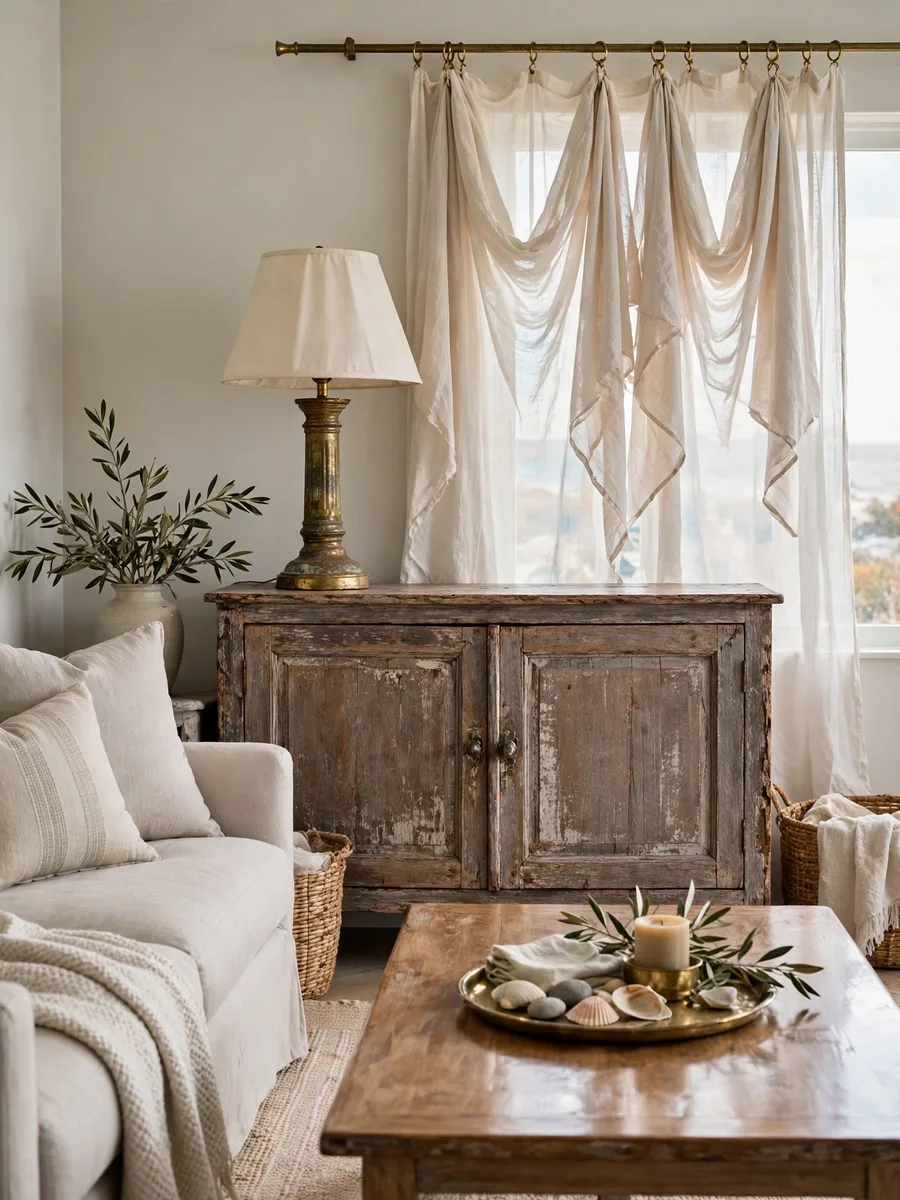
Aged brass fits a coastal room as a warm, matte metal that echoes sun and sand. Unlike shiny chrome or bright gold, aged brass has a soft patina that sits comfortably beside weathered wood, linen and rattan.
A concrete example is an aged-brass table lamp on a weathered wood sideboard, a slim aged-brass curtain rod over linen sheers, and a small brass tray on the coffee table, each matte and understated.
Quick tip: Keep brass matte and aged, never polished or shiny.
22. How Do Glass and Mirrors Bounce Coastal Light?
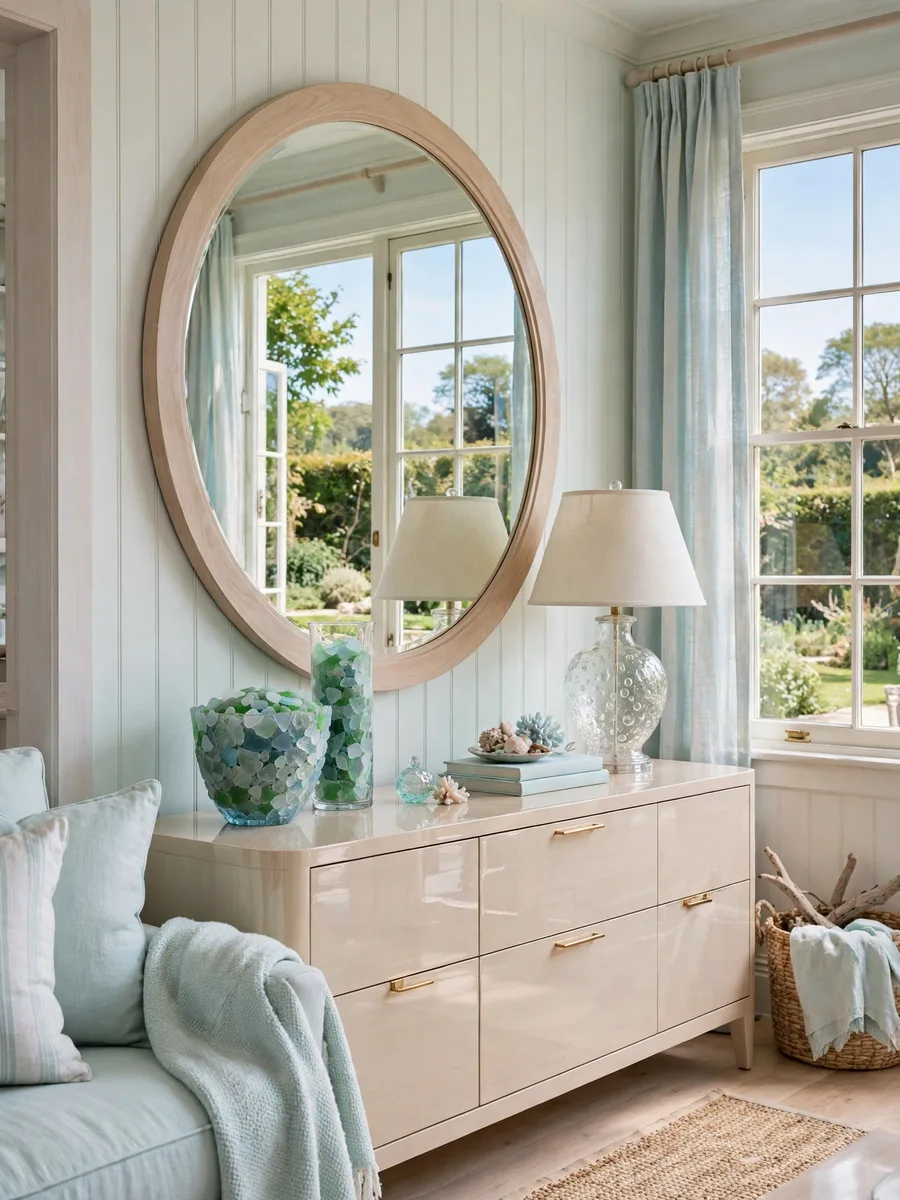
Glass and mirrors bounce coastal light around the room and make it feel larger. A mirror opposite the window doubles the daylight, while sea-glass vases and glass lamps keep the look airy instead of heavy.
A concrete example is a large round mirror with a pale wood frame opposite the main window, reflecting the garden and sky, with a sea-glass vase and a glass lamp on the sideboard below.
Quick tip: Hang the mirror where it reflects the window, not a blank wall.
23. What Is Coastal Grandmother Style in a Living Room?
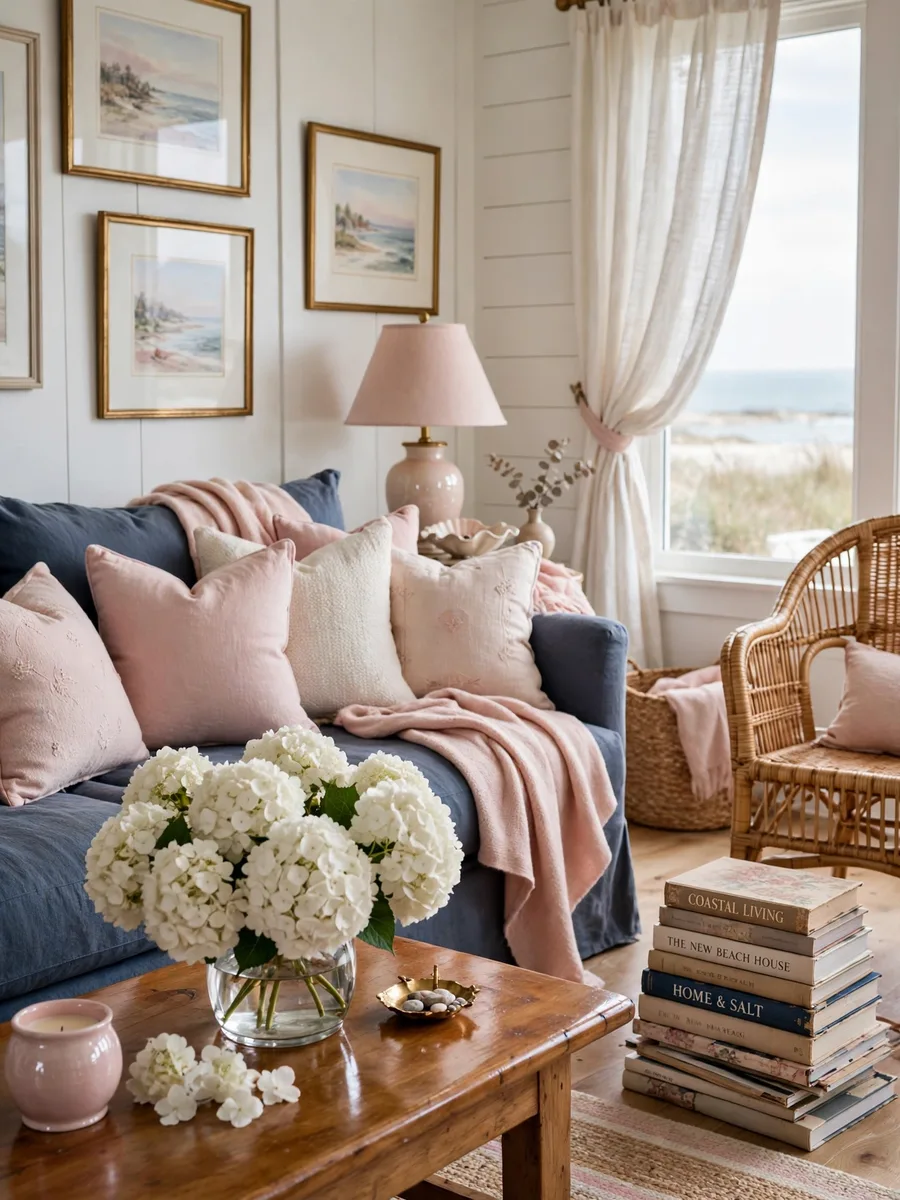
Coastal grandmother style is the softer, more lived-in cousin of coastal, with plump cushions, fresh flowers, linen throws and a lived-in elegance that feels like a gracious seaside house. It is coastal with extra comfort and extra flowers.
A concrete example is a white living room with a deep linen sofa piled with soft cushions, white hydrangeas on the coffee table, a cashmere throw over the arm, and well-loved books beside a rattan chair.
Quick tip: Add fresh flowers weekly; they are the heart of this look.
24. How Do You Make Coastal Work in a Small Living Room?
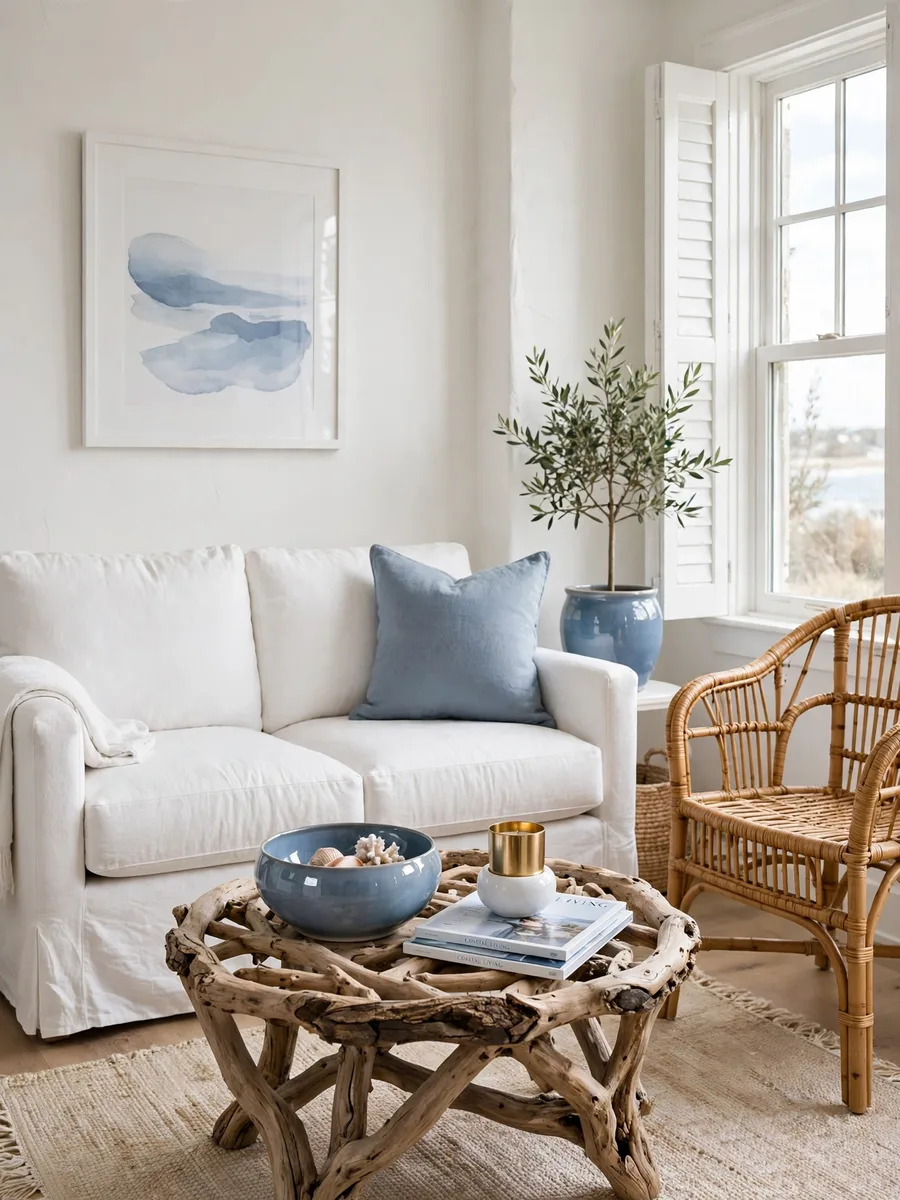
Coastal works beautifully in a small living room because its pale palette and light textures make the space feel larger. A slim sofa, a small round coffee table, sheer curtains and a single woven chair give you the look without crowding it.
A concrete example is a compact living room with a two-seat white linen sofa, a round driftwood coffee table, one rattan chair and a pale jute rug, where every piece is low and light and the walls stay warm white with one dusty-blue cushion.
Quick tip: Choose a round coffee table; it frees up floor space in a small room.
25. How Do You Style a Coastal Fireplace?
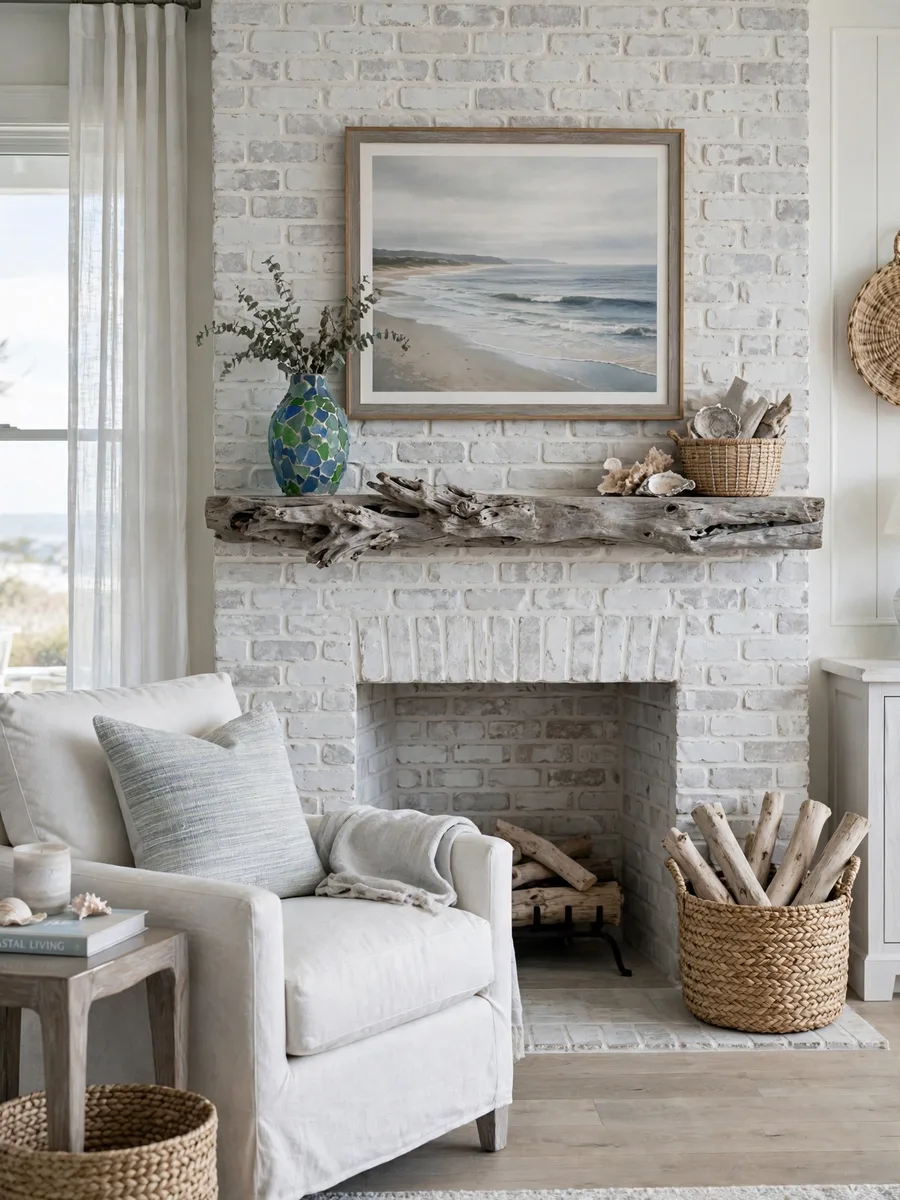
A coastal fireplace works best in whitewash, pale stone or soft plaster, with a simple mantel dressed sparsely. The fire is a warm focal point in winter, while the pale surround keeps the room light in summer.
A concrete example is a whitewashed brick fireplace with a driftwood mantel holding a seascape print, a sea-glass vase and a woven basket, flanked by pale logs in a seagrass basket and a linen armchair angled toward the fire.
Quick tip: Keep the mantel to three objects, with space between them.
26. How Do You Keep an Open-Plan Living Room Cohesive?
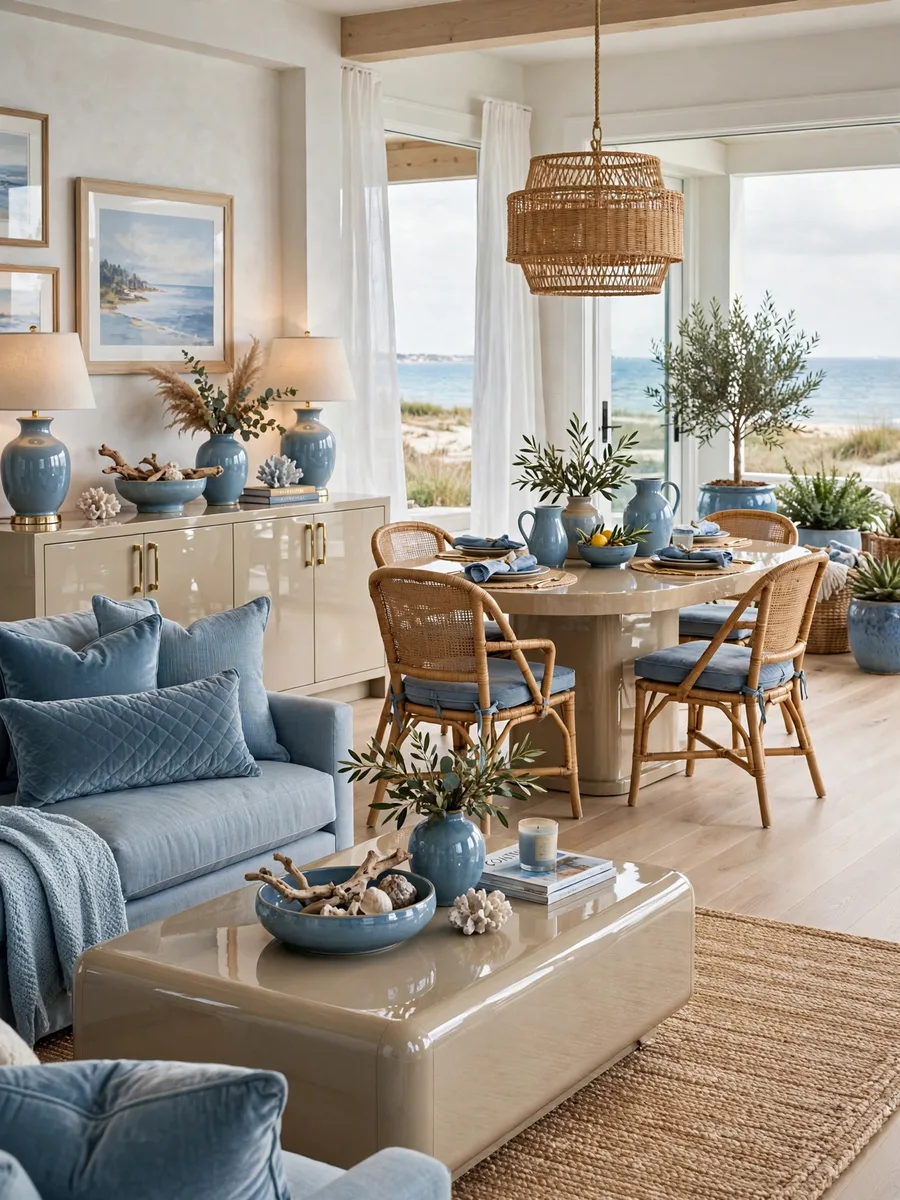
An open-plan living room stays cohesive when one palette and one set of textures runs through every zone. The same warm white, sand and dusty blue, the same linen and jute, and the same weathered wood link the sofa area to the dining table.
A concrete example is a living and dining space sharing a pale oak floor and a jute rug, with rattan dining chairs echoing the rattan pendant over the living area, and dusty-blue cushions matching the dining chair pads.
Quick tip: Repeat one material, such as rattan, in both zones to tie them together.
27. What Evening Lighting Keeps a Coastal Room Warm?
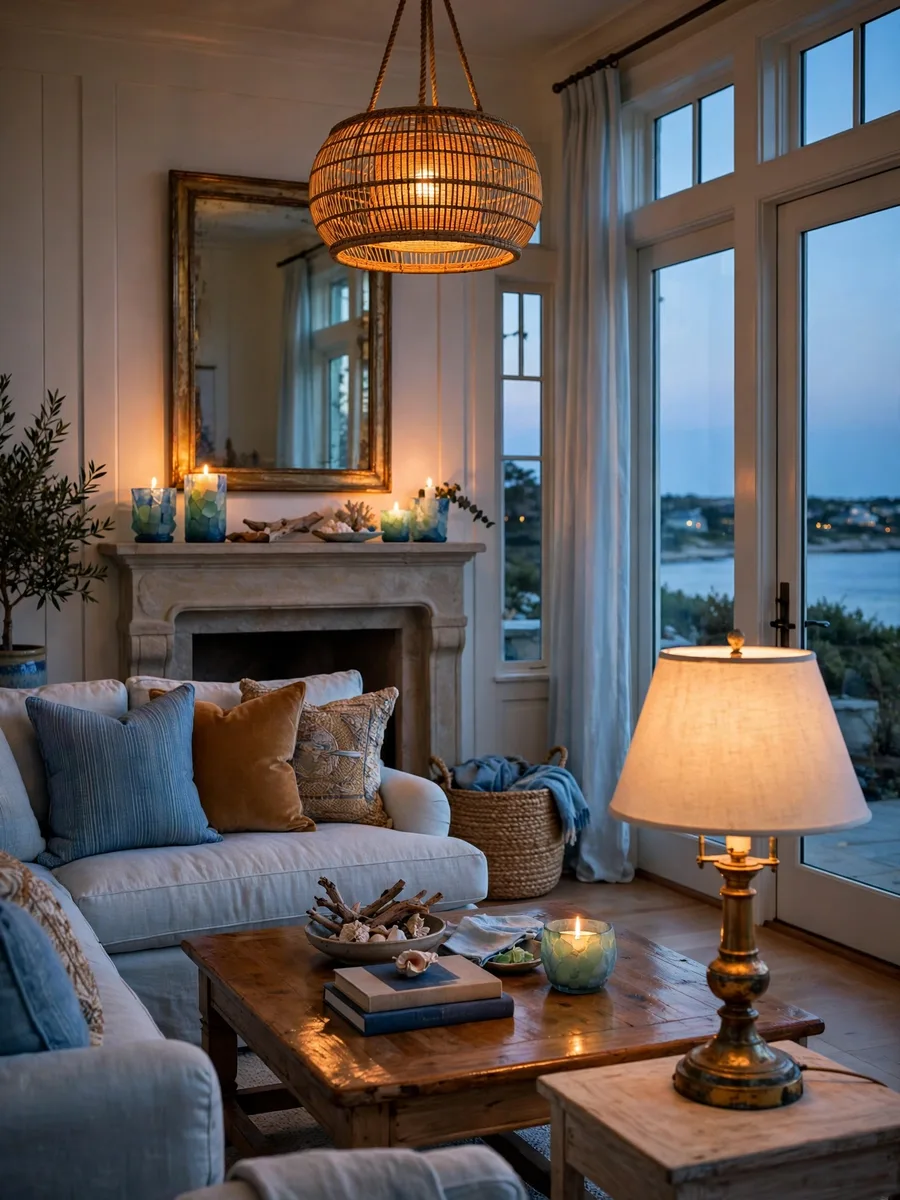
Evening lighting keeps a coastal room warm when it is layered, dimmable and warm-toned. A rattan pendant, a linen-shaded table lamp and a few candles give you pools of soft light, so the pale room never feels cold after dark.
A concrete example is a living room at dusk with a rattan pendant glowing over the coffee table, an aged-brass lamp with a linen shade on the sideboard, and two candles in sea-glass holders on the mantel, all on warm bulbs.
Quick tip: Use warm-white bulbs, never cool white, in every coastal lamp.
28. How Do You Refresh a Coastal Room Each Season?
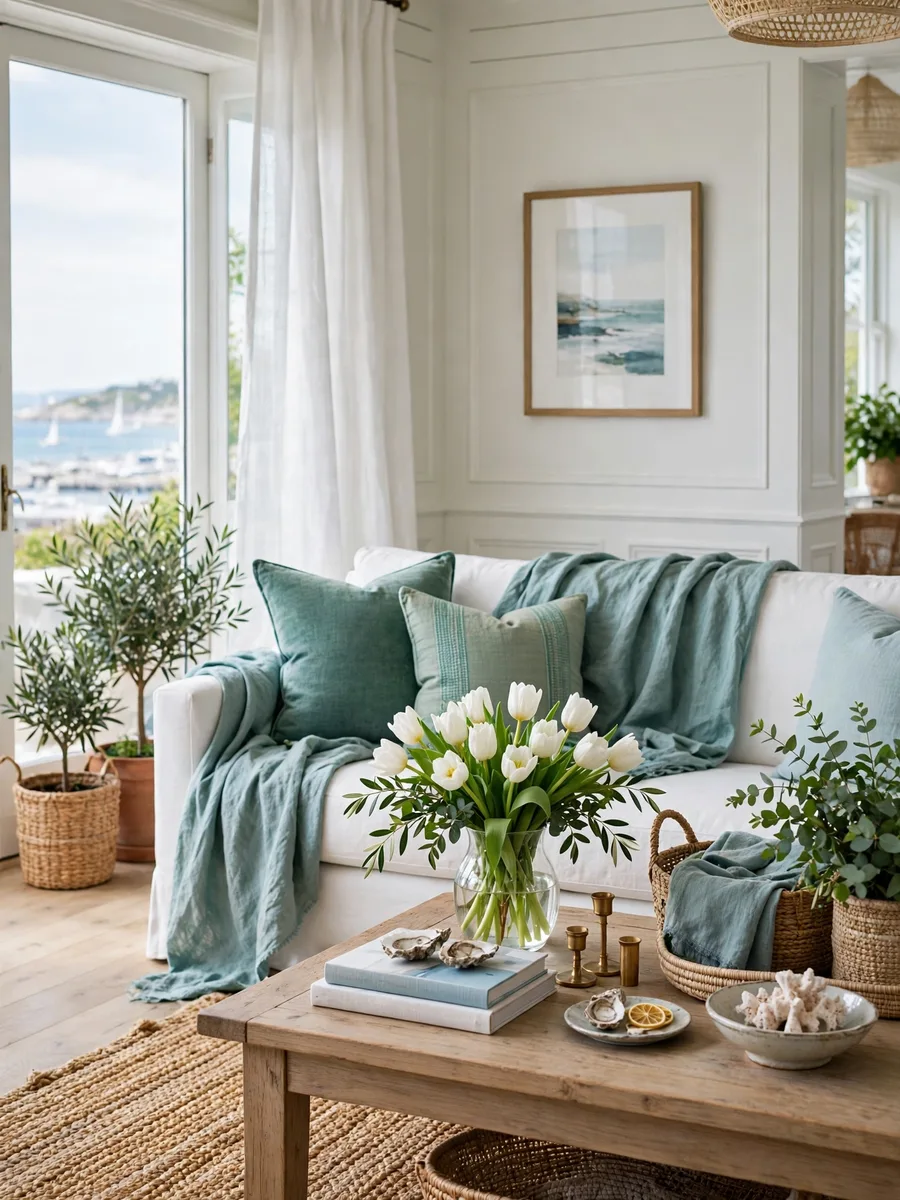
Refreshing a coastal room each season is easy because the base never changes. Swap the throws, cushions and flowers with the seasons, keeping the white sofa, jute rug and weathered wood in place, and the room feels new without a large purchase.
A concrete example is a spring refresh with sea-green cushions and white tulips, a summer swap to soft teal linen, an autumn change to warm sand throws, and a winter layer of cream wool, all on the same white sofa and jute rug. You only ever change the softest, smallest pieces, which keeps the refresh affordable and true to the calm feeling that made you choose coastal.
Quick tip: Change only cushions, throws and flowers each season; keep the furniture the same.
Frequently Asked Questions
What colours are best for a coastal living room?
Warm white, off-white, warm sand and pale greige make the best coastal base, with dusty blue, soft teal, faded sea green or weathered navy as accents. Sea Salt SW 6204 walls with Extra White SW 7006 trim is a popular starting point.
How do I make my living room coastal without it looking like a beach theme?
Let texture and colour carry the look instead of beach props. Use linen, cotton, jute, rattan and weathered wood, keep the palette soft with ocean-toned accents, and swap fish wall decor for a seascape painting, bright blue paint for sand neutrals, and busy tropical pillows for one livelier solid.
What is the difference between coastal and nautical decor?
Coastal is light, relaxed and texture-led, with soft neutrals and natural fibres. Nautical is bolder and more literal, with navy, white stripes, rope and maritime motifs. Hamptons is polished, with crisp white, tailored upholstery and classic detailing.
What furniture works best in a coastal living room?
A white slipcovered sofa, linen armchairs, wicker or rattan chairs, a raw wood coffee table and a weathered wood sideboard work best. Choose low, comfortable pieces in natural materials with matte finishes and relaxed shapes.
Can a coastal living room work in a small space?
Yes, coastal suits small living rooms very well, because its pale palette and light textures make a space feel larger. Choose a slim sofa, a round coffee table, sheer curtains and one woven chair, keep the walls warm white, and never block the window.
Conclusion
These 28 coastal living room ideas prove the look is carried by light, palette and texture, not by beach props. Start with a soft neutral base, add ocean-toned accents, layer linen, jute and rattan, and finish with one seascape, one woven pendant and a few curated objects.