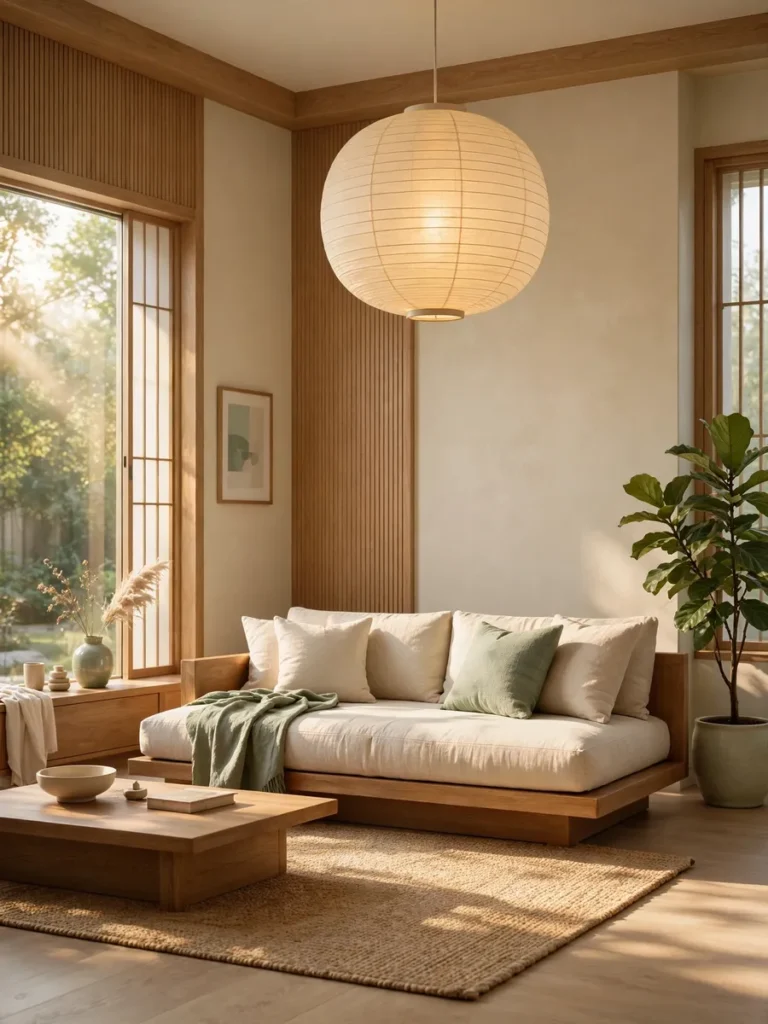
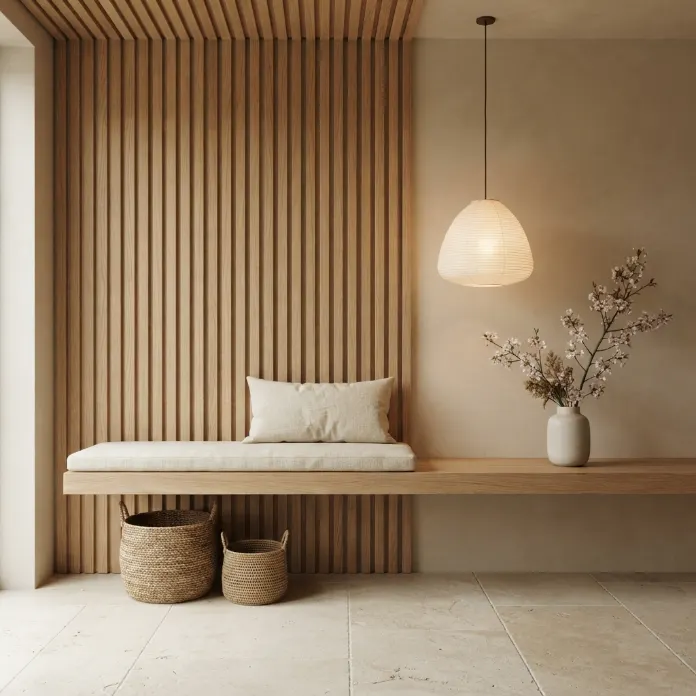
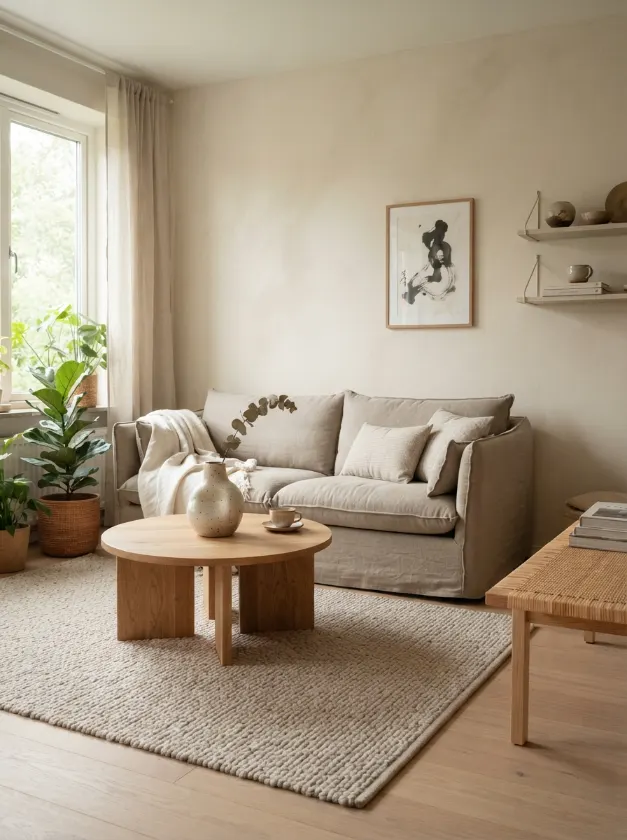
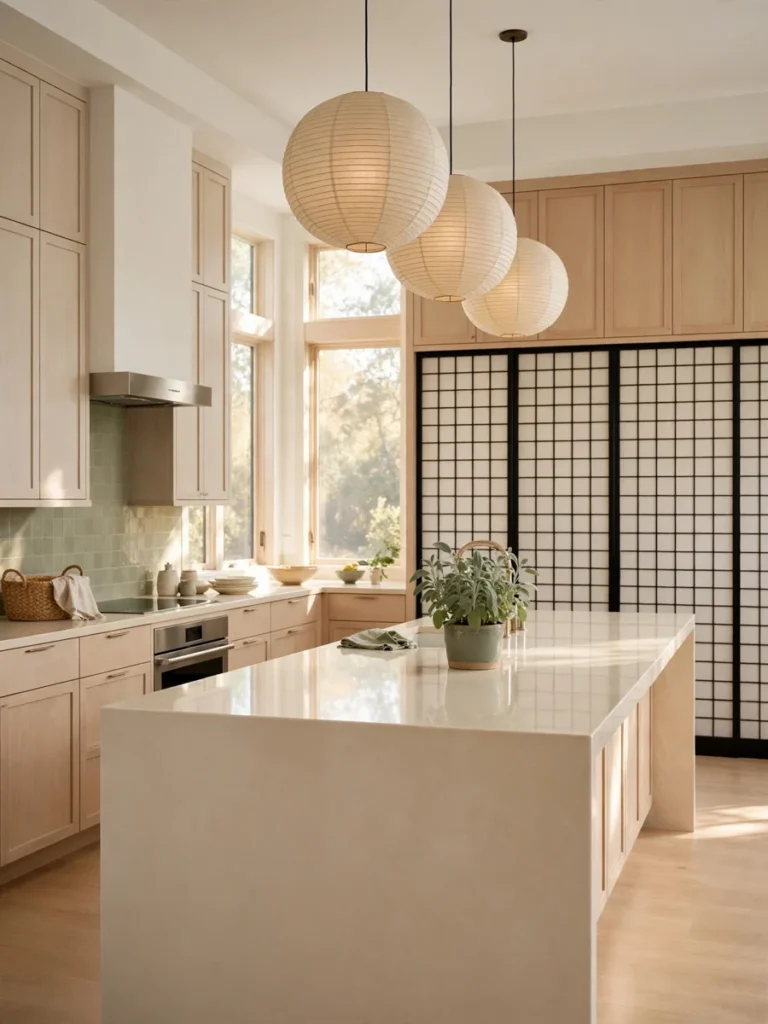
26 Serene Japandi Bedroom Ideas for a Calm, Clutter-Free Retreat
Japandi bedroom ideas blend Japanese calm with Scandinavian comfort to create a bedroom that feels quiet, warm, and easy to live in. The style pairs a warm neutral palette with natural wood, soft linen, and low, simple furniture, so the room looks uncluttered without feeling empty. A Japandi bedroom is not about owning less for its own sake; it is about choosing fewer, better pieces that earn their place and leaving breathing room around them.
The look rests on two ideas that work beautifully together. Wabi-sabi, from Japan, finds beauty in imperfection, natural wear, and honest materials, while hygge, from Scandinavia, is about comfort, warmth, and function. Start with off-white, sand, and light beige walls and bedding, add one earthy accent at about ten percent of the room, and anchor it with one dark tone, such as charcoal or smoked oak. A low platform bed, twelve to sixteen inches off the ground, sets the calm, grounded mood at once. If you love the same quiet balance in the living room, these Japandi living room ideas carry the palette and low furniture through the rest of the home.
Key Takeaways
What is a Japandi bedroom? A Japandi bedroom combines Japanese minimalism and Scandinavian comfort, using a warm neutral palette, natural materials such as wood, linen, and wool, low-profile furniture, and soft diffused light to create a calm, clutter-free retreat.
What colours work best in a Japandi bedroom? Warm neutrals such as off-white, sand, light beige, and soft grey form the base, with one earthy accent at about ten percent, such as sage, clay, or muted terracotta, and one dark tone, such as charcoal or dark olive, to anchor the room.
How low should a Japandi bed be? A low platform bed twelve to sixteen inches off the ground is the classic Japandi choice. It keeps the room feeling grounded and spacious, works well with a minimal or slatted headboard, and pairs naturally with a low nightstand and a natural fibre rug.
Can Japandi work in a small bedroom or a rental? Yes, and it suits both well. Choose a low wooden frame, linen bedding, one woven basket, and hidden storage, and use removable, renter-friendly swaps such as linen curtains, a natural fibre rug, and a paper lantern light instead of changing the walls or the bed frame.
1. How Do You Build a Warm Neutral Base Palette?
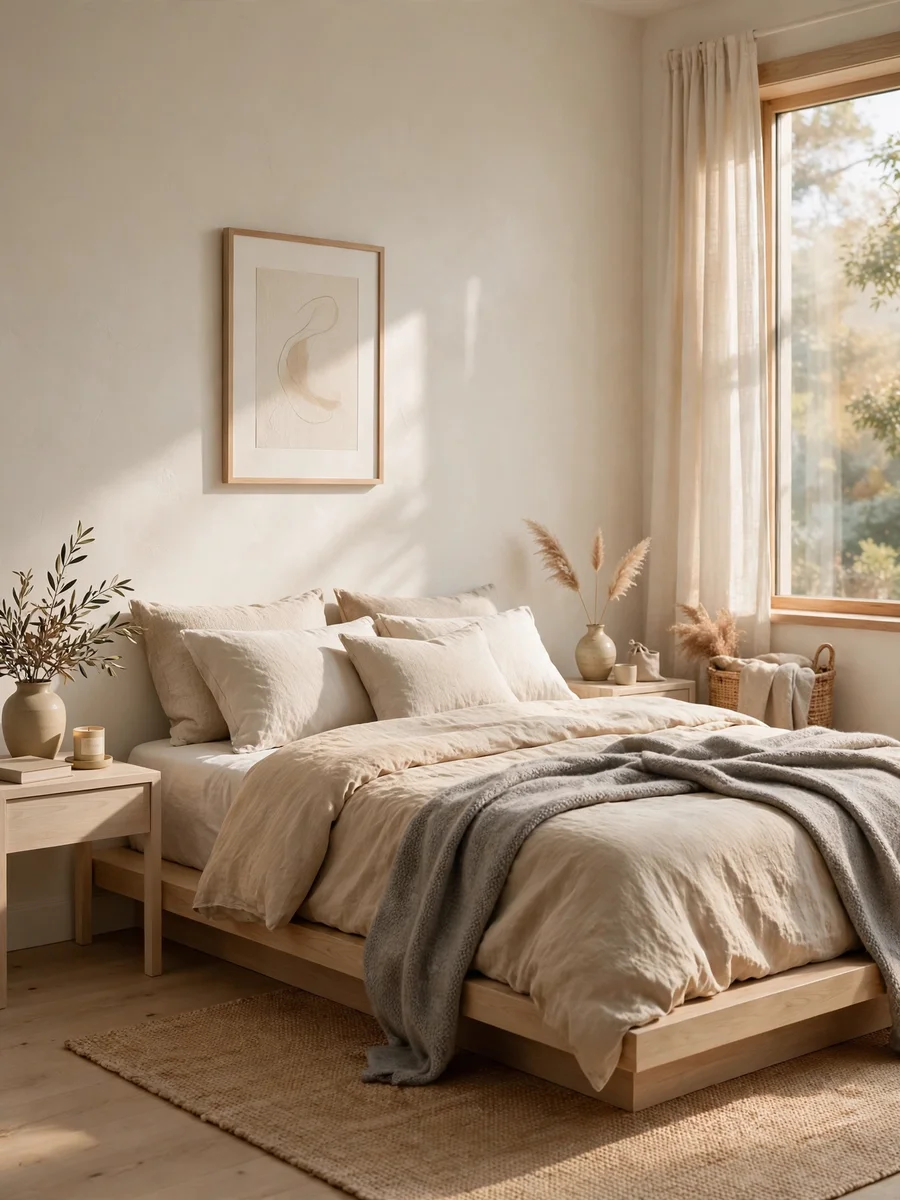
A warm neutral base palette is the foundation of every Japandi bedroom, built from off-white walls, sand bedding, light beige linen, and soft grey wool.
A concrete example is a bedroom with warm off-white walls, a sand linen duvet, light beige throw pillows, and a soft grey wool throw folded at the foot of a pale oak bed.
Quick tip: Pick three warm neutrals and repeat them in at least two places each.
2. How Much Earthy Accent Colour Should You Add?
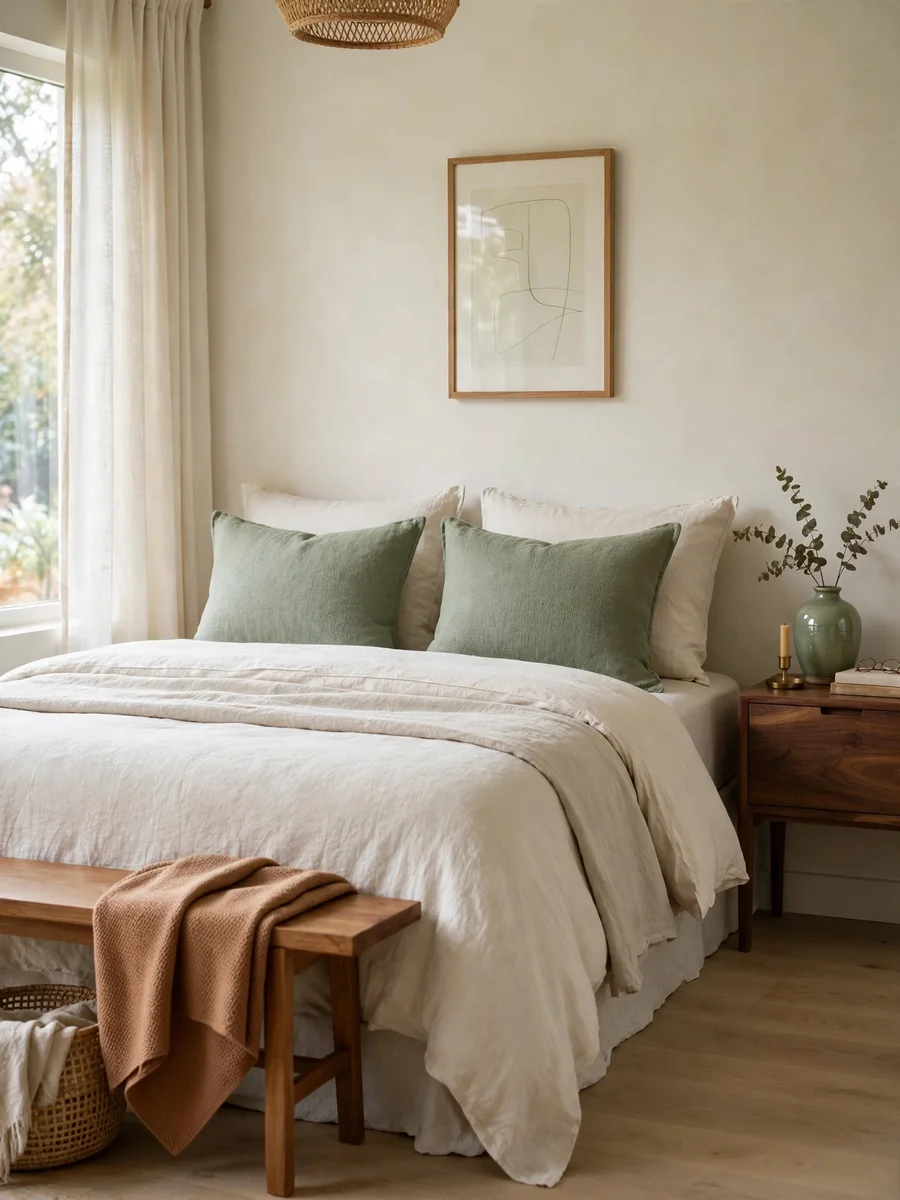
One earthy accent at about ten percent of the room keeps a Japandi bedroom warm without breaking its calm, so a sage throw or clay cushion earns its place while the neutrals still lead.
A concrete example is a sand and off-white bedroom where sage appears only in two linen cushion covers and a small glazed ceramic vase on the nightstand, while a clay-coloured throw waits folded on a wooden bench.
Quick tip: Limit your accent to three small items in the same tone.
3. Why Does One Dark Tone Anchor the Room?
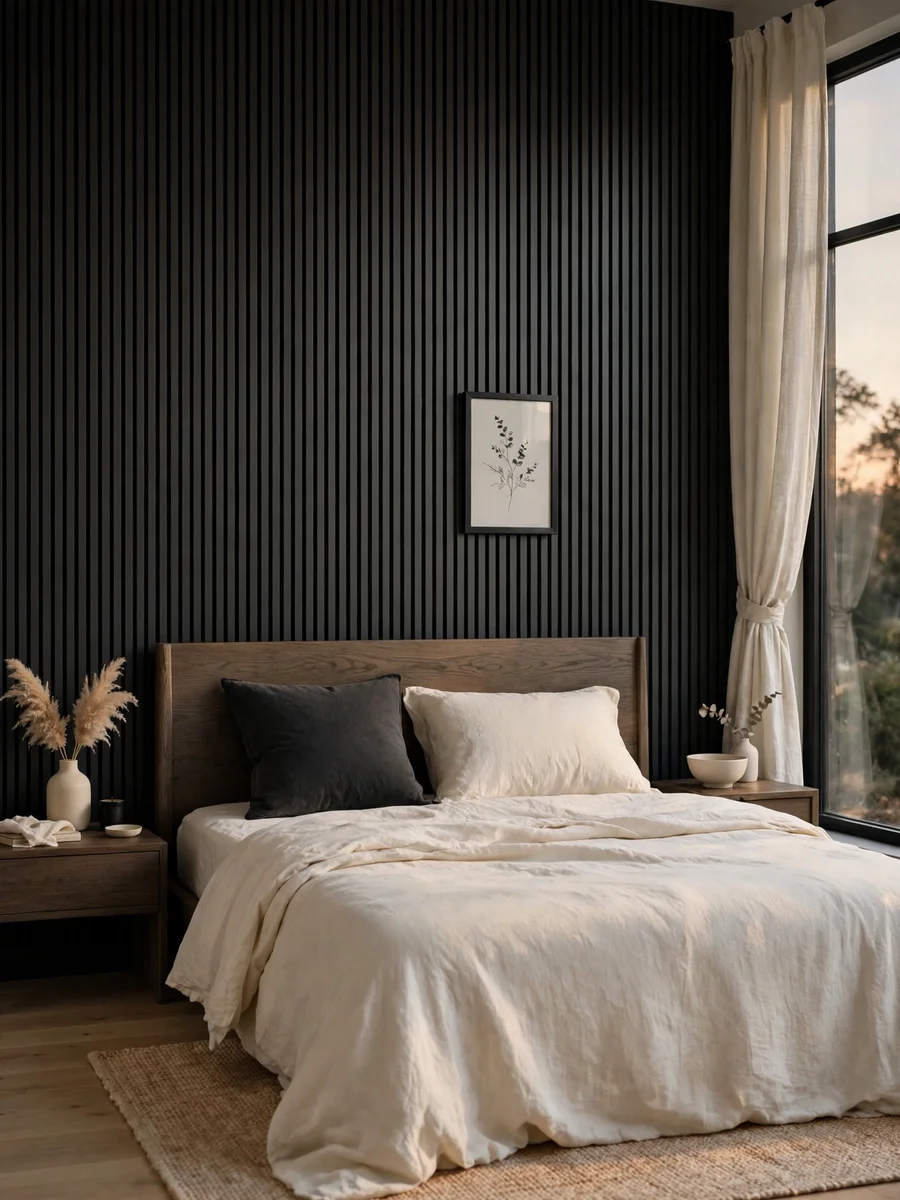
One dark tone anchors a Japandi bedroom and stops the pale palette from floating away, so a black lamp base or deep walnut frame gives the eye somewhere steady to rest.
A concrete example is a pale bedroom with a smoked oak headboard, a charcoal linen cushion, and a narrow black picture frame above the nightstand, while everything else stays cream, sand, and light wood.
Quick tip: Put your dark tone at the bed wall first, then add one small echo elsewhere.
4. How Low Should a Japandi Platform Bed Be?
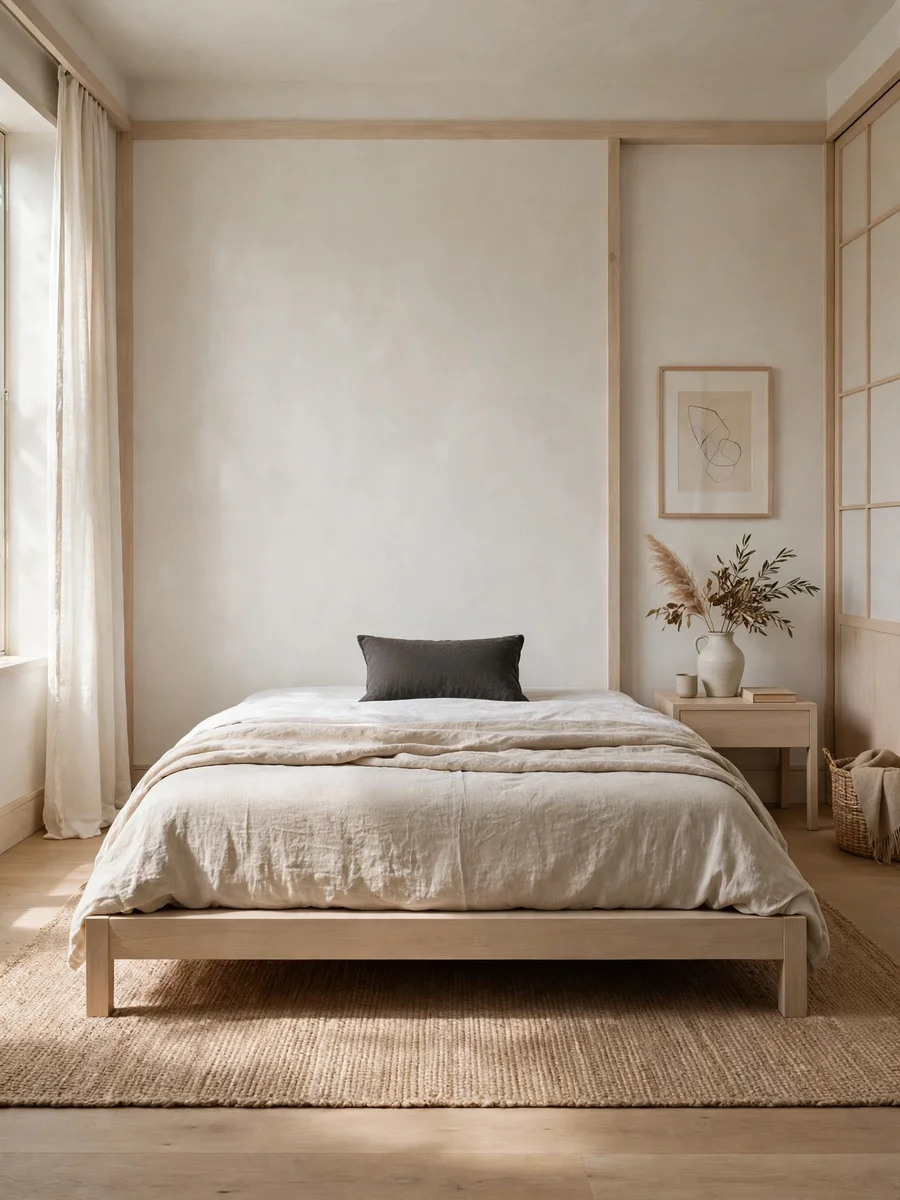
A low platform bed twelve to sixteen inches off the ground is the signature piece of a Japandi bedroom, grounding the room in the same calm, grounded stance as a traditional Japanese futon.
A concrete example is a pale oak platform bed fourteen inches high, dressed with a white linen fitted sheet, a sand linen duvet, and a single charcoal cushion, sitting on a flat-weave jute rug with bare floor visible around it.
Quick tip: Measure the finished height with the mattress on, and aim for twelve to sixteen inches.
5. What Makes a Slatted Headboard So Japandi?
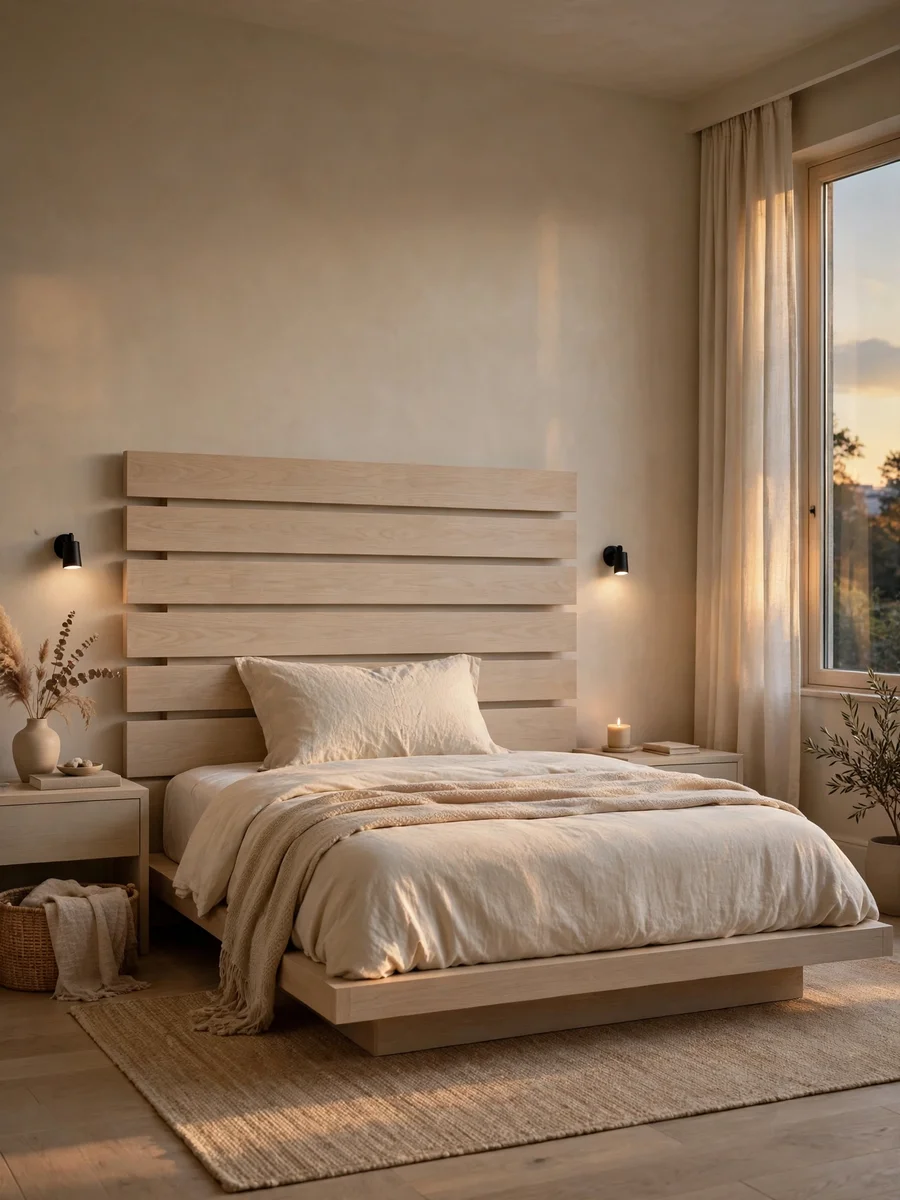
A minimal slatted headboard suits a Japandi bedroom because it adds texture and structure without visual weight, letting the wood grain itself do the decorating instead of carving or ornament.
A concrete example is a low pale oak bed with a headboard of five wide horizontal slats, a single cream linen pillow against it, and a small black wall sconce on each side, with no artwork above the bed at all.
Quick tip: Keep the headboard no taller than thirty inches above the mattress.
6. How Do You Choose Natural Wood Furniture?
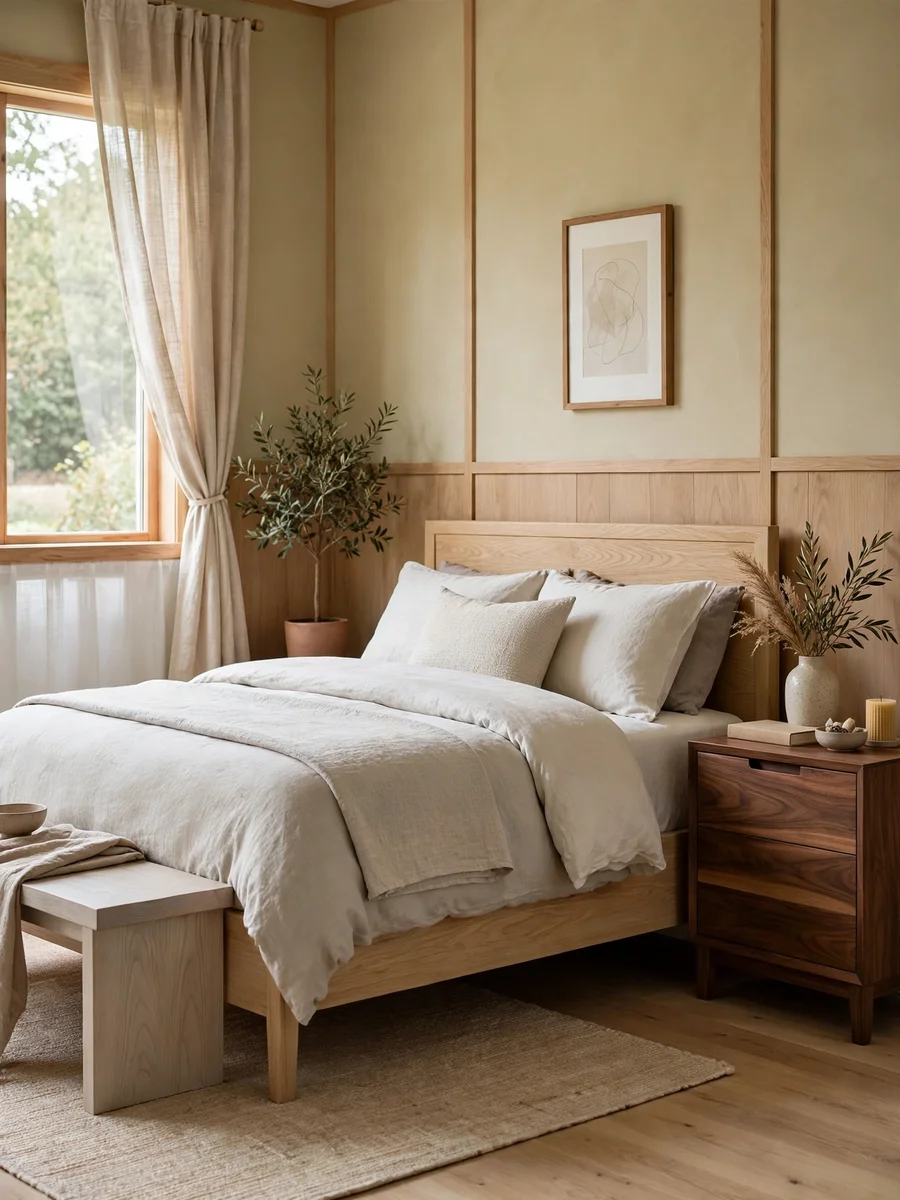
Natural wood furniture with visible grain is the heart of Japandi materiality, because honest materials are the decoration, and oak, walnut, or ash age gracefully instead of looking tired.
A concrete example is a bedroom furnished with a pale oak bed, a walnut nightstand with a single recessed handle, and a low ash bench at the foot of the bed, each piece showing its own grain pattern.
Quick tip: Run your hand over the wood before buying; smooth, matte grain is the Japandi feel.
7. Why Is Washed Linen Bedding the Japandi Standard?
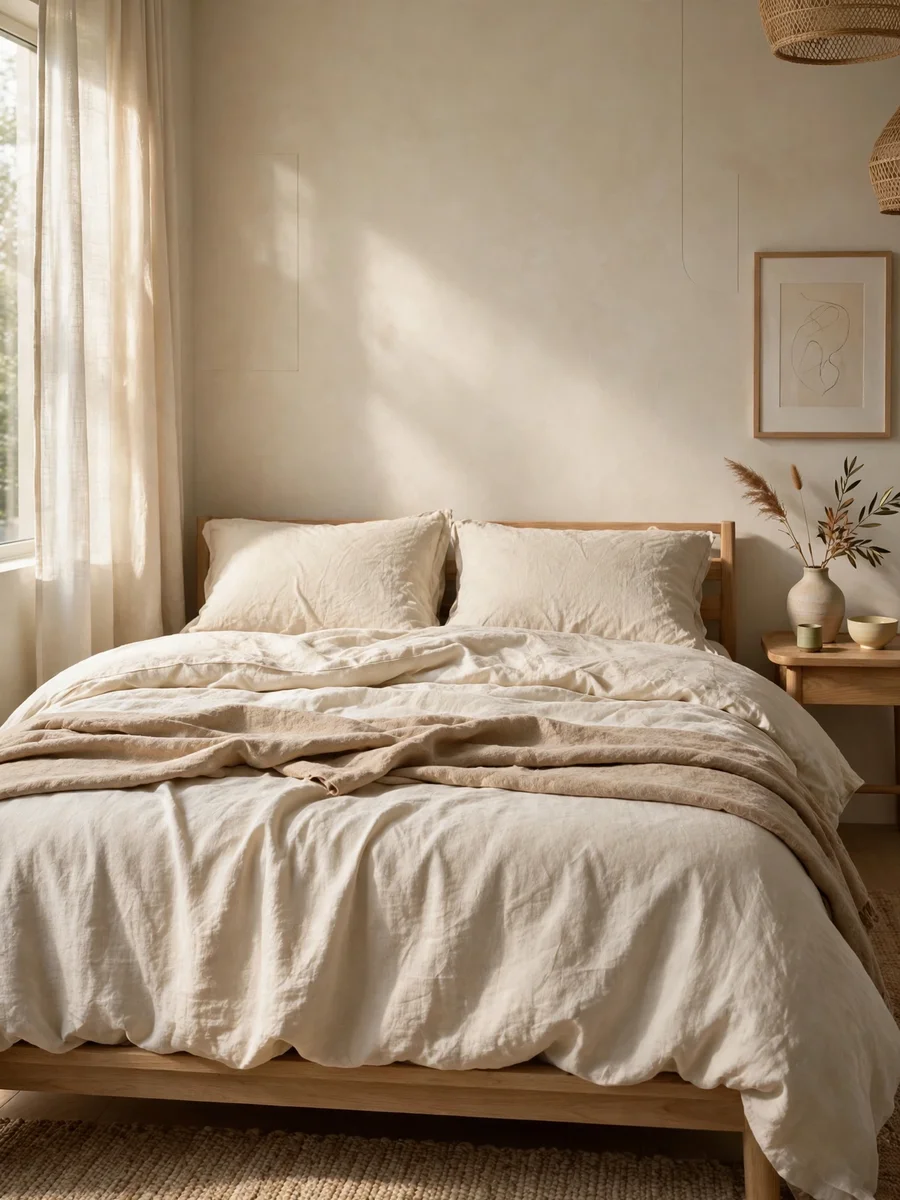
Washed linen bedding is the Japandi standard because it is soft, breathable, and beautifully imperfect, getting softer with every wash while its gentle wrinkles suit the wabi-sabi spirit.
A concrete example is a bed dressed with a cream stonewashed linen duvet, two oatmeal linen pillowcases, and a sand linen throw folded across the lower third, with the duvet pulled back in a loose fold to show the texture.
Quick tip: Buy one linen set first and live with it for a month before adding more.
8. How Does Wool Add Weight and Warmth?
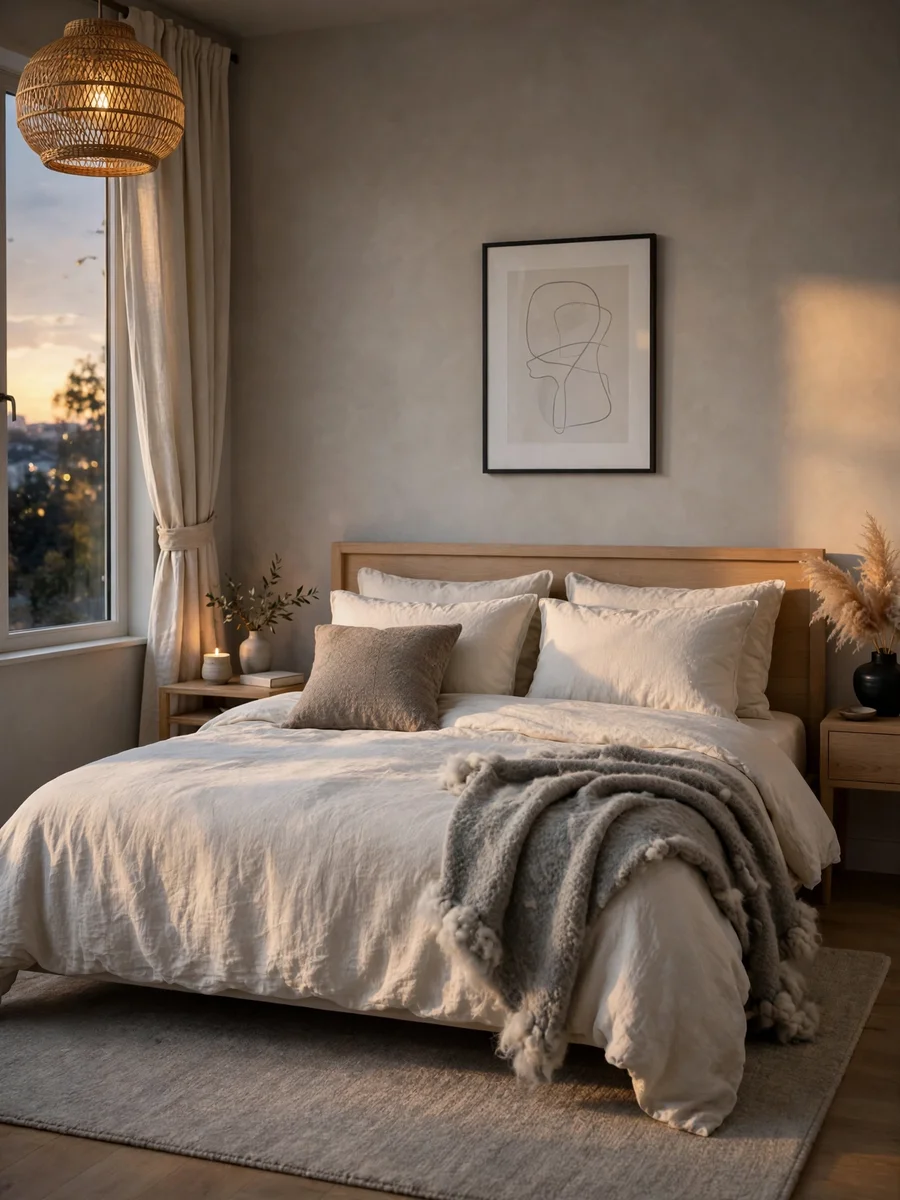
Wool adds weight, warmth, and quiet luxury to a Japandi bedroom, balancing the lightness of linen and pale wood with a dense throw or rug that feels substantial underfoot.
A concrete example is a cream linen bed with a soft grey lambswool throw draped over one corner, a taupe wool cushion beside the sleeping pillows, and a low-pile wool rug under the bed that feels warm under bare feet.
Quick tip: One large wool throw beats three small ones for both warmth and calm.
9. Where Do Woven Textures Belong in a Japandi Bedroom?
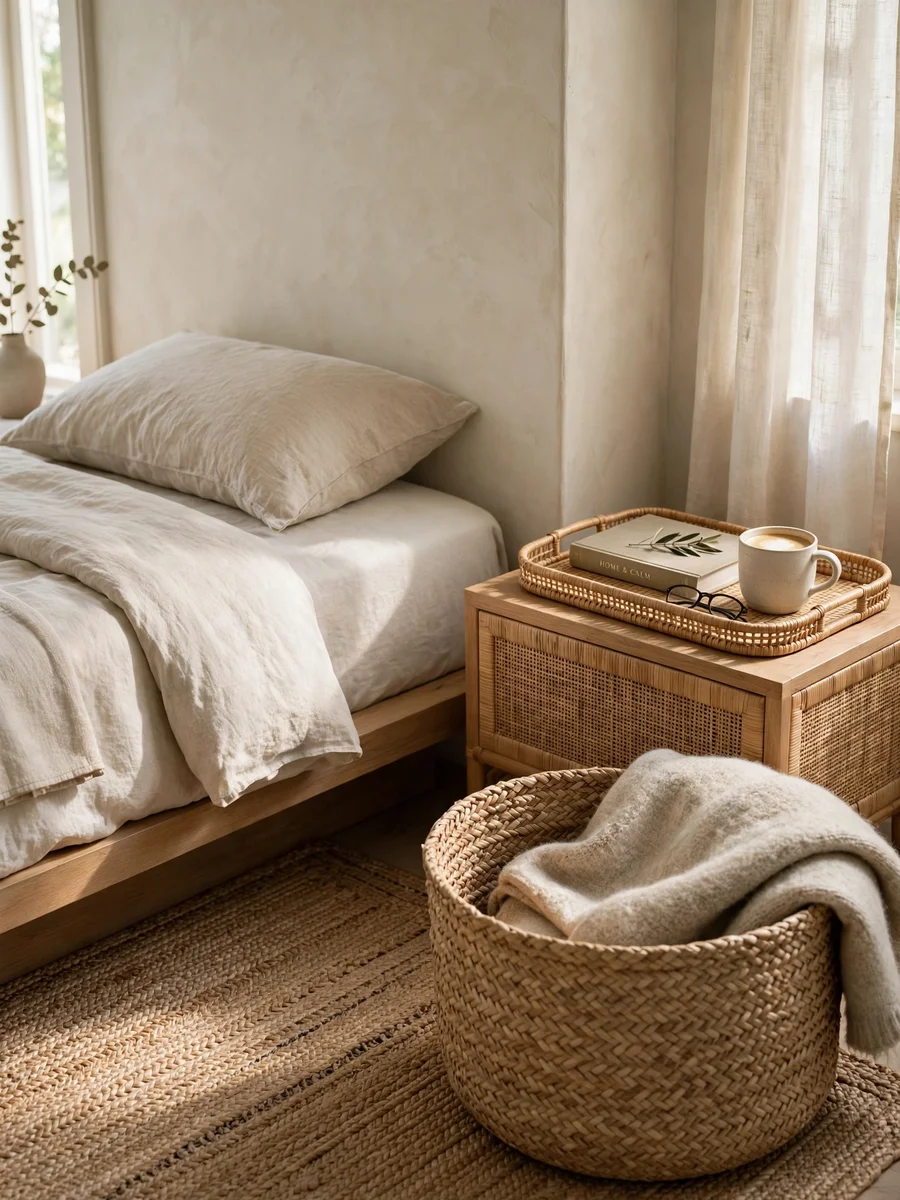
Woven textures such as rattan, jute, seagrass, and bamboo belong in a Japandi bedroom wherever a hard surface needs softening.
A concrete example is a bedroom with a large seagrass basket holding a folded wool throw, a rattan tray on the nightstand holding a ceramic cup and a book, and a jute rug under the bed, each woven piece in a different scale.
Quick tip: Choose woven pieces in their natural colour and let the material be the pattern.
10. How Do You Pick a Natural Fibre Rug?
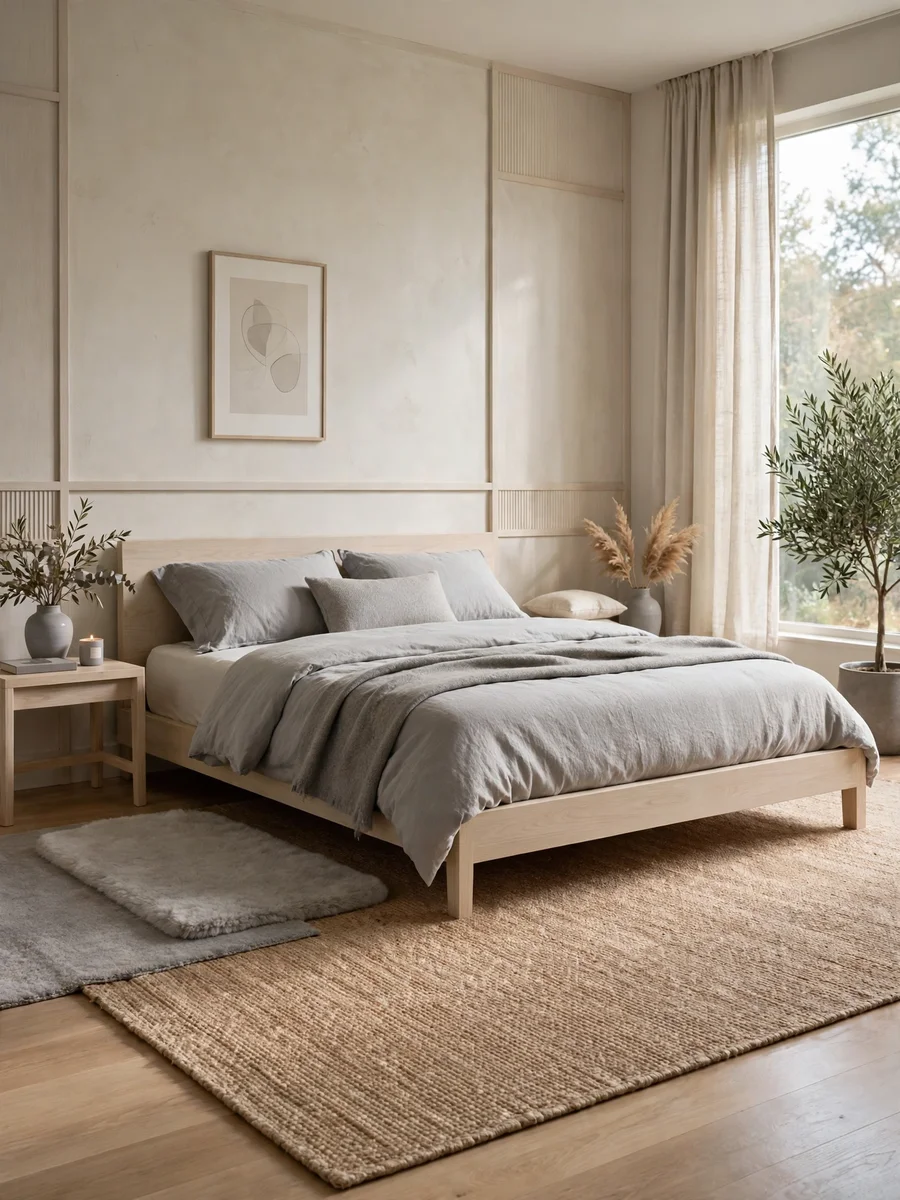
A natural fibre rug in jute, sisal, seagrass, or wool grounds a Japandi bedroom and softens the floor under a low bed.
A concrete example is a large jute rug in warm sand tones placed under the lower two-thirds of a pale oak platform bed, with a smaller soft grey wool rug layered on top at the bedside for bare feet.
Quick tip: Size the rug to the bed, not the room, and leave bare floor showing at the edges.
11. How Do You Get Soft Diffused Lighting at 2700K to 3000K?
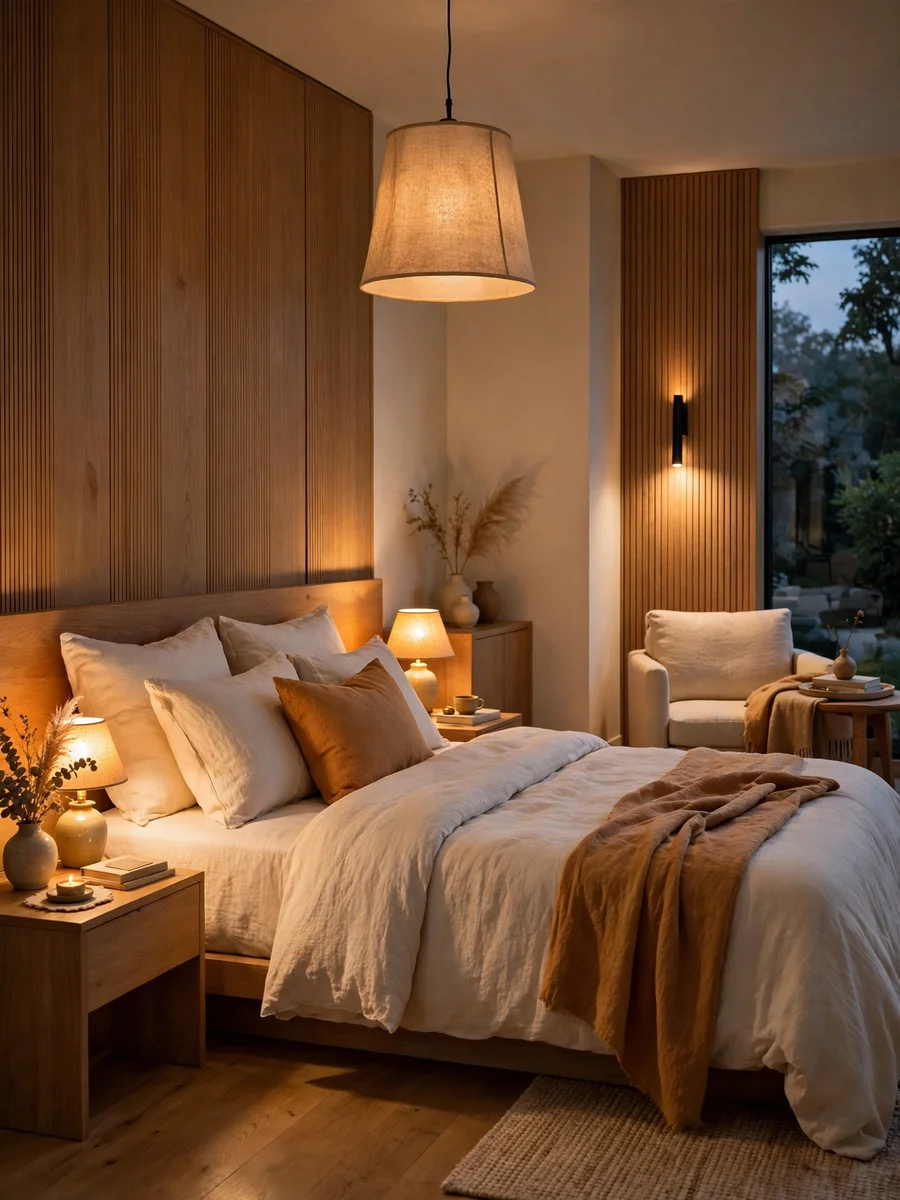
Soft diffused lighting at 2700K to 3000K with a dimmer is the Japandi lighting rule, because warm, low light is what makes a minimal room feel restful at night.
A concrete example is a bedroom lit by a linen-shaded pendant on a dimmer, two small bedside lamps with warm 2700K bulbs, and a narrow black sconce above the reading chair, all switched low in the evening so the wood and linen glow.
Quick tip: Put the main light on a dimmer before buying any new lamp.
12. Why Does a Paper Lantern Light Suit a Japandi Bedroom?
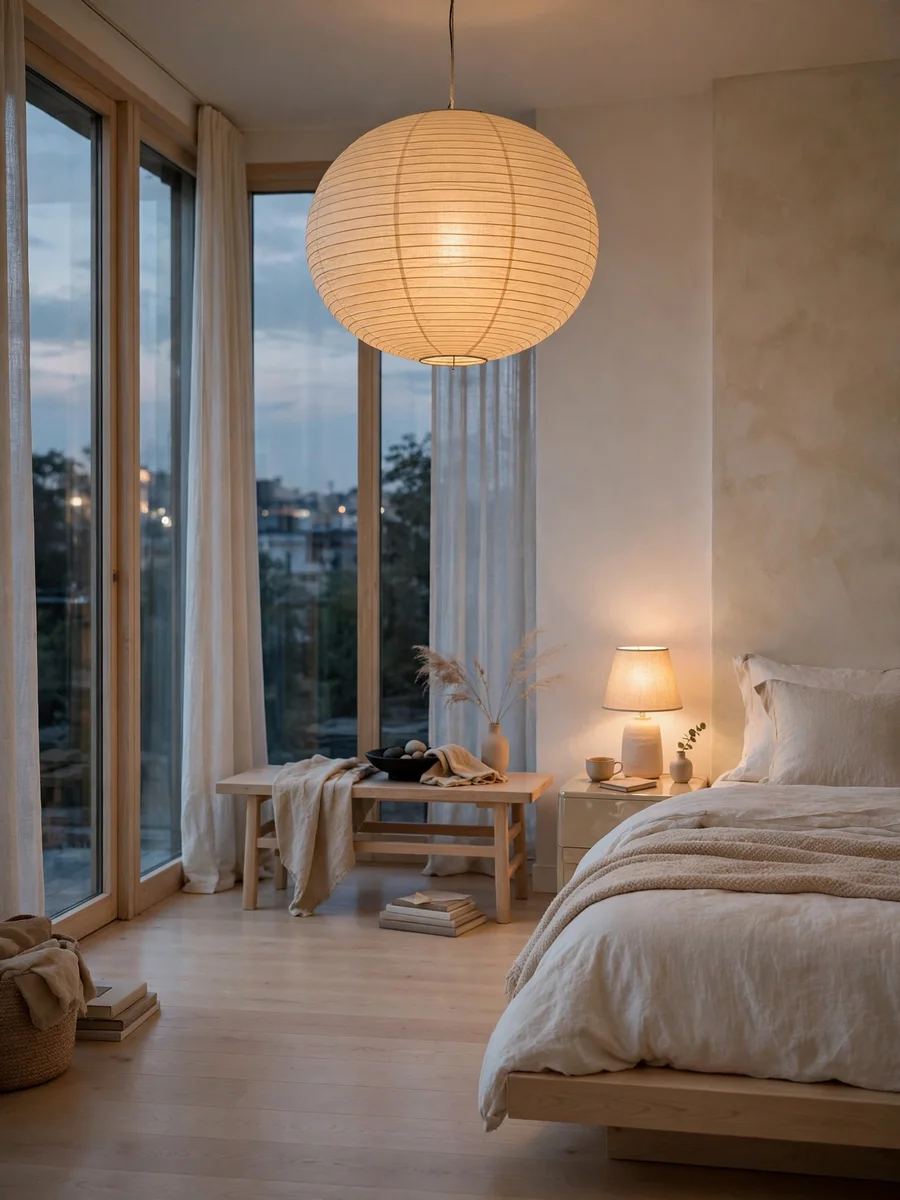
A rice paper lantern light suits a Japandi bedroom because it turns a single bulb into a soft, glowing orb with no hard edges.
A concrete example is a large round paper lantern hung at eye level above a low wooden bench, glowing warmly at dusk, paired with a small linen-shaded bedside lamp and no overhead spotlights at all.
Quick tip: Hang the lantern so its lowest point is above head height when standing.
13. How Do You Use Black Accents Without Losing the Calm?
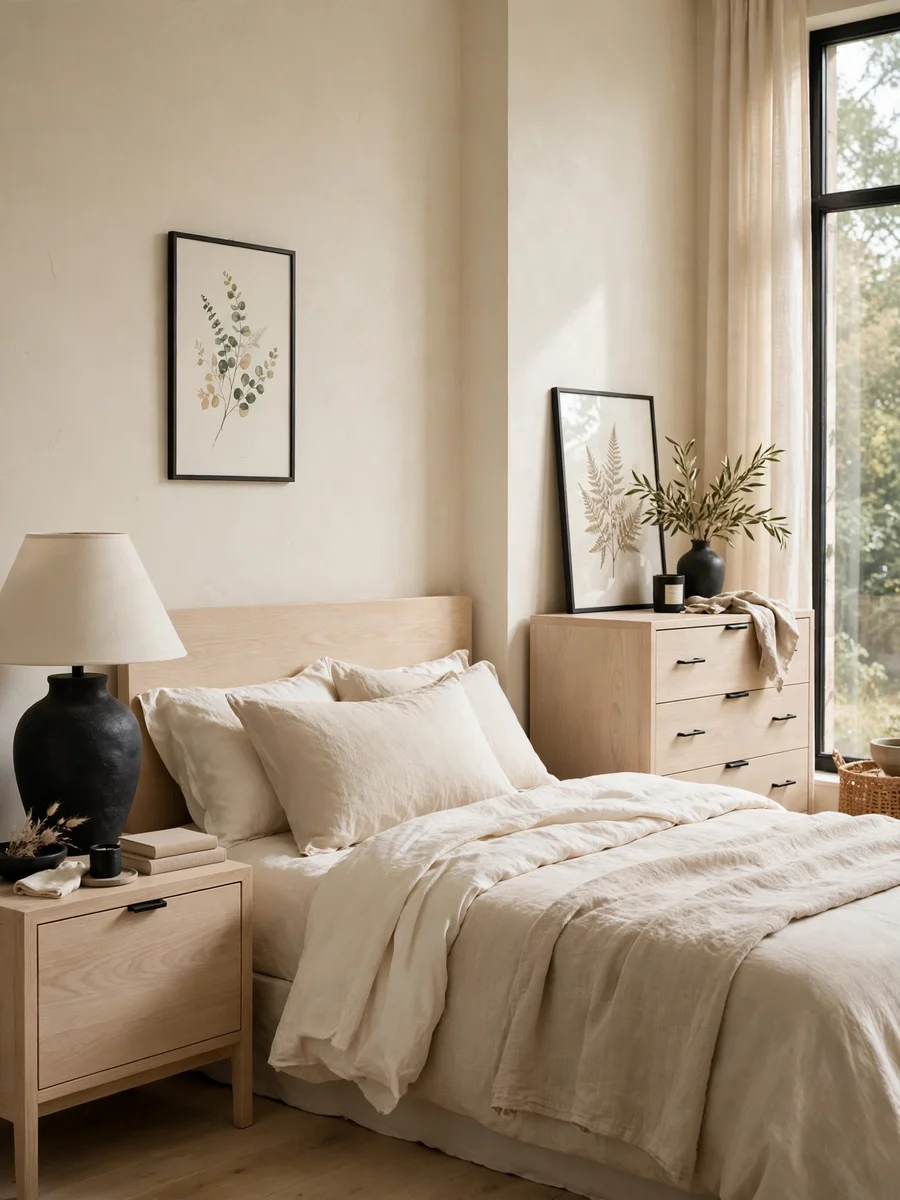
Black accents work in a Japandi bedroom when they are small, few, and functional, such as a lamp base, a simple frame, a narrow sconce, or a drawer handle.
A concrete example is a bedroom with a matte black ceramic lamp base on the nightstand, a thin black frame holding a single botanical print, and black metal handles on a pale oak dresser, all spaced apart so no corner feels dark.
Quick tip: Count your black pieces on one hand and keep them matte.
14. Why Is Negative Space the Most Japandi Design Choice?
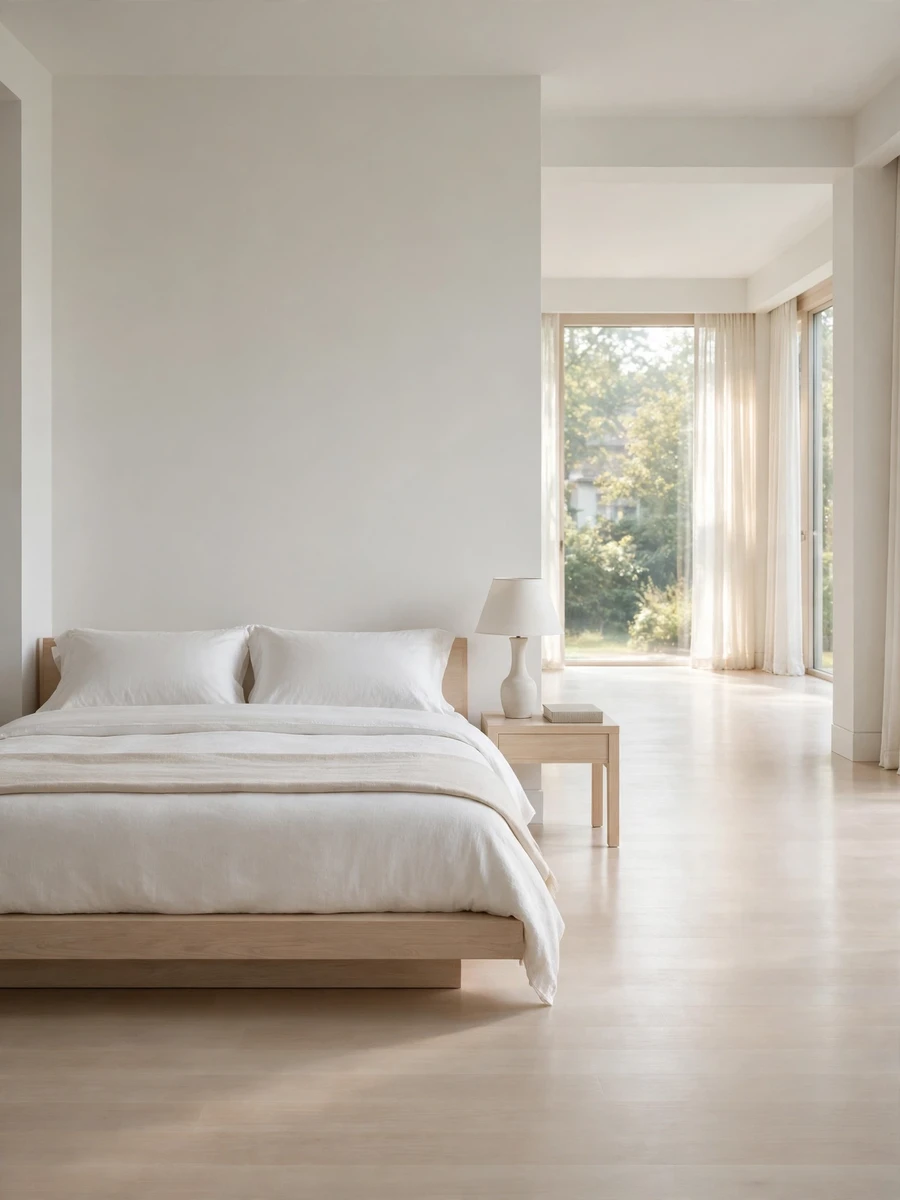
Negative space is the most Japandi design choice because empty wall, clear floor, and an unfilled surface are treated as design, not as something missing.
A concrete example is a bedroom where the wall above the low bed holds nothing at all, the nightstand carries only a lamp and a book, and a wide stretch of bare floor runs from the bed to the window, so the room feels larger than its measurements.
Quick tip: Leave one wall completely empty for a week before deciding it needs anything.
15. How Do Japanese and Scandinavian Elements Combine?
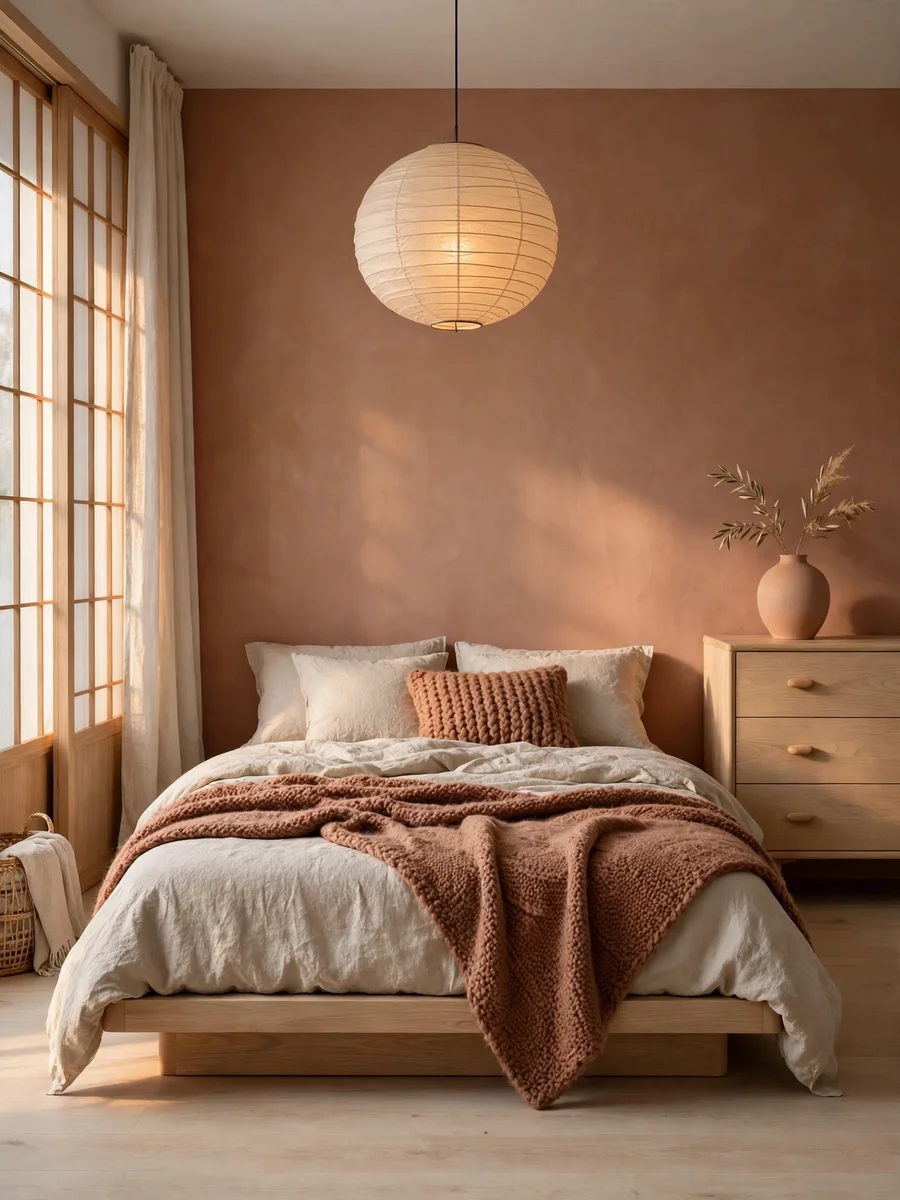
Japanese and Scandinavian elements combine by sharing what they agree on and letting each side lead where it is strongest.
A concrete example is a bedroom with a low Japanese-style platform bed and paper lantern, dressed with Scandinavian wool throws and linen bedding, furnished with a pale oak dresser and a single ceramic vase, where every piece is both beautiful and useful. For the same balance in a shared space, these Scandinavian living room ideas show how pale wood and soft textiles warm up a minimal room without adding clutter. The table below shows how each tradition contributes, so you can check your own room for balance and spot which side is missing.
| Design area | Japanese element | Scandinavian element | How they combine |
|---|---|---|---|
| Palette | Warm off-white, ink black, clay | Sand, pale grey, soft white | A warm neutral base with one dark anchor |
| Furniture | Low platform bed, minimal lines | Pale wood, practical storage | Low, simple wood pieces that store well |
| Textiles | Linen, paper, natural fibres | Wool, cotton, cosy layers | Linen bedding with a wool throw |
| Light | Paper lantern, diffused glow | Candles, warm lamps, dimmers | Warm 2700K to 3000K light on a dimmer |
| Decor | One ceramic vase, wabi-sabi imperfection | One artwork, functional objects | Few intentional pieces, each with a use |
Quick tip: If the room feels cold, add Scandinavian wool; if it feels cluttered, add Japanese restraint.
16. How Does Hidden Storage Keep the Room Clutter-Free?
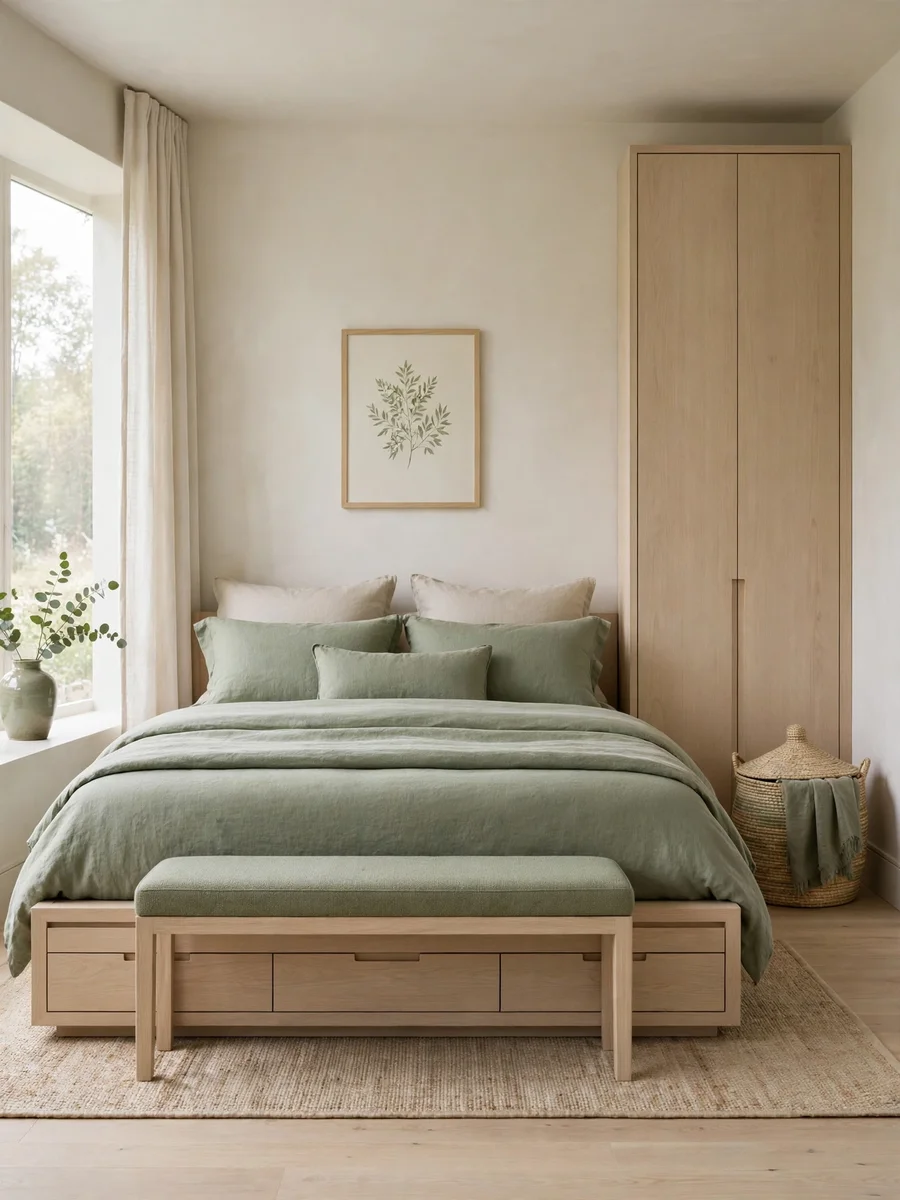
Hidden storage keeps a Japandi bedroom clutter-free because everything has a closed home and nothing lives on display by default.
A concrete example is a low platform bed with two wide under-bed drawers holding spare linen, a pale oak storage bench at the foot of the bed holding out-of-season clothes, and a seagrass basket with a lid beside the wardrobe for chargers and small items.
Quick tip: Give every loose item a closed home before buying any new decor.
17. What Minimal Furniture Does a Japandi Bedroom Really Need?
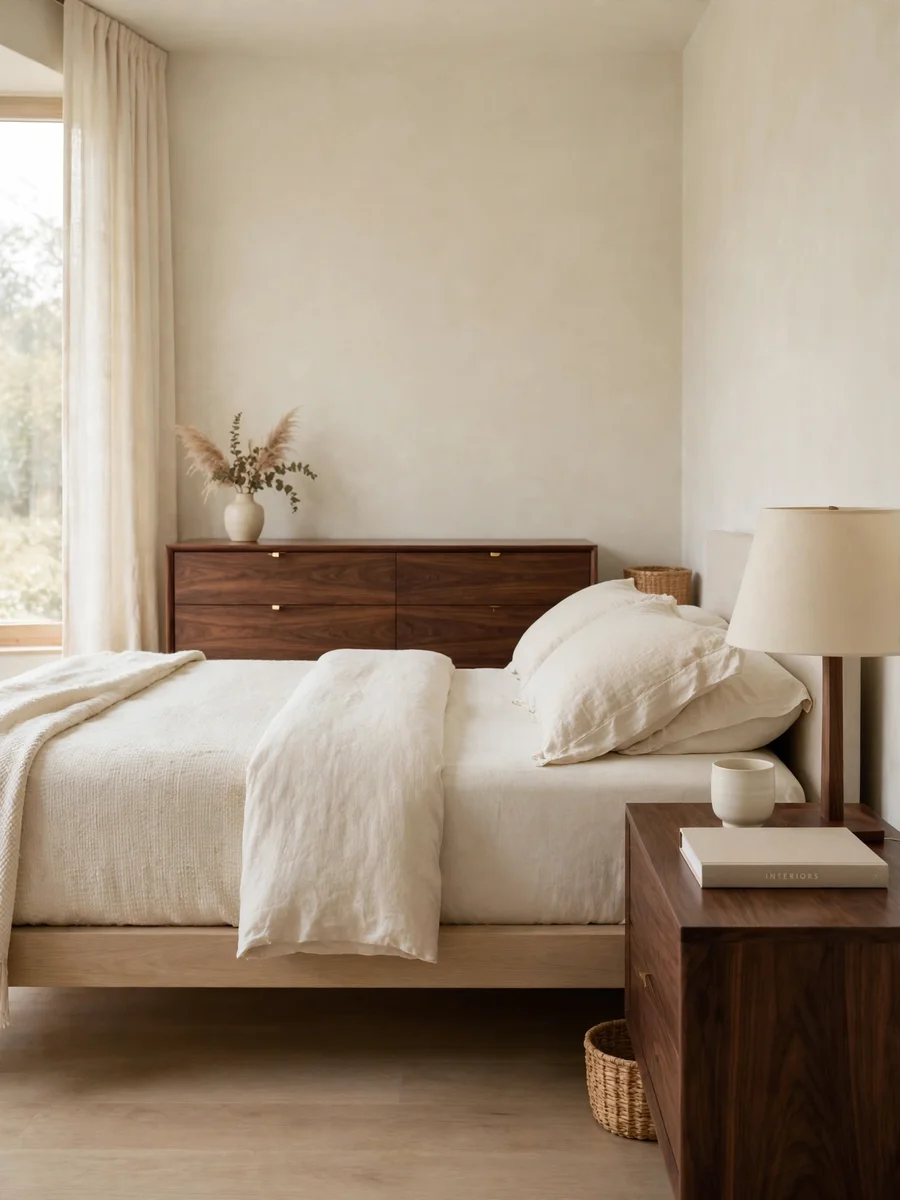
A Japandi bedroom really needs only a bed, one nightstand, and one storage piece, with an optional low bench or small reading chair if space allows.
A concrete example is a small bedroom with a low pale oak bed, a single walnut nightstand holding a lamp, a book, and a ceramic cup, and a low dresser against the opposite wall, with no second nightstand and no extra chair.
Quick tip: Start with three pieces and add only what you reach for daily.
18. Why Keep Accessories to One Vase, One Stack of Books, One Artwork?
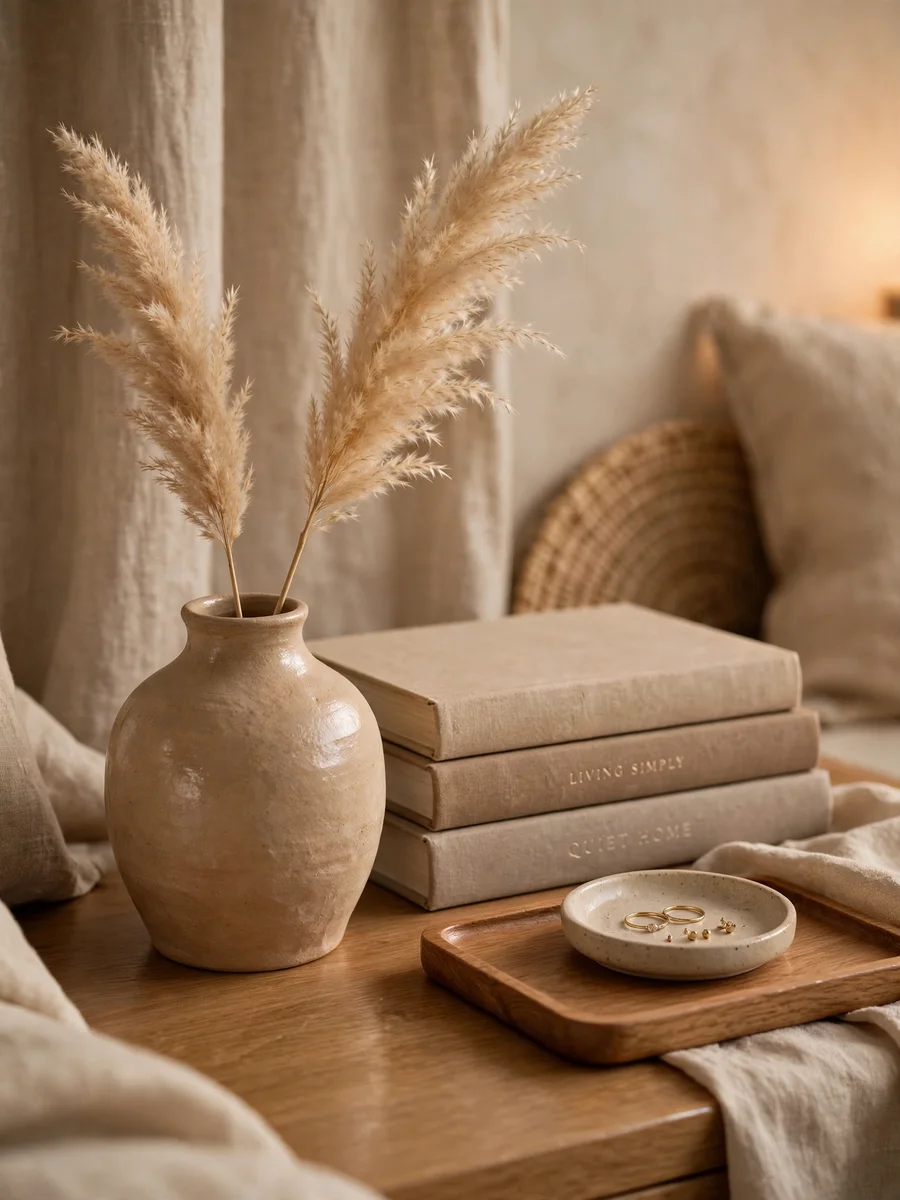
Keeping accessories minimal and intentional is the Japandi rule that protects the calm, because one ceramic vase, one stack of books, and one artwork each get attention instead of competing.
A concrete example is a nightstand holding a single handmade clay vase with two dried pampas stems, a stack of three books with the current one on top, and nothing else, while the dresser holds one small wooden tray and a ceramic dish for jewellery.
Quick tip: Remove every accessory, then return only the three you missed most.
19. How Do You Choose the One Artwork for the Room?
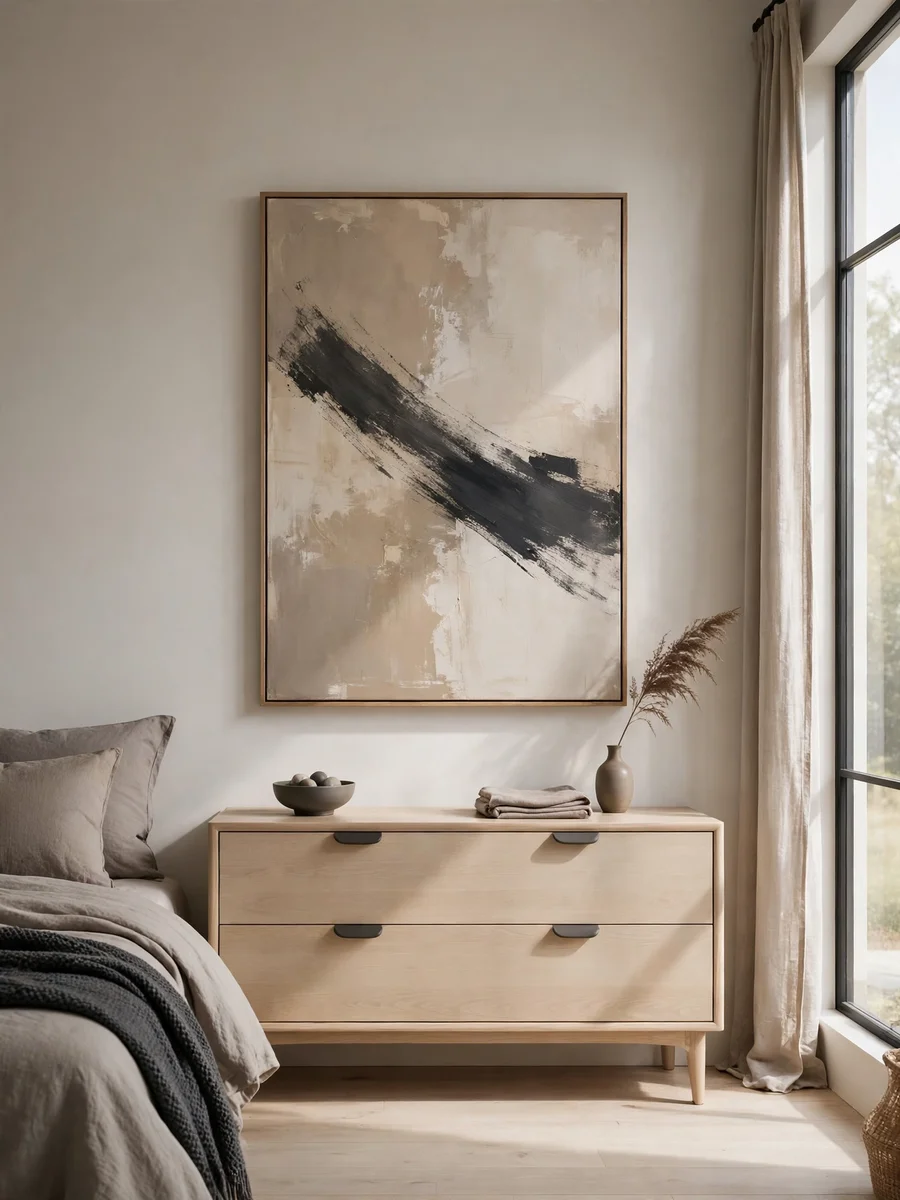
Choosing one artwork for a Japandi bedroom means picking a single large, quiet piece instead of a gallery wall, so a soft abstract print or ink landscape can hold the room on its own.
A concrete example is a bedroom with one large abstract canvas in warm beige, taupe, and a single charcoal brushstroke hung above a low pale oak dresser, with the rest of the walls bare.
Quick tip: Hang the artwork so its centre sits at eye level when you stand beside the bed.
20. How Do You Lay Out a Small Japandi Bedroom?
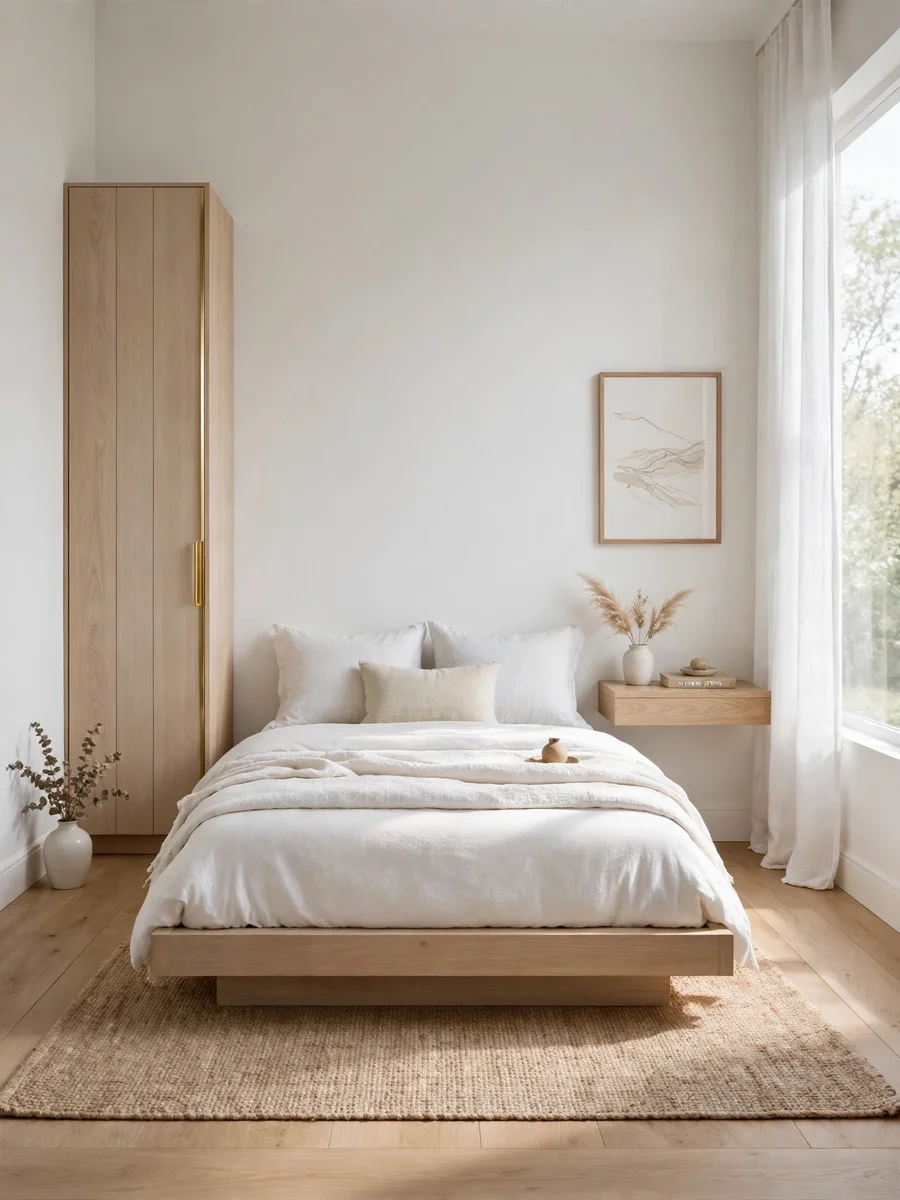
Laying out a small Japandi bedroom starts with the low bed against the longest wall, a single nightstand, and clear floor on at least one side, so the room feels open even when it is not large.
A concrete example is a ten-by-twelve-foot bedroom with a low platform bed centred on the long wall, a floating oak shelf as a nightstand, a tall narrow wardrobe on the short wall, and a jute rug that stops short of the walls to show bare floor.
Quick tip: Draw the layout on paper and leave the centre of the room empty on purpose.
21. How Can Renters Get the Japandi Look Without Renovating?
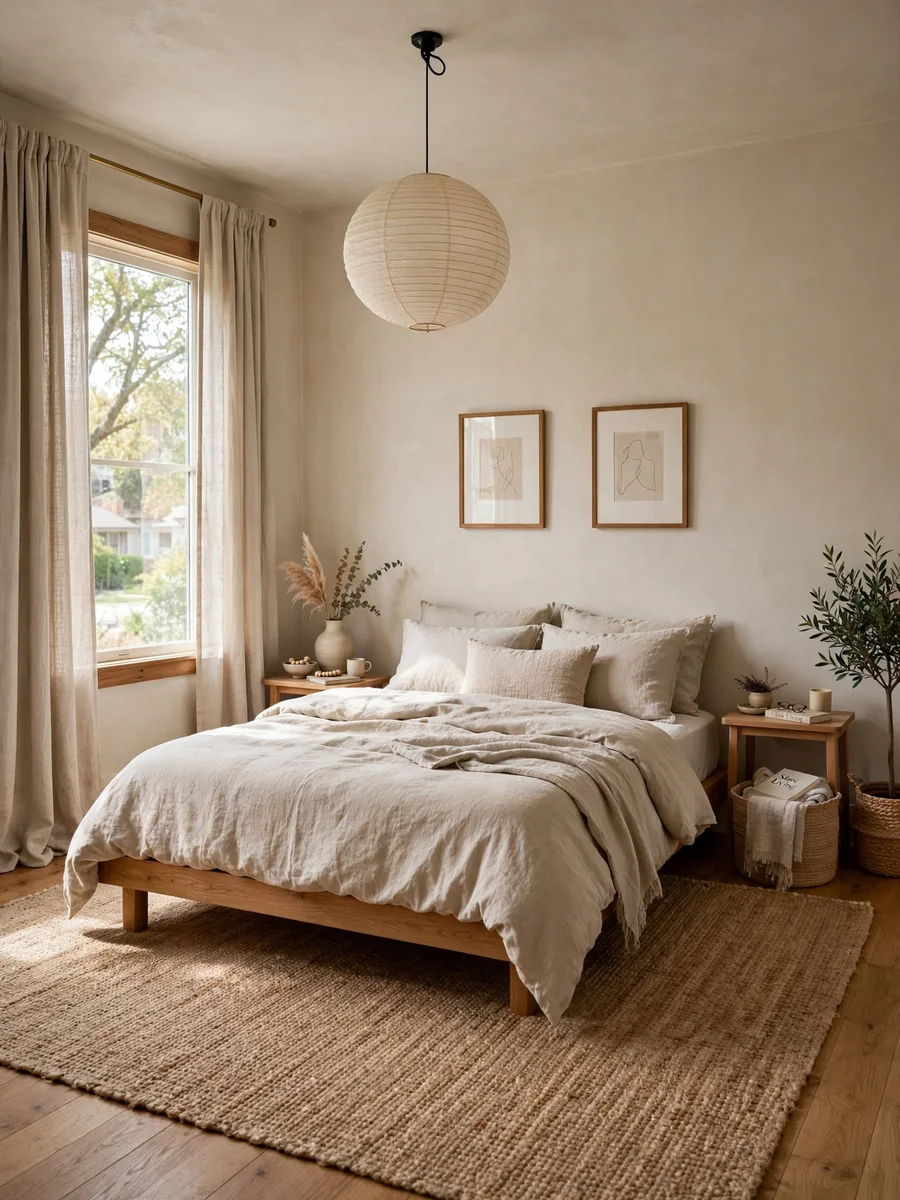
Renters can get the Japandi look without renovating by swapping only what is removable: linen curtains, a natural fibre rug, a paper lantern, linen bedding, and a low wooden bed frame.
A concrete example is a rental bedroom with the landlord’s white walls softened by oatmeal linen curtains, a large jute rug over the existing floor, a paper lantern hung from the existing ceiling hook, and sand linen bedding on a freestanding low oak frame.
Quick tip: Start with bedding and a rug, because those two swaps change the room most.
22. What Window Treatment Keeps the Light Soft?
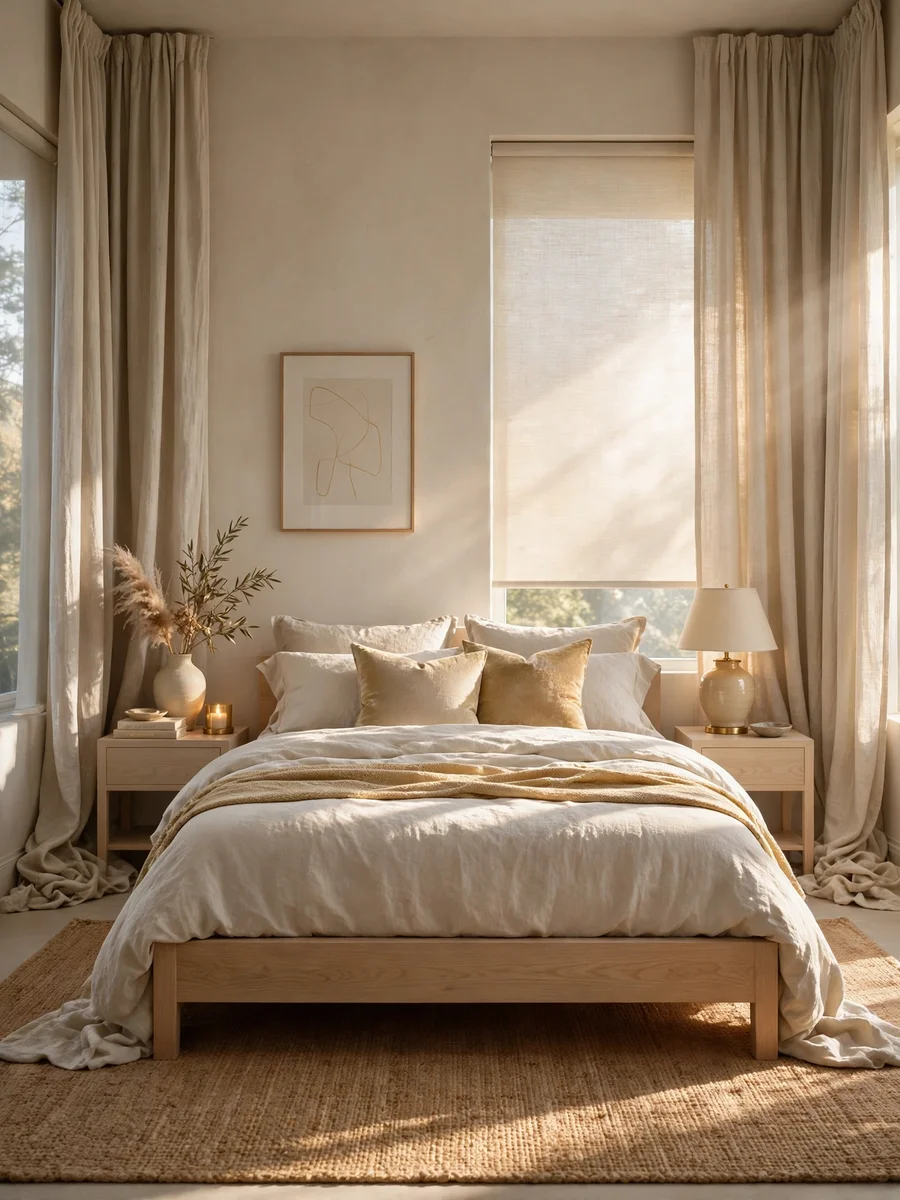
A window treatment that keeps the light soft in a Japandi bedroom is sheer or light linen curtains in off-white, oatmeal, or sand, hung from a simple wooden or matte black rod.
A concrete example is a bedroom with floor-length oatmeal linen curtains hung just above the window frame, pooling slightly on the floor, filtering morning light across a pale oak bed and a jute rug.
Quick tip: Hang linen curtains high and wide so the window looks larger and the light spreads evenly.
23. Which Single Plant Suits a Japandi Bedroom?
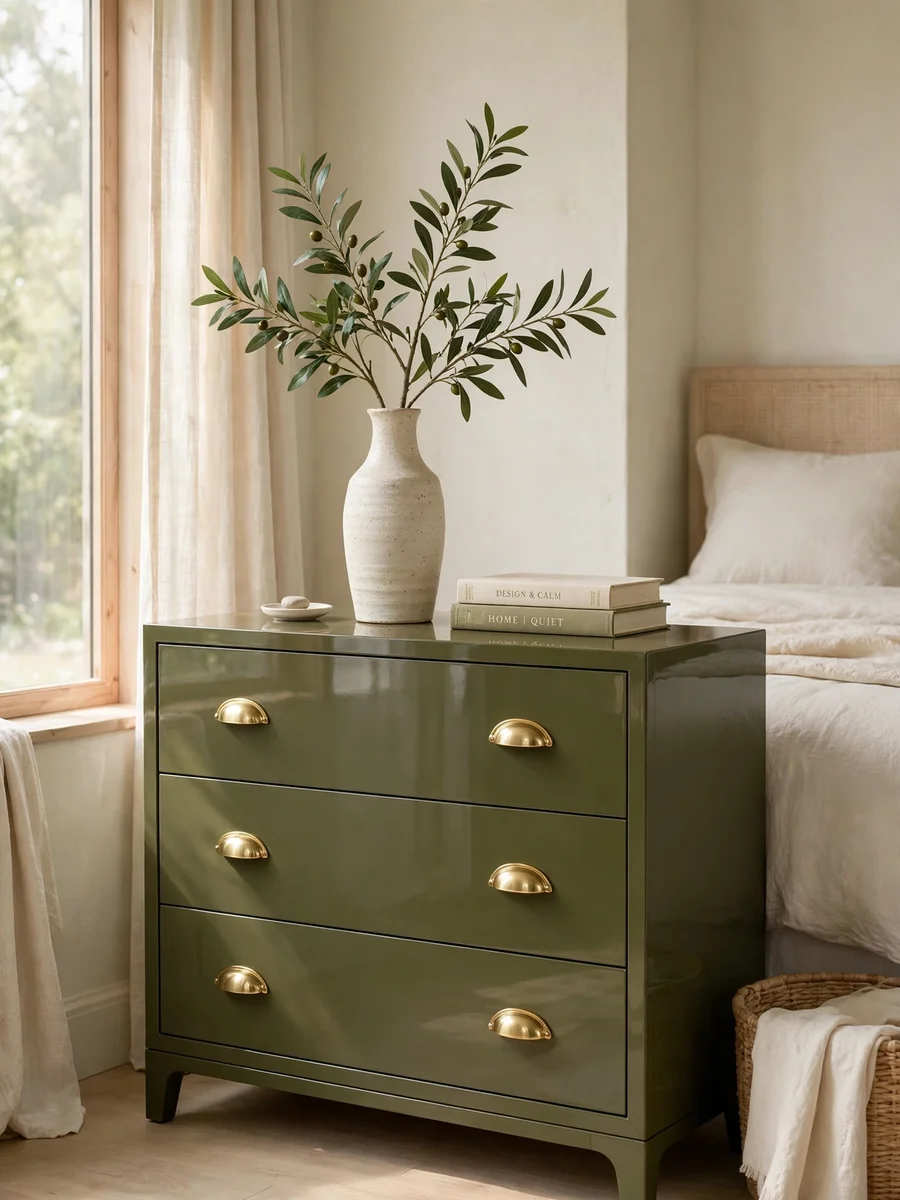
A single plant suits a Japandi bedroom better than a collection, because one living stem adds nature without adding clutter.
A concrete example is a bedroom with one olive branch in a tall handmade ceramic vase on the dresser, its green leaves the only strong green in the room, beside a stack of two books and nothing else.
Quick tip: One plant, one pot, one place; do not add a second until the first thrives.
24. How Do Layered Warm Wood Tones Add Depth?
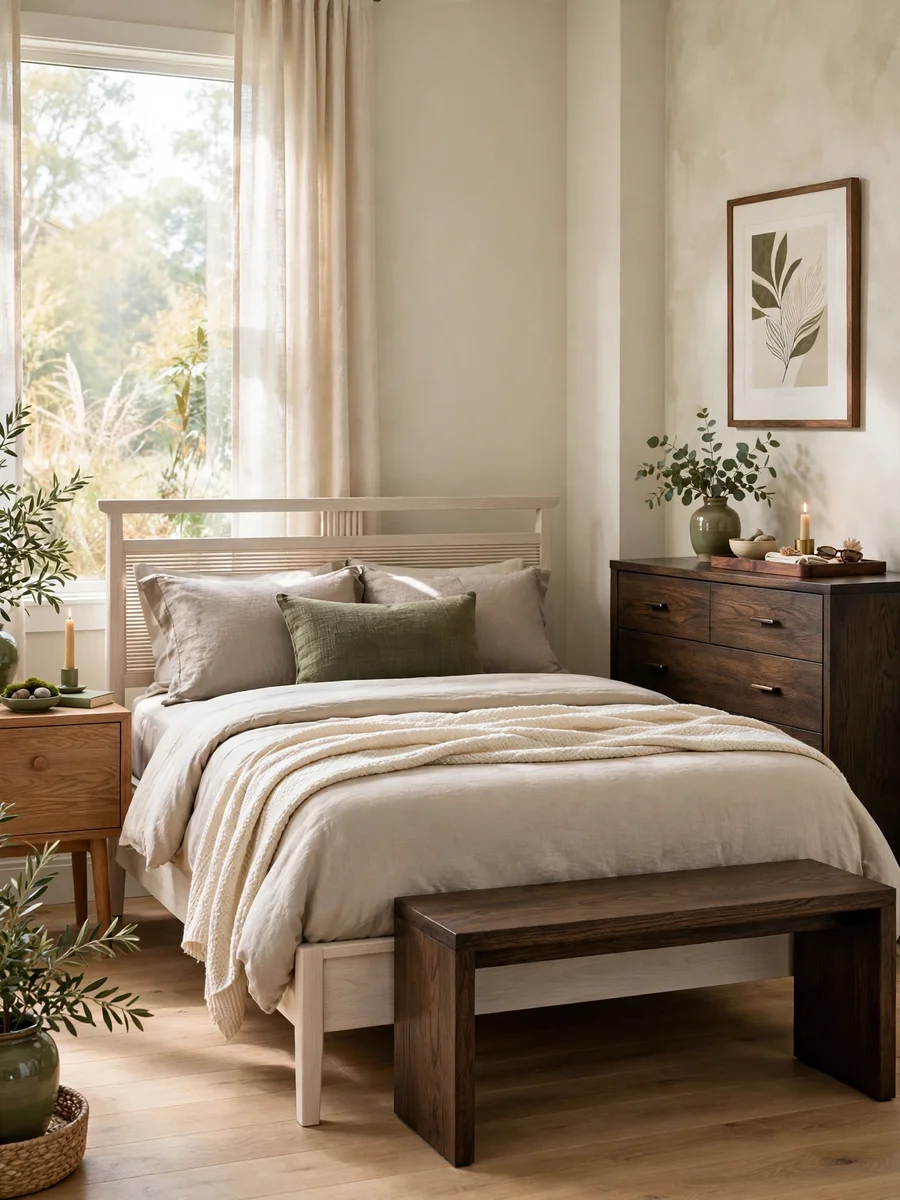
Layered warm wood tones add depth to a Japandi bedroom when pale ash, mid-tone oak, and smoked oak sit together in a deliberate gradient.
A concrete example is a bedroom with a pale ash bed frame, a mid-tone oak nightstand, a smoked oak bench at the foot of the bed, and a walnut tray on the dresser, where the tones step gradually from light to dark.
Quick tip: Lay wood samples side by side in daylight and keep only tones that blend in a gradient.
25. How Do You Style a Low Dresser or Open Shelf?
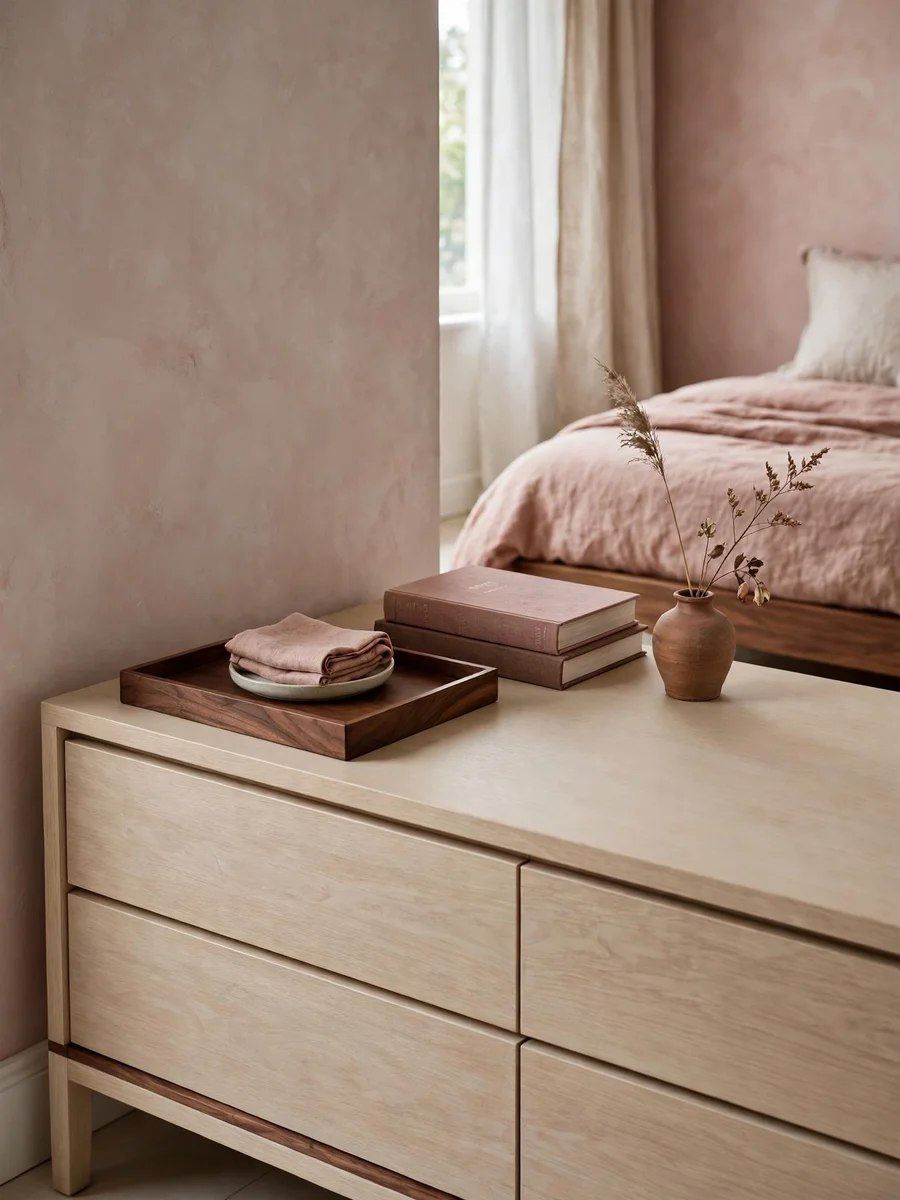
Styling a low dresser or open shelf in a Japandi bedroom means leaving most of the surface empty and grouping the few objects you keep into one small arrangement.
A concrete example is a low pale oak dresser with a walnut tray holding a ceramic dish and a folded linen cloth on the left, a stack of two books in the centre, and a small clay vase with a single dried stem on the right, leaving half the surface bare.
Quick tip: Keep half of every dresser and shelf surface empty at all times.
26. How Do You Finish a Japandi Bedroom with a Wabi-Sabi Edit?
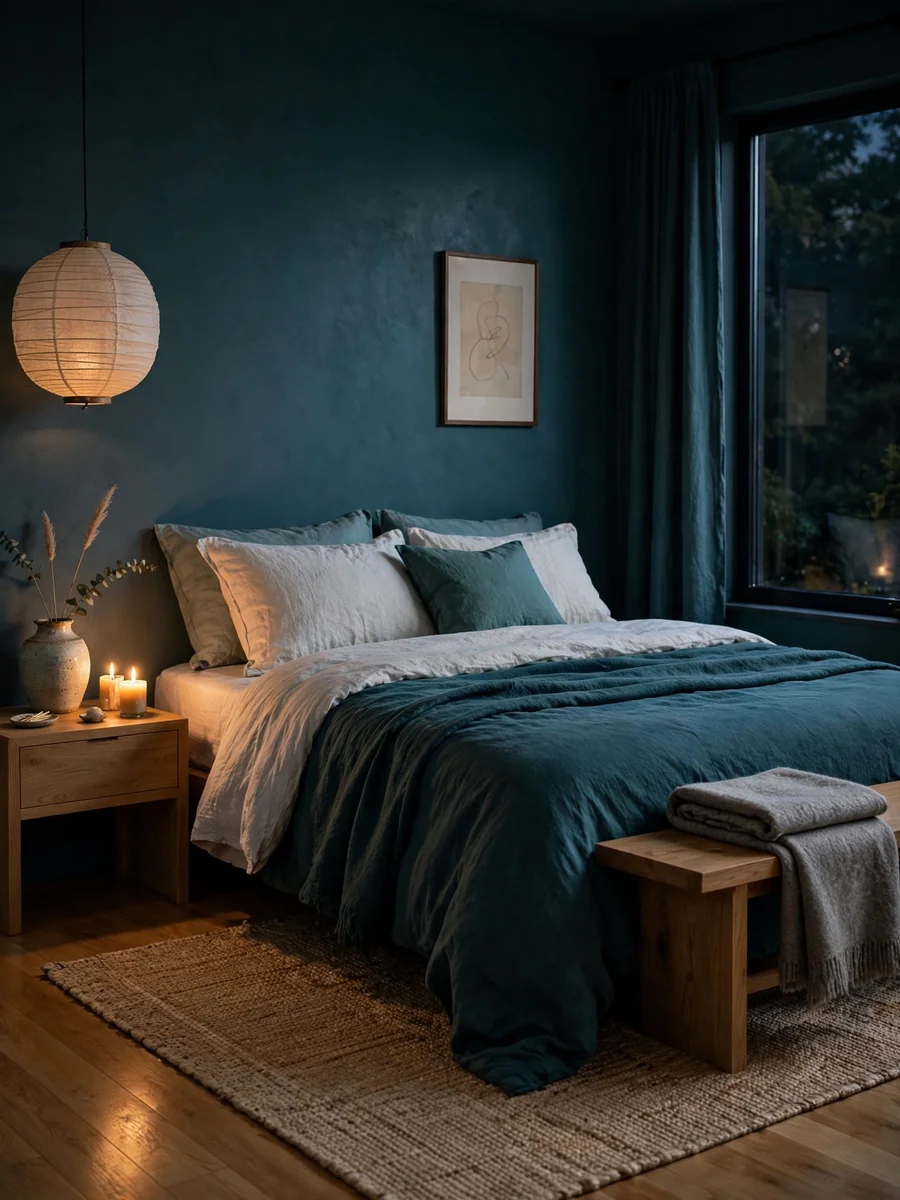
Finishing a Japandi bedroom with a wabi-sabi edit means stepping back, removing one more thing, and keeping the imperfect piece that has character. Wabi-sabi finds beauty in a chipped ceramic bowl, a hand-stitched linen throw, a worn wooden bench, and a rug that has softened with use, so the room feels lived in rather than staged. The final edit is not about adding a finishing touch; it is about trusting that the room is already enough, and that thought is worth carrying into the last step, because the calm you feel when you walk in at night, with the lamp low, the linen soft, and the floor clear, is the real test of the style, and it matters more than any single purchase, any perfect photograph, or any trend list, since a bedroom that helps you sleep well and wake slowly is doing its job, and that quiet, everyday comfort is the whole point of Japandi design in the first place.
A concrete example is a finished bedroom where the owner removes a second cushion, keeps a handmade vase with a slightly uneven rim on the nightstand, folds a wool throw over the bench, dims the paper lantern to its lowest setting, and leaves the floor clear except for the jute rug. The room is not perfect, and that is exactly why it feels calm.
Quick tip: Remove one object from the room before you call it finished.
Frequently Asked Questions
What is the difference between Japandi and Scandinavian style?
Japandi and Scandinavian styles share pale wood, natural light, and minimalism, but Japandi adds Japanese restraint, low furniture, wabi-sabi imperfection, and darker anchors such as charcoal and smoked oak. Scandinavian style leans warmer and cosier, with more wool, more texture, and more practical comfort.
What colours should I avoid in a Japandi bedroom?
Avoid bright primary colours, neon tones, and high-gloss finishes in a Japandi bedroom, because they break the warm, muted palette. Avoid more than one strong accent colour at a time, and avoid cool stark white on large surfaces, which can feel cold.
Can I do Japandi in a small bedroom?
Yes, Japandi suits small bedrooms well. Choose a low platform bed, one nightstand, hidden storage, and a natural fibre rug, and keep the centre of the room clear.
What bed is best for a Japandi bedroom?
The best bed for a Japandi bedroom is a low solid-wood platform bed, twelve to sixteen inches off the ground, in pale oak, ash, or walnut, with a minimal or slatted headboard. Pair it with washed linen bedding in a warm neutral tone and a natural fibre rug underneath.
How do I keep a Japandi bedroom clutter-free?
Keep a Japandi bedroom clutter-free with hidden storage, a one-in-one-out rule, and a weekly five-minute reset. Give every item a closed home, keep surfaces mostly clear, and limit accessories to a few intentional pieces.
Conclusion
These 26 Japandi bedroom ideas follow a real makeover order, from a warm neutral palette and a low platform bed through linen, wool, woven texture, soft light, hidden storage, and a final wabi-sabi edit. Start with the palette and the bed, add one earthy accent and one dark anchor, and finish by removing one more thing than feels comfortable. The result is a calm, clutter-free retreat that helps you rest well every night.