The Golden Ratio and Front Yard Design: A Foolproof Layout Trick That Works Every Time
The golden ratio is 1:1.618, a loose proportion guide for balanced front-yard layouts — not a rigid law. Have you ever walked past a front yard that felt balanced, welcoming, and quietly beautiful without looking overly planned? The secret is often proportion. In front yard design, the Golden Ratio offers a practical way to organize lawns, planting beds, pathways, focal points, and lighting so the whole space feels connected.
The Golden Ratio is commonly represented by approximately 1:1.618. It is not a strict landscaping law, and it will not replace drainage, climate, safety, or plant-care decisions. Think of it as a visual guide that helps you avoid layouts that feel too crowded, too empty, or unintentionally awkward.
What Is the Golden Ratio in Front Yard Design?
The Golden Ratio describes a proportion in which the relationship between a larger part and a smaller part is similar to the relationship between the whole and the larger part. In everyday landscaping, you can simplify it to a practical relationship of about 1 to 1.6.
You do not need advanced math. If one planting bed is 3 feet deep, a related area might be around 5 feet. If a path is 4 feet wide, the adjacent lawn or open visual zone might be around 6.5 feet. These are starting points, not rules that must be followed perfectly.
Why Proportion Makes a Front Yard Feel Better
A front yard contains many competing elements: the house, driveway, porch, lawn, trees, shrubs, flowers, steps, and lighting. When every feature has the same visual weight, the space can feel busy. When one feature dominates without support, the yard can feel unbalanced.
Proportion creates hierarchy. It tells the eye where to look first, where to move next, and where to rest. A larger lawn can give a small house breathing room, while a generous planting bed can soften a wide driveway. The goal is not perfect symmetry; it is a comfortable relationship between parts.
Apply the Golden Ratio to Front Yard Elements
1. Balance the Walkway and Lawn
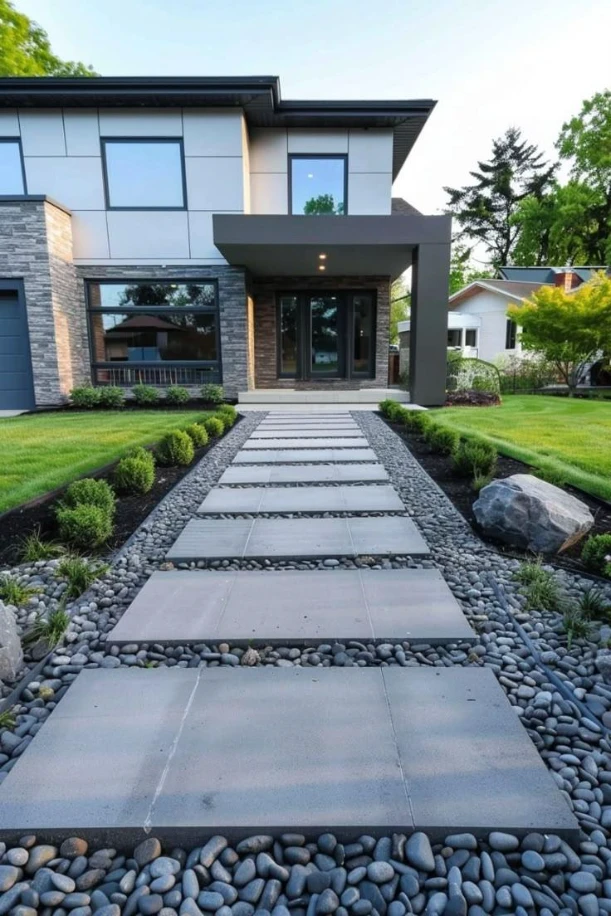
Start with the relationship between your front path and the lawn beside it. A walkway should guide visitors toward the entrance without visually taking over the yard. Use the Golden Ratio as a guide for the width of the path compared with the adjacent open space.
For example, a 4-foot walkway may feel more natural beside a 6- to 6.5-foot lawn or planting zone than beside a narrow strip of grass. If your property is small, prioritize accessibility first and use proportion in the surrounding beds, edging, and open space.
2. Divide Lawn and Hardscape with a 1/3 and 2/3 Balance
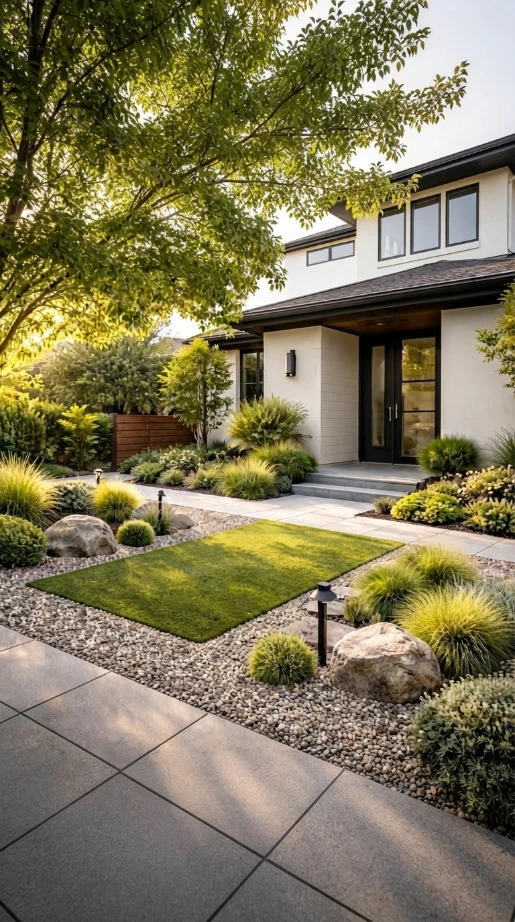
One useful adaptation is the one-third/two-thirds approach. Allow roughly one-third of the visible front yard to be hardscape—such as a walkway, gravel, pavers, or a small sitting area—and about two-thirds to remain lawn and planting.
This balance keeps the yard functional without making it feel like a parking area. On a very dry site, you can reverse the emphasis and use more gravel or permeable paving, then soften it with layered plants and shade trees.
3. Place the Main Focal Point Slightly Off Center
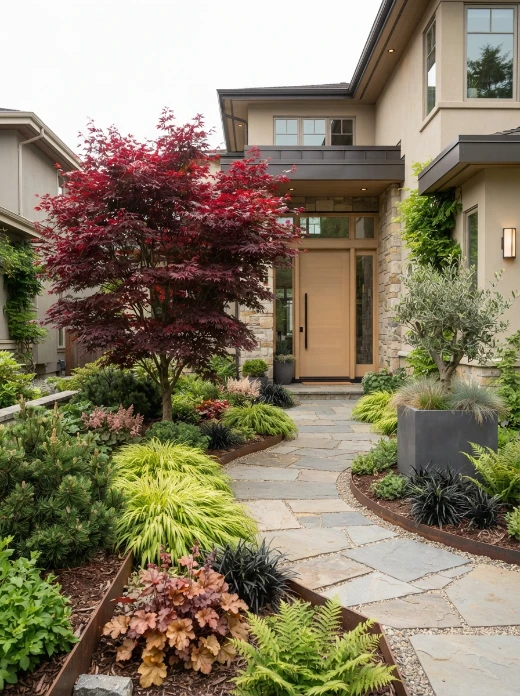
A front yard usually benefits from one clear focal point: a small ornamental tree, sculptural planter, fountain, distinctive shrub, or attractive front door. Instead of automatically placing it in the exact center, try positioning it slightly off center using a proportional grid.
The focal point should support the entrance rather than block it. Keep sightlines open, avoid plants that hide house numbers, and check mature plant size before digging. A beautiful tree in the wrong location can eventually overwhelm windows, paths, or utility lines. For example, a 5- to 6-foot ornamental tree set about two-thirds across the frontage, with a 3-foot shrub beside it, gives a clear focal point without blocking the door.
4. Layer Plant Heights in Golden Steps
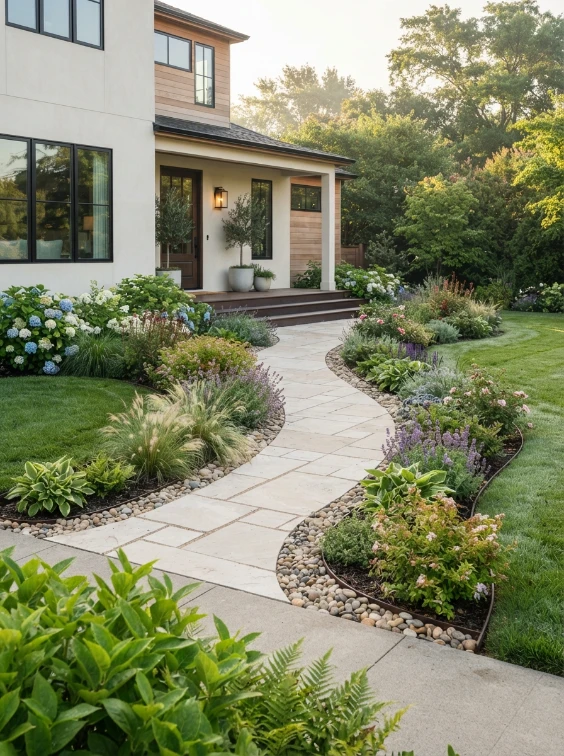
Plant layering gives a front yard depth. Place low groundcovers and edging plants near the path, medium shrubs behind them, and taller shrubs or small trees farther back. A useful visual rhythm is to make each layer approximately 1.5 to 1.6 times taller than the layer in front.
For instance, low plants may be 10 inches tall, middle plants around 16 inches, and the next layer around 25 inches. Real gardens need variation, so mix textures and allow mature growth habits to guide the final arrangement.
5. Frame the Front Door with Unequal Planting Zones
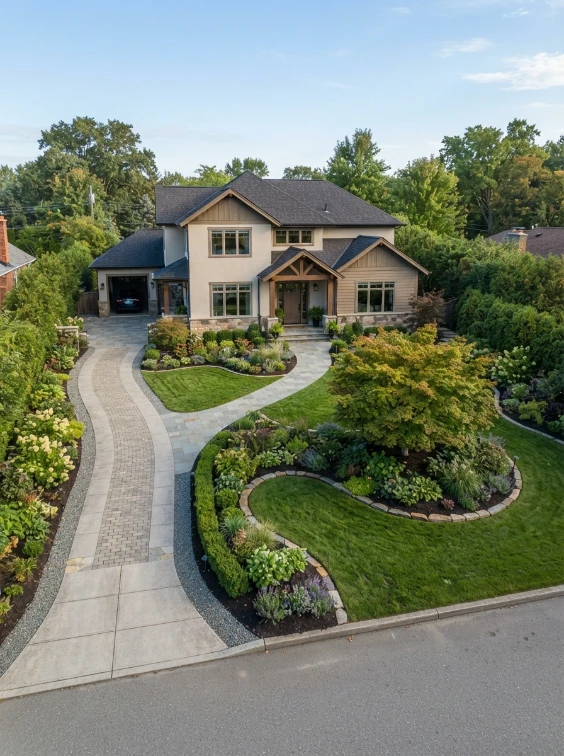
Balanced does not always mean identical. An asymmetrical entrance can feel more natural when one side carries greater visual weight and the other side provides breathing room. Try a fuller planting bed on one side of the walkway with a smaller planter, low shrub, or open gravel detail on the other.
Use color, height, foliage density, and repetition to connect both sides. The larger zone might carry around 60 percent of the visual weight while the smaller zone carries 40 percent. The exact numbers matter less than the overall feeling.
6. Shape Curved Beds with Golden Arcs
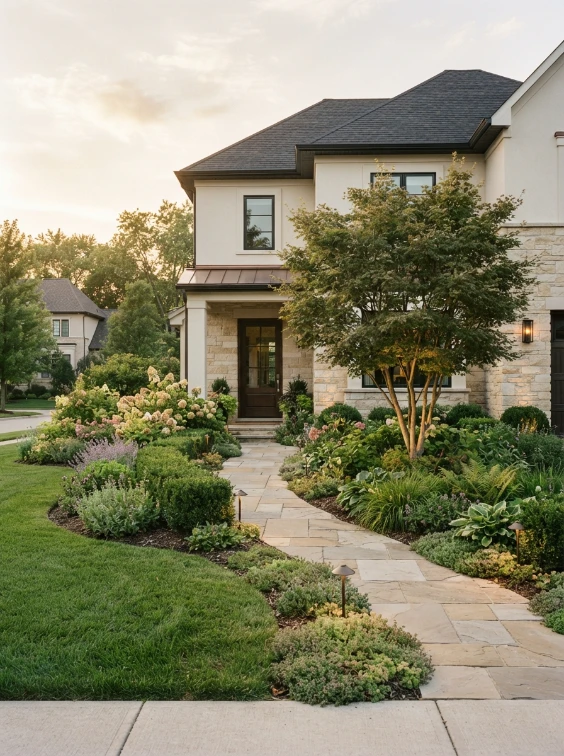
Curved planting beds can make a front yard feel softer and guide the eye toward the porch. Use a garden hose or rope to test a curve before installing edging. Begin with a gentle, narrow curve and let it widen gradually rather than creating several unrelated bends.
A Golden Ratio-inspired curve can help the bed feel intentional, but do not force a mathematical spiral into a space that needs a clear walkway or turning area. Curves should improve movement, mowing, drainage, and maintenance—not make them harder. For example, let a bed widen from 3 feet near the path to about 5 feet near the porch, keeping the curve gentle and mowable.
7. Group Outdoor Lighting with Golden Spacing
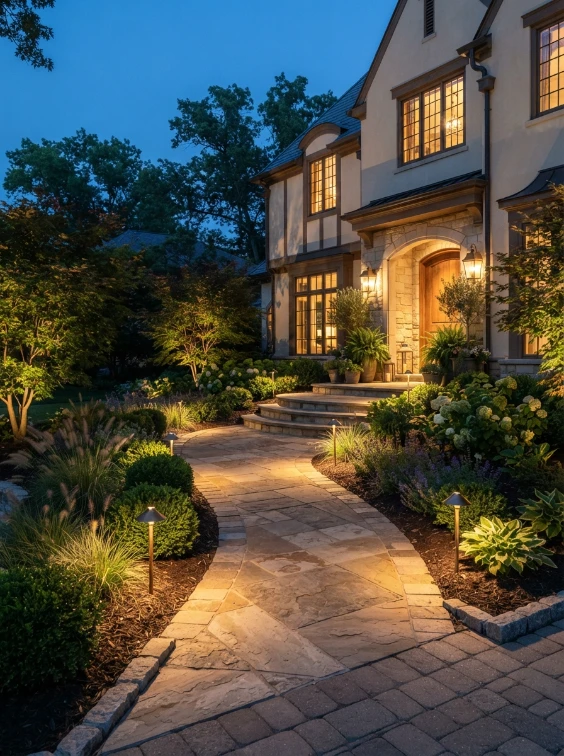
Outdoor lighting looks more refined when fixtures are grouped around important moments instead of placed at identical intervals everywhere. Begin near the front door, steps, or a change in path direction. Then vary spacing slightly to create rhythm.
A simple sequence such as 5 feet, 8 feet, and 13 feet can inspire the layout, but safety and illumination come first. Use enough light for steps and changes in elevation, avoid glare into windows, and choose fixtures rated for outdoor use.
8. Repeat Colors and Materials
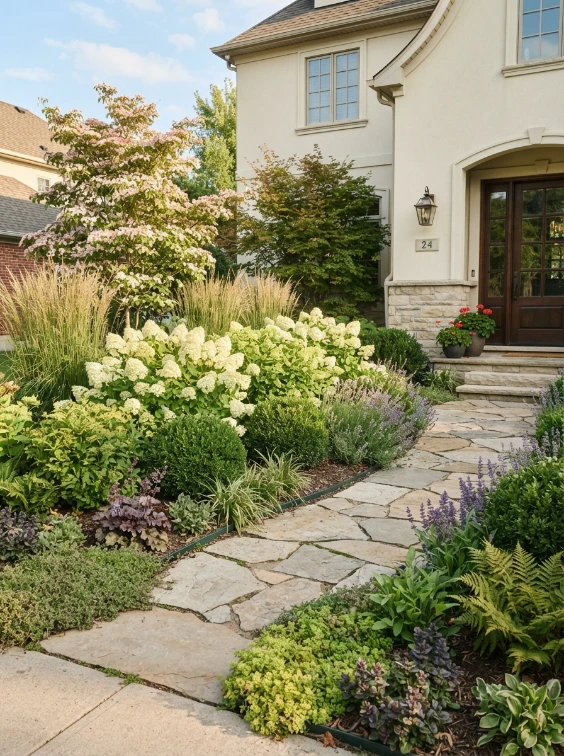
Proportion also applies to color and texture. Repeat one or two materials from the house—such as warm stone, brick, black metal, or natural wood—in the path, edging, or planters. Use a dominant neutral background, a supporting plant color, and one restrained accent.
For example, soft green foliage can occupy most of the planting palette, white or pale flowers can create continuity, and a smaller amount of burgundy or blue-green foliage can add contrast. Repetition makes separate areas feel like one design. Repeat the same material or plant in at least three places: for example, ornamental grasses along the path, by the porch, and at the bed edge.
Golden Ratio Sizes at a Glance
| Element | Small size | Golden-ratio partner |
| Path | 4 ft | 6.5 ft lawn zone |
| Planting bed | 3 ft | 5 ft |
| Plant layers | 10 in | 16 in, then 25 in |
| Lighting | 5 ft | 8 ft, then 13 ft |
A Simple Golden Ratio Planning Method
- Measure the total width and depth of the front yard.
- Mark the house entrance, driveway, utilities, drainage paths, and walking route.
- Divide the plan into broad zones before choosing individual plants.
- Use a 1:1.6 relationship for selected widths, depths, or visual masses.
- Choose one focal point and support it with smaller elements.
- Layer plants from low to tall and repeat key colors or materials.
- Check the design from the street, porch, and driveway before installing.
Golden Rectangle Garden Rooms
A golden rectangle garden room is an outdoor space whose length is about 1.618 times its width. For example, a patio or play lawn about 10 feet wide and 16 feet long fits this proportion, while still leaving room for planting around it.
Avoid long, narrow bowling-alley shapes, which feel cramped and hard to furnish. For planting inside or around the room, use Fibonacci groupings of 3, 5, or 8 plants, which tend to look naturally balanced.
Common Mistakes to Avoid
Do not treat the Golden Ratio as a guarantee that every layout will work. A yard with poor drainage, unsuitable plants, blocked visibility, or an unsafe path will still be unsuccessful. Avoid squeezing plants into narrow beds just to hit a number. Mature size, sunlight, irrigation, soil, and maintenance should always win.
Also avoid copying the same curve, plant, or light fixture throughout the entire yard. Proportion creates consistency, while small differences create character. Leave some open space so the design can breathe.
Frequently Asked Questions
Is the Golden Ratio necessary for every front yard?
No. It is a flexible visual guideline. Accessibility, drainage, sunlight, budget, and plant suitability are more important than exact ratios.
What is the easiest place to start?
Start with the walkway, lawn, and main planting bed. These large areas establish the visual structure of the entire yard.
Can the Golden Ratio work in a small front yard?
Yes. Use it for smaller relationships such as planter size, bed depth, plant height, and the spacing between lighting fixtures. Keep the path comfortable and safe.
Does the golden ratio work with a sloping yard?
Yes. On a slope, use terraces or level planting zones sized in roughly golden proportions, while keeping drainage and safe steps first.
What if my yard is mostly hardscape?
Yes. Use the ratio for paving, planting pockets, and seating areas, so hardscape is broken into related sizes rather than one flat expanse.
Final Thoughts
The Golden Ratio is a helpful shortcut for making front yard design feel more organized and intentional. Use it to compare lawn and hardscape, arrange planting layers, position a focal point, shape curves, and create lighting rhythm. You do not need perfect measurements. A close proportion, combined with practical planning and plants suited to your climate, can create a front yard that feels welcoming from every angle.