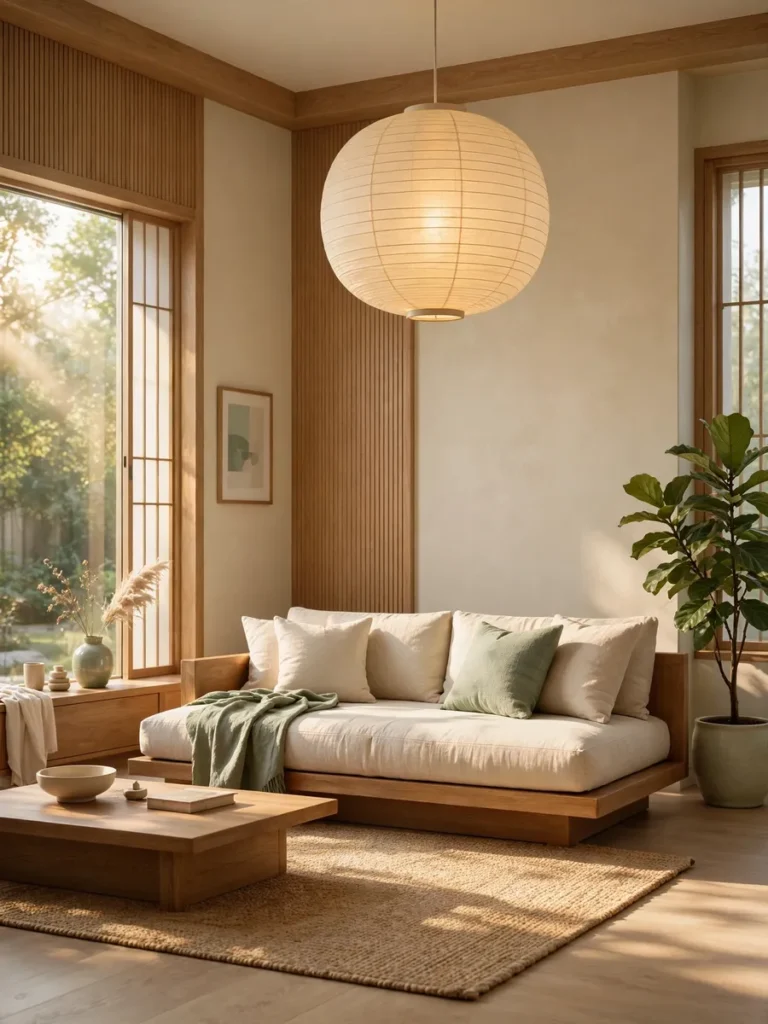
28 Japandi Kitchen Ideas for a Stunning Calm Kitchen You Will Love to Cook In
Japandi kitchen ideas bring together the best of Japanese minimalism and Scandinavian warmth to create a kitchen that feels calm, organised and genuinely welcoming. A Japandi kitchen uses pale wood, soft neutrals, natural stone and clean lines, with every object earning its place. The result is a room that works hard every day yet still feels like a quiet retreat, and the same gentle balance carries beautifully into the rest of the home, as these Japandi living room ideas show.
If your kitchen feels busy or cold, Japandi style is a practical fix. You do not need a full remodel to start, as a change of cabinet colour, a stone worktop or warmer lighting can shift the whole mood. This guide shares 28 Japandi kitchen ideas to mix and match, from full renovations to small weekend updates.
Key Takeaways
Q: What is a Japandi kitchen?
A: A Japandi kitchen blends Japanese minimalism with Scandinavian warmth, using natural materials, neutral colours and clutter-free storage to create a calm, functional cooking space.
Q: What colours suit a Japandi kitchen?
A: Warm whites, beige, greige, soft taupe, pale wood tones and muted sage or dusty blue work best, with matte black or dark walnut used sparingly as contrast.
Q: Where should you start?
A: Start with the palette and the clutter. Choose two or three honest materials, clear the worktops, then add warmth through wood, stone and soft lighting.
1. How Do Pale Oak Cabinets Create a Calm Japandi Kitchen?
Pale oak slab-front cabinets with warm white walls and a quiet stone worktop create the classic Japandi kitchen base, because the soft wood grain adds warmth without pattern or visual noise.
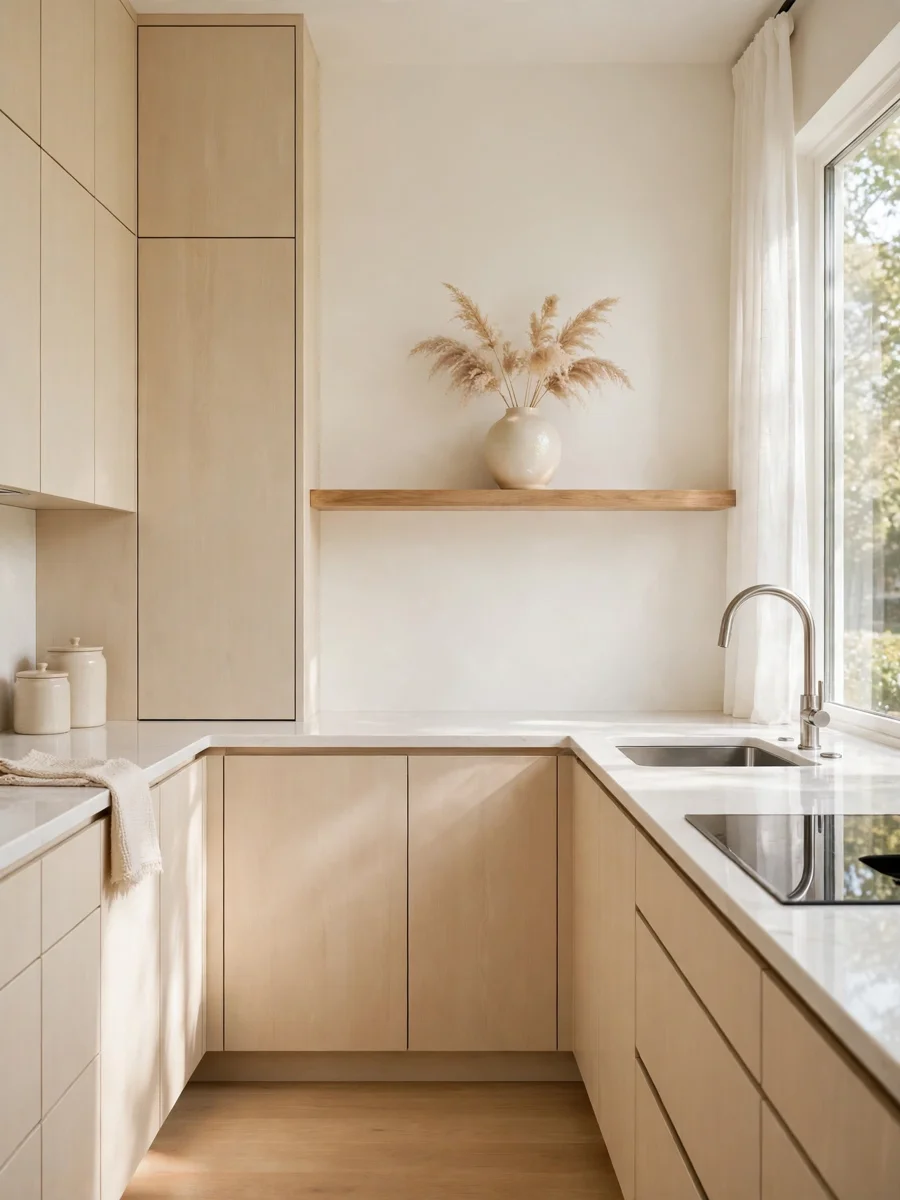
Choose flat, handle-free fronts in white oak or pale ash and let the grain be the decoration. A concrete example is a run of pale oak base cabinets with a white quartz top, a single oak shelf and a ceramic vase, which reads calm from every angle.
Quick tips
- Keep cabinet fronts flat and handle-free for clean lines.
- Match the wood tone across cabinets, shelves and stools.
- Leave one stretch of worktop completely clear.
2. Why Does a Walnut Island Anchor a Japandi Kitchen So Well?
A dark walnut island anchors a pale Japandi kitchen because the deep wood gives the room a focal point while the surrounding light cabinets keep the balance calm and airy.
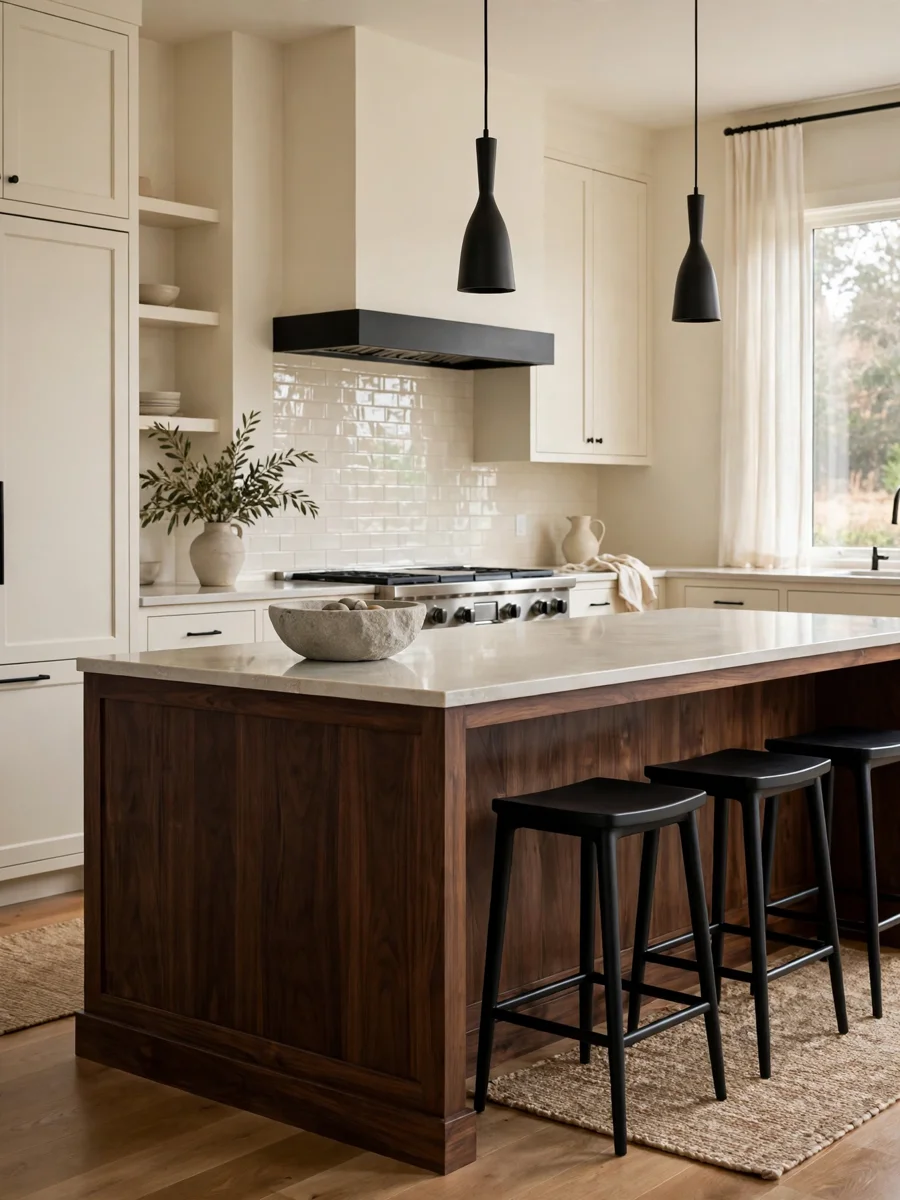
Use walnut only on the island so the contrast feels deliberate. A concrete example is a walnut island with a pale stone top in a cream kitchen, where the island becomes the natural gathering spot for breakfast and conversation.
Quick tips
- Use dark wood on one element only.
- Choose a pale worktop to lighten the island.
- Keep island styling to two or three objects.
3. Which Stone Worktops Suit a Japandi Kitchen Best?
Soapstone, honed marble and pale quartz suit a Japandi kitchen best because their soft matte surfaces and gentle veining add natural texture without shine or fuss.
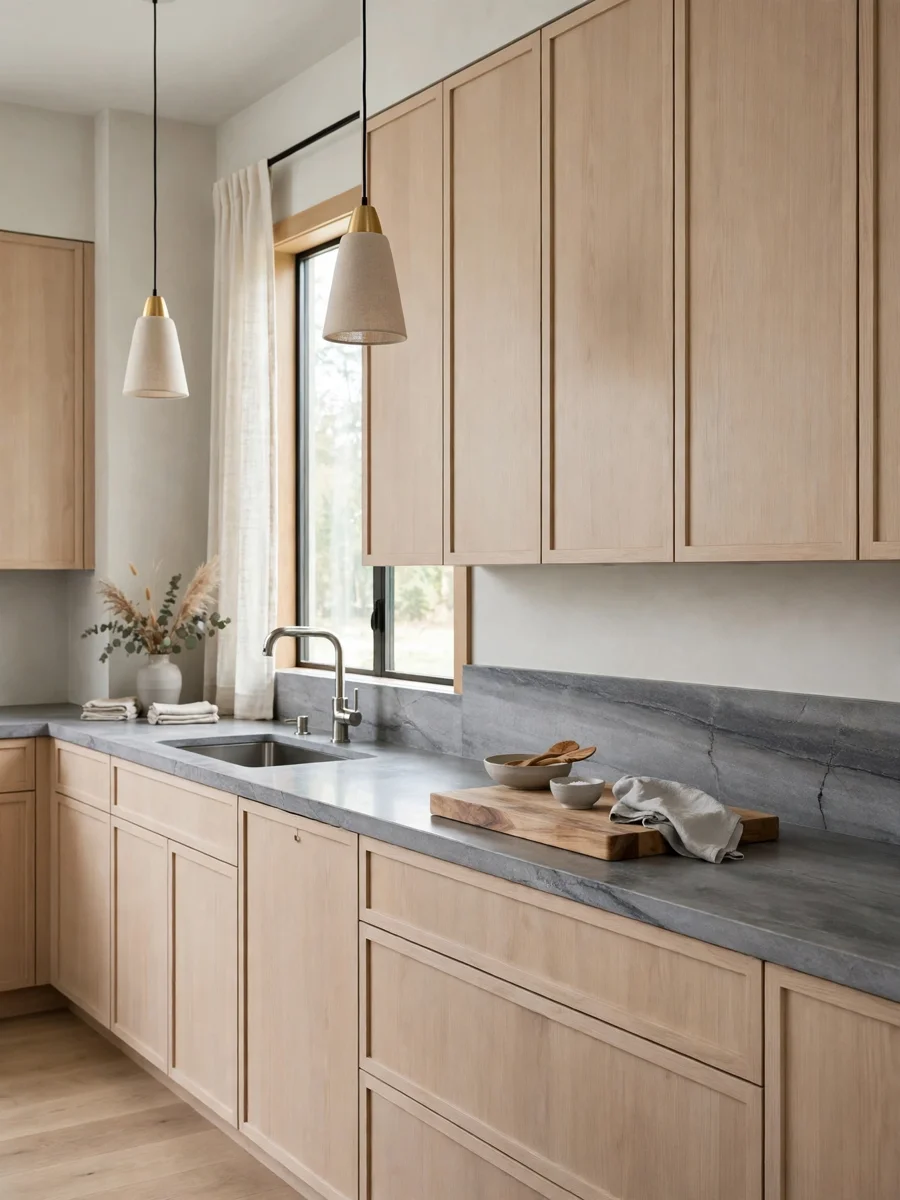
Pick a honed finish rather than high gloss, so the stone feels tactile and calm. A concrete example is a grey soapstone worktop with pale oak cabinets and a matching stone upstand, which ages gracefully and hides everyday marks well.
Quick tips
- Choose honed or matte stone finishes.
- Keep veining soft and understated.
- Seal natural stone and wipe spills promptly.
4. How Can Open Shelving Stay Calm in a Japandi Kitchen?
Open shelving stays calm in a Japandi kitchen when you display only handmade ceramics and everyday essentials in a limited palette, leaving generous empty space on every shelf.
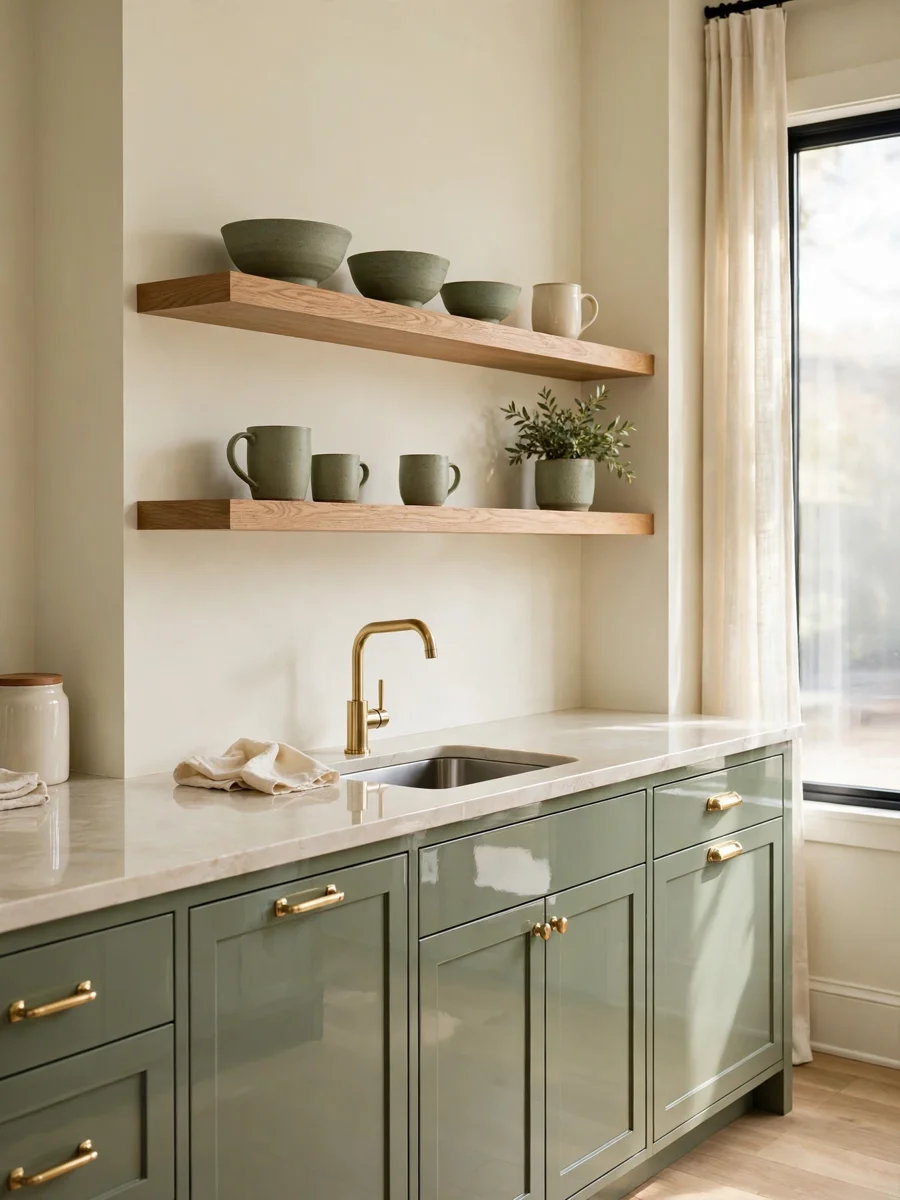
Replace one run of wall cabinets with two oak shelves. A concrete example is two shelves holding six stoneware bowls, four mugs and one small plant, with the rest stored behind closed doors.
Quick tips
- Display only items you use every week.
- Repeat one colour across the ceramics.
- Leave at least a third of each shelf empty.
5. What Makes Shoji-Inspired Panels Work in a Kitchen?
Shoji-inspired panels work in a kitchen because their light wood frames and translucent panels soften daylight, divide space gently and add a Japanese focal point without blocking light.
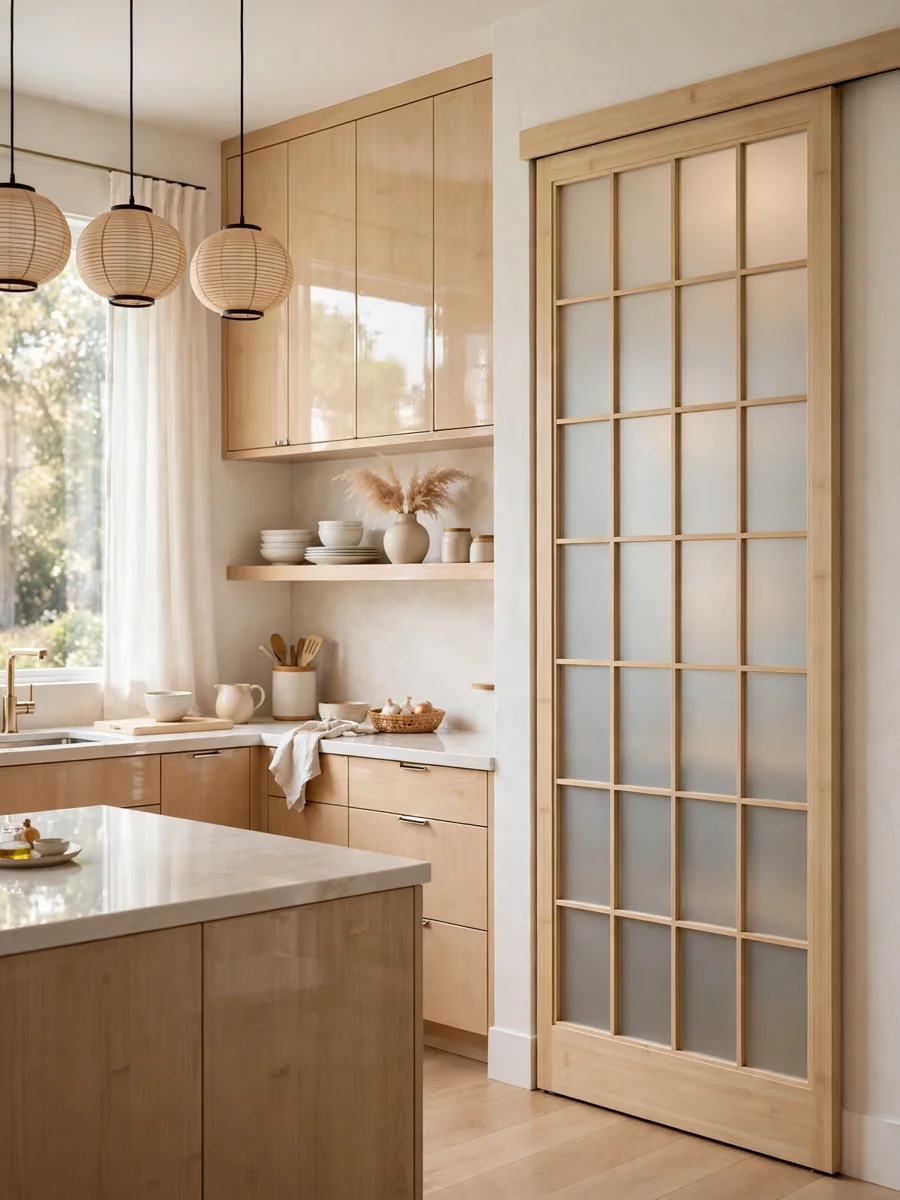
Use a sliding panel as a pantry screen or a room divider. A concrete example is a shoji-style sliding door hiding a pantry in an open-plan kitchen, which closes the mess away in seconds.
Quick tips
- Use frosted glass instead of paper near cooking areas.
- Keep frames pale and slim.
- Use panels to hide storage, not to add clutter.
6. How Do Matte Black Fixtures Add Contrast Without Clutter?
Matte black taps, handles and light fittings add contrast in a Japandi kitchen because the soft black lines define the room quietly, without the glare or fuss of chrome.
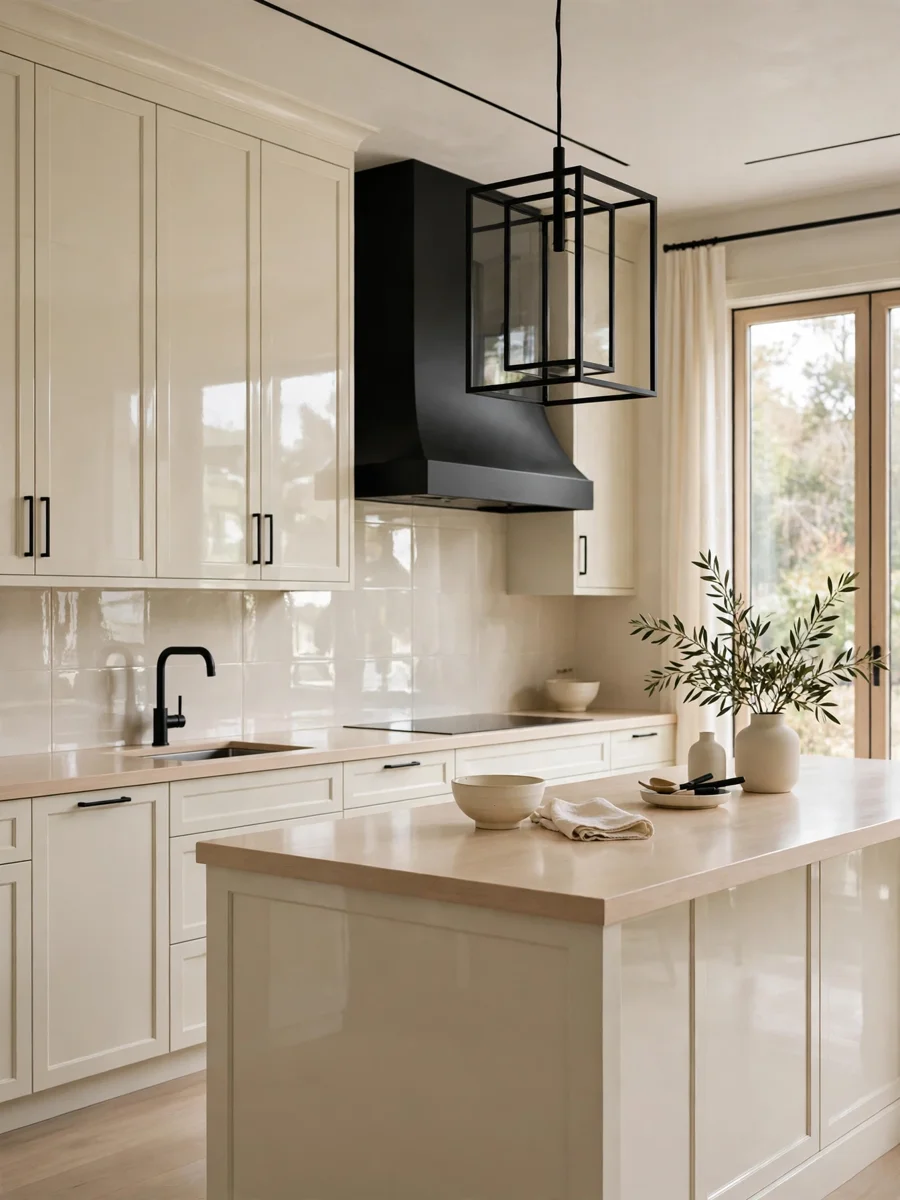
Repeat matte black in small doses, such as the tap, cabinet pulls and one pendant. A concrete example is a cream kitchen with a matte black tap, black-framed pendant and slim black handles, which feels crisp rather than dark.
Quick tips
- Repeat black in three small places only.
- Choose matte, not glossy, black finishes.
- Balance black with plenty of pale wood.
7. Can Terracotta Accents Warm Up a Neutral Japandi Kitchen?
Terracotta accents warm a neutral Japandi kitchen because the soft clay tone adds earthy colour and handmade character while staying inside the natural, muted palette.
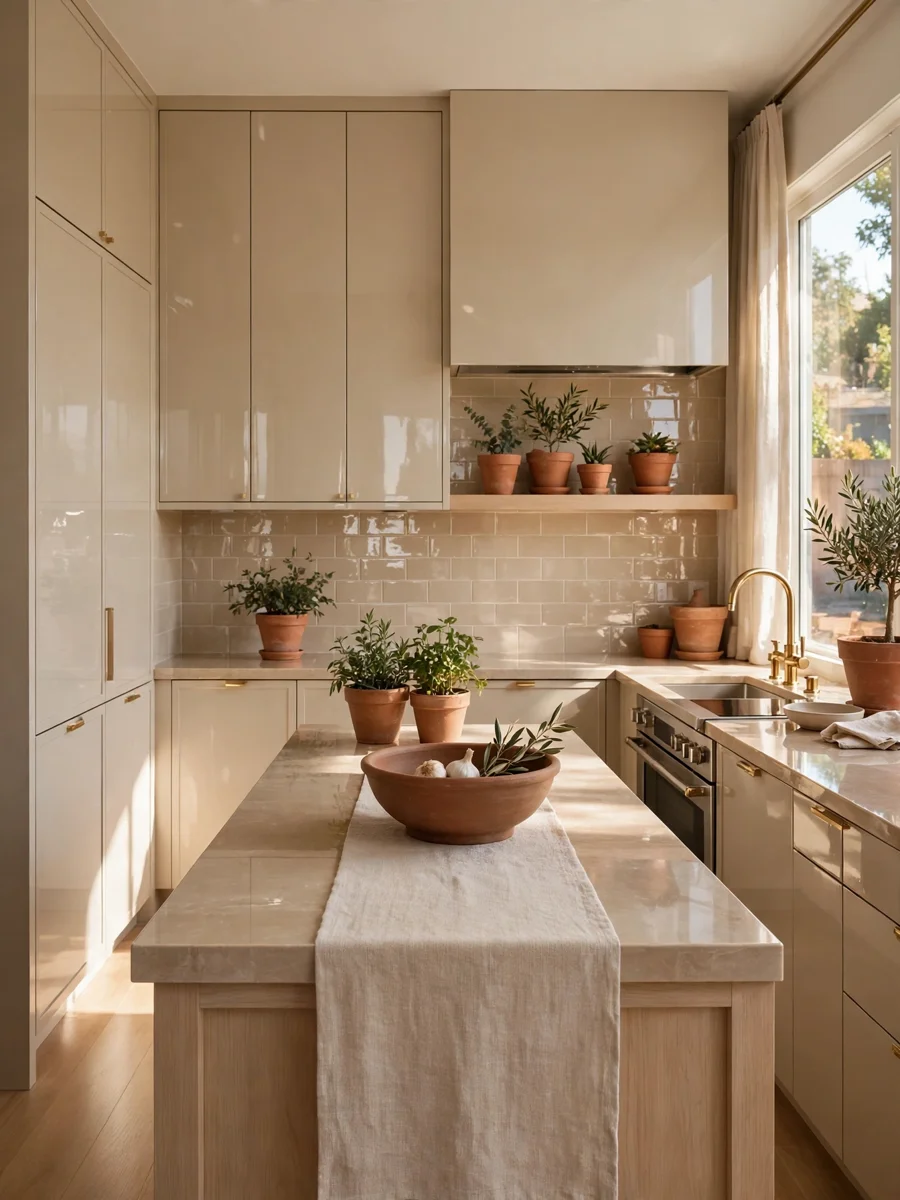
Add terracotta through a vase, a set of bowls or a tiled splashback. A concrete example is a beige kitchen with terracotta plant pots, a clay serving bowl and a linen runner in the same tone.
Quick tips
- Use terracotta in accessories, not on every surface.
- Pair it with cream, beige and pale wood.
- Choose unglazed or matte clay textures.
8. Why Is Soft Sage the Perfect Japandi Cabinet Colour?
Soft sage is the perfect Japandi cabinet colour because it brings nature indoors in a muted, restful way, pairing beautifully with pale wood, cream walls and stone worktops.
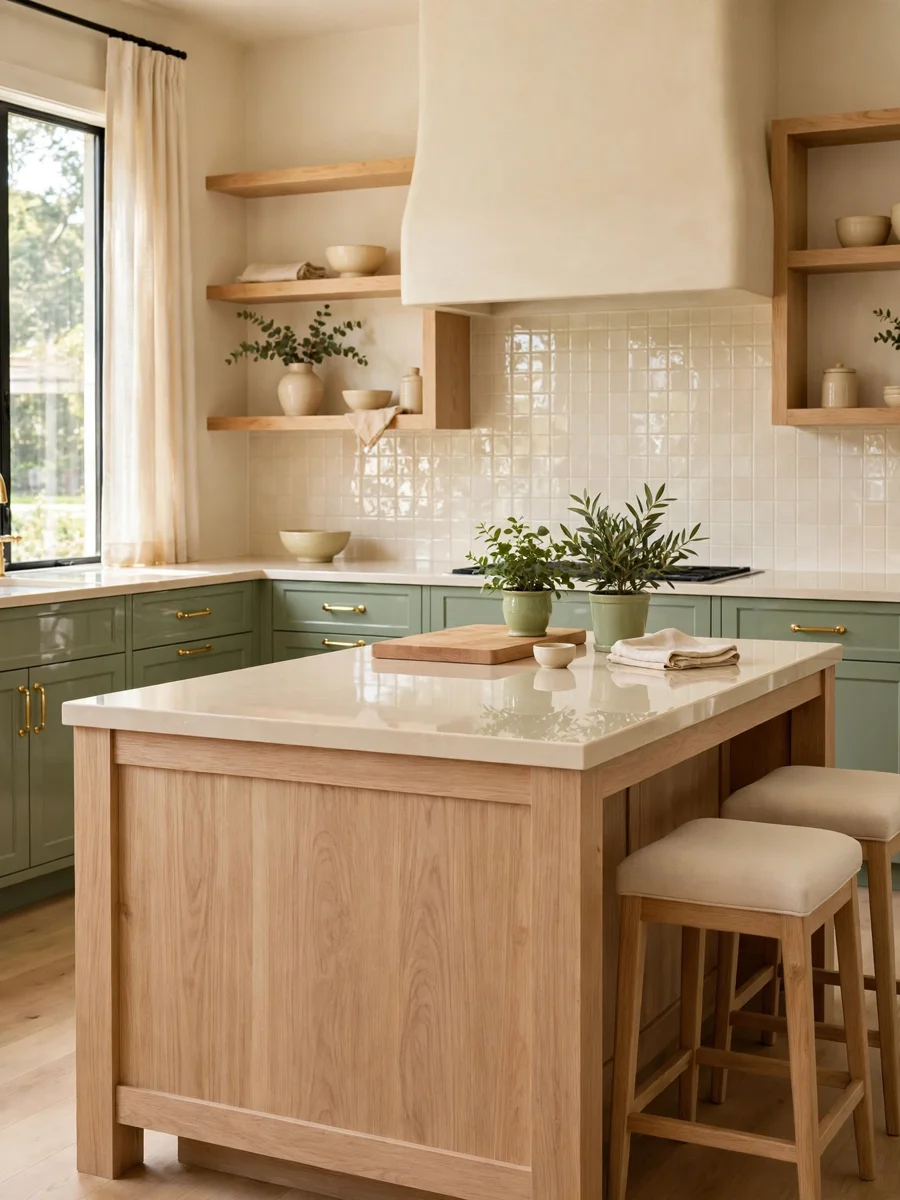
Paint lower cabinets sage and keep uppers pale wood or warm white. A concrete example is sage base cabinets with a white oak island and a cream stone worktop, a combination that feels fresh in summer and cosy in winter.
Quick tips
- Use sage on lower cabinets only.
- Pair it with warm, not cool, whites.
- Add a green plant to echo the colour.
9. How Do Linen and Natural Textiles Soften a Japandi Kitchen?
Linen and natural textiles soften a Japandi kitchen because their gentle texture and matte finish balance hard stone and wood, making the room feel lived in and comfortable.
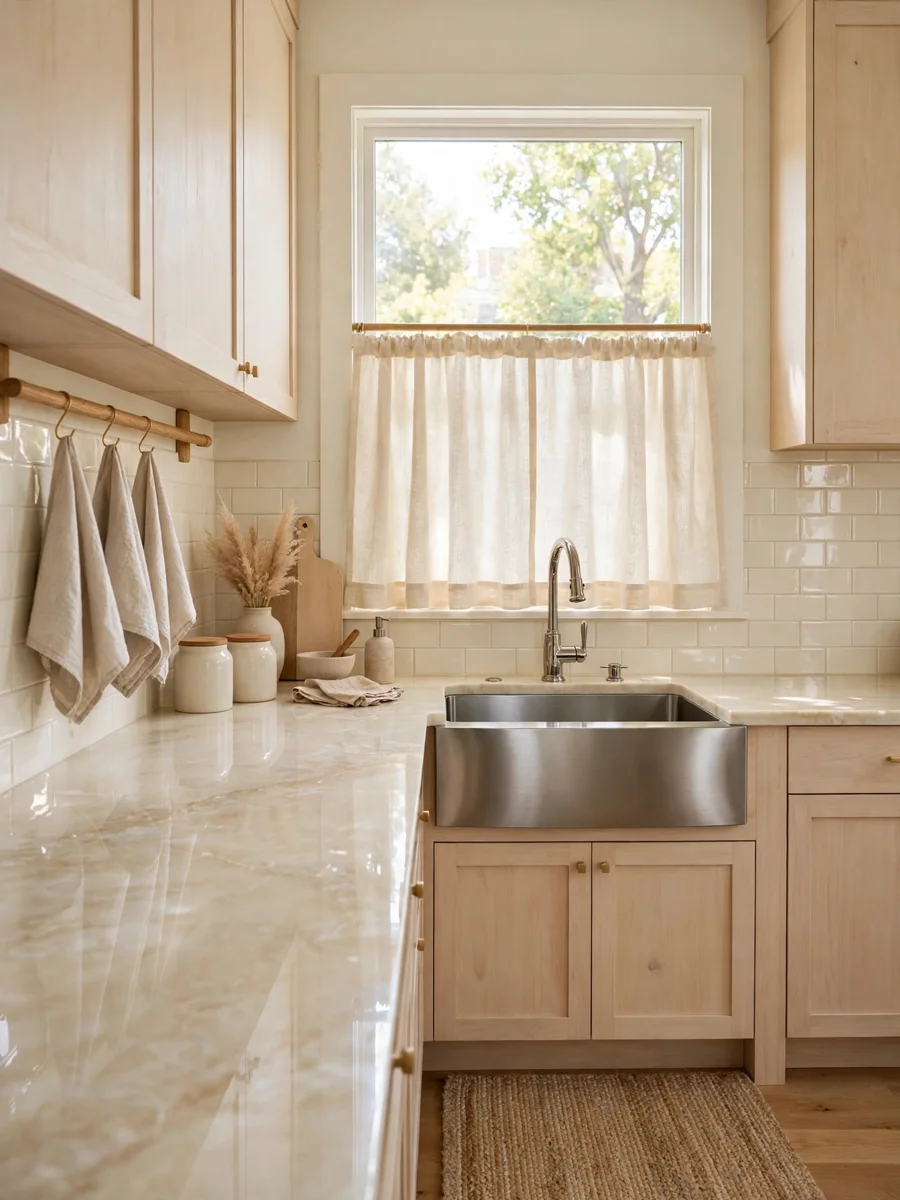
Add a linen cafe curtain, cotton tea towels in natural tones and a woven runner by the sink. A concrete example is a cream linen curtain at a kitchen window, beige tea towels on an oak rail and a jute runner, which together warm a pale kitchen instantly.
Quick tips
- Choose undyed or softly dyed linen.
- Keep textile patterns simple and calm.
- Wash and rotate towels to keep them fresh.
10. When Does Concrete Belong in a Japandi Kitchen?
Concrete belongs in a Japandi kitchen when it is used in small, smooth doses, such as a worktop or floor, because its cool grey tone contrasts beautifully with warm pale wood.
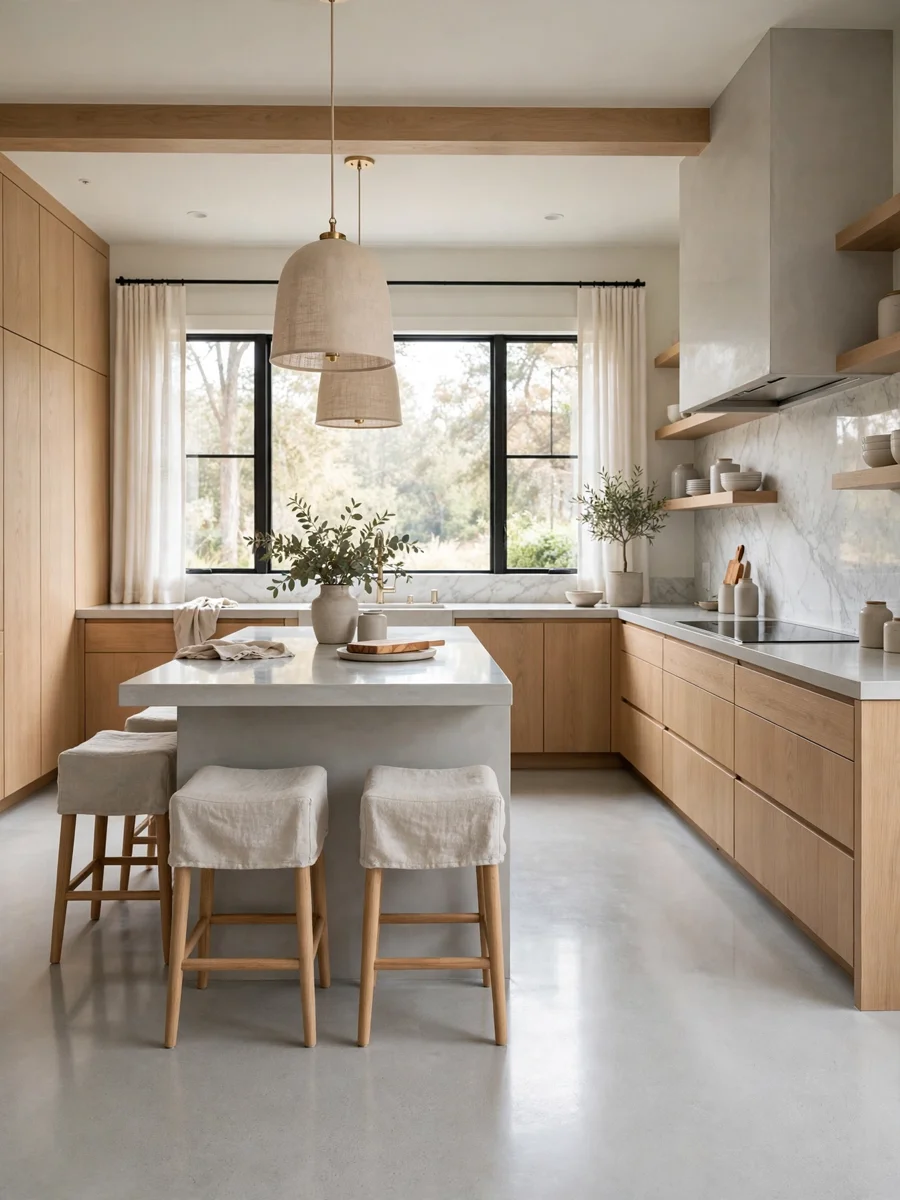
Choose polished concrete floors or a concrete worktop and balance them with oak cabinets and soft textiles. A concrete example is a pale concrete floor with oak cabinets, a white stone splashback and linen stools, where the floor grounds the room without chilling it.
Quick tips
- Use concrete on one surface only.
- Warm it with wood and woven textures.
- Seal concrete to protect it from stains.
11. How Does Layered Lighting Create a Japandi Glow?
Layered lighting creates a Japandi glow because paper lantern pendants, under-cabinet strips and soft sconces together mimic warm, diffused daylight at every level of the room.
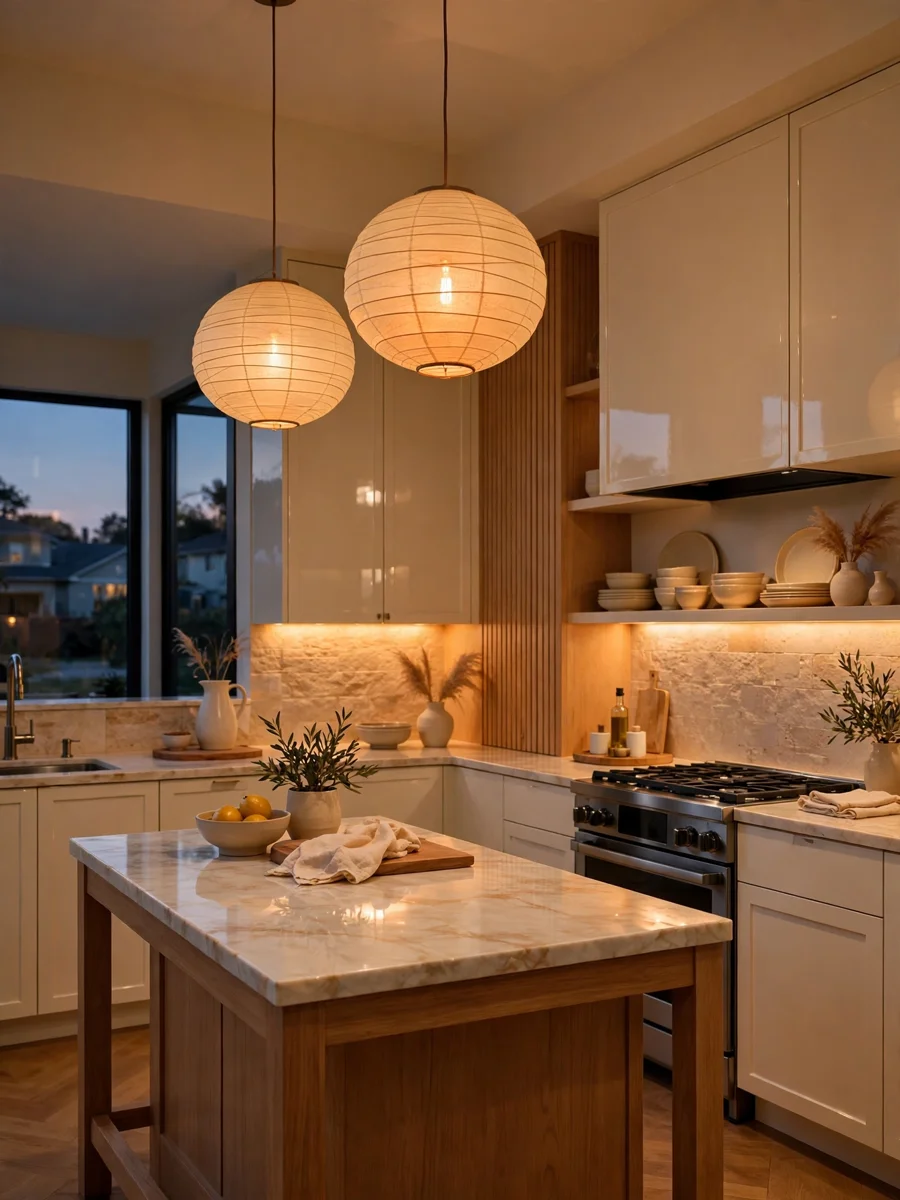
Hang two paper or linen pendants over the island, add warm under-cabinet lighting for tasks and a small sconce for evenings. A concrete example is a pair of round paper lanterns over a wooden island, glowing softly at dusk while under-cabinet lights keep the worktop bright.
Quick tips
- Use warm white bulbs, around 2700K.
- Layer three light sources, not one.
- Put task lights on a separate switch.
12. What Makes a Built-In Banquette So Japandi?
A built-in banquette is so Japandi because it saves space, hides storage under the seat and creates a calm, low dining nook that invites slow, unhurried meals.
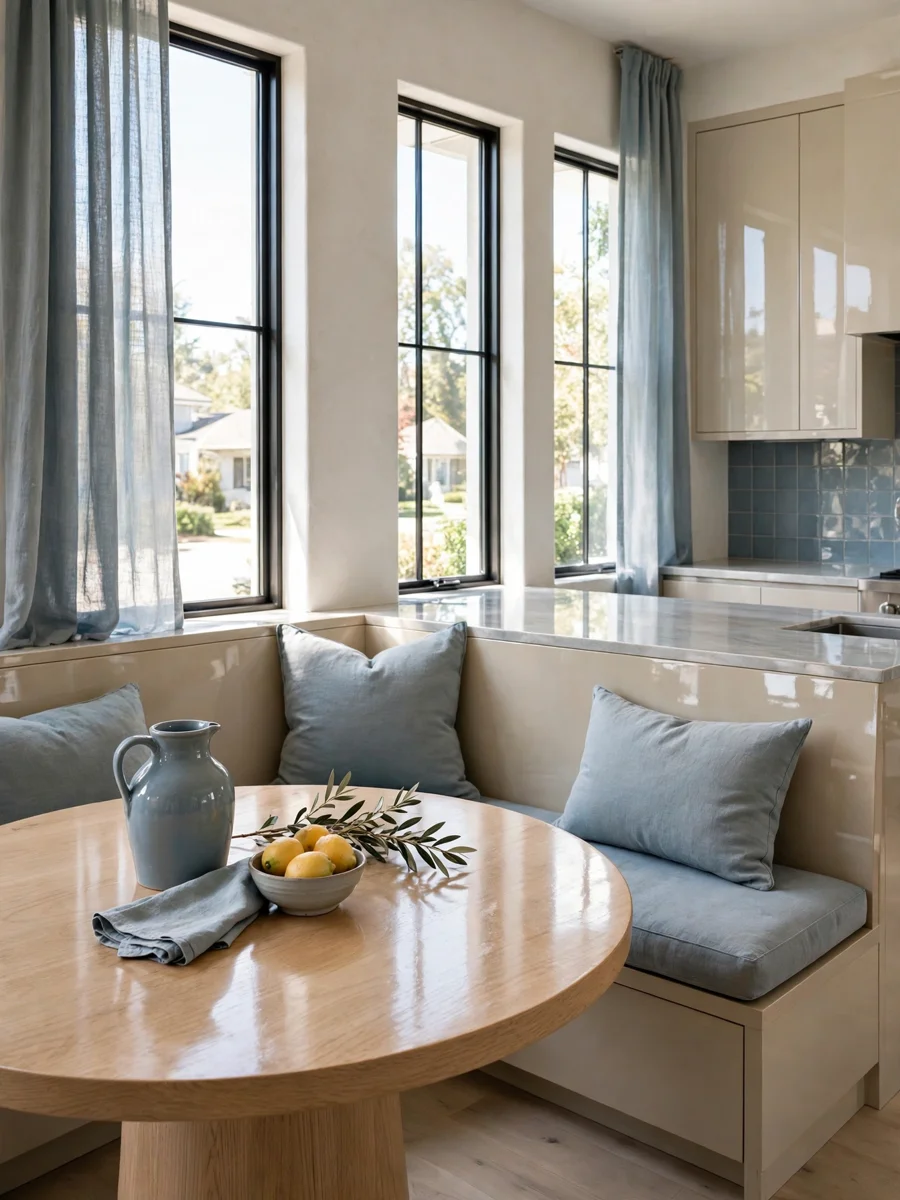
Build a low wooden bench along a wall with lift-up storage, a slim table and linen cushions in muted blue-grey. A concrete example is a pale wood banquette beside a window with two linen cushions, a round oak table and a single ceramic jug.
Quick tips
- Keep banquette cushions in one muted tone.
- Use the seat base for hidden storage.
- Choose a table that seats the household comfortably.
13. How Do Dark Walnut and Brass Add Quiet Luxury?
Dark walnut and brass add quiet luxury to a Japandi kitchen because the rich wood and warm metal bring depth and craftsmanship without pattern, shine or ornament.
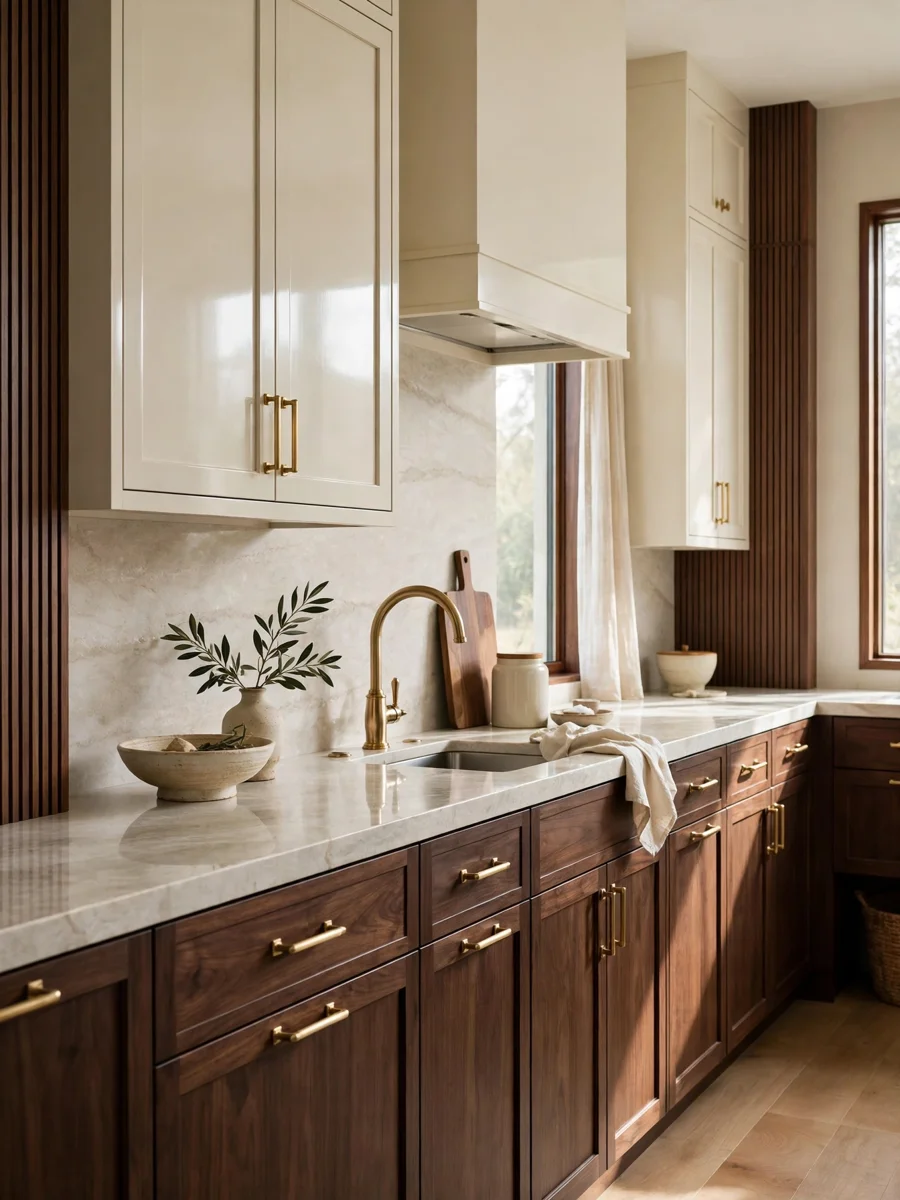
Use walnut on lower cabinets or a feature wall and brass on taps, handles and one pendant. A concrete example is a walnut and cream kitchen with a brushed brass tap and matching cabinet pulls, which feels tailored and calm.
Quick tips
- Choose brushed brass, not shiny gold.
- Repeat brass in two or three places.
- Let walnut grain be the main decoration.
14. Can an All-White Japandi Kitchen Still Feel Warm?
An all-white Japandi kitchen still feels warm when you layer warm whites with pale wood, woven textures and soft lighting, so the white reads as creamy and calm rather than cold.
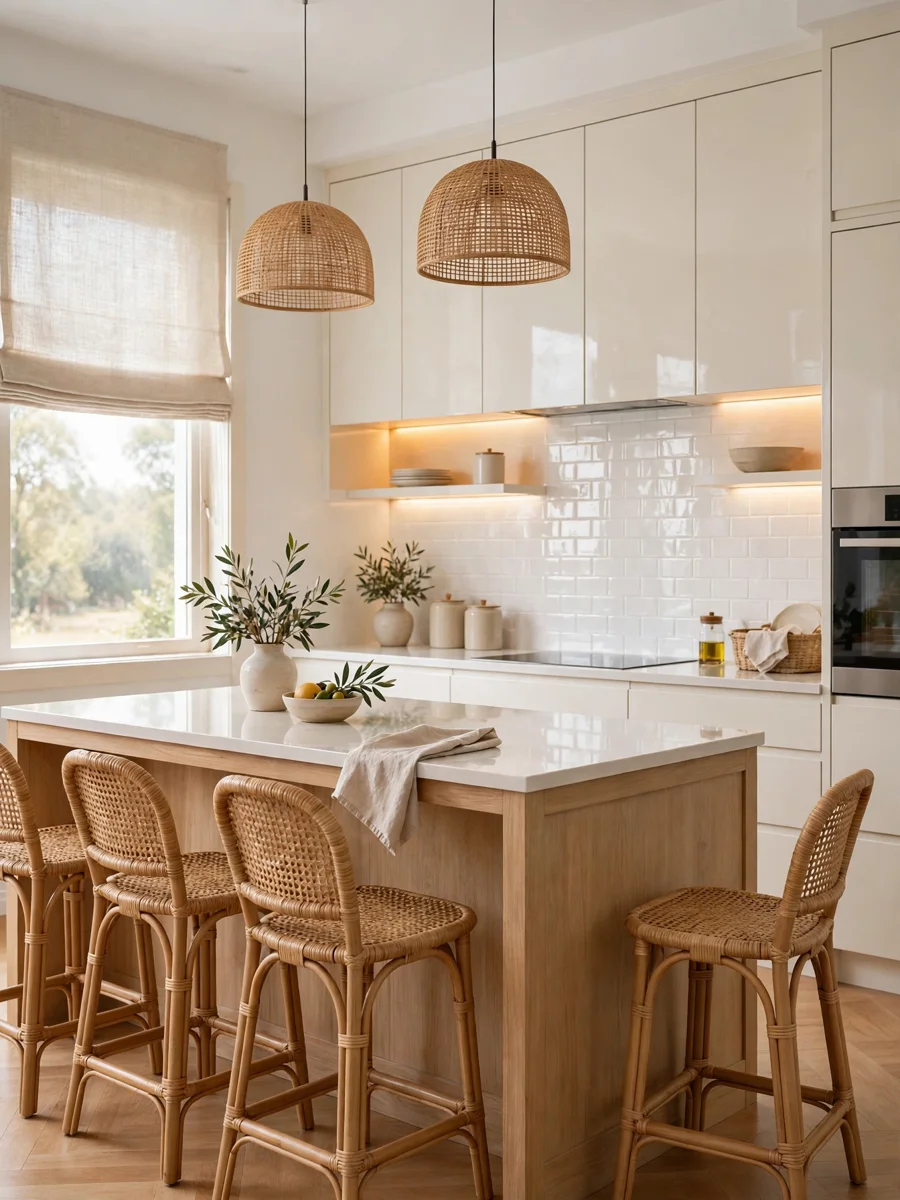
Mix warm white cabinets with an oak floor, a wooden stool and a linen blind. A concrete example is a white kitchen with a light oak island, rattan stools and warm under-cabinet lighting, which feels bright, soft and welcoming.
Quick tips
- Choose warm white paint with a creamy undertone.
- Add wood at floor, island and stool level.
- Use warm lighting to soften the white.
| Material | Best Use | Look and Feel | Care |
|---|---|---|---|
| Pale oak and ash | Cabinets, shelving, floors | Warm, light, natural grain | Oil yearly, wipe spills quickly |
| Walnut | Islands and feature cabinets | Rich, deep, grounding | Oil yearly, avoid harsh cleaners |
| Honed stone | Worktops and splashbacks | Soft matte, gentle veining | Seal regularly, clean with mild soap |
| Concrete | Floors and worktops | Cool, smooth, modern calm | Seal well, mop with plain water |
| Ceramic and clay | Tiles, bowls, vases | Handmade, tactile, earthy | Hand wash treasured pieces |
15. How Do Rattan and Woven Textures Add Japandi Warmth?
Rattan and woven textures add Japandi warmth because their natural fibres and soft shadows bring handmade character to smooth cabinets and stone, without adding colour or clutter.
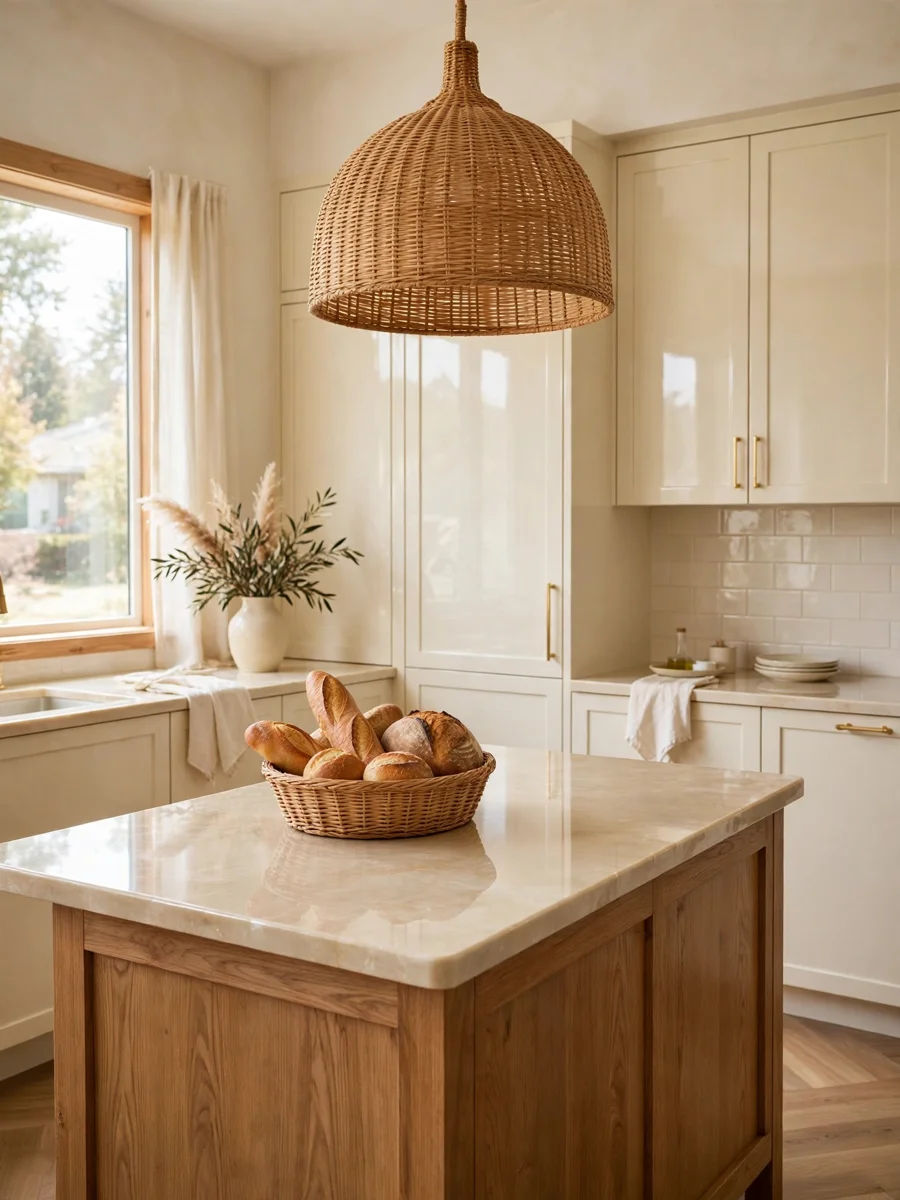
Add rattan through pendant shades, stool seats or a basket for vegetables, and woven linen through blinds or runners. A concrete example is a rattan pendant over a wooden island with a woven basket of bread on the worktop, which adds texture in seconds.
Quick tips
- Use rattan in one or two places only.
- Keep the weave natural honey or pale.
- Dust woven shades gently and regularly.
16. Why Does a Green Marble Splashback Work So Well?
A green marble splashback works so well in a Japandi kitchen because its muted emerald veining adds a single natural colour moment against pale wood and cream, like a landscape in stone.
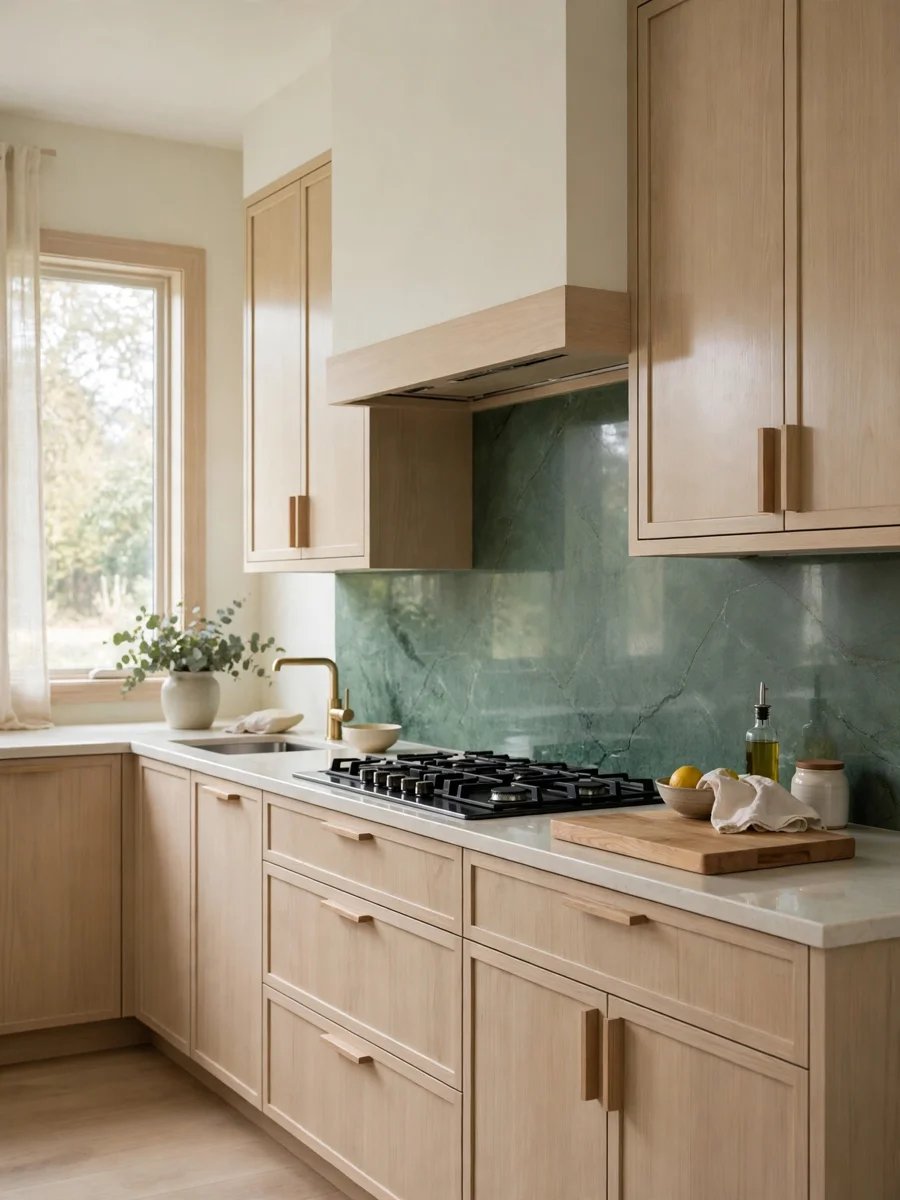
Keep the splashback as the only strong pattern in the room and pair it with plain cabinets and a light worktop. A concrete example is a pale oak kitchen with a soft green marble splashback behind the hob, balanced by cream walls and a wooden chopping board.
Quick tips
- Let the splashback be the only pattern.
- Choose muted, not vivid, green marble.
- Seal marble and wipe cooking splashes promptly.
17. How Can a Small Galley Kitchen Feel Japandi?
A small galley kitchen feels Japandi when you use pale birch cabinets, handle-free fronts, hidden storage and a single shelf, because the pale, unbroken surfaces make the narrow room feel longer and calmer.
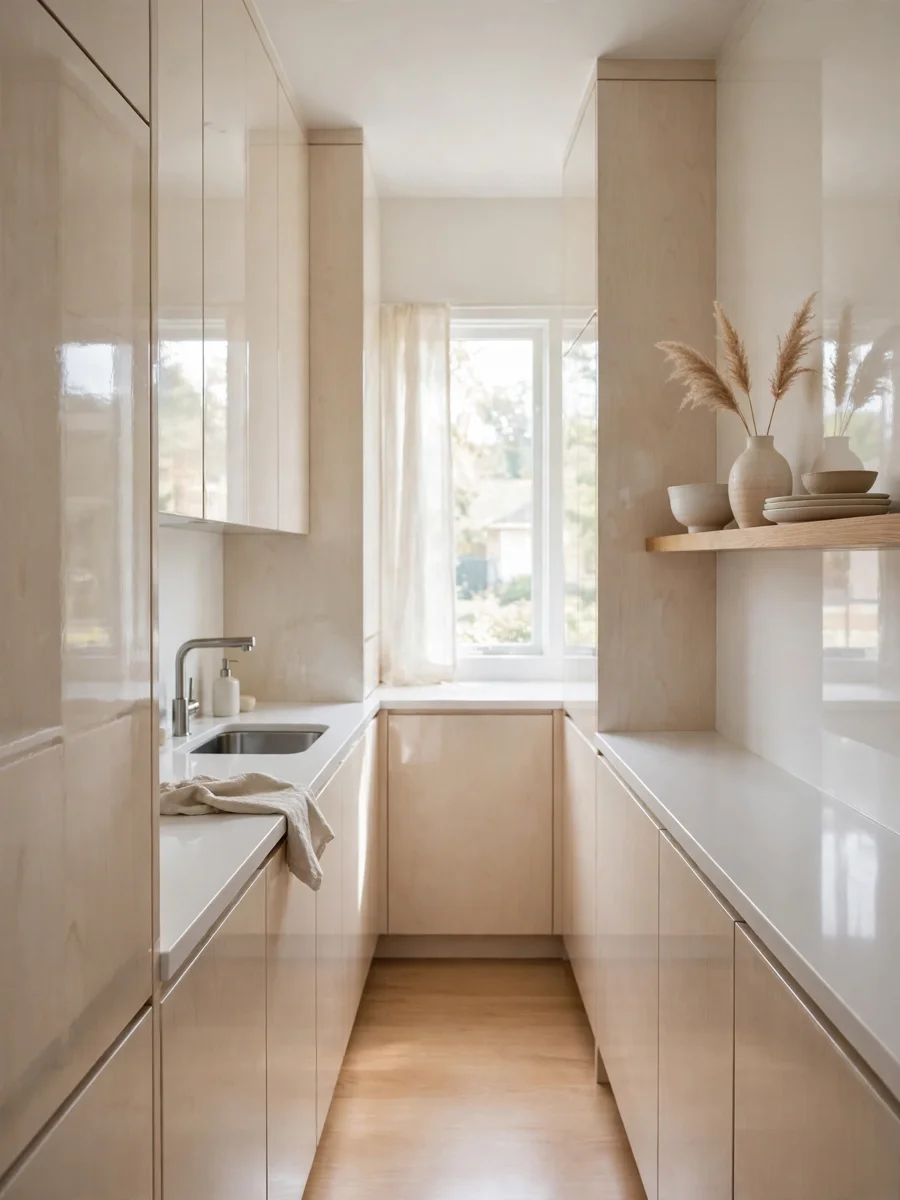
Run cabinets along both walls, hide appliances behind panels and keep one wall free of uppers. A concrete example is a narrow galley with pale birch cabinets, a white worktop and a single shelf of ceramics, which feels spacious despite its size.
Quick tips
- Hide small appliances behind closed doors.
- Use pale colours on every surface.
- Keep one worktop stretch completely clear.
18. What Makes a Japandi Island the Heart of the Kitchen?
A Japandi island becomes the heart of the kitchen when it combines a waterfall stone top, pale wood seating and clear space for cooking, eating and gathering in one calm piece.
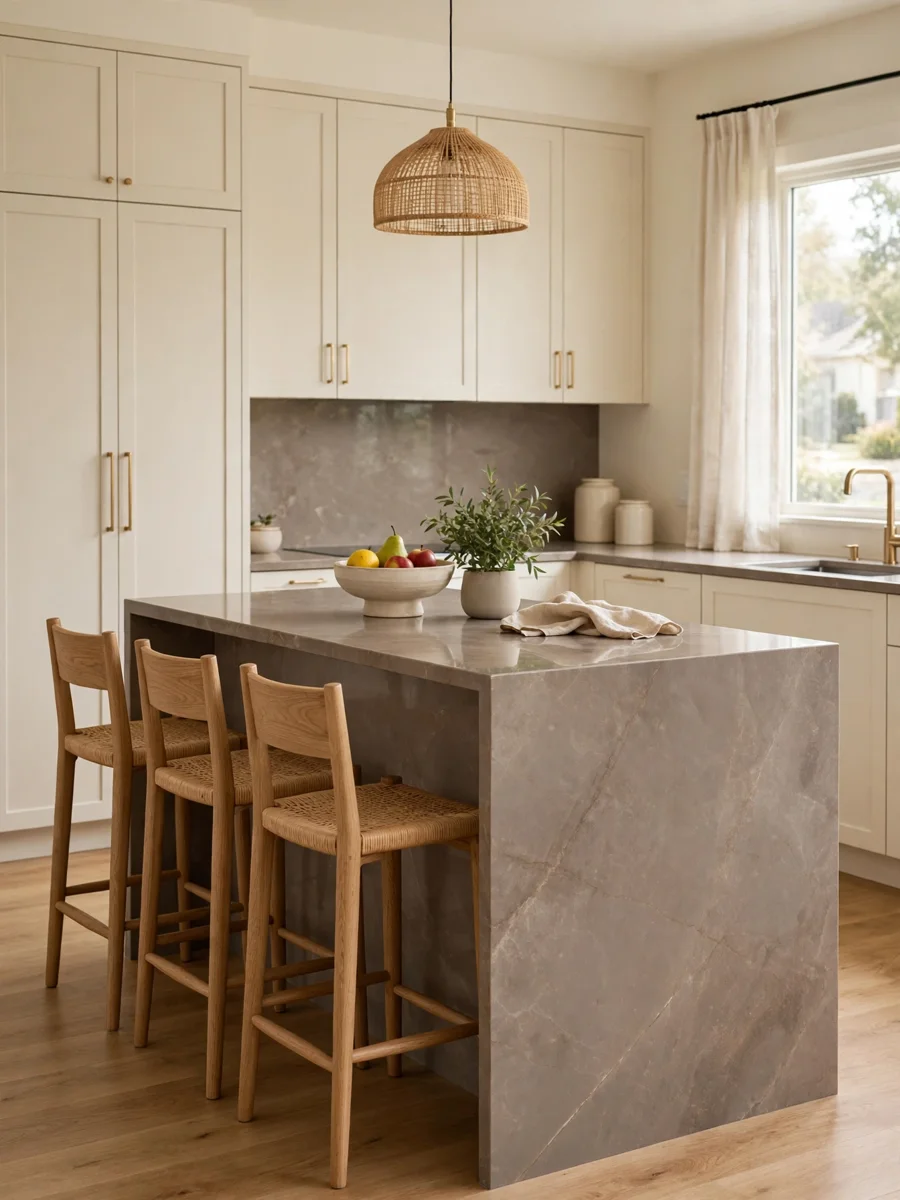
Choose a stone-topped island with room for two or three stools, and style it with a single bowl or vase, following these kitchen island decor ideas for a calm Japandi finish. A concrete example is a taupe stone island with oak stools, a ceramic fruit bowl and a small plant, used for breakfast, homework and cooking prep alike.
Quick tips
- Leave knee space for comfortable seating.
- Keep island styling minimal and useful.
- Choose stools that tuck fully underneath.
19. How Do Handmade Ceramic Tiles Transform a Splashback?
Handmade ceramic tiles transform a Japandi splashback because their slight variations in glaze and shape add quiet craftsmanship and soft dusty blue or cream colour without a busy pattern.
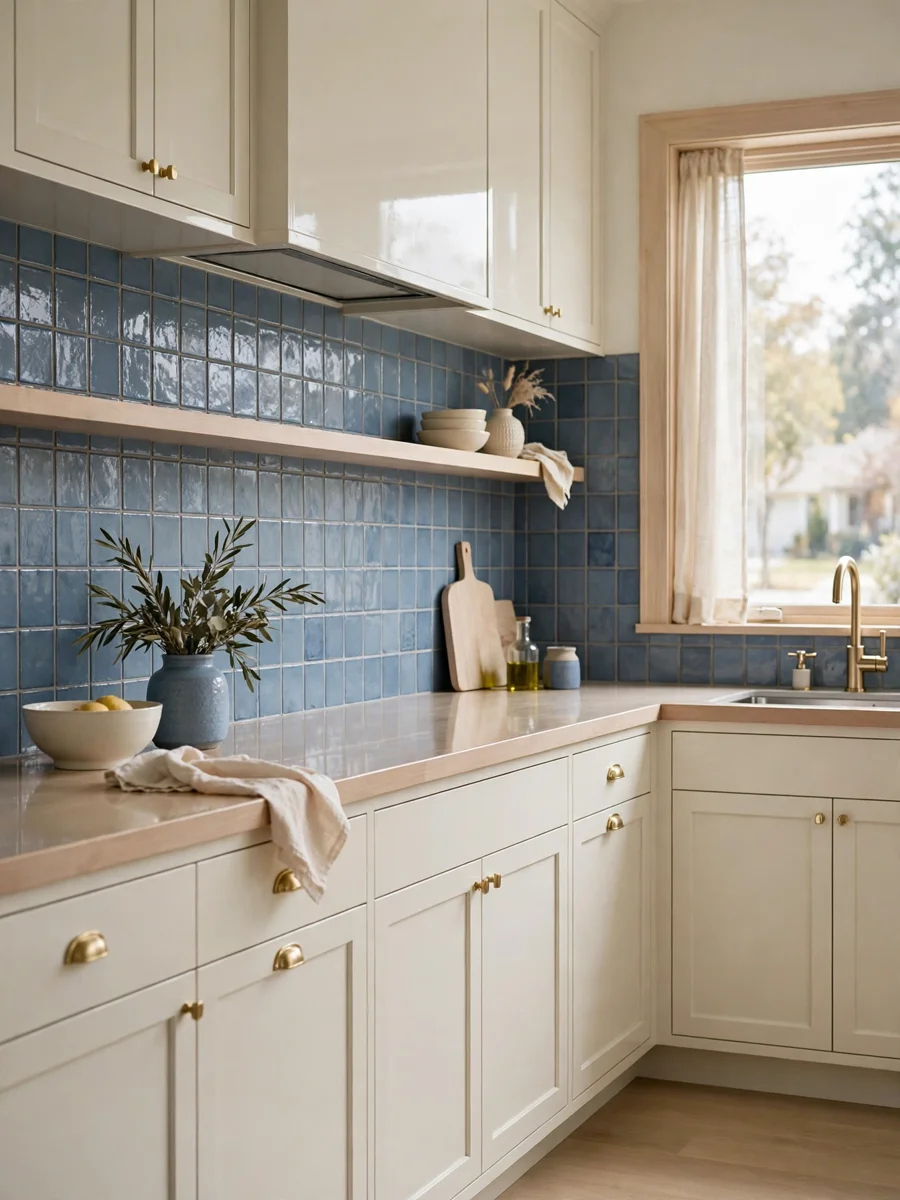
Choose small square or subway tiles in a muted glaze and lay them in a simple grid. A concrete example is a dusty blue handmade tile splashback behind a pale wood worktop, where each tile catches the light slightly differently.
Quick tips
- Choose one muted tile colour only.
- Keep the layout simple and straight.
- Seal grout to keep it clean.
20. Why Is Warm Greige the Easiest Japandi Neutral?
Warm greige is the easiest Japandi neutral because it sits between grey and beige, flattering both pale wood and dark walnut while keeping the room soft in any light.
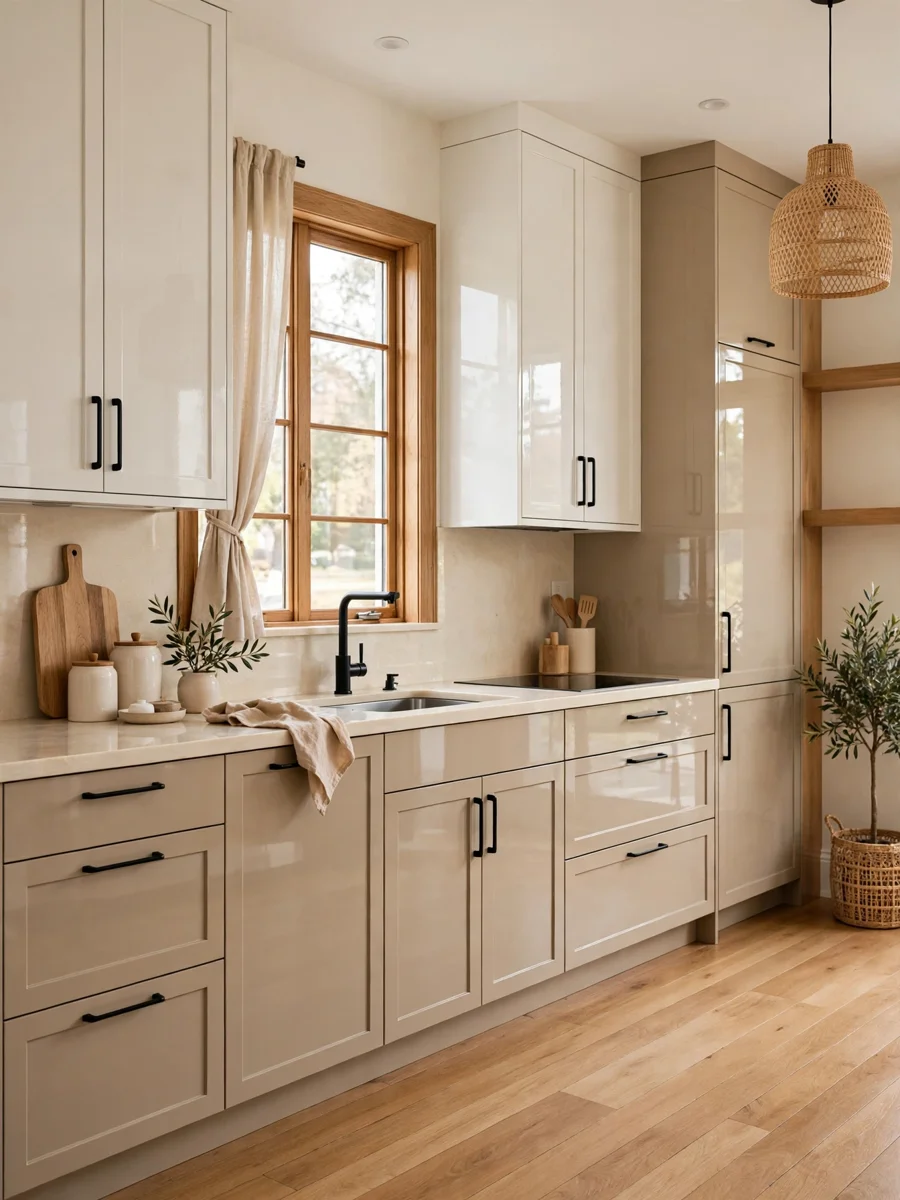
Paint cabinets or walls greige and pair them with an oak floor and cream stone. A concrete example is greige lower cabinets with warm white uppers, an oak floor and a stone worktop, a palette that suits both small and large kitchens.
Quick tips
- Test greige swatches in morning and evening light.
- Pair greige with warm wood, not cool grey.
- Use greige on cabinets or walls, not both.
21. How Do Black-Framed Glass Cabinets Stay Light and Airy?
Black-framed glass cabinets stay light and airy in a Japandi kitchen because the glass keeps the room open while the slim black frames add structure and a Japanese screen-like rhythm.
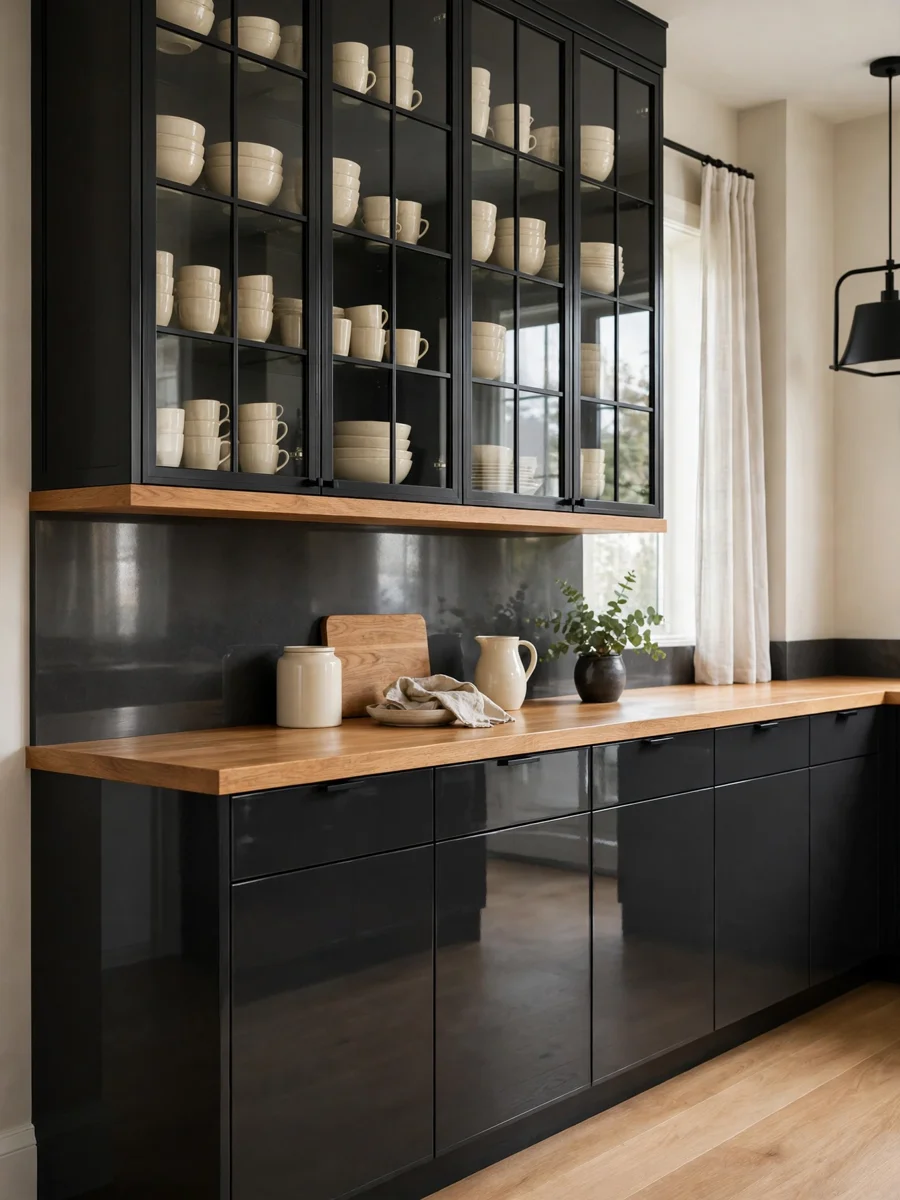
Use glass fronts on one wall cabinet run and keep the contents tidy, with plain ceramics in a single tone. A concrete example is a charcoal-framed glass cabinet holding cream bowls and cups above an oak worktop, which displays the essentials without visual clutter.
Quick tips
- Keep glass cabinet contents tidy and tonal.
- Use glass on uppers only.
- Clean glass weekly to keep it clear.
22. Can Rustic Beams and Plaster Work in a Japandi Kitchen?
Rustic beams and plaster work in a Japandi kitchen when the beams are pale and the plaster is warm sand, because the natural textures add age and warmth while the palette stays calm.
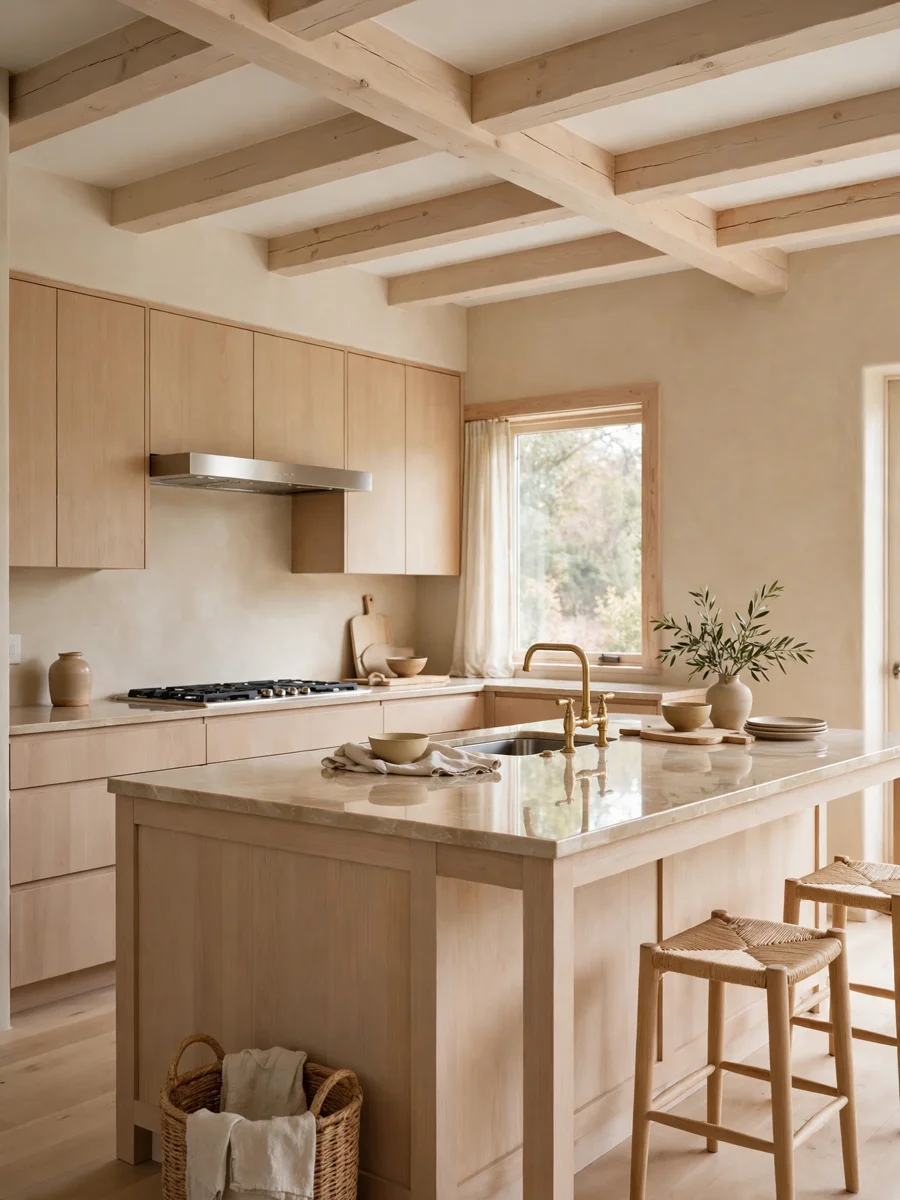
Keep beams light, walls matte plaster and cabinets simple pale wood. A concrete example is a kitchen with pale timber beams, warm sand plaster walls and a simple oak island, which feels like a quiet country retreat.
Quick tips
- Keep beams pale and lightly oiled.
- Choose matte plaster, not shiny paint.
- Balance rustic texture with simple cabinets.
23. How Does Soft Blush Add Gentle Colour to Japandi?
Soft blush adds gentle colour to a Japandi kitchen because the muted rose tone warms pale wood and cream without breaking the calm, natural palette or demanding attention.
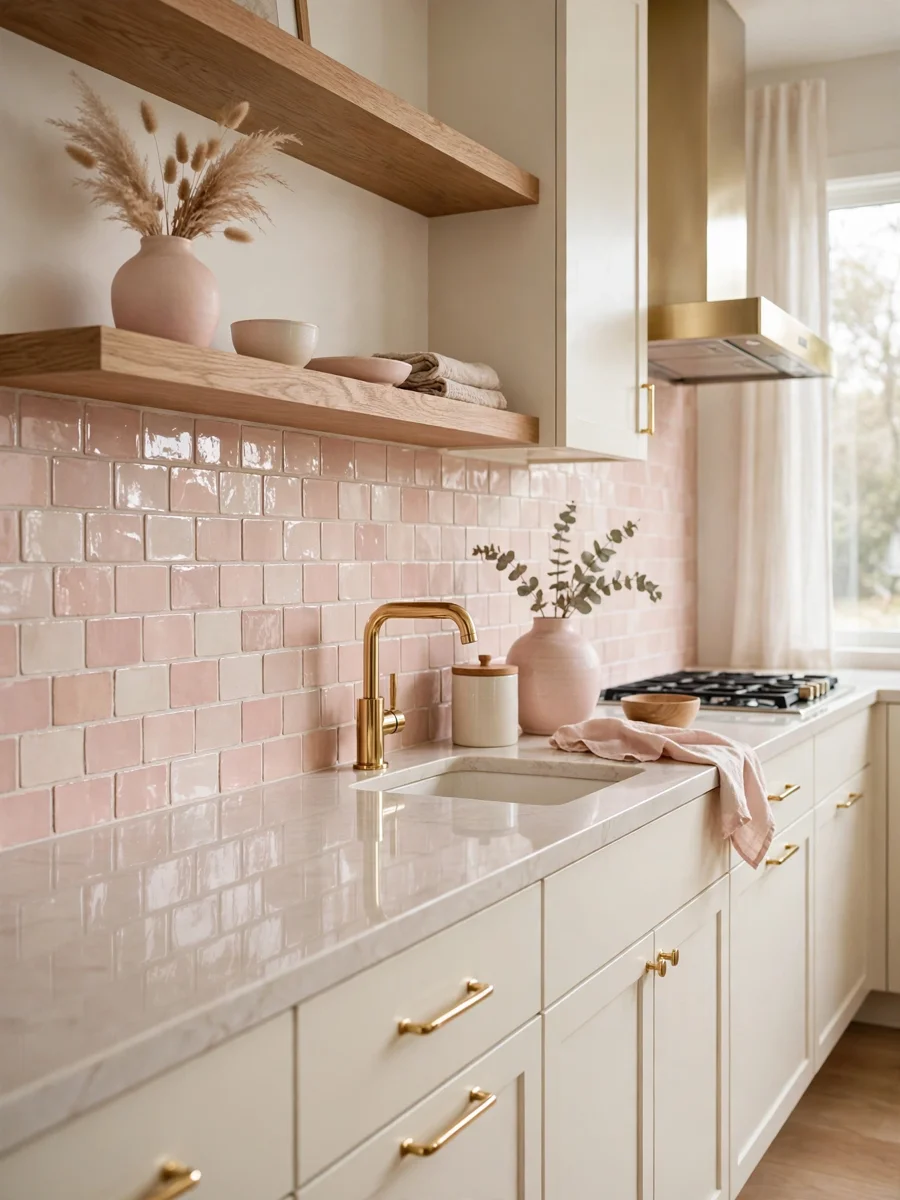
Add blush through a tiled splashback, linen cushions or ceramic bowls, and keep the rest neutral. A concrete example is a cream kitchen with a soft blush tile splashback, oak shelves and a ceramic vase in the same tone.
Quick tips
- Use blush in one area only.
- Pair it with cream, beige and oak.
- Choose muted rose, not bright pink.
24. Why Does Deep Slate Blue Suit a Japandi Kitchen?
Deep slate blue suits a Japandi kitchen because the muted navy tone echoes Japanese indigo dye, adding calm depth to pale wood and cream while staying soft and natural.
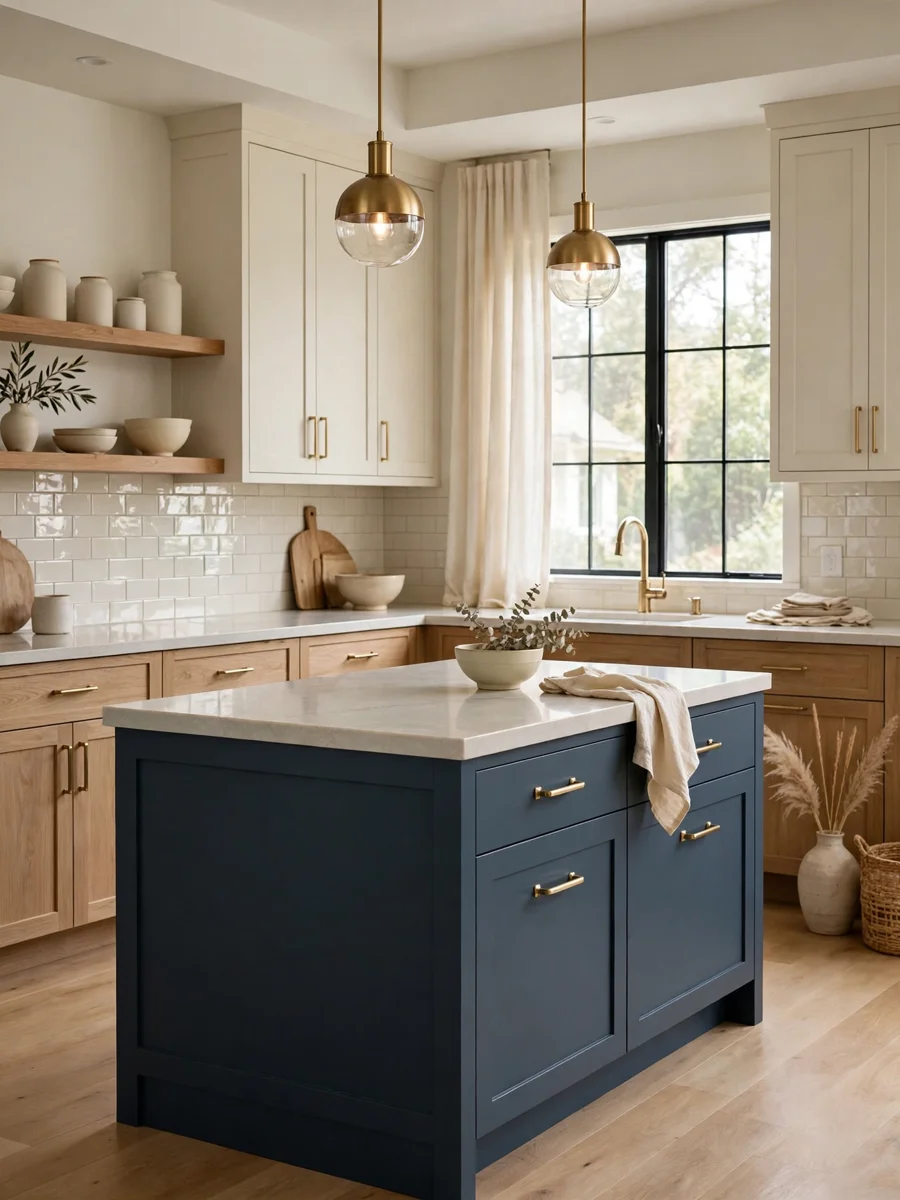
Use slate blue on an island or lower cabinets and keep the rest pale. A concrete example is a slate blue island with a pale stone top in a cream and oak kitchen, which anchors the room like a quiet evening sky.
Quick tips
- Use slate blue on one element only.
- Pair it with brass and pale wood.
- Keep walls warm white to balance the depth.
25. How Do Olive Green Cabinets Bring Nature Indoors?
Olive green cabinets bring nature indoors in a Japandi kitchen because the soft, earthy green echoes leaves and moss, pairing naturally with walnut, cream and stone.
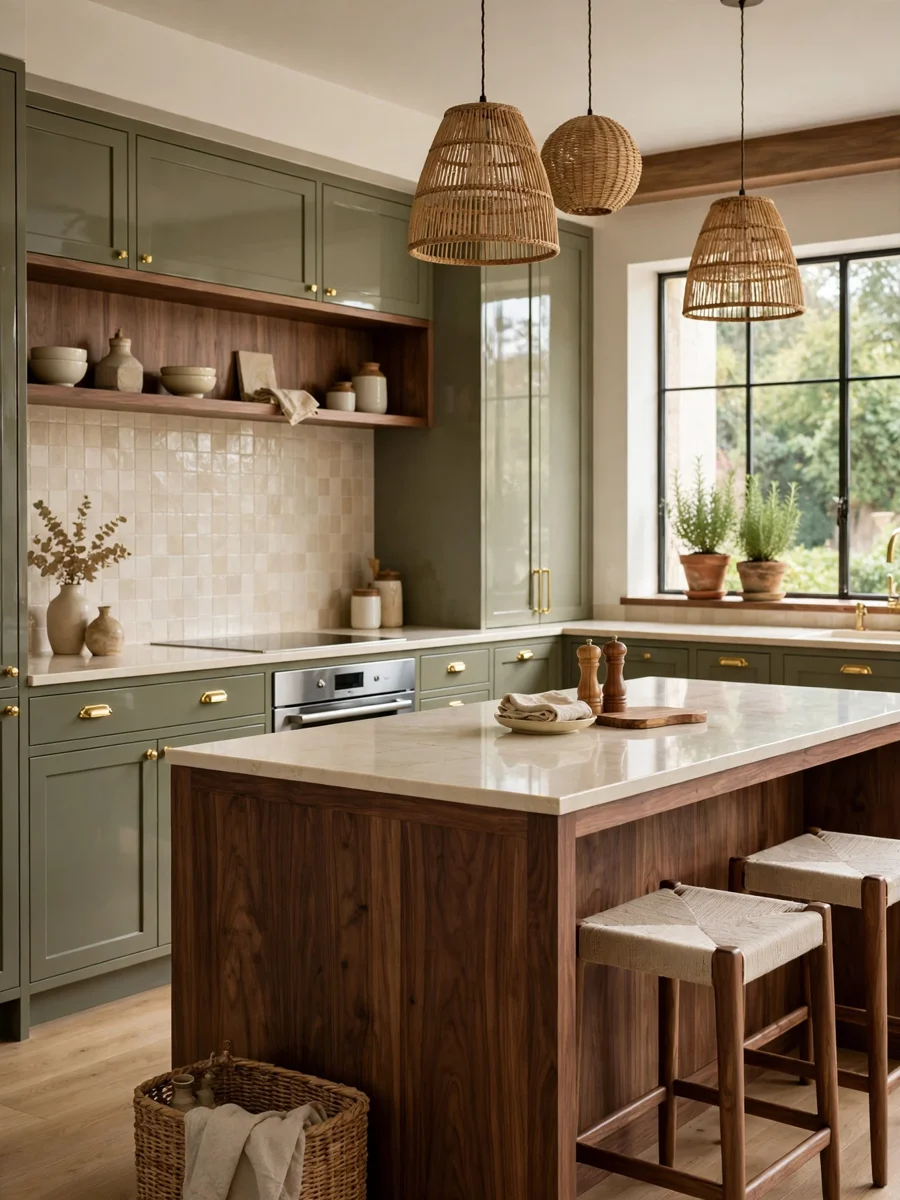
Paint lower cabinets olive and keep uppers pale wood or cream. A concrete example is olive base cabinets with a walnut island and a cream stone worktop, finished with a potted herb on the sill.
Quick tips
- Choose muted olive, not vivid green.
- Pair olive with walnut or pale oak.
- Add a living plant to echo the tone.
26. What Keeps an Ivory and Oak Kitchen Feeling Luxurious?
An ivory and oak kitchen feels luxurious when you layer ivory cabinets with a pale oak floor, a stone worktop and one sculptural light, because the restrained palette lets quality materials shine.
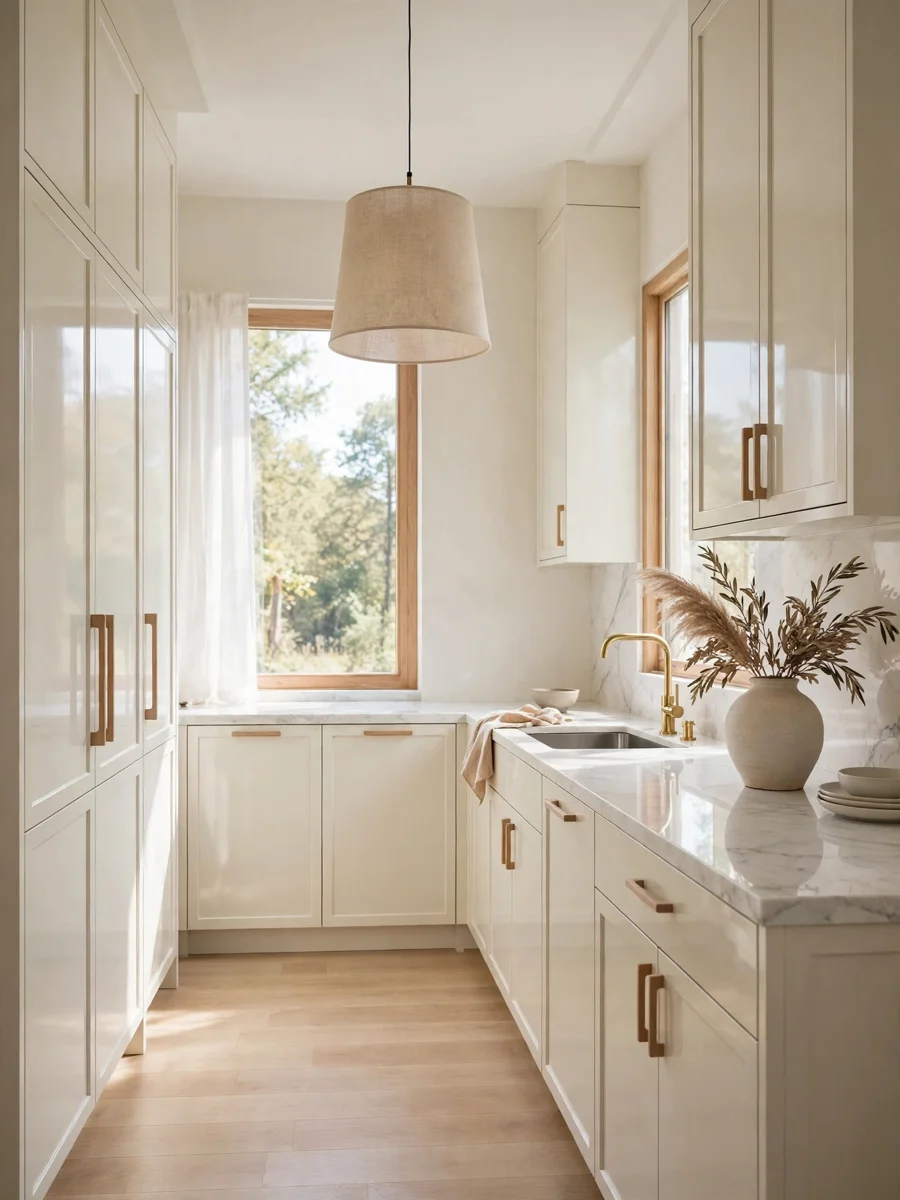
Invest in the worktop and the lighting, and keep everything else simple. A concrete example is an ivory kitchen with a white marble worktop, oak flooring and a single linen pendant, which feels polished without feeling formal.
Quick tips
- Invest in one beautiful worktop.
- Choose a single sculptural pendant.
- Keep styling to a vase and a bowl.
27. How Do Copper and Bronze Accents Warm a Japandi Kitchen?
Copper and bronze accents warm a Japandi kitchen because their soft metallic glow echoes handmade craft, adding warmth to pale wood and stone without shine or glare.
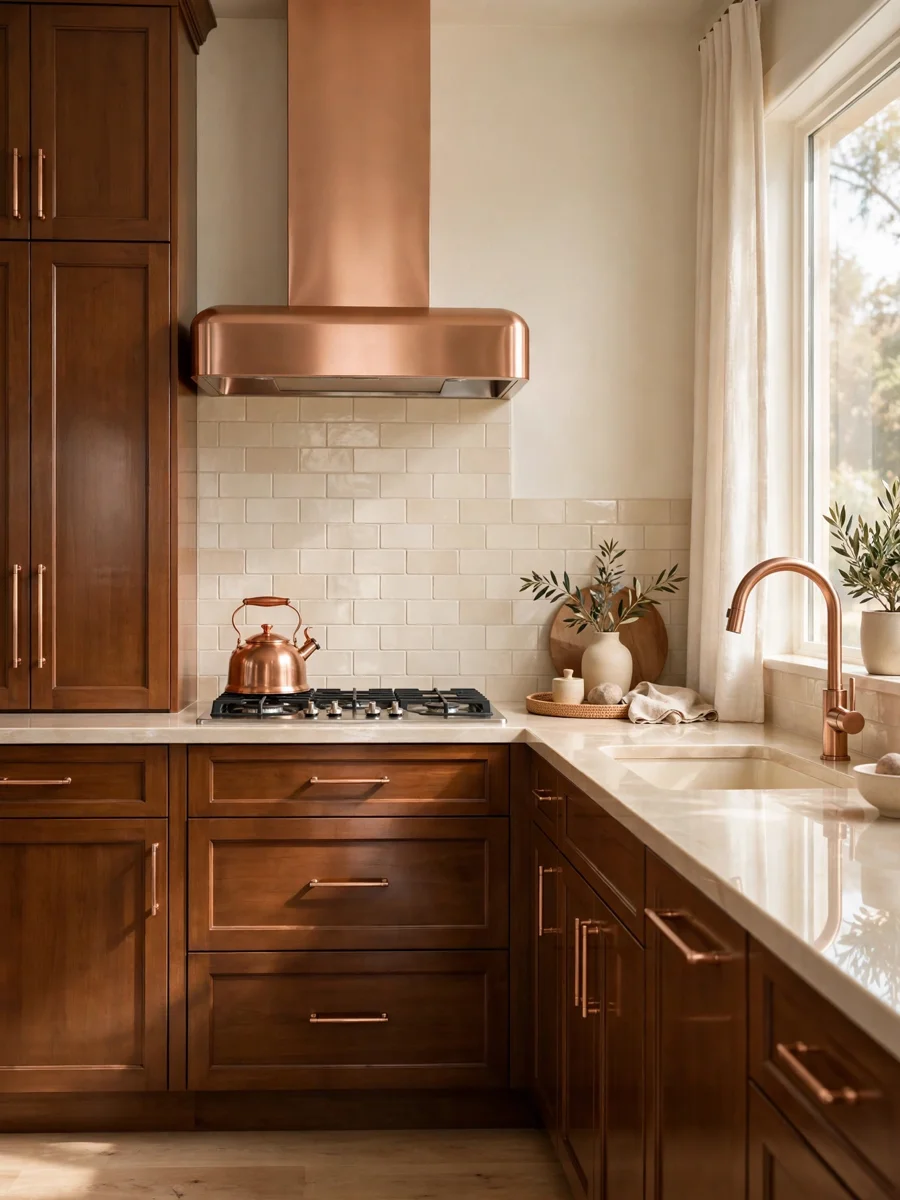
Use copper on a tap, a pendant or a set of pans, and keep the finish brushed or aged. A concrete example is a warm brown and cream kitchen with a brushed copper tap, matching handles and a copper kettle on the hob.
Quick tips
- Choose brushed or aged copper finishes.
- Repeat copper in two small places.
- Pair copper with warm wood tones.
28. How Does a Kitchen Herb Garden Complete the Japandi Look?
A kitchen herb garden completes the Japandi look because fresh green herbs in simple ceramic pots add life, scent and colour to a calm room, connecting cooking directly with nature.
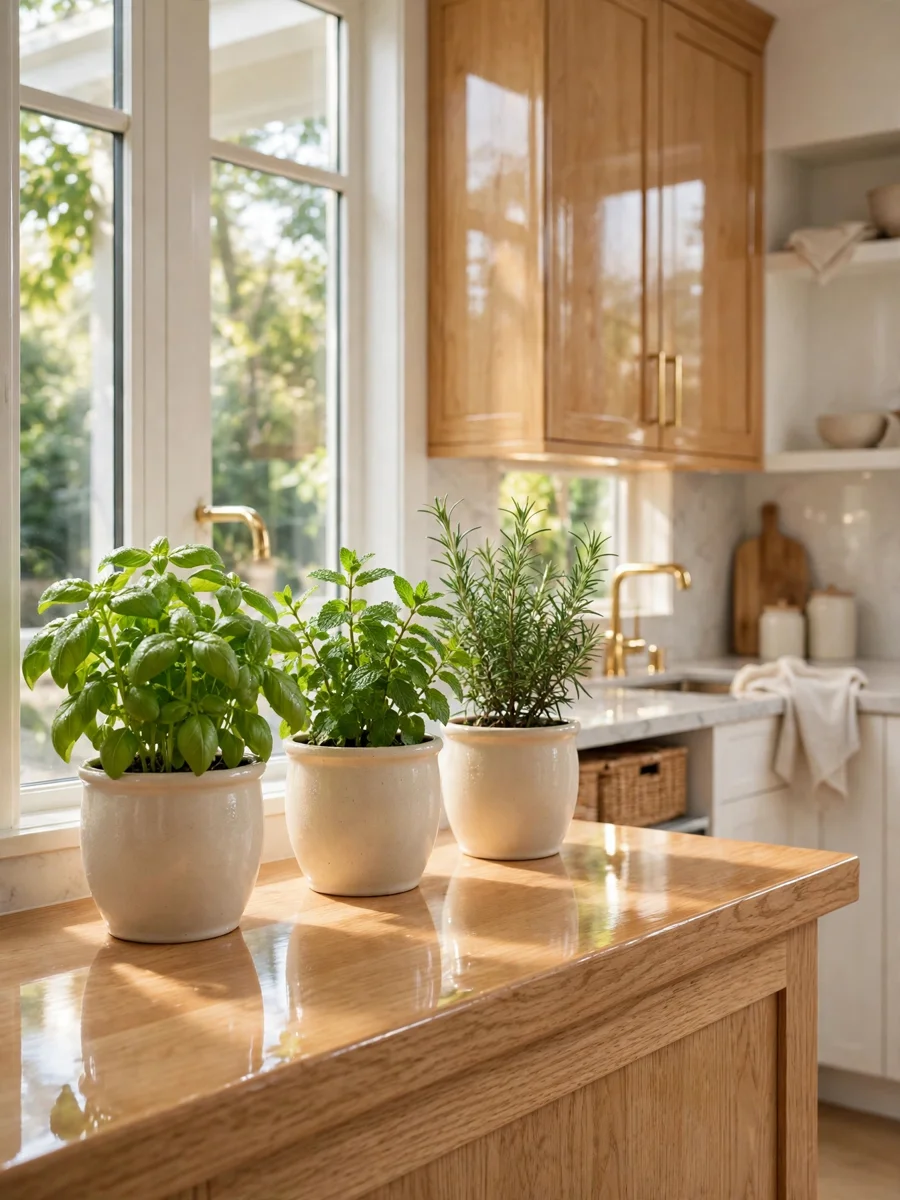
Place three ceramic pots of basil, mint and rosemary on a sunny sill or a slim oak shelf. A concrete example is a white oak kitchen with a row of cream ceramic herb pots on the windowsill, ready for cooking and easy to water daily.
Quick tips
- Choose three herbs you cook with often.
- Use matching plain ceramic pots.
- Place herbs where they get morning light.
Frequently Asked Questions
What is a Japandi kitchen?
A Japandi kitchen blends Japanese minimalism with Scandinavian warmth. It uses natural materials such as pale wood and stone, a neutral palette and clutter-free storage to create a calm, functional cooking space.
What colours work best in a Japandi kitchen?
Warm whites, beige, greige and pale wood tones form the base, with muted sage, dusty blue or terracotta as gentle accents. Matte black or dark walnut adds contrast in small doses.
What materials are used in a Japandi kitchen?
Pale oak, ash, walnut and bamboo are the main woods, paired with honed stone, concrete, handmade ceramics, linen and rattan. Matte finishes are preferred over gloss.
Can a Japandi kitchen work in a small kitchen?
Yes, Japandi suits small kitchens very well. Pale colours, handle-free cabinets, hidden storage and clear worktops make a narrow room feel larger and calmer.
How do I make my kitchen look Japandi on a budget?
Start by decluttering and clearing the worktops, then paint cabinets warm white or sage, swap handles for matte black pulls, add linen towels and a ceramic vase, and hang a paper pendant.
What is the difference between Japandi and minimalist style?
Minimalism focuses on reducing everything to the essentials, while Japandi adds Scandinavian warmth and Japanese craft to that simplicity. A Japandi kitchen keeps clean lines but feels warmer through wood, texture and plants.
Conclusion
A Japandi kitchen is not about owning less for its own sake. It is about choosing well and letting natural materials, soft light and calm colour do the work. Start with one idea, such as pale oak cabinets or layered lighting, and build from there to create a kitchen that cooks beautifully and still feels quiet.