10 Brilliant Landscape Ideas for a Lush Grass-Free Front Yard
A grass-free front yard replaces turf with stone, gravel, shrubs, groundcovers and paths. Done well, it uses less water, needs less mowing, and generally means lower upkeep than a traditional lawn. A front yard does not need a traditional lawn to look full, polished, and welcoming. In fact, some of the most attractive landscape ideas replace turf with a thoughtful mix of gravel, stone, shrubs, ornamental grasses, drought-tolerant plants, and clearly defined paths.
The key is not simply removing grass. A grass-free yard needs structure, repetition, contrast, and enough planting layers to create the feeling of abundance. When those elements work together, the space can feel lush while using less water and demanding less routine mowing.
If you are planning a front-yard makeover, these ideas show how to create a finished designer look without relying on a large patch of turf.
1. Build a Strong Framework With Repeated Shrubs
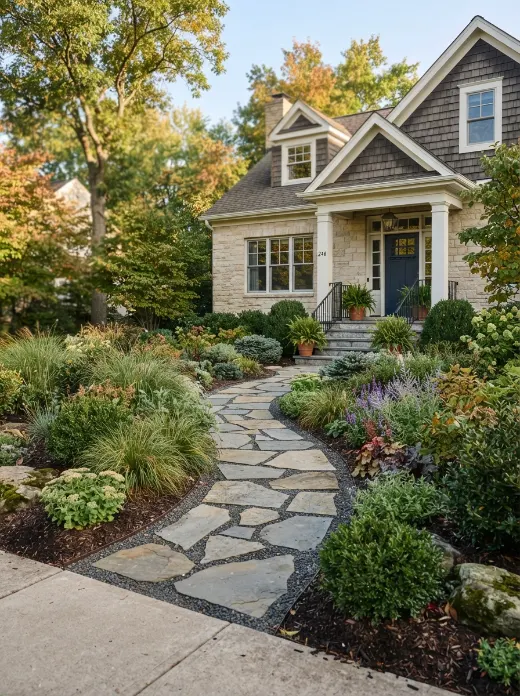
One of the easiest ways to make a grass-free front yard feel intentional is to repeat the same shrubs throughout the planting beds. Rounded boxwood, dwarf evergreen shrubs, clipped holly, or other climate-appropriate plants can create rhythm along a walkway or beneath windows.
Instead of scattering plants randomly, repeat a few forms at regular intervals. This gives the yard visual order and makes a modest planting scheme feel much more expensive.
For a polished look, keep the beds neatly edged and use one consistent mulch or gravel. A dark ground cover can also make green foliage appear richer.
This is one of the landscape ideas that works especially well with traditional, Colonial, cottage, and transitional homes because the repeated shapes echo the architecture.
2. Replace a Straight Walkway With a Gentle Curve
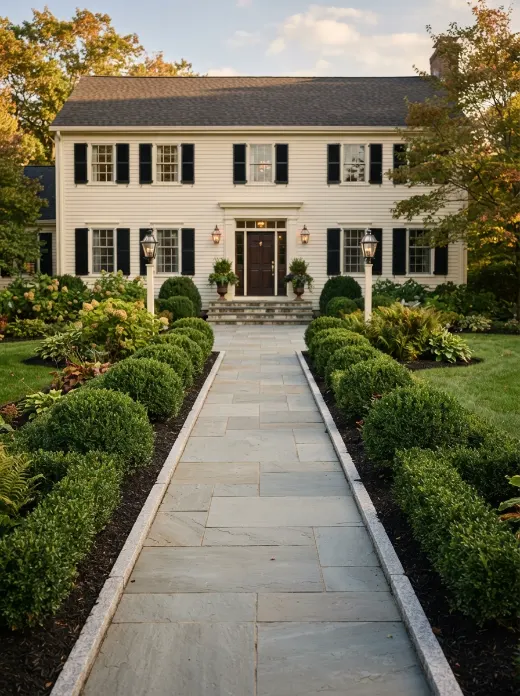
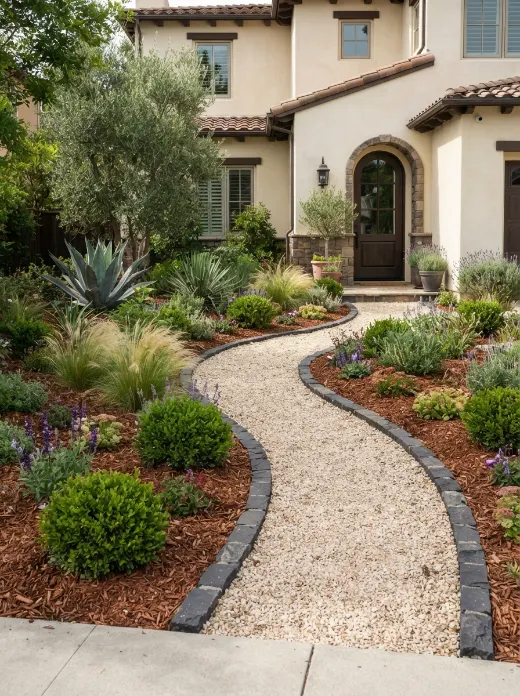
A curved walkway is one of the most effective landscape ideas for making a compact front yard feel more natural and inviting. Rather than sending visitors directly from the sidewalk to the door, a soft curve creates movement and gives you more opportunities for planting.
Use large stepping stones, pavers, or natural flagstone with gravel between them. Keep the curve broad enough for comfortable walking, and repeat the same stone material elsewhere in the yard for continuity.
Plant low groundcovers or small shrubs along the edges, then add taller plants farther back. The change in height makes the path feel surrounded by greenery instead of sitting in an empty bed.
When comparing landscape ideas, this approach is useful when you want the entrance to feel relaxed rather than overly formal.
3. Let Natural Stone Become the Main Feature
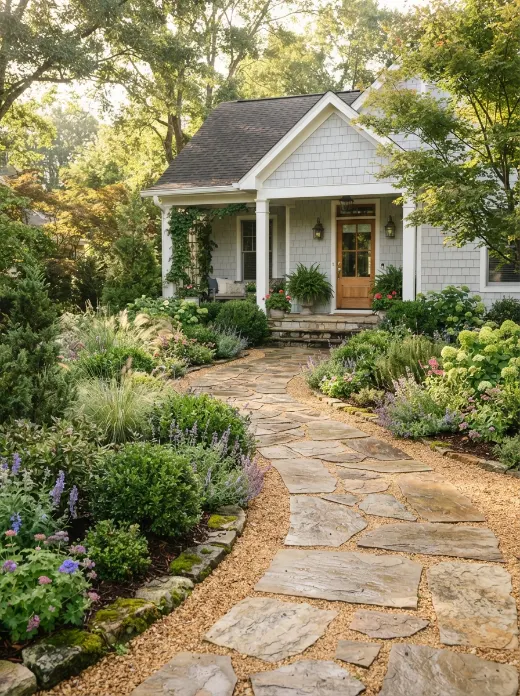
Stone can replace much of the visual role a lawn normally plays, making it a useful foundation for creative landscape ideas. A broad gravel bed, dry creek-style strip, or fieldstone planting area creates a neutral foundation for greenery.
Choose stones that relate to the colors already found on the house. Warm beige stone works beautifully with cream, tan, and earthy exteriors, while charcoal gravel can sharpen modern architecture.
Add a few larger boulders as focal points rather than filling every inch with small rock. Then soften the hard material with layered plants such as ornamental grasses, flowering perennials, agaves, or low shrubs suited to your climate.
The balance between hard and soft materials is what keeps a rocky yard from feeling bare.
4. Create a Grand Entrance With Oversized Stepping Stones
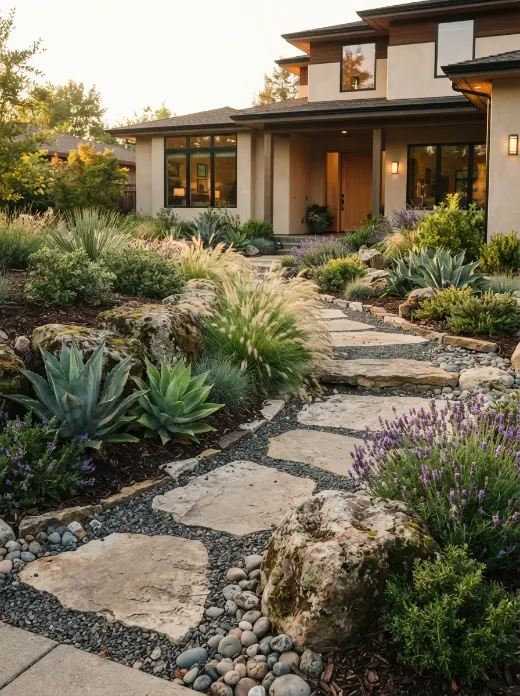
If your goal is strong curb appeal, use the walkway itself as a design statement; this is one of the landscape ideas that can change the entire first impression.
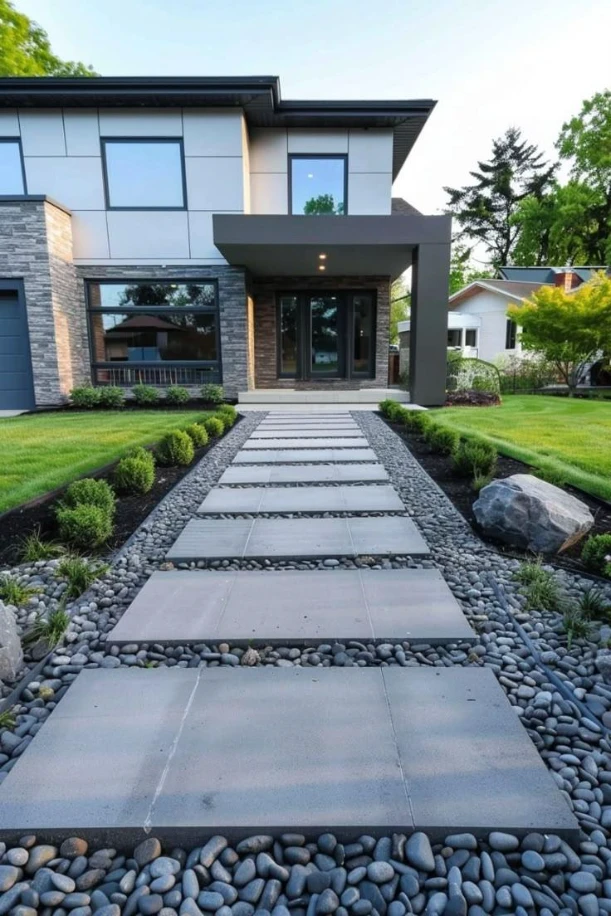
Oversized square or round stepping stones can create a clean visual route through gravel or mulch. Space each stone consistently and keep the surrounding ground cover level. A crisp edge around the path makes the entire arrangement look more professional.
Add vertical plants near the entrance to create height. Narrow evergreens, ornamental grasses, or sculptural plants can frame the door without blocking it.
Among modern landscape ideas, this is a particularly useful trick because it combines function with a strong geometric pattern.
5. Layer Different Plant Textures for a Lush Look
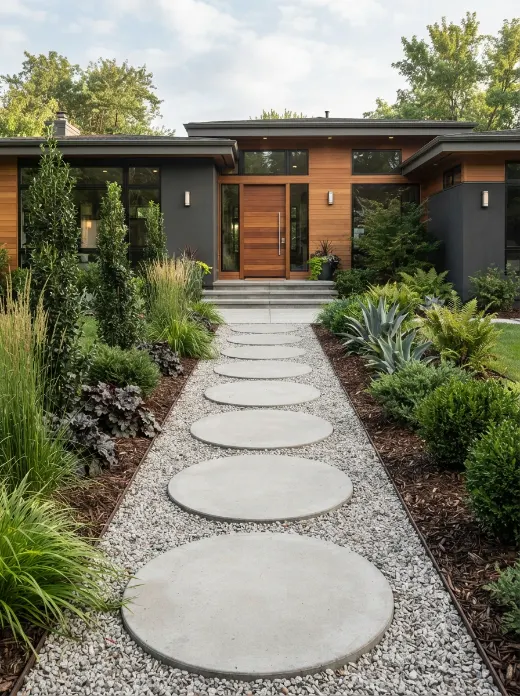
A grass-free yard can look lush when you think in layers rather than individual plants, which is a useful principle behind many successful landscape ideas. Combine fine-textured grasses with broad leaves, rounded shrubs, flowering perennials, and upright forms.
Start with a low layer near the path. Place medium shrubs behind it, then add taller plants close to the house or at important corners. This creates depth even when there is no lawn.
Color matters, but texture often makes the bigger difference. A combination of glossy leaves, feathery grasses, matte foliage, and small flowers feels fuller than a bed filled with one plant type.
For landscape ideas that remain attractive across seasons, choose plants with different bloom periods and evergreen or structural foliage.
6. Use Clean Lines for a Modern Front Yard
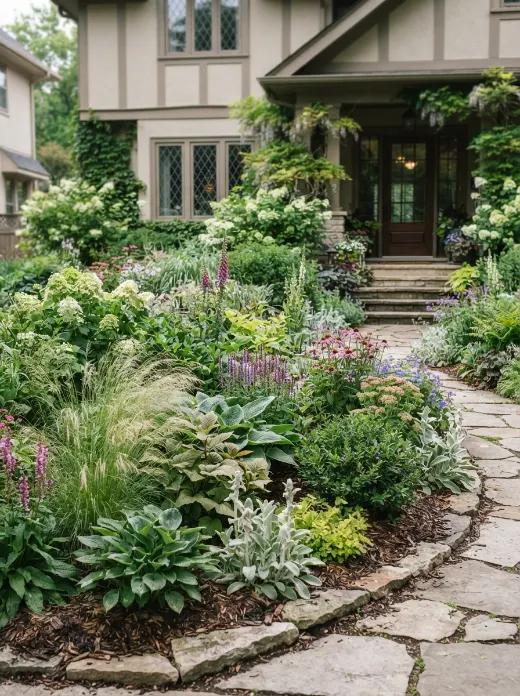
A modern grass-free yard does not have to feel wild, and some of the cleanest landscape ideas rely on simple geometry.
Straight planting beds, rectangular gravel sections, repeated plants, and linear pavers can create a calm architectural look. Use metal or stone edging to separate gravel from planting areas. Repeat one or two plant varieties instead of mixing too many colors.
For example, a row of compact evergreens can run beside a wide gravel strip, while large concrete stepping stones create a simple path. The result feels organized without being sterile.
This style works particularly well around contemporary homes with strong horizontal or rectangular architectural lines.
7. Turn a Dry Climate Into a Sculptural Garden
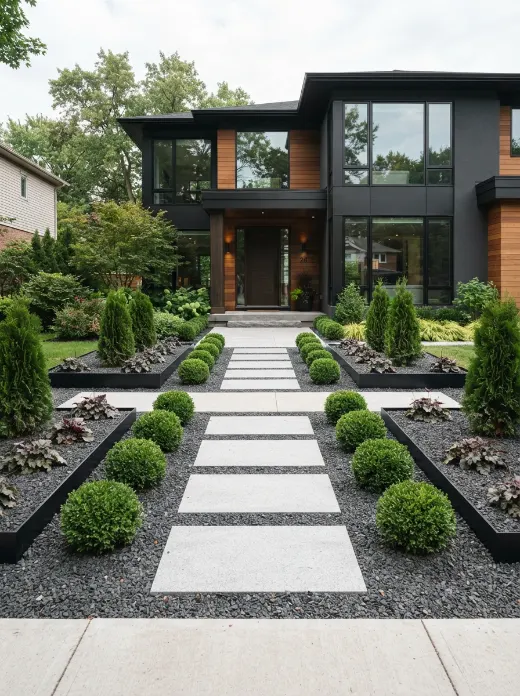
If your region has hot summers or limited rainfall, embrace plants that naturally suit those conditions instead of trying to imitate a traditional lawn.
Agaves, yuccas, cacti, sedums, lavender, rosemary, and drought-tolerant grasses can create dramatic shapes while reducing irrigation needs. Always choose species appropriate for your local growing conditions, winter temperatures, and soil.
Use gravel as a clean background and place larger stones around statement plants. Vary the height and silhouette of the plants so the bed has visual movement.
One of the most practical landscape ideas for dry regions is to design around the climate rather than fighting it.
As a rough guide to xeriscape costs, a professional install can run roughly $5–20 per sq ft, while a DIY approach using mulch and young plants can be roughly $1–5 per sq ft. In some dry states, utility rebates can be roughly $1–5 per sq ft, and water use can fall roughly 50–85% compared with a lawn, so payback is typically 2–5 years. These are ranges only, and the final cost will depend on materials, plant sizes, and local labor.
8. Add Large Containers for Flexible Color
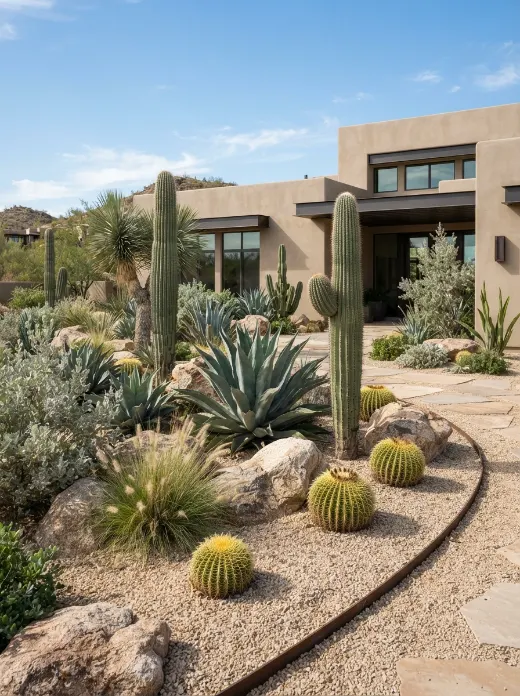
Containers give a grass-free front yard another layer of height and personality, making them a flexible option among practical landscape ideas. They are especially helpful when a planting bed is new and still needs time to mature.
Choose three or five pots in complementary shapes rather than using many unrelated containers. Group them near the porch, entrance, or a corner that needs extra height.
Use tall plants in the back, medium plants in the center, and trailing or low plants toward the front. This simple formula creates a fuller composition.
Large terracotta, concrete, stone-look, or matte ceramic planters can also introduce color and texture without permanent construction.
9. Make Gravel and Mulch Part of the Color Palette
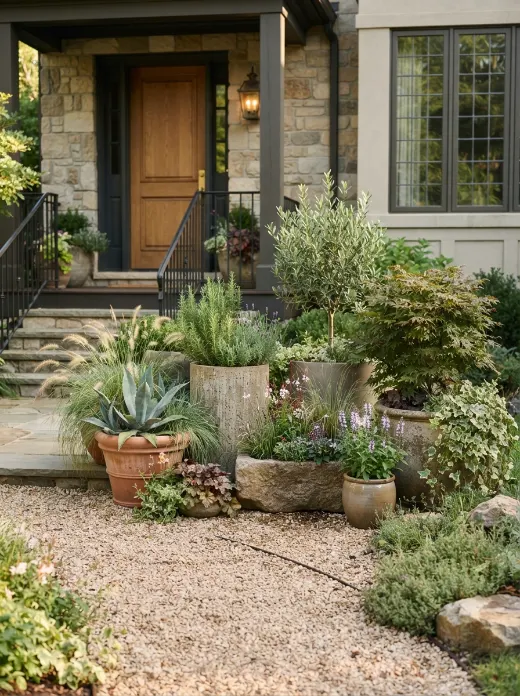
Ground cover should not be treated as an afterthought when planning landscape ideas because it can cover a large percentage of the visible yard.
Warm red-brown mulch can complement brick and warm stucco. Pale gravel can brighten a contemporary yard, while dark gravel can create contrast against silvery foliage and pale stone.
You can also combine two ground-cover materials to define separate zones. For example, use gravel along the path and mulch inside planting beds.
Keep transitions crisp and use edging where needed. Clean boundaries are one of the simplest ways to make landscape ideas look professionally planned.
10. Add Evening Lighting for a Finished Designer Effect
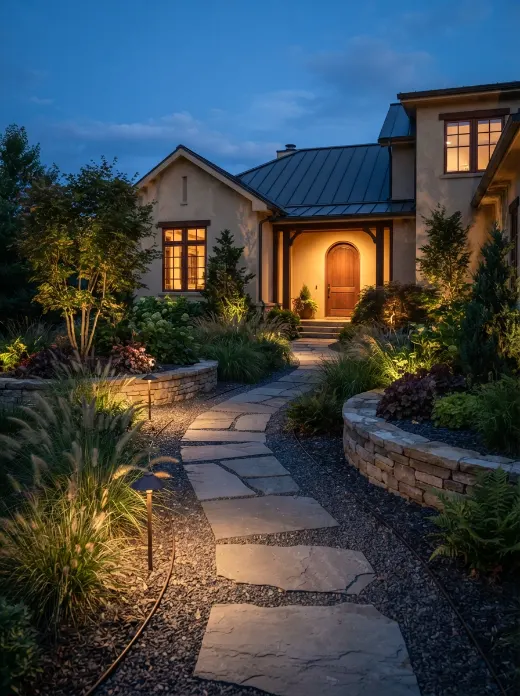
A grass-free yard should look attractive after sunset too. Low-voltage path lights, small uplights, and recessed wall lights can highlight the elements that make your design special.
Place lights where they improve both safety and atmosphere. A path can receive soft directional lighting, while a mature tree or sculptural plant can receive a subtle uplight.
Avoid placing identical bright lights everywhere. Layering a few softer sources usually creates a more elegant effect.
Lighting also reveals texture at night, especially on stone walls, gravel paths, tree trunks, and ornamental grasses. It turns the front yard into an extension of the home’s architecture. For example, a warm uplight on a small ornamental tree by the front door, paired with low path lights along the walk, gives visitors a clear, welcoming route after dark.
Living Lawn Alternatives: Clover, Thyme, Sedum and Moss
If you still want a soft, green surface without turf, these living covers can fill that role. Match the cover to your light and foot traffic:
- Clover — Best light: full sun to part shade — Foot traffic: light to moderate — Look/feel: soft, lawn-like green with small white flowers.
- Creeping thyme — Best light: full sun — Foot traffic: light, including between pavers, scent underfoot — Look/feel: low, fragrant mat with tiny flowers.
- Sedum — Best light: full sun — Foot traffic: light — Look/feel: succulent, textured, drought-tolerant groundcover.
- Moss — Best light: shade — Foot traffic: very light, no regular foot traffic — Look/feel: soft, velvety green carpet for shade.
How to Replace Grass, Step by Step
Start by removing the existing grass rather than covering it. For a faster result, a sod cutter lifts the turf in strips; for a slower, low-effort option, sheet mulching — also called smothering — layers cardboard and mulch over the lawn until the grass underneath dies back. Once the ground is clear, level the soil, set your paths and edging, and, where you plan gravel, lay a weed barrier underneath it to slow weeds and keep the stone from sinking into the soil. Do not lay gravel or stone over living grass: it will push through, look uneven, and leave you with weeds growing through the new surface.
Small Front Yards Without Grass
A small front yard works best when every element earns its place. Create one sitting nook — a single bench or a pair of chairs on a small gravel or paver pad — rather than several competing features, and add vertical interest with a narrow tree, a tall planter, or a climbing plant on a trellis so the eye travels upward. Checkerboard pavers with groundcover joints keep the surface open and green without a lawn, and the pattern itself makes the space feel designed rather than leftover.
How to Make a Grass-Free Yard Feel Lush Instead of Empty
The biggest mistake is removing turf and leaving a large expanse of one material. That creates a yard that is technically low-maintenance but visually flat.
Instead, think about five layers: structure, pathways, ground cover, planting height, and lighting.
Start with the shape of the beds and walkway. Add a consistent ground cover. Repeat a few reliable plants for rhythm. Then introduce different heights and textures. Finally, use lighting to make the strongest features visible after dark.
You should also leave enough breathing room around doors, windows, utility access, and paths. Lush does not mean crowded. The most successful landscape ideas balance fullness with clear circulation.
Choosing Plants for Your Local Conditions
Plant selection should always begin with your climate rather than a photo you saw online. A plant that thrives in a dry western garden may struggle in a humid region, while a shade-loving perennial may fail in a hot, exposed bed.
Check your local hardiness zone, sunlight levels, soil drainage, and typical rainfall. Native plants and well-adapted regional species can be especially useful because they are already suited to local conditions.
Before buying, make a simple list of the conditions in each part of the yard. Note whether the area receives full sun, partial shade, or shade, and whether water drains quickly or remains after rain.
This planning step prevents a common landscaping problem: choosing beautiful plants that are wrong for the location.
Shade deserves its own plan, because it is often where grass fails first. Under trees or on the north side of a house, moss and woodland planting — ferns, hostas, and other shade-tolerant groundcovers — can form a soft, green layer where turf would thin out and turn patchy. Keep the palette simple, mulch the soil to hold moisture, and let the planting follow the natural shade pattern instead of fighting it.
How to Keep the Design Looking Expensive
A designer-looking front yard is usually more about consistency than expensive materials.
Repeat the same stone in two or three places. Use a limited plant palette. Keep edges clean. Match the colors of the gravel, planters, and house exterior. Give pathways enough width. Prune shrubs when necessary without turning every plant into a rigid shape.
Most importantly, avoid filling every empty space immediately. A new garden often looks sparse at first, but plants grow. Leaving room for mature size will help the yard look intentional instead of overcrowded later.
You can also create a focal point near the front door. A sculptural planter, small ornamental tree, attractive bench, or distinctive stone can give the eye somewhere to land.
For smaller properties, landscape ideas should also account for what is visible from the street. A strong foreground planting layer can hide bare soil, while a clear route to the front door keeps the entrance easy to read. This combination creates depth without requiring a large footprint, so even a narrow yard can feel layered, intentional, and comfortably green.
Before converting, check HOA rules and any local requirements that may limit materials, plant heights, or how much of the yard can be hardscaped. This is where cues to care matter most: tidy edges and clearly defined borders — a crisp line between gravel, mulch, and planting — signal that the design is intentional, which helps the yard keep its curb appeal even without a lawn.
Grass-Free Front Yard FAQs
What is the easiest grass-free front yard idea for beginners?
Start with one simple, low-risk change rather than replacing the whole yard at once. A gravel path with stepping stones, or a single mulched planting bed edged with a few repeated shrubs, is easy to build, easy to adjust, and immediately makes the yard look intentional. Once that first area works well, you can extend the same materials and plants across the rest of the front yard.
What ground cover replaces grass best?
There is no single best choice, because the right cover depends on light and foot traffic. Clover suits sunny areas with light use and stays soft and green, creeping thyme works well between pavers in full sun, sedum handles hot, dry spots, and moss is the better choice for shade. Match the cover to the spot first, and it will fill in far more reliably than turf would.
Will my HOA allow a grass-free front yard?
It depends on your association’s rules, so check them before you convert. Many HOAs allow grass-free designs that stay tidy and well defined, while some limit hardscape, plant heights, or specific materials. Reading the rules first, and keeping edges clean and borders clear, makes approval far more likely.
Can I convert my front yard gradually instead of all at once?
Yes, and converting in stages is often the most practical way to do it. Start with one area, such as the walkway or the bed nearest the front door, and use the same gravel, edging, and plant palette there. Once that section looks settled, extend it to the next area. Working in stages spreads the cost and effort, and it keeps the yard looking intentional throughout, because each finished area already matches the next one.
Is a grass-free front yard cheaper to maintain long-term?
Usually, yes, although it is not maintenance-free. Without turf, there is no regular mowing, watering, or fertilizing, which removes most of the weekly work. The remaining upkeep is lighter and less frequent: occasional weeding, topping up mulch or gravel, and replacing the odd plant. Over time, that lower routine workload is what makes a grass-free yard cheaper to look after than a lawn.
Final Word
A lush front yard does not require a traditional lawn. With the right structure, layered planting, natural materials, and carefully planned paths, you can create an outdoor space that feels green, welcoming, and finished while reducing the maintenance associated with turf.
The best landscape ideas are the ones that fit both your home’s architecture and your local climate. Start with the layout, choose plants that can genuinely thrive, repeat a few materials and forms, and let the design develop over time.
Whether you prefer crisp modern geometry, relaxed curves, natural stone, drought-tolerant planting, or a colorful container garden, a grass-free front yard can have plenty of character—and still feel beautifully lush.
Related Outdoor Ideas
For more outdoor inspiration, see our Golden Ratio and Front Yard Design guide and explore rock landscaping for more ways to combine stone, planting, and structure.